Quackoria Tools
Why Didn’t My Duck Eggs Hatch? An Incubation Troubleshooter
Tick what you found — clear eggs, blood rings, ducklings dead in the shell, pipped and stuck, sticky, early, late — and this matches it to the causes the university hatching tables list, with the duck figures beside them. It matches; it does not diagnose.
How to use it
- Tick everything you found, in the four groups: at candling, at hatch time, the ducklings that did hatch, and the eggs.
- Answer the optional questions under About this hatch if you can: days stored, where, turning, weight lost by day 25, the vents, whether the incubator was opened, the drakes, and the incubator type and set temperature.
- Once two or more findings are ticked, read Themes across what you ticked to see which theme comes up under the most of them.
- Read the panel for each finding: the causes grouped by theme, each naming its sources, and the Next time line.
- Check What your answers say for each question you answered, and the duck figures the tables assume beneath it.
- Press Copy result to keep it, or follow the links to the hatch date calculator, the weight-loss tracker and the other tools.
Duck eggs not hatching is usually the sum of two or three small things, and the eggs carry the evidence. Tick what you found and the troubleshooter sets beside it the causes the published hatching tables and guides list for it: Mississippi State’s troubleshooting table, Florida’s CIR1112, California’s ANR 8127, Texas A&M, Penn State, Missouri and Brinsea. The duck figures it checks your answers against come from Cornell’s Duck Research Laboratory, Metzer Farms, Texas A&M and Mississippi State. It is a match against those tables, not a diagnosis.
Key takeaways
- Candle, then open the eggs that did not hatch: California’s ANR 8134 says true fertility can only be told by breaking out the clears, and each stage of death has its own list of causes.
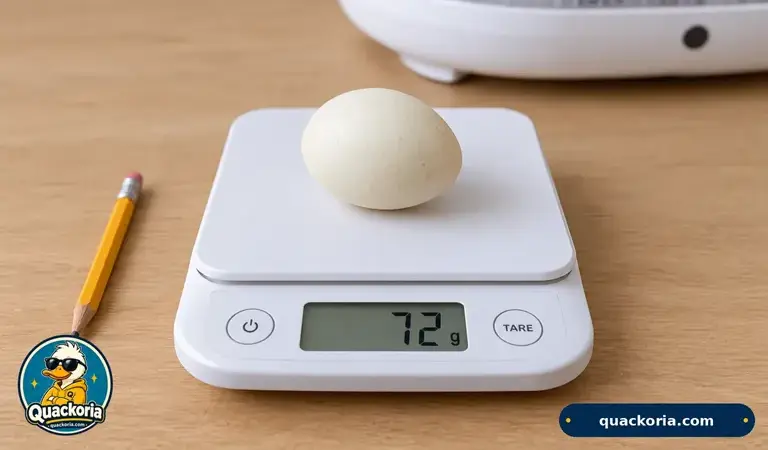
- Duck eggs take 28 days (Muscovy 35–37) at 99.5–100 °F and should lose about 13–14% of their weight by day 25 (Cornell about 14% of the setting weight, Metzer about 13% from laying) and 13–15% by pipping (Brinsea).
- Storage is on every table that covers clear eggs and heads the lists for blood rings: Mississippi State says hatchability holds reasonably well up to seven days and declines rapidly afterwards; its P1182 puts it near zero after three weeks.
- Vents closed at hatch time to raise the humidity suffocate ducklings that had pipped: Mississippi State says never to decrease the openings at hatching, and Cornell opens them about 50% wider at pipping.
- A good hatch is above 85% of fertile eggs by California’s standard; Missouri says about two eggs in ten normally do not hatch, and Metzer hatches 70–75% of all eggs set.
What a failed hatch can tell you
Mississippi State’s table begins with the point: when a hatch fails, the eggs usually carry a sign that someone trained can read. Most of the reasons for duck eggs not hatching leave one, and every source gives the same method: candle, then open the eggs that did not hatch. California’s ANR 8134 says true fertility can be told only by incubation, candling and breaking out the clears, because a clear egg is either infertile or an embryo that died before it showed. Florida’s VM101 does the same at the other end: count the pips, take off the shell cap, and see why each egg stopped.
Each stage has its own list. Florida’s VM101 puts deaths in the first four days down to egg management — the egg room, the storage time, the age of the sperm; deaths between days 5 and 18 down to the machine; and dead-in-shells down to hatcher ventilation and malposition. The troubleshooter matches what you found to those rows, and once two or more findings are ticked it counts which theme — temperature, humidity, turning, ventilation, storage, the breeders, disease, the eggs themselves or hatch time — comes up most. That count is arithmetic over the sources’ lists, not a verdict.
Six questions before you blame the incubator
Penn State’s index puts it in a line: “Maximum hatchability requires fresh eggs from well-bred and properly managed flocks.” The tool asks about these six things in eight optional questions and flags each answer as within the published figures, worth a look, or outside them. First, storage. Mississippi State’s incubation guide wants 55 °F and 75% humidity, small end down, and setting within seven days; its P1182 says hatchability is reduced below 40 °F, and most refrigerators run colder than that. California allows duck eggs one week at 55–68 °F and never above 80 °F, where eggs start to pre-incubate; Florida prices each day of waiting at 0.5 to 1.2% off the hatch.
Second, the drakes. Metzer says that in a flock over 25 or 30 one drake serves every three to five ducks, and that eggs can be fertile a week after the last mating and never after three weeks; Mississippi State lists too few males among the causes of clear eggs, with undernourished, old or sterile males, crowding and a seasonal decline in fertility. Third, turning: Mississippi State and California want at least three turns a day, Cornell a minimum of four; set the eggs small end down and stop turning three days before the hatch. Fourth, the thermometer: 99.5 °F (Texas A&M, Metzer, Cornell) to 100 °F (Mississippi State) for forced air, and 102 °F at the top of the eggs for still air (Mississippi State). California’s 8127 says a degree above 99.5 °F brings the hatch about 24 hours early and a degree below makes it late.
Fifth, humidity, judged by the scales: Cornell wants common duck eggs to lose about 14% of their setting weight by day 25, Metzer about 13%, Brinsea 13 to 15% between laying and pipping; Mississippi State’s 12% is a general poultry figure, not a duck one. The egg weight-loss tracker plots your weighings against those targets. Sixth, the air at hatch time. Mississippi State’s page on pipped eggs says the need for air is greatest on the last day, and that closing the vents then to push the humidity up suffocates the duckling instead: “Never decrease ventilation openings at hatching in an attempt to increase humidity.” Cornell opens the vents about 50% more at pipping, and Mississippi State adds that the membranes around a pipped egg can dry within one or two minutes of the door being opened.
Clear eggs, blood rings and embryos that stopped
Cornell candles at about seven days and removes the clear and the cloudy eggs; California’s 8134 candles duck eggs after 8 to 10 days. Mississippi State’s P1182 describes an infertile egg as clear except for a slight shadow from the yolk, and a dead germ by the blood ring around the embryo. A clear egg sends you to the breeders and the storage: besides the drakes, Mississippi State lists eggs stored too long or incorrectly, and Texas A&M adds rough handling and an incubator too hot or too cold in the first days.
A blood ring, which Missouri says means death in the first three days, has storage at or near the top of every list — Mississippi State, Florida, Texas A&M, Penn State, California — then the incubator temperature at the very start, breeder nutrition and disease. Embryos that died part-way move the blame to the machine: Mississippi State’s first cause is temperature, usually too high, then turning, inherited low hatchability, ventilation and salmonella from the breeders.
Dead in the shell, pipped and stuck, early and late
A fully formed duckling that never pipped is the commonest late failure in a home incubator, and here the tables disagree. Mississippi State’s PDF table and Penn State list a low average humidity; Florida’s CIR1112 and California’s 8127 list humidity too high. Your egg weights settle it, and so does the opened egg: Florida says a large unabsorbed yolk points to poor turning or too wet an incubation. Malposition, from poor turning or eggs set small end up, is on most of the lists.
A duckling that pipped and then died was, by Mississippi State’s account, normally healthy enough to hatch, and something in the incubator stopped it, usually ventilation or humidity. Too dry during the hatch and the membranes stick so it cannot turn; dried, shrunken membranes around the hole are the sign. Too wet throughout and it drowns in what is left in the shell, with a dried coating around the nostrils and bill. Metzer’s advice on helping is patience — after pipping the duckling rests 12 to 24 hours, then takes several breaks over the one to three hours it needs — and “It is best to allow them to do the hatching themselves.” Help only after a hole and 12 hours without progress, and if blood appears, stop and wait several hours.
Early and late hatches are mostly the thermometer. Every table puts an early hatch with bloody navels down to a temperature too high, Missouri adding one that swung too widely; a late hatch is the reverse, or old eggs, humidity too high or large eggs. Check the breed first: the sources give 28 days and Muscovies 35 to 37, but Metzer puts Mallards at about 26.5 to 27 days and Runners at 28.5. Missouri says ducklings arriving more than 24 hours after the start of the hatch are commonly culls that will not grow well.
The ducklings that hatched badly
Sticky ducklings smeared with egg contents go with humidity too high and temperature too low, the pair California names behind leftover albumen; dry ducklings with shell stuck to the down are the reverse, low humidity after pipping began by Missouri’s reading. Small or weak ducklings go with small eggs, high temperature, low humidity and poor air in the hatcher (Mississippi State). A large, soft, mushy duckling with a wet, smelly navel is omphalitis in Florida’s table, navel infection from dirty trays, machines or eggs.
Rough, dry, unhealed navels point to a temperature too high or swinging (Missouri, Brinsea, Florida) or humidity too high (Mississippi State, Brinsea, Florida, Texas A&M). Spraddled legs and crooked toes carry temperature, breeder nutrition and heredity, and one you can fix tonight: Mississippi State and Florida both name slick hatching trays. A duckling that cannot stand needs a vet. Short down or eyes stuck shut go with a hatcher too hot, too dry or too draughty. Exploding eggs are dirt — Texas A&M’s three causes are dirty eggs, badly cleaned eggs and a dirty incubator — and air cells too small, or eggs that lost under 10%, are humidity too high by Texas A&M, Brinsea and Florida.
What a good hatch looks like, and what the tables cannot tell you
The figures depend on what they are a percentage of. California’s 8127 and 8134 say the hatch of fertile eggs should be above 85%. Missouri says “Approximately two out of every 10 eggs normally do not hatch.” Metzer counts all eggs set: “In our large commercial incubators, we normally hatch 70-75% of all eggs set.” A dozen duck eggs that gave eight or nine ducklings is a normal result; four is not.
The tables were written for poultry in general, mostly chickens — Mississippi State’s rows mention cockerels, combs and wattles — so the tool shows the duck figures with their own duck sources and gives both sides where the sources disagree: Mississippi State’s table stores eggs at 50–60 °F and 60% humidity while its own incubation guide says 55 °F and 75%. None of this is a diagnosis. The same finding sits under several causes, and a sick flock is a question for a vet, not a tick list. The tool stores and sends nothing.
Next time
The hatch date calculator gives the candling, lockdown and hatch days for your breed, and duck egg development day by day shows what each candling should look like. The incubator humidity converter turns the published targets into a wet-bulb reading for your machine. For practice sorting candled eggs into keep, clear, dead and cracked, there is the Candling Room game; for the routine from collection to brooder, read incubating duck eggs.
Frequently asked questions
Why didn't my duck eggs hatch?
Usually for more than one reason, and the stage tells you which. Florida's VM101 puts deaths in the first four days down to egg storage and sperm age, deaths between days 5 and 18 down to the incubator's turning, temperature and humidity, and dead-in-shells down to ventilation and malposition. Candle, open the eggs that failed, and match what you find.
How do I tell if duck eggs were infertile or died early?
Only by opening them: California's ANR 8134 says true fertility can only be told by candling and breaking out the clears. Mississippi State's P1182 describes an infertile egg as clear except for a slight shadow from the yolk, and a dead germ by a blood ring around the embryo, which Missouri says means death in the first three days.
How long can duck eggs be stored before incubating?
About a week. Mississippi State says hatchability holds reasonably well up to seven days and declines rapidly afterwards, at about 55 °F and 75% humidity with the small end down; its P1182 puts hatchability near zero after three weeks. Texas A&M allows under ten days.
What temperature should duck eggs be incubated at?
99.5 °F (Texas A&M, Metzer, Cornell) to 100 °F (Mississippi State) in a forced-air incubator, and 102 °F at the top of the eggs in a still-air one (Mississippi State). California's 8127 says a degree above 99.5 °F brings the hatch about 24 hours early and a degree below makes it late.
How much weight should duck eggs lose during incubation?
About 13 to 15% of the setting weight. Cornell wants about 14% by day 25, Metzer about 13% by day 25, Brinsea 13 to 15% from laying to pipping, and the British Waterfowl Association about 15% over the whole incubation.
Why did my duckling pip and then die?
Mississippi State says a duckling that reaches pipping is normally healthy enough to hatch, and the usual blocks are closed vents and the wrong humidity: dried, shrunken membranes mean the hatch was too dry, a dried coating around the nostrils and bill means it was too wet throughout, and opening the incubator can dry the membranes within one or two minutes.
What hatch rate is normal for duck eggs?
California's standard is above 85% of fertile eggs, and Florida's VM101 hatchery standard is an 85% hatch with 4.5% infertile. Missouri says about two eggs in ten normally do not hatch, and Metzer hatches 70 to 75% of all eggs set in its commercial incubators.
Where these figures come from
Every number this tool produces traces back to one of these. Where they disagree with each other, the tool says so rather than picking a favourite.
- Cornell University Duck Research Laboratory — Hatching Duck Eggs (US university)
- University of California ANR Publication 8134 — Egg Candling and Breakout Analysis (US extension)
- Mississippi State University Extension P1182 — Hatching Quality Chicks (US extension)
- Metzer Farms — FAQ (US hatchery)
- Mississippi State University Extension — Trouble Shooting Failures with Egg Incubation (Tom W. Smith) (US extension)
- University of California ANR Publication 8127 — Common Incubation Problems: Causes and Remedies (Ernst, Bradley, Delany, Abbott & Craig, 2004) (US extension)
- University of Florida IFAS Extension CIR1112 — Hatchability Problem Analysis (H. R. Wilson) (US extension)
- Penn State Extension, Pennsylvania 4-H Embryology — Trouble Shooting (US extension)
- Texas A&M AgriLife Extension POSC-PU-018 — Incubating and Hatching Eggs (US extension)
- University of Missouri Extension G8353 — Incubating Poultry Eggs (worked example) (US extension)
- University of Florida IFAS Extension VM101 — A Systematic Approach to Solving Hatchability and Chick Quality Problems (US extension)
- Metzer Farms — Candling Pictures (US hatchery)
- British Waterfowl Association — Incubation (UK)
- Mississippi State University Extension — Trouble Shooting Failures with Egg Incubation (PDF, with the "fully formed, dead without pipping" row) (US extension)
- Brinsea — Incubation Handbook (UK incubator maker)
- Mississippi State University Extension — Pipped Eggs That Do Not Hatch (US extension)
- Metzer Farms — Hatching Process and When to Help (US hatchery)
- Metzer Farms — Hatching Instructions (US hatchery)
- Oklahoma State University Extension AFS-8100 — Artificial Incubation (US extension)
- Mississippi State University Extension — Care and Incubation of Hatching Eggs (US extension)
Last reviewed: October 5, 2026