Quackoria Tools
Duck Name Generator
Pick a mood, press the button, and keep pressing until one of them is obviously right. That is genuinely the whole method, and it works better than sitting and thinking about it.
How to use it
- Choose a mood — classic, funny, elegant, or named after snacks.
- Press Again until something makes you laugh or stops you.
- Copy the one you want.
Key takeaways
- Short names with a hard consonant carry best across a garden.
- Ducks do learn to associate a sound with food and attention, though nobody should claim they know their name the way a dog does.
- Wait on gendered names — most ducks cannot be reliably sexed by appearance until the drake feather appears.
- Naming by breed is a good shortcut when nothing else is landing.
What actually makes a good duck name
There is no science here and this page is not going to pretend otherwise. But there are a few things people who keep ducks tend to converge on.
Short beats long when you have to shout it. A name is mostly used across a garden at feeding time, and two syllables carry better than four. Hard consonants — a k, a p, a t — cut through wind and through the noise a flock makes when it thinks food is coming.
Distinct beats pretty. If you have six ducks, the names need to be different from each other at a distance, not just on paper. Two names that rhyme will be one name by the end of the month.
Wait on gendered names. Most breeds cannot be reliably sexed by appearance until the drake feather — the curled feather at the tail — appears. Voice is the earlier clue, and it works the opposite way round to most people’s expectation: the loud, clear, unmistakable quack belongs to the female. Drakes are quieter and hoarser. Why ducks quack goes into what those calls are actually for.
Naming by breed, when nothing else lands
If nothing is sticking, the bird’s own breed often supplies the answer.
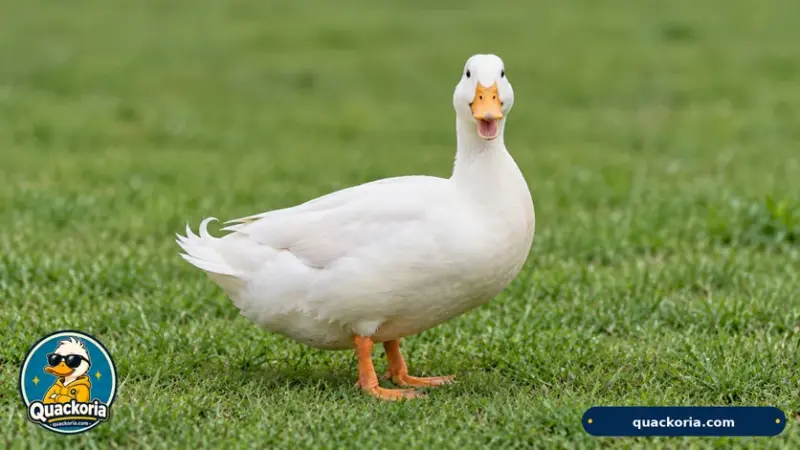
An Indian Runner stands bolt upright and hurries everywhere — names that sound like they are in a rush suit it. A Pekin is large, white and unhurried, and carries a grand name well. A Cayuga looks black until the light catches it green and purple, which is an invitation. A Call duck is small and extraordinarily loud, and the joke writes itself. A Muscovy is a different species that perches in trees and is usually silent rather than quacking, and tends to end up with something faintly gothic.
If you are not sure what you have, the breed quiz introduces six of the common ones properly, and telling a duck from a goose or a swan is the place to start if the bird arrived without paperwork.
Do ducks actually learn names?
Honestly: they learn a sound, and they learn what follows it.
Ducks associate a consistent call with food and attention quickly and reliably, and a flock will come to a familiar voice using a familiar sound. Whether an individual bird distinguishes its own name from its neighbour’s is a much harder claim, and no source found here supports it. Anyone telling you their duck knows its name in the way a dog does is describing something real — the coming when called — and explaining it more generously than the evidence allows.
Which does not matter much. Name the duck. It is your duck.
Naming a whole flock at once
Six ducks arriving on the same afternoon is a different problem from one duck arriving alone, and the trick is to give yourself a system rather than six separate decisions.
The approaches that hold up over time are the ones with a rule behind them. A theme — all named after biscuits, all named after Victorian novelists, all named after streets in your town — means you never run out and never repeat. A colour or marking system works if your birds actually differ: it is the only method that lets a visitor learn the names in an afternoon. And matching the name to the bird’s place in the flock has its own logic, since ducks do sort themselves into a fairly stable order and the one who leads to the water tends to keep doing it.
What does not hold up is naming them all in one enthusiastic sitting without checking the names against each other out loud. Two ducks called Poppy and Bobby are one duck by the end of the week.
The other honest complication: if you cannot yet tell your birds apart, names will not stick no matter how good they are. Leg bands in different colours cost very little and solve the problem in a morning, and they are worth having anyway — being able to say which specific bird has been off her food for two days is the difference between noticing a problem and noticing it too late. Common duck health problems is much easier to act on when you know which duck you are watching.
Names worth thinking twice about
Not rules, just the ones people tend to regret.
Anything you would be embarrassed to shout. You will be shouting it, in a garden, possibly while a neighbour is hanging washing. This eliminates more clever names than anything else.
Names that sound like a command. If you also keep a dog, a duck called Sit is going to cause a scene eventually.
Anything too close to another animal’s name. Same reason. Households with several pets end up with a lot of confused heads turning at once.
A name that only works if the bird stays small. A Pekin duckling is a handful of yellow fluff for about three weeks, and then it is a large white bird that weighs three and a half kilos. Names chosen in week one sometimes age strangely by month three — which is worth remembering while you are still getting the first weeks right.
And one that is not a mistake at all, despite how often people worry about it: naming an animal you might later lose. Ducks live longer than most people expect when they are kept properly, and a name is not what makes the loss hurt.
What to do once it has a name
A named duck is usually a duck someone intends to keep well, which makes this a reasonable moment for the practical reading.
If it is young, raising ducklings week by week covers the sequence and the mistakes. If it is grown, the housing and space calculator will tell you whether the setup it has arrived into is big enough. And how long ducks live is worth knowing before the name gets attached to anything, because a well-kept duck is a longer commitment than most people expect.
Frequently asked questions
Do ducks learn their names?
They learn to associate a sound with food and attention, reliably and quite quickly. Whether that is the same as knowing a name is a question this page is not going to settle. What is true is that a consistent short call, used at feeding time, gets a flock moving towards you.
What names work best for calling a duck?
Short ones with a hard consonant. Two syllables carry further than one, and a sound the bird does not hear in ordinary conversation is easier for it to pick out.
Should I wait before choosing a gendered name?
Usually yes. Most breeds cannot be reliably sexed by appearance until the drake feather curls at the tail, and voice is a better early clue — females quack loudly, drakes are quieter and hoarser.
Can I name a duckling before it hatches?
You can, and plenty of people do. Just be ready for the possibility of a Beatrice who turns out to be a Bernard.
Last reviewed: September 5, 2026