Quackoria Tools
Duck Housing & Space Calculator
Put in how many ducks you have and how old they are, and the calculator gives you house size, run size, feeder length and water depth — with the welfare minimum and the recommended figure shown side by side, because they are not the same number and the gap between them is large.
How to use it
- Enter how many ducks you have.
- Choose their age band — the space each bird needs changes as they grow.
- Switch between feet and metres if you prefer.
- Read the recommended figure and the welfare minimum together. For a backyard flock, build to the recommendation.
Key takeaways
- Four square feet of house per adult duck is Metzer Farms’ figure; eXtension’s page on space allowances recommends 5. The welfare minimum works out around 2.2, and that minimum assumes commercial conditions.
- Feeder space is where the two tracks diverge most: about 4 inches per bird recommended, against a welfare minimum twenty times smaller.
- Water must be deep enough for a duck to submerge its whole head — 4.5 cm from day one, at least 10 cm from three weeks.
- No authoritative source publishes a swimming water volume per duck, so this calculator does not invent one.
- Two published brooder temperature schedules disagree by several degrees in week one, and they never meet: eXtension turns the heat off at three to four weeks, while Cornell steps down to 55 °F from five weeks old.
Why there are two numbers and not one
This is the finding that shaped the whole calculator, and most pages on this subject hide it.
Two very different kinds of organisation publish duck space figures. Welfare standards bodies and government codes — the RSPCA, DEFRA — set minimums for commercial production. Extension services and hatcheries — eXtension, Cornell, Metzer Farms — publish recommendations for people keeping birds. They are not measuring the same situation, and the numbers reflect that.
For indoor space the gap is about twofold. For feeder space it is twentyfold: the recommended figure is about 4 inches of feeder edge per adult bird, and the welfare minimum works out at a fifth of an inch. That minimum is not a mistake. It assumes a commercial shed where feed is continuously replenished by machine and birds eat in rotation around the clock. Give a backyard flock a fifth of an inch each and the bottom of the pecking order does not eat.
So the calculator shows both, labelled, with the body that published each. For a small flock, build to the recommendation every time.
House and run
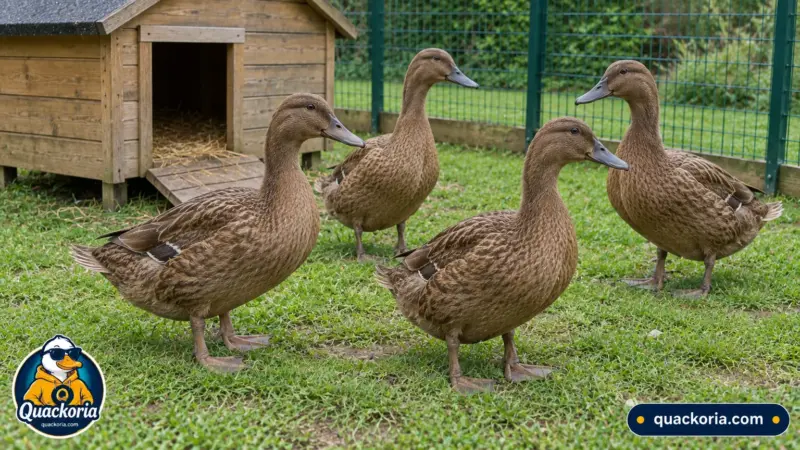
Indoor house. Four square feet per adult duck, from both eXtension’s meat duck guidance and Metzer Farms, which gives it as the sheltered space ducks need whether they spend the whole day in it or only the night; eXtension’s page on space allowances recommends 5. The RSPCA’s welfare standard is expressed as a stocking density of 17 kg per square metre, which for a 3.5 kg Pekin works out at about 2.2 square feet each — a commercial floor for birds with range access, not a target for a backyard house.
Space per bird changes with age, and Metzer publishes the clean series the calculator uses: 1 square foot up to three weeks, 3 square feet from four to eight weeks, 3.5 from nine to seventeen, and 4 from eighteen weeks on. Each bracket also carries a minimum total, because two ducklings in a five square foot space is a different proposition from two ducklings in two.
Outdoor run. Metzer recommends 50 square feet of pasture per bird from 18 weeks. The RSPCA minimum is 2.5 square metres — about 27 square feet — rising to 4 square metres where the grass cover is poor, and DEFRA lands in the same place for breeding ducks. Ducks are hard on ground: the more you can give them, or the more you can rotate, the longer the grass survives.
One deliberate omission. Cornell publishes a floor space table that would have been useful here, but its age column is ambiguous as printed — the values only make sense as weeks while the heading reads days. Rather than guess which was meant and hand you a figure built on a guess, the calculator uses Metzer’s unambiguous brackets instead.
Duck coop size and run size: the numbers in one table
Keepers in North America say “coop”; the extension services say “house”. It is the same building. These are the figures the calculator runs on, per bird, with the body that published each.
| Space | Recommended | Published by | Welfare minimum | Published by |
|---|---|---|---|---|
| Coop or house, adult duck (18 weeks and over) | 4 sq ft (0.37 m²) each, 24 sq ft minimum total | Metzer Farms; eXtension (4 sq ft only) | About 2.2 sq ft — a density of 17 kg/m², for a 3.5 kg Pekin | RSPCA |
| Run, adult duck | 50 sq ft (4.6 m²) of pasture from 18 weeks | Metzer Farms | 2.5 m² (about 27 sq ft); 4 m² where grass cover is poor | RSPCA; DEFRA |
| Ducklings, up to 3 weeks | 1 sq ft each, 5 sq ft minimum total | Metzer Farms | — | — |
| Ducklings, 4 to 8 weeks | 3 sq ft each, 16 sq ft minimum total | Metzer Farms | — | — |
| Growers, 9 to 17 weeks | 3.5 sq ft each, 20 sq ft minimum total | Metzer Farms | — | — |
| Feeder edge, adult | About 4 in (10 cm) | Cornell; eXtension | About 0.2 in (0.5 cm); DEFRA’s guide, about 0.24 in (0.6 cm) | RSPCA; DEFRA |
| Water depth | 4.5 cm from day one, at least 10 cm from three weeks — deep enough to submerge the whole head (RSPCA) | |||
Worked out for a backyard flock: four adult ducks need a coop of 24 square feet, because Metzer’s minimum total for adults is 24 whatever the count — a 4 ft by 6 ft house — and a run of around 200 square feet, or a smaller run that you move or rest so the ground recovers. Six ducks: still 24 square feet of coop, and about 300 of run. Eight: 32 and 400. Build to the recommendation, not the minimum; the minimum assumes a commercial shed.
Water: the measurement that matters most
If you take one number from this page, take this one.
A duck must be able to submerge its whole head in water. That is not a comfort or an enrichment — it is how a duck cleans its eyes and its nostrils, and a bird kept without water deep enough to do it develops eye and nostril problems. The RSPCA’s farm standard requires it, and DEFRA’s duck code recommends it. The RSPCA standard puts a number on it: at least 4.5 cm of depth from day one, and at least 10 cm from no later than three weeks of age. DEFRA’s code gives no measurement: “Consideration should be given to the provision of water troughs which are deep enough to allow the ducks to get their heads completely under water.”
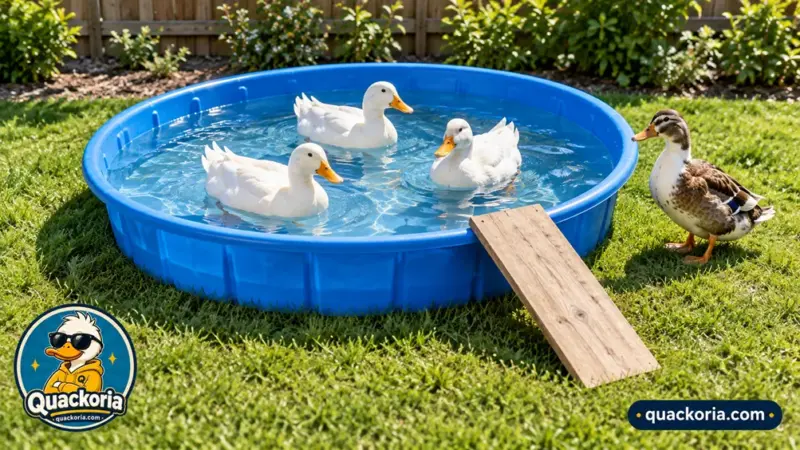
That is achievable with a bucket. It does not require a pond, which is the point our article on whether ducks need a pond makes at more length.
Swimming water is a separate question, and here the calculator stops rather than guessing. The RSPCA specifies at least 50 cm of open water facility edge per 100 ducks, a facility at least 50 by 100 cm, and full-body access from no later than 21 days. No authoritative source gives a volume of swimming water per duck. Plenty of websites will give you one; none of them can show you where it came from.
Drinking water has the same honest gap. Metzer publishes measured consumption for Pekin ducklings to seven weeks — 0.23 litres a day in week one, 1.51 by week seven. There is no published figure for adult ducks, so the calculator does not show one. Stretching the week-seven number to a grown bird would be a guess wearing a decimal point.
Brooder temperature, and the two schedules
Ducklings need heat, and the two published schedules disagree at the start by several degrees.
eXtension and Ohio 4-H start at 90 to 95°F for the first week and drop five degrees a week until the birds are three to four weeks old or the pen reaches 70°F. Cornell’s Duck Research Laboratory starts considerably cooler at 86°F and steps further down, to 55°F by five weeks.
They do not converge, and it is worth understanding why rather than splitting the difference. eXtension is describing a brooder you switch off: the schedule ends at 70°F because that is roughly room temperature and the supplementary heat comes out at three to four weeks. Cornell keeps going, describing what growing ducklings will tolerate as they feather up. The two are measuring slightly different things, which is exactly why the calculator shows both columns instead of averaging them into a number neither source published.
The practical resolution is behavioural rather than numerical: watch the ducklings. Huddled tightly under the lamp means too cold. Pressed against the far corners means too hot. Spread out and moving about, eating and sleeping in turns, means it is right — whichever column that corresponds to in your shed on that day.
Heat is only half of week one. The other half is feed, and ducklings need more niacin than chicks do — short of it, Metzer Farms says, problems show within several days, and in time the hocks swell and the legs bow. The food checker carries the figure and the two sources that agree on it.
For everything else about the first weeks, raising ducklings week by week covers the sequence, and what ducklings actually are covers the biology behind it.
Feeders and nest boxes
Feeder space. Cornell gives about 1 inch per duck for the first three weeks and about 4 inches linear per breeder; eXtension gives about 2 inches per duckling for the first two weeks, doubling to 4 after. Two independent sources arriving at 4 inches for adults is good agreement. Against that, the RSPCA specifies 50 cm per 100 birds, and DEFRA’s code, as a guide, 60 cm per 100 ducks from eight weeks old — the commercial minimums discussed above.
Nest boxes. This is the weakest evidence on the page and the calculator says so. The RSPCA duck standards contain no nest box requirements, and the DEFRA duck code says that nest boxes and roosting areas “should not be so high above floor level that birds have difficulty or risk injury in using them”, and counts nest boxes in a breeding flock’s floor area; neither gives a size. The University of Georgia gives about 12 by 18 by 12 inches; Metzer gives roughly 12 by 14 and advises against two ducks sharing a nest.
No authoritative source gives a ducks-per-box ratio. The widely repeated “one box per three to five ducks” appears only on blogs and forums, and it is left out here for that reason. If you are setting up for laying, when ducks start laying is the more useful starting point.
One warning worth carrying: most search results for duck nest boxes are wild wood duck conservation boxes, published by wildlife agencies for a completely different bird in a completely different situation. Those dimensions do not apply to a domestic duck on the ground.
Winter, and why space changes
The run figures assume birds that can get out. In a hard winter they often cannot, and the house that was comfortable in July becomes the whole world in January.
Metzer Farms gives its 4 square feet per adult as the sheltered space ducks need whether they spend the whole day in it or only the night, and eXtension’s page on space allowances recommends 5. If weather regularly confines your flock indoors for days at a time, eXtension’s 5 square feet gives them more room. Keep the litter dry either way. Keeping ducks in winter goes through the seasonal side properly.
And if you are still at the planning stage with eggs rather than birds, the hatch date calculator will tell you how long you have before you need any of this ready.
Frequently asked questions
How much space do ducks need?
Four square feet of indoor house per adult duck is Metzer Farms' figure, for sheltered space whether the ducks spend the whole day in it or only the night, and the least eXtension's meat duck guide gives; eXtension's page on space allowances recommends 5. For the run, Metzer recommends 50 square feet per bird from 18 weeks; the RSPCA welfare minimum is 2.5 square metres, about 27 square feet.
Why does the calculator show two different numbers?
Because two different kinds of body publish them and they are measuring different situations. Welfare minimums are commercial floors, assuming continuously refilled mechanised feeding and managed range access. Extension and hatchery recommendations are for keepers with a small flock. Handing a backyard keeper the commercial minimum would be actively bad advice.
How deep does duck water need to be?
The RSPCA's farm standard puts a number on it: 4.5 cm from day one and at least 10 cm from three weeks of age. The requirement is that a duck can submerge its whole head — that is how it cleans its eyes and nostrils, and a bird that cannot do it develops eye and nostril problems.
Do ducks need a pond?
They need water deep enough to clean their head, which a shallow trough provides. Swimming water is a separate question, and the RSPCA specifies access width and depth rather than a volume.
How warm should a duckling brooder be?
The two published schedules disagree. eXtension starts at 90 to 95°F and drops five degrees a week; Cornell starts at 86°F. They do not meet: eXtension turns the heat off at three to four weeks, while Cornell steps down to 55 °F from five weeks old. Watch the ducklings rather than the thermometer — huddled under the lamp means cold, spread to the corners means too hot.
How big should a duck coop be?
Four square feet of floor per adult duck, with 24 square feet as the smallest sensible house whatever the flock size, according to Metzer Farms — so a 4 ft by 6 ft coop covers up to six ducks. Add about 4 inches of feeder edge per bird and water deep enough for a duck to dunk its whole head.
How much run space do ducks need?
Metzer Farms recommends 50 square feet of pasture per duck from 18 weeks. The RSPCA welfare minimum is 2.5 square metres — about 27 square feet — rising to 4 square metres where the grass is poor. Ducks are hard on ground, so more space or a rotated run keeps the grass alive.
Where these figures come from
Every number this tool produces traces back to one of these. Where they disagree with each other, the tool says so rather than picking a favourite.
- eXtension / poultry.extension.org — Raising Meat Ducks in Small and Backyard Flocks (US extension)
- Metzer Farms — How Much Space Do Ducks Need (US hatchery)
- eXtension / poultry.extension.org — Space Allowances in Housing for Small and Backyard Poultry Flocks (US extension)
- RSPCA welfare standards for domestic and common ducks (UK welfare standard)
- Cornell University Duck Research Laboratory — Duck Housing and Management (US university)
- RSPCA Australia Knowledgebase — How should I care for my pet ducks? (Australian welfare advice)
- DEFRA — Code of Recommendations for the Welfare of Livestock: Ducks (UK welfare standard)
- Metzer Farms — Pekin Duckling Feed, Water and Manure Guide by Age (Cornell Duck Research Laboratory data) (US hatchery)
- Cornell University Duck Research Laboratory — Duck Nutrition (US university)
- University of Georgia Extension — Managing Ducks for Eggs (US extension)
Last reviewed: September 22, 2026