Quackoria Tools
Duck Flock Planner: How Many Ducks, Which Breed, and No Drake
Start from the eggs you want and the space you have, and this works out how many ducks that is, which breeds fit, and whether a drake belongs in the plan.
How to use it
- Enter the eggs you would like each week — a dozen is a household.
- Enter the run area you can give the ducks, and the house floor area if it exists. Metres or feet.
- Choose what matters most: eggs, calm birds, mothers, a small garden, or eggs and meat.
- Read the recommendation, the run and house capacity, and the breeds that fit — then read the drake note.
Most first flocks are the wrong size, and usually too big: people plan by chicken numbers, buy six ducklings because that is how many were in the box, and discover in June that they are giving eggs away. This planner starts from the other end — the eggs you actually want and the space you actually have — and works out how many ducks that is, which breeds lay that much, and whether a drake belongs in the plan.
Key takeaways
- Never one, and three is the practical minimum. A pair becomes a single duck the day something goes wrong.
- Three or four good layers is a household’s eggs. Metzer’s hybrids lay 200–290 a year; Campbells 165–240; most other breeds 100–180.
- Space caps the flock: 50 sq ft of run each (Metzer) for a comfortable garden flock, 27 sq ft at the RSPCA welfare floor, 4 sq ft each in the house.
- Only a flock that is to hatch ducklings needs a drake: University of Minnesota Extension says to keep one male for each 5–6 females. For a first flock kept for eggs the planner recommends none.
How the planner works
You enter the eggs you want per week, the run area, the house floor area if you have one, and what matters most — eggs, calm birds, mothers, a small garden, or a dual-purpose bird. The planner filters Metzer Farms’ breed chart to the breeds that fit, ranks them, and takes the top breed’s egg figure without artificial light — the lower, honest end of the range — to work out how many ducks produce your weekly target over a year. It then checks that number against the space: the run divided by 50 sq ft, the house divided by 4 sq ft, and the smaller of the two is the cap.
The recommendation is the smaller of what you need and what fits, and never fewer than three. If the space will not hold three, it says so rather than suggesting a pair.
Sizing by eggs
A dozen eggs a week is 624 a year. A Golden 300 or White Layer at Metzer’s no-lights figure of 200 needs four ducks for that; a Khaki Campbell at 165 needs four; a Cayuga or Buff at 130 needs five; a Call duck at 25 would need twenty-five, which is why nobody keeps Calls for eggs. Seasonal lay means the real pattern is a glut in spring and summer and few or none in midwinter — when ducks start laying and a duck keeper’s year cover the shape of it — and the annual figure smooths that out.
The upper figures in Metzer’s chart assume 17 hours of light through lay. Without lights, plan on the lower number, which is what the planner does.
Sizing by space
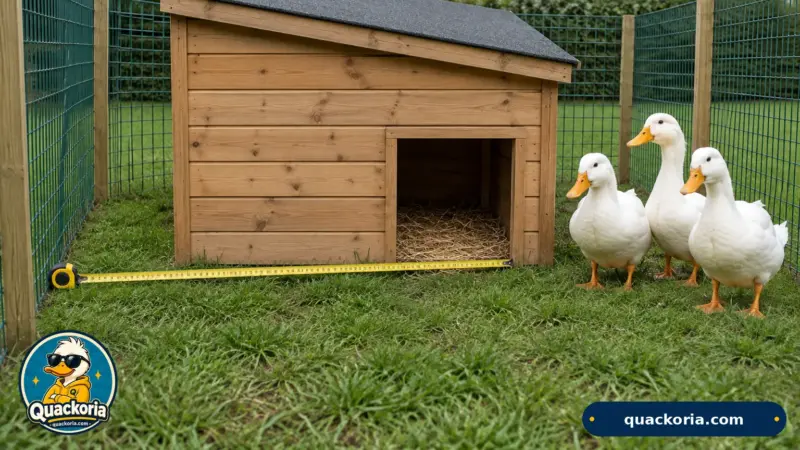
The published figures for space per duck disagree by a factor of three, and the planner uses the ones that suit a garden flock. Metzer recommends 50 sq ft of run per bird from eighteen weeks; the RSPCA’s welfare minimum is 2.5 m², about 27 sq ft. Indoors, Metzer and eXtension’s meat duck guide both say 4 sq ft per adult; eXtension’s page on space allowances recommends 5. The run figure is the one that bites: a 6 m by 5 m run is about 320 sq ft, six ducks comfortably, twelve at the floor, and a flock at the floor turns a run into mud in one wet winter. The housing and space calculator gives the same figures with feeder edge and water depth added; the duck house guide covers the building, and what killed my duck is the reason the house has to be built properly.
The drake
Two of the sources the planner uses give a ratio. University of Minnesota Extension’s fact sheet on raising ducks, on breeder flocks, says: “Keep one male for each 5-6 females.” Metzer Farms keeps one male to five females on its own farm; its FAQ says ten birds or fewer can be kept in pairs if there is room, and a flock of more than 25 or 30 needs one male to every three to five females unless it has a large pen with plenty of hiding places. When the goal is ducklings the planner keeps one drake for up to six females, two for seven to twelve, and so on.
What the sources do support is enough to decide. Ducks lay without a drake. More females per drake is safer for the females. Too many males, Metzer Farms says, “will become very aggressive sexually and will harm some of the weaker females”. So for a first flock kept for eggs the planner’s answer is no drake (choose ducklings as the goal and it adds drakes, one for up to six females, two for seven to twelve): all female, eggs from the start, no injuries, and — since it is the female that quacks loudly — no more noise. Add drakes later if you want ducklings — Minnesota Extension says one for each 5–6 females. How many ducks to keep goes through the arithmetic and the options for surplus drakes.
Which breed
The planner’s breed table is a filtered view of the full breed comparison, which has all twenty-one breeds and every column. For a first flock the choice usually comes down to how much you mind noise and nerves: the best layers in Metzer’s chart are also the most nervous — Khaki Campbell 9.0 on Metzer’s temperament scale, Golden 300 at 7.7 — while the calmest birds, Saxony, Appleyard, Welsh Harlequin, Muscovy, lay less. Calm and 150 eggs is a good trade for most gardens. Buying your first ducks is the next step.
What it will not do
It will not size a flock for meat — that is a question of how many you will process, not how many will lay. It will not account for foraging, climate or your neighbours’ tolerance. And it gives a drake ratio only when the goal is ducklings.
Frequently asked questions
How many ducks should I start with?
Never one, and three is the practical minimum — a pair becomes a single duck the day something goes wrong. Three or four good layers is a household's eggs.
How many eggs does a duck lay a year?
Metzer's chart without artificial light: hybrids 200, Khaki Campbell 165, Rouen 140, Cayuga and Buff 130, most others 100–130, Call ducks 25. The upper figures assume 17 hours of light.
How much space does a duck need?
Metzer: 4 sq ft each indoors and 50 sq ft of run from eighteen weeks. The RSPCA welfare minimum is 2.5 m² of run — about 27 sq ft — and the planner treats that as a floor, not a target.
Do I need a drake for eggs?
No. Ducks lay without one. A drake is for fertile eggs: for a first flock kept for eggs the planner recommends none, and when the goal is ducklings it adds one drake for up to six females, two for seven to twelve, and so on.
How many females per drake?
University of Minnesota Extension says to keep one male for each 5–6 females in a breeding flock. Metzer Farms says ten birds or fewer can be kept in pairs if there is room, and a flock of more than 25 or 30 needs one male to every three to five females unless the pen is large with plenty of hiding places. Too many males, Metzer says, "will become very aggressive sexually and will harm some of the weaker females".
Where these figures come from
Every number this tool produces traces back to one of these. Where they disagree with each other, the tool says so rather than picking a favourite.
- Metzer Farms — Compare Duck Breeds (US hatchery)
- The Livestock Conservancy — Rouen duck
- Cornell Lab of Ornithology — Muscovy Duck sounds
- Metzer Farms — Muscovy Ducks (US hatchery)
- Metzer Farms — FAQ (US hatchery)
- Metzer Farms — Rouen Ducks (US hatchery)
- British Waterfowl Association — Rouen
- eXtension / poultry.extension.org — Selecting a Duck Breed for Small or Backyard Poultry Flocks (US extension)
- Metzer Farms — Welsh Harlequin Ducks (US hatchery)
- eXtension / poultry.extension.org — Raising Meat Ducks in Small and Backyard Flocks (US extension)
- Metzer Farms — How Much Space Do Ducks Need (US hatchery)
- eXtension / poultry.extension.org — Space Allowances in Housing for Small and Backyard Poultry Flocks (US extension)
- RSPCA welfare standards for domestic and common ducks (UK welfare standard)
- Cornell University Duck Research Laboratory — Duck Housing and Management (US university)
- University of Minnesota Extension — Raising Ducks (Poultry Fact Sheet 43) (US extension)
- Metzer Farms — Male to Female Ratio: How Many Males and Females Should You Have for Ducks? (US hatchery)
- Metzer Farms — Sexing Ducks and Geese (US hatchery)
- Metzer Farms — Hatching Instructions (US hatchery)
- NC State Extension — Feeding Ducks (US extension)
- Metzer Farms — How Much Do Ducks Eat? (US hatchery)
- eXtension / poultry.extension.org — Feeding Ducks for Egg Production Kept in Small Flocks (US extension)
Last reviewed: September 11, 2026