Quackoria Tools
Free Duck Coloring Pages: 20 Printable Ducks to Colour
Twenty original duck drawings — on the pond, in the bath, on the moon. Print one, save it as a PNG, or print the whole set for a rainy afternoon.
How to use it
- Use the chips at the top to pick a group — pond and water, seasons and weather, dress-up ducks, family and friends — and the second row to choose simple pages or pages with more detail.
- Press Print on any card to send just that drawing to your printer. Choose "fit to page" and plain black and white.
- Press Print all to print every page in the current filter, one drawing per sheet.
- Press Save as PNG to download a large image of the page, or Open full size to view it on its own and save it from your phone.
What is in the set
Twenty pages, all drawn for Quackoria: a duck on the pond with her duckling, a family walk over the hill, a duckling hatching, a duck under an umbrella, a birthday duck with a top hat and balloons, a duck in the bath, a winter duck in a woolly hat, a duck reading under a tree, a duck sailing, a duck in flight, a beach duck in sunglasses, a duck on her nest, a farm duck, a duck meeting a frog, a duck in a space helmet on the moon, a chef duck with pancakes, a school duck with a backpack, two duck friends, an autumn duck among falling leaves, and a duck flying a kite.
They are grouped four ways at the top of the page — pond and water, seasons and weather, dress-up ducks, family and friends — and you can also filter by how much there is to colour. The simple pages have a big duck and a few large shapes, which suits small hands and thick crayons. The more detail pages have backgrounds, props and smaller areas for older children, or for adults who find a page of ducks a decent way to spend a quiet half hour.
Every page has a line for the artist’s name and a small Quackoria credit at the bottom corner. There is nothing else on them: no border art to colour around, no words, no puzzle.
Printing tips
The pages are drawn in portrait and scale to whatever paper you have — A4 in most of the world, Letter in North America — with the printer’s “fit to page” setting. Plain copier paper is fine for crayons and pencils. If markers are going to be involved, a heavier paper (120 gsm or more, or “cardstock” in the American aisle) stops the colour bleeding through onto the table. Print in black and white; there is no colour on the page to lose.
“Print” on any card sends just that drawing to the printer, without the rest of this page. “Print all” sends the whole filtered set as one document, one drawing per sheet, which is the quick way to prepare a classroom or a party table. “Save as PNG” makes a large image you can keep, send, or drop into a document; the lines are drawn at double resolution so they stay crisp. “Open full size” shows the drawing on its own, which is the easiest way to save it on a phone.
Colour it like a real duck
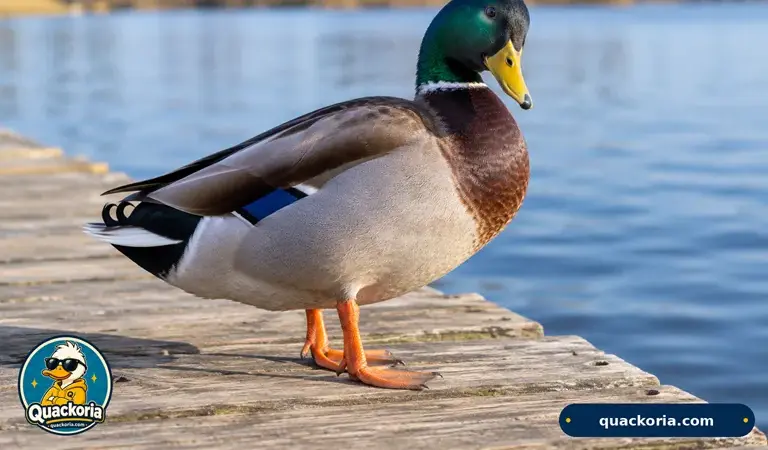
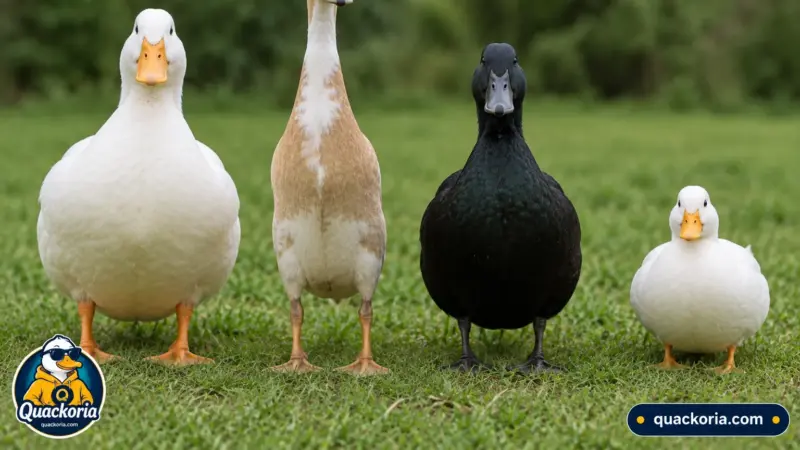
Yellow is the classic, and the classic is fine — most ducklings really are yellow, or yellow and brown. But the adult ducks on these pages could be any breed, and matching a real one is a good excuse to look at real ducks. A male mallard has a glossy green head, a white ring round the neck, a brown chest, a grey body and a yellow bill; the female is mottled brown all over with an orange-and-brown bill, and both have a blue patch on the wing. A Pekin is pure white with an orange bill and feet. A Cayuga is black with a green shine. A Khaki Campbell is the colour of its name. The beginner’s guide to duck breeds has the colours of the common ones, and the breed comparison lists twenty-one.
Some pages carry a real fact worth mentioning while the colouring happens. The duck on her nest is sitting on three eggs that will take about four weeks to hatch — the ducklings article covers what happens next. The winter duck does not need the scarf: ducks’ feet do not freeze on ice, because the duck lets them run cold, losing little heat, and below freezing more blood appears to be sent down to keep the tissue from freezing. The duck in the bath is doing what ducks do every day, and why the water runs straight off is one of the best stories in biology. And the hatching duckling is breaking out with a tiny hard point on the tip of its bill — the egg tooth — which drops off within days and is the closest thing a duck ever has to a tooth.
Using the pages
These pages are free to print for home, classroom, library, party and club use, as many copies as you need. They are Quackoria’s own drawings, so please do not sell them, put them in a product, or present them as your own. If you post a finished page online, a mention of Quackoria is appreciated and entirely optional.
For the rest of a rainy afternoon: a hundred duck jokes and puns for reading aloud while the crayons are out, the duck games for when the pages are done, and the duck name generator for naming the duck you just coloured.
Frequently asked questions
Are the coloring pages free?
Yes. Print as many as you like for home, classroom, library, party or club use. The drawings are Quackoria's own; please do not sell them or present them as yours.
What paper should I print on?
Plain copier paper for crayons and pencils. For markers, a heavier paper — 120 gsm or more, sold as cardstock in North America — stops colour bleeding through.
Will they print on A4 and on Letter?
Yes. The pages are portrait drawings that scale to the sheet; choose "fit to page" in the print dialog and they fill either size.
Which pages are best for toddlers?
Filter by Simple. Those pages have a big duck and a few large shapes, with less to go outside the lines of.
Can I download the whole set at once?
Print all sends every page in the current filter to the printer as one document. For files, use Save as PNG on each card — each one downloads as its own image.
Last reviewed: September 15, 2026