Quackoria Care
Common Duck Health Problems (and When to Call a Vet)
Ducks hide illness until it is serious, so the skill worth learning is noticing early. Here are the problems backyard keepers actually meet, what they look like, and the signs that mean stop reading and phone a vet.
Key takeaways
- Ducks mask illness — a duck that looks a little off is often quite unwell.
- Wet bedding and dirty water are linked to several problems on this page, from bumblefoot and wet feather to aspergillosis and botulism.
- Breathing difficulty, straining, prolapse, paralysis, collapse or blood mean call a vet now.
- Routine blanket worming is outdated advice; test droppings and treat on the result.
- A single duck kept alone is a welfare problem, not just a lonely one.
- Coughing, a twisted neck or a limp that lasts are signs, not diagnoses — each has several causes with different treatments, which is why they go to a vet.
What you need
- The phone number of an avian or farm vet, found before you need it
- A clean, dry, quiet isolation pen for a sick bird
- Clean towels for drying and handling
- Plain saline for flushing eyes and small wounds
- A notebook or your phone, for recording what you saw and when
Read the flock first, the bird second
Spend two minutes a day watching your ducks do nothing in particular. You are looking for the bird that is not doing what the others are doing: standing apart, tail held low, eyes half shut, not eating, not bathing, slow to get up. Ducks are prey animals and hide weakness, which means by the time a duck looks obviously ill it has usually been ill for a while.
The problems you are most likely to meet
Bumblefoot
A swelling, scab or dark spot on the underside of the foot, often with limping. It often starts with a small cut or a bruise from rough or wet ground and becomes an infection that can reach the bone. Prevention is dry bedding, smooth surfaces and no rough gravel where they walk daily. Established cases need veterinary treatment, not home surgery.
Wet feather
Feathers that look permanently damp, matted and scruffy, and a duck that gets soaked instead of shedding water. Causes include dirty bathing water, an underlying illness, a preen gland problem or contamination with oil or detergent. Start with clean bathing water every day and clean dry housing; if it does not resolve, see a vet. A duck that cannot waterproof itself is at real risk in cold weather.
Leg weakness and bowed legs in ducklings
One well-known cause is a niacin shortfall, especially on a starter made for chickens: the Merck Veterinary Manual notes that ducks are “much more severely affected by niacin deficiency than are chickens”, and Metzer Farms that a chick starter made only for laying chickens “probably does not have enough niacin”. Fixable if caught early; PoultryDVM’s advice is to call your veterinarian. Full details in raising ducklings week by week.
Angel wing
A wing that twists outward instead of folding flat, seen in growing birds. It is linked to fast growth on an over-rich, high-energy diet. Caught very early in a young bird it can sometimes be corrected by wrapping and diet change, under veterinary guidance; once the bones set it is permanent. Bread is often named as the specific cause. Indiana’s Department of Natural Resources attributes most cases in wild birds to bread from well-intentioned people; PoultryDVM lists feeding bread or other high-carbohydrate foods as one risk factor, alongside a high-protein or high-energy diet during growth. Either way, PoultryDVM’s advice is that bread and other high-carbohydrate foods should never be fed to ducks.
Egg binding
A laying duck straining, squatting, walking with a wide stance, off her food, sometimes with a swollen abdomen — signs that can mean egg binding. This is an emergency. Untreated it can kill. The Merck Veterinary Manual’s advice for backyard chickens is that a bird that cannot pass the egg “should be seen by a veterinarian as soon as possible, because egg binding can be life-threatening.” Get to a vet.
Botulism
Progressive weakness that travels: in the Merck Veterinary Manual’s description, leg weakness progresses to limp paralysis of the legs, wings, neck and third eyelids. Associated with stagnant, warm, rotting water. Remove birds from the suspect water source and get veterinary help immediately.
Aspergillosis
A fungal infection of the airways from mouldy bedding or feed. Signs are open-mouthed breathing, gasping, tail bobbing with each breath. Prevention starts with never using mouldy bedding or feed, and keeping bedding dry: Merck notes that large numbers of spores can form when shavings used as bedding get wet and then dry out.
Parasites
Internal worms show up as weight loss and poor condition; lice and mites show up as irritation, feather damage and restlessness. Diagnose worms with a faecal egg count rather than guessing.
Coughing, sneezing and wheezing
Respiratory signs in a duck — coughing, sneezing, a discharge from the nostrils or eyes, noisy or open-mouthed breathing — are never just a cold. The Merck Veterinary Manual lists “oronasal discharge; coughing or sneezing” among the signs of avian influenza in backyard poultry, and adds that “if a poultry flock has sudden high death rates […] or many birds with respiratory signs, owners should contact a veterinarian or the state animal health emergency number to test for AI infection” — because ducks “are natural hosts for the AI virus” and can shed it “often without showing any clinical signs of illness”. Aspergillosis (above) is another cause, and it has no effective treatment, so remove any mouldy bedding at once. A duck coughing, or two ducks with discharge, is a phone call.
Wry neck (a twisted or drooping head)
A duck holding its head twisted to one side, bent back, or unable to lift it is showing a sign, not a disease, and the list of causes is long. In ducklings, Cornell’s Duck Research Laboratory names Riemerella infection — “new duck disease” — in which ducks “show incoordination, shaking of the head and twisted neck” and “are commonly found on their backs, paddling their legs”; it is treatable with antibiotics from a vet. Nutritional causes look different: the Merck Veterinary Manual describes thiamine deficiency as beginning with “lethargy and head tremors” and progressing until birds “draw back their heads in a star-gazing position”, and vitamin E deficiency as ataxia — a wobbling, uncoordinated bird. A knock to the head and botulism (above) can look similar. Because the treatable causes need different treatments, this is a see-a-vet-today sign, not a guess-and-supplement one.
Limping and foot problems
Common causes include these three. Bumblefoot (top of this list) shows as a swelling or dark scab under the foot; Merck notes it “is often precipitated by injuries that allow contamination of subcutaneous tissue in the footpad” and that “swollen footpads and limping are common clinical signs.” A niacin shortfall in growing ducklings shows as bowed legs and swollen hocks — in Merck’s words, “ducks and turkeys with a niacin deficiency show a severe bowing of the legs and an enlargement of the hock joint.” And a plain sprain or cut from rough ground. A duck that will not bear weight at all, or a limp that is not better in a week, needs a vet.
Duck diseases with names
Backyard keepers should know the names of the serious infectious diseases of ducks, because their early signs are easy to mistake for something milder — and with duck viral enteritis the first sign is often sudden death. The descriptions below are the Merck Veterinary Manual’s and Cornell’s.
- Duck viral enteritis (duck plague) — “an acute and often severe disease of both wild and domestic waterfowl”, caused by a herpesvirus. “The first clinical sign of DVE is often sudden death”; birds that linger may show “photophobia, inappetence, extreme thirst, droopiness, ataxia, nasal discharge, soiled vents, and watery or bloody diarrhea”. “There is no treatment for DVE.” Prevention is keeping domestic ducks away from wild waterfowl and anything they may have contaminated, such as free-flowing water; a vaccine for domestic ducks is approved in the US.
- Duck viral hepatitis — “an acute infectious disease affecting young ducklings”, with mortality “up to 95% in fully susceptible ducklings”. Ducklings “become lethargic, lose balance, paddle spasmodically, and die within minutes”. Not seen in ducks over seven weeks old. There is no specific treatment; breeder flocks can be vaccinated, and strict isolation in the first five weeks is the advice.
- Riemerella infection (new duck disease) — a bacterial disease of ducklings, usually one to seven weeks old: “ocular and nasal discharges, mild coughing and sneezing, tremors of the head and neck, depression, and incoordination”. Treatable with antibiotics from a vet; biosecurity is the prevention, with vaccination where a vet advises it.
- Avian influenza — ducks can carry it without looking ill. Any sudden run of deaths, or respiratory illness across the flock, is a same-day call to a vet or the animal-health authority, not a wait-and-see.
- Botulism and aspergillosis — covered above. Both are environmental: botulism is linked to stagnant water with decaying matter, aspergillosis to mouldy or damp bedding and feed.
Call a vet now if you see
- Open-mouthed or laboured breathing, gasping, or tail bobbing with each breath
- Straining, or anything protruding from the vent
- Blood in droppings or around the vent
- A duck unable to stand, or paralysis spreading through the body
- Tremors, seizures, or a head held twisted
- Sudden collapse, or a bird not eating or drinking at all with obvious lethargy
- A wound that is deep, dirty, or bleeding steadily
Quackoria Care is written to help you look after your birds well. It is not a diagnosis, and nothing on this page replaces a qualified avian or farm vet. Find one before you need one — the worst time to start searching is at seven on a Sunday evening. RSPCA Australia advises a check by a vet with poultry knowledge straight after buying ducks and at least once a year.
Preventing most of it
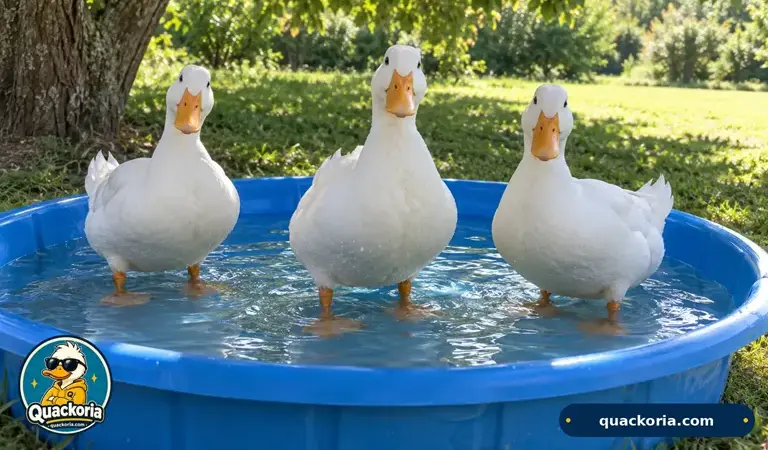
- Dry bedding. Damp, dirty bedding is linked to bumblefoot and aspergillosis, two of the problems above.
- Clean water, changed daily. See water for ducks.
- The right feed. A waterfowl or all-flock ration, with the right niacin for growing birds. See what to feed ducks.
- Space. Roughly 0.4–0.5 m² (4–5 sq ft) per adult bird inside — Metzer Farms gives 4 sq ft, the extension network’s Small and Backyard Poultry site 5 — and far more outside; Metzer lists leg problems, fighting, wetter pens and dirtier birds as the cost of crowding.
- The right number of drakes. About one drake to four or five ducks. Fewer females per drake means over-mating injuries.
- Company. Never keep one duck alone. Two is the minimum.
- Quarantine. Keep new birds separate for two to three weeks before they join the flock.
How to pick up and check a duck
Half of good duck-keeping is being able to get hold of one calmly. Panicking a bird into a corner and grabbing at it is how wings and legs get hurt.
- Move slowly and herd, do not chase. Two people and a gentle wide approach beats one person sprinting.
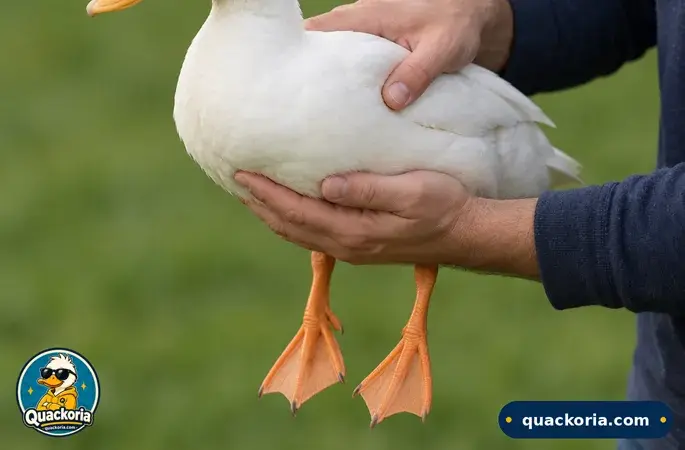
- Lift with one hand under the breast, the other supporting the legs, and hold the bird against your body with its wings folded flat.
- Never carry a duck by the legs or by the neck; take its weight on a hand under the body.
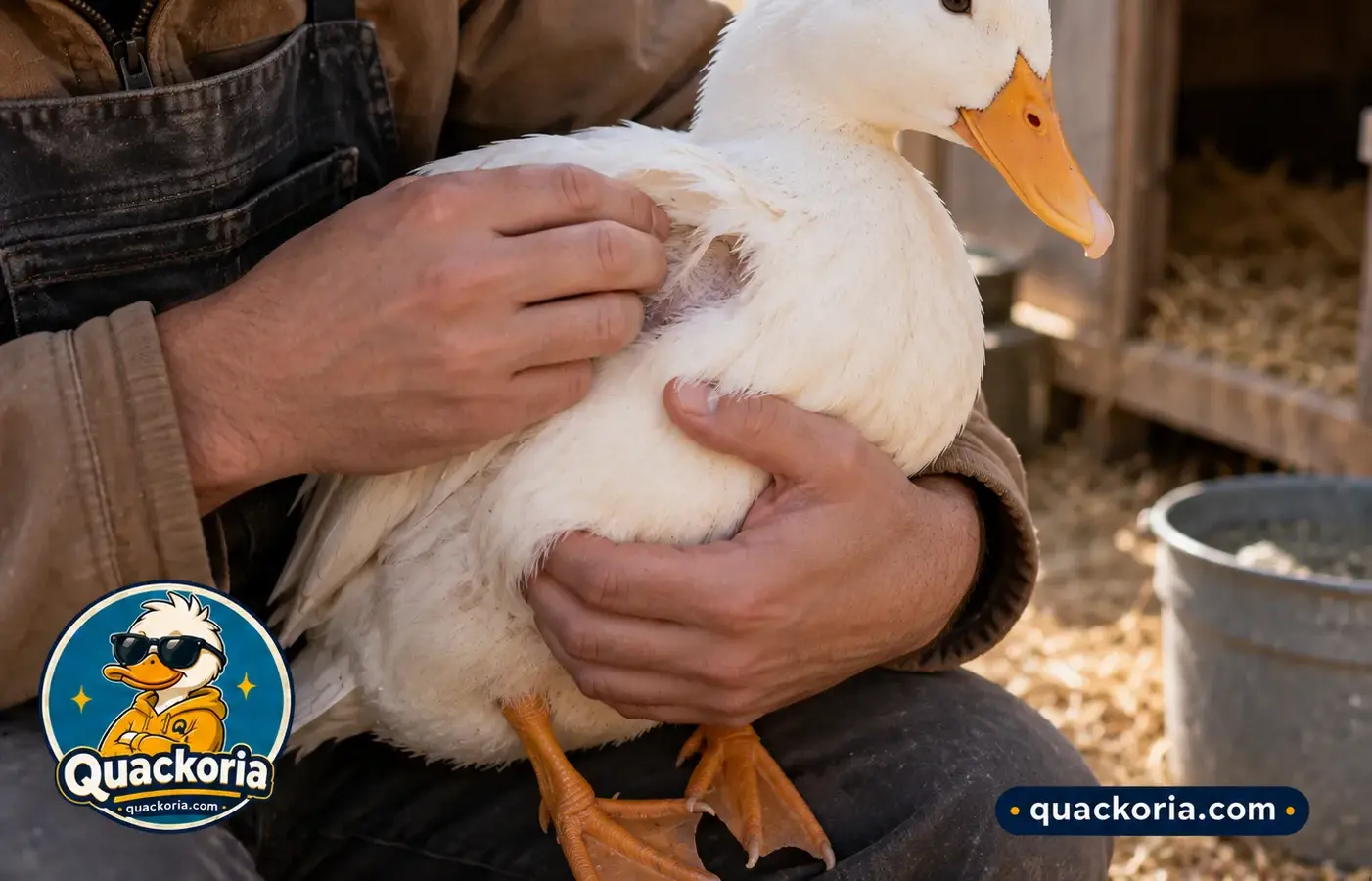
- Once held, work through it in the same order every time: eyes and nostrils, bill, breathing, keel bone for weight, vent for cleanliness, then each foot.
- Put the bird down facing away from you, and let it walk off.
A duck you handle occasionally when nothing is wrong is a duck you can handle when something is.
The isolation pen
Have one ready before you need it: a dog crate, a spare hutch or a partitioned corner. It should be dry, draught-free, quiet, easy to clean, and within sight or sound of the flock so the bird is not distressed by being alone.
Use it for a sick bird, an injured bird, a bird being bullied, and every new bird for two to three weeks. Clean it out completely between occupants, and wash your hands after handling a sick duck before touching the healthy ones.
A small first-aid kit worth keeping
- Plain saline for flushing eyes and rinsing dirt out of wounds
- Clean towels for drying, wrapping and holding
- Vet wrap and non-stick dressings
- Blunt-ended scissors
- Electrolyte and vitamin powder for a bird that is off-colour
- Brewer’s yeast, for niacin support in growing birds
- Disposable gloves
- Your vet’s number written down, not only in a phone
Note what is not on that list: antibiotics and prescription medicines. Those are for a vet to decide.
Keeping records
A note on your phone is enough. Date, bird, what you saw, what you did. Two lines each time.
It sounds fussy until the day a vet asks how long a bird has been limping, or you realise the same duck has had a swollen foot three winters running, or you spot that laying stopped the week you changed feed. Memory is unreliable; a dated line is not.
When to worry about the whole flock, not one bird
Several birds off their food at once, several with the same droppings, sudden deaths, or a group all showing weakness together is a different situation from one poorly duck. Stop, shut the flock in, do not move birds to or from anywhere, and call a vet — and in many countries there are notifiable diseases where the authorities also want to know. Fast action protects your flock and everyone else’s.
Frequently asked questions
How do I know a duck is unwell?
Look for a bird standing apart, tail down, eyes half closed, not eating or bathing, walking oddly, or breathing with an open bill. Ducks are prey animals and hide weakness, so a small change in behaviour is worth taking seriously.
Do ducks need worming?
Not on a routine schedule. Test first — the Merck Veterinary Manual recommends routine yearly faecal examinations for backyard flocks and a faecal examination before any treatment, and Poultry Keeper suggests testing ducks at least twice a year, ideally every three months — then treat on the result, because blanket worming drives drug resistance.
Do ducks need vaccinations?
Only in some situations. For small flocks, the Merck Veterinary Manual says vaccination "is generally necessary only if the birds have had disease problems in the past or could potentially be exposed to other birds" — for example at shows or through wild bird access — or when new birds join the flock. Good biosecurity and healthy stock are the everyday protection. Ask a local vet about anything specific to your region.
Can I treat a sick duck myself?
You can manage the basics — clean dry housing, isolation, warmth, food and water. Diagnosis and medication need a vet. Guessing at antibiotics does harm.
My duck's feathers look wet and messy — what is that?
That pattern is called wet feather: the feathers stop shedding water, often because of dirty bathing water, a preen gland problem or contamination. Clean water, clean housing and a vet check if it does not resolve.
Why is my duck coughing or sneezing?
Repeated coughing, sneezing, discharge from the nostrils or eyes, or noisy breathing is not something to wait out — the causes range from mouldy-bedding aspergillosis to avian influenza, which ducks can carry with few signs. Merck lists coughing and sneezing among the signs of avian influenza, and says a flock with many birds showing respiratory signs should contact a vet; we would make that a same-day call.
What causes wry neck in ducks?
It is a sign, not a diagnosis. In ducklings one infectious cause is Riemerella ('new duck disease'), which Cornell describes with head shaking and a twisted neck; thiamine or vitamin E shortfalls, a head injury and botulism can all produce a bent or drooping head too. The treatable causes need different treatments, so see a vet rather than guessing at a supplement.
What are the most common duck diseases?
In backyard flocks the everyday problems are bumblefoot, wet feather, niacin-related leg weakness, egg binding, botulism from foul water, aspergillosis from mouldy bedding, and parasites. The serious named diseases — duck viral enteritis, duck viral hepatitis, Riemerella and avian influenza — mostly hit ducklings or arrive with wild birds, and are easy to miss early: some begin with signs that look mild, and with duck viral enteritis the first sign is often sudden death.
Sources
- Merck Veterinary Manual — Common infectious diseases in backyard poultry
- Merck Veterinary Manual — Common management-related problems in backyard poultry (early signs of illness, egg binding)
- Merck Veterinary Manual — Duck viral enteritis
- Merck Veterinary Manual — Duck viral hepatitis
- Merck Veterinary Manual — Riemerella anatipestifer infection
- Merck Veterinary Manual — Aspergillosis in poultry
- Merck Veterinary Manual — Botulism in poultry
- Merck Veterinary Manual — Vitamin deficiencies in poultry (niacin, thiamine, vitamin E)
- Merck Veterinary Manual — Staphylococcosis in poultry (bumblefoot)
- Cornell University Duck Research Laboratory — Duck health care
- The Open Sanctuary Project — common duck health issues
- Poultry Keeper — worming ducks
- Merck Veterinary Manual — Vaccination of backyard poultry
- Cornell Wildlife Health Lab — Duck viral enteritis
- PoultryDVM — Bumblefoot in pet ducks
- PoultryDVM — Wet feather in pet ducks
- PoultryDVM — Angel wing in pet ducks
- PoultryDVM — Egg binding in pet ducks
- PoultryDVM — Niacin deficiency in pet ducks
- PoultryDVM — Lice in pet ducks
- British Waterfowl Association — Wet feather
- Indiana Department of Natural Resources — Angel wing syndrome
- Metzer Farms — Are my ducklings' leg problems due to a niacin deficiency?
- Metzer Farms — Wry neck in ducks
- Metzer Farms — How much space do ducks need
- Metzer Farms — Male to female ratio for ducks
- Small and Backyard Poultry (extension) — Space allowances in housing for small and backyard poultry flocks
- Small and Backyard Poultry (University of Kentucky) — Biosecurity for small poultry flocks
- DEFRA — Code of recommendations for the welfare of livestock: ducks
- Penn State Extension — Handling poultry
- RSPCA Australia — How should I care for my pet ducks?
- USDA APHIS — Defend the Flock