Quackoria Care
How to Pick Up and Hold a Duck Without Hurting It
A duck's legs are easily dislocated or broken, and the UK welfare codes say never to carry a bird by them. This is how to catch, hold and put one down safely.
Key takeaways
- Never by the legs — DEFRA's duck code and the RSPCA standard both say it without qualification. Purdue Extension: a waterfowl's shanks "are easily dislocated or broken".
- Corner slowly, or catch in the house at dusk. Purdue Extension says birds "are easier to catch once it is dark."
- Two holds: one hand under the breast taking the weight with the other holding the wings closed, or both hands either side with the wings pinned.
- Carry low and against your body, with the head tucked under your arm (Penn State Extension).
- Ducklings are picked up bodily in the palm (DEFRA). Muscovies are handled with gloves (Metzer, Humane Slaughter Association).
- Panting or fighting your hands means put it down. Watch every bird walk away afterwards — poor handling can leave a duck lame (Humane Slaughter Association).
What you need
- Gloves, for Muscovies
- A capture net, for a bird that will not be cornered
- A calm approach and no hurry
Most of this is about slowing down. Penn State Extension’s instruction for picking up any bird is to make sure “your movements are slow and deliberate to prevent the bird from getting overly excited”, and the Merck Veterinary Manual notes that “Catching birds on the first attempt minimizes stress”. The technique is not complicated; the discipline is.
The one rule: never by the legs
Chickens are sometimes carried upside down by the legs. Nothing should be: the Merck Veterinary Manual says “The bird should not be restrained upside down”, and the RSPCA’s duck standards list “hanging head downwards” among the ways ducks must not be carried.
The UK’s welfare code for ducks says it in eight words: “Birds should never be carried by the legs.” The RSPCA’s duck welfare standard makes it a numbered requirement — T 2.12.1, ducks must not be carried “by the legs”. Neither body qualifies it. There is no situation, no size of duck, and no hurry that makes it acceptable.
What goes wrong is dislocation or a fracture. Purdue Extension puts it plainly: “DO NOT catch waterfowl by the legs, as their shanks are easily dislocated or broken.” The Humane Slaughter Association, writing on catching and handling ducks, says a duck should “never be caught by the leg as there is a high risk of hip dislocation”, and that “Poor catching and handling can easily lead to ducks becoming lame”. Penn State Extension’s note on waterfowl is shorter still: “Their legs, however, are very sensitive.”
The same goes for the wings and the neck, and here the sources differ. The RSPCA standard rules out carrying a duck “by the wing(s)”, “by the neck”, “by the head” or “by the tail”; Penn State Extension says “water fowl are best carried by their wings” and Purdue Extension that a caught duck “can be carried by the wings or neck”. This page follows the UK codes. The neck is at most a catching hold — the DEFRA code says “It may be necessary to catch older ducks by the neck” and that the bird should then be supported by one of the two holds below — and the same code asks that handling be “undertaken only by competent persons who have been appropriately trained”, so it is not something to try without having been shown.
Catching without a chase
A chased duck runs, flaps, crashes into things and, if it is a flying breed, leaves. The DEFRA code requires that “Care must be taken in catching ducks to avoid creating panic and subsequent injury to or smothering of the birds”, and the RSPCA standard that “The catching of birds must be carried out quietly and confidently”. The goal is to make the duck stop moving before you touch it, and there are three ways to do that.
1. Corner it, slowly
Purdue Extension’s advice for waterfowl is that they “should be corralled into a smaller area to be captured”. Walk them, unhurried, into a corner of the run or against a wall — a fence corner is ideal, the corner of the house better still. Do not rush the last two metres; that is where the chase starts. Crouch as you get close so you are not looming, and let the bird settle for a breath before you reach.
2. Do it in the house
The easiest place to catch a duck is inside its house at dusk, when the flock has gone in and the light is going. Purdue Extension says that “Birds tend to become more docile as the sun sets” and that “Therefore, birds are easier to catch once it is dark.” They also cannot run far, and there is no open water to escape onto. If you need to handle a bird for any reason that is not an emergency, this is when to do it.
3. Use a net
For a bird that will not be cornered, Purdue Extension says “A capture net is likely the best option.” Bring it down over the duck from above rather than swinging it, and then reach in and take the bird with one of the holds below rather than lifting the net with the duck in it.
What does not work: grabbing at a passing bird, lunging, or anything that involves the word “quick”.
The hold
The DEFRA code and the RSPCA standard describe the same two ways to support a grown duck:
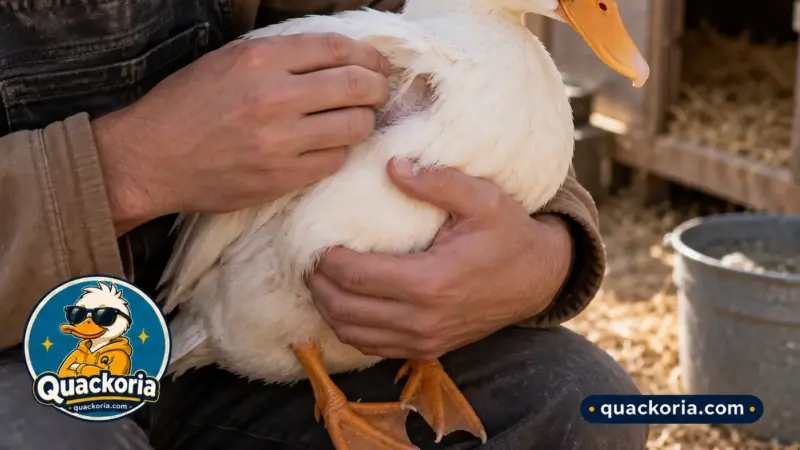
Under the body. One hand slides under the breast from the front, palm up, so the keel — the breastbone — rests along your palm and fingers and the bird’s weight is on your hand. The code’s words are “taking the weight of the bird by a hand placed under its body”; the RSPCA’s are “a hand or arm placed under its body”. Your other hand comes over the top and holds the wings closed against the body. Lift with the lower hand.
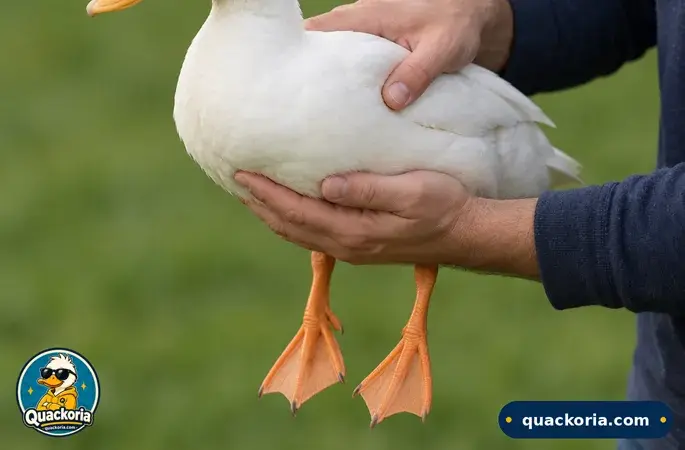
Either side of the body. In the code’s words, “holding the bird with a hand on either side of its body with the wings in the closed position”: both hands on the sides of the bird, thumbs over the back, fingers under, wings pinned closed under your palms. Lift. This is the hold for a bird that is already still — cornered against a wall, or in the nest.
Either way, the two things that matter are the wings are closed and held closed, and the weight is supported, which is how both codes put it. Penn State Extension’s reason for covering the wings with your free hand is “to prevent injury or flapping”.
Carrying
Once the bird is up, tuck it against your side, under your arm. Penn State Extension: “You can tuck its head under your arm which will help it stay calm.” Your arm clamps the wings and your hand under the breast takes the weight.
Keep the bird low and against your body. The Merck Veterinary Manual’s instruction is that “It is important to remain low to the ground when handling bigger birds”, and a duck held out in front at chest height is a duck that flaps.
Ducklings
The code is specific: day-old and young ducklings are “picked up bodily in the palm of the hand”. Scoop from below with the whole hand, fingers together, and close the other hand loosely over the top so it cannot jump. Never by a wing, never by a leg.
Muscovies
Muscovies are the exception to almost everything, and handling is no different. They are heavy — eXtension puts the male at 10 to 12 pounds and the female at 5 to 6 — and they have claws, long and sharp, for perching in trees: Oklahoma State’s breed register says their feet “are equipped with strong sharp claws for grasping tree branches and roosting”. Metzer says Muscovies are “very strong”, the males especially, and that “you can be accidentally scratched”.
The holds are the same — wings closed, weight supported — with one addition: gloves. Metzer says “it is best to use gloves when handling them because of their sharp nails”, and the Humane Slaughter Association that “It is recommended to wear gloves when handling Muscovy ducks as these birds are strong and have sharp claws.” There is more on the breed in keeping Muscovy ducks.
Reading the bird
A duck tells you when it has had enough. The DEFRA code’s sign of heat stress is “prolonged panting”, and the Merck Veterinary Manual says of a big bird that struggles in the hand that it “might need to be released quickly to prevent injury”. Both point the same way: a bird that is panting or fighting your hands goes down.
What to watch for:
- Wings working against your hands — keep them covered and closed, which Penn State Extension gives as the way “to prevent injury or flapping”, and get to where you are going; do not stand still and wrestle.
- Panting with the bill open — stop. Put the bird down somewhere shaded with water and leave it alone. On a hot day this may be heat rather than handling, and the emergency routine in keeping ducks in summer applies.
- An uneven walk when released — the Humane Slaughter Association says “Poor catching and handling can easily lead to ducks becoming lame”. A bird that is not walking normally needs a proper look, and a lame duck is a matter for a vet.
The last one is the check to make after every handling: watch the bird walk away. An even waddle means you did it right. A limp means something is wrong.
Putting a duck down
The same rules cover letting go of a duck as cover picking one up. The RSPCA standard requires that “the weight of the bird must be supported” while it is carried, and both it and the DEFRA code ask for care “to avoid unnecessary struggling”.
So put the bird down on its feet, on the ground, from as low as you can crouch — not dropped from standing, not tossed, not released in mid-air. Keep the wings held until its feet are on the ground and it has its balance, then open your hands and step back. Merck’s reason for staying low with a bigger bird is that it may struggle and “might need to be released quickly to prevent injury”.
Making it easier next time
Handling is easier when it is brief, routine and done the same way every time.
- Approach the same way every time — same door, same pace, same voice, and movements that stay “slow and deliberate” (Penn State Extension).
- Handle in the house at dusk, not in the open by day: Purdue Extension says birds “are easier to catch once it is dark.”
- Keep it short. Whatever you need to do — check feet, look under a wing, treat something — have it ready before you pick the bird up, so it is held for a minute and not five.
- Do not make handling the only time you approach them. Feed by hand, sit with them, walk through them slowly.
The aim is not a duck that enjoys it. The aim is a duck that tolerates it without harm to either of you.
When to handle at all
Less than you think. The RSPCA’s standards start from the position that “The transport and handling of livestock needs to be kept to an absolute minimum”, and the Merck Veterinary Manual’s note that “Catching birds on the first attempt minimizes stress” says what the cost of a second attempt is. The good reasons:
- The health check when you buy a duck, done in front of the seller
- Checking feet — the Merck Veterinary Manual’s physical examination includes “Check the footpads for scratches, swellings, or ulcers due to footpad dermatitis”, and the footpads are invisible until you turn the bird over; see common duck health problems
- Looking at a bird that is behaving differently from the flock
- Moving birds to a new house, or to a carrier for the vet
- A wing clip, if you keep a flying breed and have decided to do it
Not on the list: showing a visitor, checking whether it is a drake, or because it is Sunday.
The short version
- Never by the legs. Never by a wing, the neck, the head or the tail (RSPCA) — the neck at most to catch, and only if you have been shown how.
- Corner slowly, or catch in the house at dusk. Panic in catching is what the codes tell you to avoid.
- One hand under the breast taking the weight, the other holding the wings closed. Or both hands either side with the wings pinned.
- Carry low and against your body, with the head tucked under your arm.
- Ducklings in the palm. Muscovies with gloves.
- Panting or fighting your hands means put it down. Limping afterwards means something is wrong.
- Put down on its feet, on the ground, from a crouch — wings held until it has its balance.
This is husbandry guidance, not veterinary advice. If a bird is ill or injured, find an avian vet.
Frequently asked questions
Can you pick a duck up by its legs?
No. The UK welfare code for ducks says "Birds should never be carried by the legs", and the RSPCA standard makes it a numbered requirement (T 2.12.1). Purdue Extension says a waterfowl's shanks "are easily dislocated or broken", and the Humane Slaughter Association warns of "a high risk of hip dislocation".
How do you catch a duck that runs away?
Stop chasing. Purdue Extension's advice for waterfowl is that they "should be corralled into a smaller area to be captured", and that birds "are easier to catch once it is dark" — so better still, catch it in the house at dusk when the flock has gone in. For a bird that will not be cornered Purdue calls a capture net "likely the best option"; take the duck out of the net by hand, rather than lifting the net with the bird in it.
How do you hold a duck properly?
One hand under the breast, palm up, taking the weight on the keel; the other hand over the top holding both wings closed. Or both hands on either side with the wings pinned under your palms. Those are the two holds the DEFRA code and the RSPCA standard both describe. Then carry it low against your body with its head tucked under your arm.
Do ducks like being held?
Not as a rule. The RSPCA's standards start from the position that handling "needs to be kept to an absolute minimum", so handle briefly, in the same way each time, and only when there is a reason — checking feet, moving birds, a vet visit.
How do you pick up a Muscovy duck?
The same two holds, with gloves. Metzer says Muscovies are "very strong", the males especially, and that "it is best to use gloves when handling them because of their sharp nails"; the Humane Slaughter Association recommends gloves too, as these birds "are strong and have sharp claws". eXtension puts the male at 10 to 12 pounds.
Sources
- DEFRA, Code of recommendations for the welfare of livestock — ducks
- RSPCA welfare standards for domestic/common ducks (2023)
- eXtension, Selecting a Duck Breed for Small or Backyard Poultry Flocks
- Purdue Extension, Poultry Capture and Handling (AS-642-W)
- Penn State Extension, Handling Poultry
- Merck Veterinary Manual, Physical Examination of Backyard Poultry
- Humane Slaughter Association, Catching and handling: ducks
- Metzer Farms, Muscovy Ducks
- Oklahoma State University, Breeds of Livestock: Muscovy Ducks