Quackoria Care
Buying Your First Ducks: How Many, What Age, and What to Check
Almost everything written about ducks assumes you already have some. This is the article for the week before: how many to get, what age, where from, and what to look at while the seller is watching.
Key takeaways
- Never one duck. Three is the practical minimum, and the RSPCA's, because two becomes one the first time something goes wrong.
- An all-female flock is the simplest first keep: eggs without fertility, no mating pressure, no drake fights.
- Minnesota Extension gives one drake to five or six females for a breeder flock; Metzer keeps one to five, and says too many males harm the weaker females.
- Quarantine newly acquired birds for at least two weeks (eXtension) or 30 days (USDA) before they meet an existing flock.
- Check the feet and hocks specifically. Footpad dermatitis points to wet bedding; swollen hocks and bowed legs to niacin deficiency.
- Ask to see where the birds are kept. The state of the bedding answers questions the seller might not.
What you need
- A pet carrier or a tall ventilated box for the journey
- The house, bedding, feed and water ready before you collect them
- A separate space for two weeks of quarantine, if you already keep birds
- A brooder with a heat source, if you are buying day-olds
Get this part right and most of the common first-year problems never happen. Get it wrong and you spend a year fixing a decision you made in twenty minutes.
Ducklings, started birds, or grown ducks
Three ways to start, and they cost you different things.
Day-old ducklings
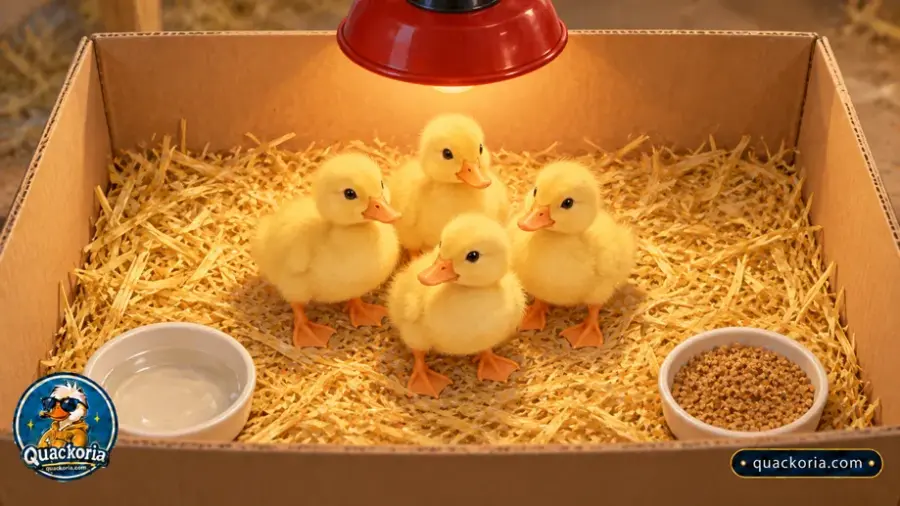
Cheapest to buy and the most work. They need a brooder with managed heat for the first few weeks, and they need it from the hour they arrive — you cannot set it up afterwards. Two published brooder schedules exist and they do not agree:
- eXtension: 90–95 °F in week one, dropping 5 °F a week, stopping at 70 °F or 3–4 weeks
- Cornell: 86 °F at day one, then 81 °F at day 7, 73 at day 14, 66 at day 21, 59 at day 28, 55 from day 35
Those two do not converge — eXtension floors at room temperature when supplementary heat comes off, while Cornell keeps describing what feathering ducklings tolerate. They are measuring different things. Watch the birds as well as the thermometer: eXtension says cold ducklings huddle together under the heat source, hot ducklings move to the outer limits of the brooder, and comfortable ducklings stay in a semicircle around the heat.
The reward is that ducklings raised by hand are tame in a way that grown birds bought later usually are not.
Started birds — a few weeks to point of lay
The middle option and, for most first-timers, the right one. The brooding is done, they are feathered, they go straight into the house. They are more expensive per bird and less likely to imprint on you.
Grown ducks
You know what you are getting — size, sex, and whether they lay. What you do not know is age, and a duck that is past laying looks much like one that is not. Bought ducks are also less tame and take longer to settle.
Buying an adult flock from someone getting out of ducks can be a good deal, or can be someone else’s problem changing hands. Ask directly why they are selling.
How many: never one
The welfare bodies say not to keep a single duck: the RSPCA recommends that you “keep at least three birds who get on well together”, and RSPCA Australia says it is best “to always have more than one duck or at least other poultry species, such as chickens, so that they can keep each other company.” Metzer Farms, a hatchery, disagrees for a pet raised alone: its FAQ says a single duck will be happy living with its keeper, “especially if it has not grown up with other waterfowl as it thinks it is human.”
The practical minimum is three, not two — the RSPCA’s figure. Two works until one dies, and then you have a single duck at short notice and no good options. Three gives you room for that to happen without an emergency.
Beyond that, work backwards from space and eggs. On space, published figures put an adult duck at 3–6 sq ft indoors (Merck gives 3–6 for ducks and geese, Metzer Farms 4, eXtension 5), and outdoors anywhere from 15 to 50 sq ft depending on which source you follow — the duck house guide sets out why they differ. On eggs, Metzer Farms publishes 200–290 a year for its best layers and 100–180 for most other breeds — the upper figures with lights giving 17 hours a day — so a modest flock produces more eggs than most households expect.
Drakes: how many, and the arithmetic
This is where first flocks most often go wrong, and it is worth being blunt about why.
Too many drakes for the number of females is the problem. Metzer Farms says a female with several males trying to mate with her is in danger of injury or even death, and its FAQ gives the reason for keeping males few: “The problem with too many males is they will become very aggressive sexually and will harm some of the weaker females.” Metzer says problems typically occur with two or more males and an equal number of females or fewer.
Here is the state of the evidence: two published figures exist. University of Minnesota Extension’s fact sheet on raising ducks (Poultry Fact Sheet 43, Hamre, rev. 1974), under breeder flock management, says: “Keep one male for each 5-6 females.” Metzer Farms keeps one male to five females on its own farm; its FAQ says ten ducks or fewer can be kept in pairs, and that in a flock of more than 25 or 30, unless the pen is large with plenty of hiding places, the ratio should be one male to every three to five females.
What is not in doubt is the direction: too many males harm the weaker females, and Metzer’s account of an over-mated female — bald spots and missing feathers — shows the failure is visible on the birds.
The clean answer for a first flock is all female. You get eggs — a duck lays without a drake; Metzer Farms: “Yes. The eggs will not be fertile, however.” — with no mating pressure, no fighting, and no more noise than a flock with a drake, since, Metzer says, it is the female that has “the typical, loud QUACK” and the male that has “a deep, raspy voice”. Buy a drake later, if and when you want ducklings.
If you are buying unsexed ducklings, accept that you will get roughly half drakes (Metzer: “about 50% males and 50% females” in larger numbers) and have a plan for them before they arrive, not after.
Which breed
Decide what you want first, because the breeds diverge sharply.
| If you want | Look at | Eggs/year (Metzer) |
|---|---|---|
| Maximum eggs | Golden 300 Hybrid, White Layer | 200–290 |
| Eggs and good foraging | Khaki Campbell | 165–240 |
| A calm bird | Welsh Harlequin, Silver Appleyard, Swedish | 100–180 |
| Slug and pest control | Runner, Campbell, Welsh Harlequin, Magpie, Ancona | 100–240 (Metzer gives no figure for the Ancona) |
| Something quiet | Muscovy | 100–150 |
The “Look at” column follows Metzer’s temperament scores (1 very calm, 9 more nervous: Silver Appleyard 1.2, Welsh Harlequin 1.3, Swedish 2.3–3.0) and eXtension’s list of the best foragers — Anconas, Campbells, Welsh Harlequins, Magpies and Runners. Two figures worth flagging. eXtension says some utility strains have produced more than 300 eggs in a year; Metzer publishes 100–180 for its Runners. eXtension itself says a Runner’s output depends on whether it is an exhibition strain or a utility strain, so the gap is one of strain, not breed. Ask the seller what their birds actually lay, not what the breed is said to lay.
And on Muscovies: the Cornell Lab of Ornithology says “Muscovy Ducks are usually silent”; females give a quiet quack or croak and males hiss and puff in courtship, and eXtension says they “hiss like a goose”. Metzer calls them quieter than other ducks, with no loud quack. Quiet, not silent, and worth knowing before you choose them for a suburban garden. Muscovies are also not Mallard-derived, incubate for 35 days rather than 28, and fly and perch in a way other domestic ducks do not.
Duck breeds: a beginner’s guide covers the breeds themselves in more depth.
Where to buy
A hatchery can sex the birds — Metzer Farms sexes ducklings on request and marks them with coloured leg bands — but ships day-olds, so you are brooding.
A local breeder is the best option if you can find one. You see the parent flock and the conditions, and you have someone to ask when something goes wrong in month three. Local also means no shipping stress.
A farm store in spring is convenient and the least reliable: you may not be able to confirm the breed or the sex, and the birds have been handled by the public in an open bin. Not a disaster, but check them carefully.
Rescues and rehoming — often abandoned Easter ducklings grown up. Cheap or free, usually adults, and worth asking why the bird was given up.
Whatever the source, if you already keep birds: eXtension’s biosecurity guidance is to quarantine newly acquired birds for at least two weeks before they meet your flock, and watch for signs of disease during that time. USDA’s backyard-flock guidance says at least 30 days, and GOV.UK says to check the health of new birds before you bring them home and to keep them in separate, cleaned and disinfected housing with separate equipment. GOV.UK also warns that ducks do not always show signs of bird flu, which is why the waiting period matters.
In England and Wales the law also applies to a duck kept as a pet: GOV.UK says you must register within one month of keeping poultry or other captive birds at any premises, and that you are breaking the law if you do not.
The health check, done in front of the seller
Pick each bird up and look at it. A seller who objects to that has told you something.
Eyes — clear, bright, fully open, no discharge, no crust at the corner. Both the same. Sticky or half-closed eyes can mean a duck has not had water deep enough to wash its head in: Jones, Waitt and Dawkins (2009) found that ducks without the chance to dip their heads were “unable to keep their eyes, nostrils and feathers fully clean”. That tells you about the conditions as much as the bird.
Nostrils — clean and dry. Any discharge or bubbling is a reason to walk away from the whole group, not just that bird.
Breathing — silent. Hold the bird still and listen: no clicking, wheezing or rattle. Do this before you look at anything else, while the bird is calm.
Feet and legs — this is the duck-specific one. Turn the bird over and look at the underside of the feet. You want smooth webs with no swelling, no scabs, no dark hard patch in the centre of the pad. Merck lists footpad dermatitis, alongside breast blisters and ammonia burns, among the problems wet litter and high ammonia cause. A duck with sore feet has been kept badly, and the problem often continues after it moves.
Legs should be straight and take the bird’s weight evenly. Swollen hocks and bowed legs in a young duck are signs Metzer Farms gives for niacin deficiency — and a chick starter made only for laying chickens, Metzer says, probably does not have enough niacin. NC State Extension’s table of suggested micronutrient requirements gives 25.0 mg of niacin per pound of feed for ducks in their first two weeks. Metzer reports improvement within several days and complete recovery possible, but only with adequate niacin within 24 hours of the first sign. A lame duckling is a vet matter.
Feathers — smooth and lying flat. On a female, check the back and back of the neck for missing feathers or bare skin, which is over-mating in the flock she came from. On any duck, ruffled feathers are one of the CDC’s signs of a sick bird.
Weight — the bird should feel solid, with a breast you cannot easily feel the keel bone through. A light bird may not have been eating.
Vent — clean. Droppings stuck around it can mean a digestive problem now or recently.
Under the wings — part the feathers and look at the skin for moving specks. External parasites travel home with the bird and into your house.
Behaviour — put it down and watch. It should stand square, walk evenly, and be interested in getting away from you. A duck that stands apart from the group, or does not object to being held, may be ill; the CDC lists eating or drinking less among the signs of a sick bird.
What to ask
- How old, exactly? “Young” is not an answer. Age determines whether an adult female has laying years left.
- What are they eating right now? You want to match it for the first week, then change gradually. If the answer is chick starter, ask whether niacin was added.
- Sexed or unsexed, and by whom?
- Vaccinated for anything?
- Has anything been ill in this group in the last month? Ask it plainly and watch the answer, not just listen to it.
- Can I see where they are kept? The single most informative question. The state of the bedding tells you more than any bird will.
- What do the females actually lay? For an adult you are buying for eggs.
Getting them home
A pet carrier is ideal — the sort sold for a cat, with a solid floor and bedding on it. A sturdy cardboard box works for a short trip if it is tall enough for the bird to stand and has airholes it cannot get its head through.
Never the boot of a car: no airflow, and exhaust fumes. Back seat or footwell, and in warm weather travel early or late rather than in the middle of the day.
Have the house, the bedding, the feed and the water ready before you leave to collect them. Arriving home with ducks and nowhere to put them is a bad first evening for everyone.
The first 48 hours
Put them straight into the house with food and water, and then leave them alone. Not “check on them every ten minutes” alone — actually alone. They have just been caught, boxed and moved, and the most useful thing you can do is stop happening to them.
Keep them shut in for the first few days so they learn where home is. A duck that is let straight out into a garden does not know where to go at dusk, and you will spend the evening herding.
Expect them not to eat much on the first day. Expect them to be nervous of you for a week or two, and longer if they were not hand-raised. Ducks settle by routine rather than by affection: same time, same door, same bucket, and they stop treating you as an event.
Watch for anything from the health checklist appearing in the first fortnight — that is what the quarantine period is for.
The short version
- Started birds are the easiest first purchase; day-olds mean a brooder from hour one
- Three minimum, never one; all-female is the simplest and calmest first flock
- Minnesota Extension gives one drake to five or six females for a breeder flock, Metzer one to five — the failure mode is visible on the females, so err towards fewer drakes
- A local breeder beats a farm store, and lets you see the conditions
- Quarantine anything new for at least two weeks (eXtension) or 30 days (USDA) if you already have birds
- Check feet and hocks specifically — they are where bad keeping shows on a duck
- Ask to see where they are kept; the bedding answers questions the seller might not
This is husbandry guidance, not veterinary advice. If a bird is ill or injured, find an avian vet.
Frequently asked questions
How many ducks should I start with?
Three — the RSPCA recommends at least three birds who get on well together. Two works until one dies, at which point you have a lone duck and no time to solve it. Three gives you room for that to happen without an emergency.
Can you keep just one duck?
The welfare bodies say no: the RSPCA recommends at least three, and RSPCA Australia more than one duck or other poultry for company. Metzer Farms, a hatchery, says a single duck can be happy living with its keeper, especially one raised without other waterfowl. If you have ended up with one, company is the safer fix.
How many drakes to how many ducks?
University of Minnesota Extension says to keep one male for each five or six females in a breeder flock; Metzer Farms keeps one to five, allows pairs in flocks of ten or fewer, and gives one male to three to five females above 25 or 30 birds. Too many males harm the weaker females, which shows as feather loss and injury. An all-female flock avoids the question.
Is it better to buy ducklings or grown ducks?
For a first flock, started birds a few weeks old are usually the right answer. The brooding is done, they go straight into the house, and you skip the stage with the most ways to go wrong. Day-olds are cheaper and tamer but need managed heat from the hour they arrive.
What should I check before buying a duck?
Clear eyes, dry nostrils, silent breathing, smooth feet with no swelling or dark hard patches, straight legs that take weight evenly, flat feathers with no bare patches on a female's back, a solid weight, a clean vent, and no moving specks in the skin under the wings. Then put it down and watch it walk. Ruffled feathers and a bird eating less are among the CDC's signs of sickness.
Sources
- eXtension, Biosecurity for Small Poultry Flocks
- eXtension, Selecting a Duck Breed for Small or Backyard Poultry Flocks
- Metzer Farms, duck breed comparison
- Merck Veterinary Manual, Management of Backyard Poultry
- eXtension — Raising Meat Ducks in Small and Backyard Flocks
- Cornell University Duck Research Laboratory — Duck Housing and Management
- University of Minnesota Poultry Fact Sheet 43, Raising Ducks (Hamre, rev. 1974, jointly with the University of Wisconsin)
- Metzer Farms — FAQ
- Metzer Farms — Male to Female Ratio: How Many Males and Females Should You Have for Ducks?
- Metzer Farms — Sexing Ducks and Geese
- Metzer Farms — Niacin Deficiency and Leg Problems
- Metzer Farms — Muscovy Ducks
- NC State Extension — Feeding Ducks (Table 2, Suggested Micronutrient Requirements of Ducks)
- Cornell Lab of Ornithology — Muscovy Duck sounds
- RSPCA — Keeping ducks and geese as pets
- RSPCA Australia — How should I care for my pet ducks?
- Jones, Waitt and Dawkins (2009), Water off a duck's back: Showers and troughs match ponds for improving duck welfare, Applied Animal Behaviour Science
- USDA APHIS NAHMS — U.S. Backyard Poultry Flocks: Biosecurity Resources, Practices, Risks and Perceptions (2024)
- GOV.UK — Bird flu (avian influenza): how to prevent it and stop it spreading
- GOV.UK — Register as a keeper of less than 50 poultry or other captive birds
- CDC — Backyard Flock Owners and Bird Flu