Quackoria Learn
Can Ducks Eat Mealworms?
Key takeaways
- Ducks can eat mealworms. Metzer Farms: "worms are a fan favorite"; Cornell notes foraging ducks eat insects and snails.
- Mealworm larvae are about 46 per cent protein and 35 per cent fat on a dry-weight basis (NFS Journal, 2020) — real nutrition, easy to overdo.
- Live mealworms are the better food; soak dried ones in warm water for 30 minutes, especially for young birds.
- A small handful a day at most, after the complete feed, per a University of Kentucky poultry specialist's Ask Extension advice; treats stay under a tenth of the diet.
- UK law bans dried insects in feed or treats for farmed animals, pets included; live mealworms are permitted.
Yes — and of every treat on this site, mealworms are the one closest to what a duck would choose for itself. They are real protein, not sugar and water, which makes them the most useful treat a keeper can offer and the one that most needs a limit. British readers should know that dried mealworms are illegal to feed to poultry in the UK, pet ducks and hens included.
The short answer
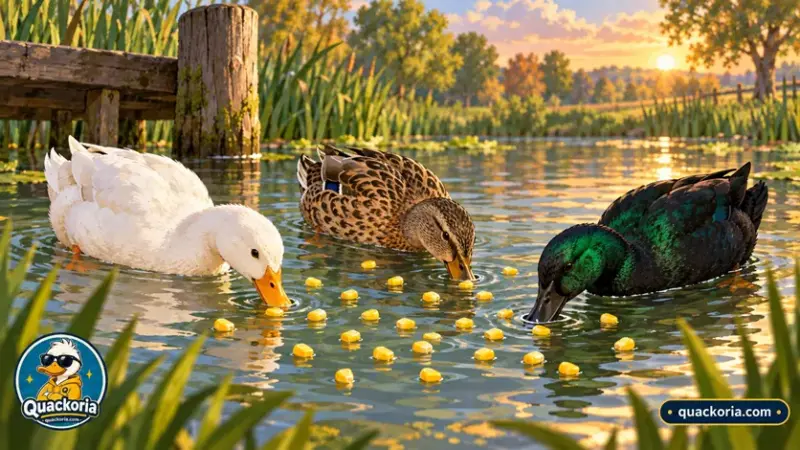
Metzer Farms, a California duck hatchery, is enthusiastic: “Ducks love slugs, snails, flies, earwigs – you name it, they’ll eat it”, and on mealworms specifically, “If you really want to give the little guys a treat, worms are a fan favorite. We offer Happy Hen Treats which are freeze-dried meal worms! They slurp them up like spaghetti.” Cornell’s Duck Research Laboratory notes that ducks with room to forage “may be able to survive, grow and lay eggs by consuming available food such as green plants, insects, snails, frogs, and table scraps.” A mealworm is a beetle larva; a duck dabbling in a pond edge is eating its relatives all day.
What is in a mealworm for a duck
This is the treat with real nutrition in it. A 2020 study of mealworm larvae in the NFS Journal found fresh larvae to be about 70 per cent water, “10.4% of fat and 13.7% of protein” as fed, and on a dry-weight basis 45.6 per cent protein and 34.5 per cent fat — with the protein “in the range of the values reported by other authors (41.0–53.2%)”. Dried mealworms, which is what most people buy, are close to that dry figure: roughly half protein, a third fat. The UN Food and Agriculture Organization’s report on edible insects summarises it as “the protein, vitamin and mineral content of mealworms is similar to that in fish and meat.”
Set that against a duck’s needs — 20 per cent protein in a starter, 18 in a grower, 16 in a layer, on North Carolina State University’s extension figures — and you can see both the appeal and the risk. A few mealworms top up protein for a moulting or laying duck. A lot of them tip the diet towards fat and away from the calcium, niacin and everything else in the complete feed.
How to feed mealworms to ducks
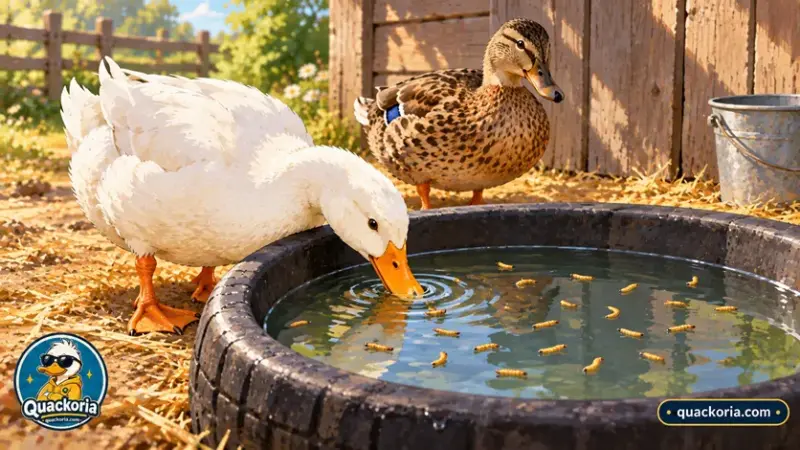
Live mealworms are the better food: a wildlife feed supplier notes that “dried mealworms are anyway a relatively poor substitute to live mealworms – which are rich in fluids as well as protein”. Live ones also move, which is the whole entertainment. Drop a few on the water and watch.
Dried mealworms are convenient and keep. Two rules. Soak them: the same supplier’s advice for birds is to “soak them in warm water for at least 30 minutes”, because “the dried mealworms will absorb liquid in the stomach of the young bird” — a dry, absorbent food is the wrong thing for a bird that eats fast and drinks after. And ration them: Dr Jacquie Jacob, a University of Kentucky poultry extension specialist answering on the national Ask Extension service, was asked how many mealworms a chicken can have and replied “I would not give them more than a small handful a day, and only at night after they have eaten their daily full of the complete feed.” The general rule holds too — treats of all kinds under a tenth of the diet, per Colorado State University Extension — and Metzer’s warning that treats “should not be a large part of your ducks’ daily feed” applies with extra force to a treat this rich. A dozen dried mealworms per adult duck is a generous evening ration.
The UK rule
In the United Kingdom, feeding dried mealworms to poultry is against the law, and the law does not care whether the birds are pets. The government’s guidance on animal by-products in feed states that “Dried terrestrial invertebrates (insects) and processed animal proteins (PAPs) of insect origin cannot be used in farm animal feed or in treats, for example hen treats”. Feed counts as farm animal feed, the same page says, if it is for “any animal kept fattened or bred by humans for food, wool, fur, feather, hides and skins or any other product” — and, explicitly, for “any farm animal species kept as pets, for example sheep or exotic pig breeds”. A pet duck is a farm animal species kept as a pet. The British Hen Welfare Trust spells out the consequence for keepers: “it remains illegal to feed dried mealworms to chickens.” Live mealworms are treated differently — they are not a processed animal protein — and Chitexo, a UK insect-feed supplier, reports that “it is currently permissible to use live invertebrates as chicken or pig feed.”
The rule is an animal-health measure aimed at the feed chain, not a nutrition judgement — and it is now a British peculiarity. As the same supplier notes, “While the EU revised its rules in 2021 to allow certain processed insect meals in pig and poultry feed (EU Reg 2021/1372), the UK did not adopt this amendment following Brexit.” In the United States there is no equivalent: a US extension service answer says plainly that “in the US there is no law against or current concern.” If you keep ducks in Britain, the live tub is the legal one.
When mealworms are a problem
Too many, for the fat and the imbalance. Dried and unsoaked, for ducklings especially. Mealworms from an unknown source — the same extension answer’s advice is to “know the source of your mealworms” — because they can be raised on anything. And the general hazard of any treat, that a flock which learns to hold out for mealworms leaves its pellets. Ducklings should be on starter feed first; a couple of soaked mealworms once they are on grower is a fine introduction, and the plan is in raising ducklings week by week.
For the protein a duck actually lives on, see what do ducks eat and the duck feed calculator. Everything else we have checked, safe and not, is in the can-ducks-eat checker.
Frequently asked questions
Can ducks eat mealworms?
Yes, and they love them. Metzer Farms recommends freeze-dried mealworms as a treat; a duck foraging naturally eats insects and their larvae all day.
Can ducks eat dried mealworms?
Yes, soaked in warm water for about 30 minutes first, so they do not absorb liquid inside the bird. Live mealworms are the better food. In the UK, dried mealworms are illegal to feed to poultry.
How many mealworms can a duck have?
A small handful a day at most, given after the complete feed — a University of Kentucky poultry specialist's rule for chickens. A dozen dried mealworms per adult duck is a generous evening ration.
Why are dried mealworms illegal in the UK?
Animal by-product rules: dried insects count as processed animal protein, which cannot be fed to farm animals — and GOV.UK counts farm-animal species kept as pets, so pet ducks and hens are covered. Live mealworms are not processed and are permitted. The EU relaxed its own rule in 2021; Britain did not.
Can ducklings eat mealworms?
A couple of soaked mealworms once they are on grower feed. Starter feed and its niacin come first.
Sources
- Metzer Farms — Treats your ducks will love
- Cornell University Duck Research Laboratory — Duck nutrition
- Costa et al. (2020), Evaluation of Tenebrio molitor larvae as an alternative food source, NFS Journal
- FAO (2013) — Edible insects: future prospects for food and feed security
- NC State Extension — Feeding ducks (Ferket & Davis)
- Vine House Farm — Only feed dried mealworms at this time of year if they're first soaked in water
- Ask Extension — Dr Jacquie Jacob (University of Kentucky) on how many mealworms to feed
- Ask Extension — Are mealworms safe for chickens (EU and US rules)?
- GOV.UK — Supplying and using animal by-products as farm animal feed
- British Hen Welfare Trust — Feeding your hens
- Chitexo — Mealworms as a poultry feed: the legal low-down
- Colorado State University Extension — Raising poultry the organic way: disease control and feeding