Quackoria Learn
What Do Ducks Eat? A Complete Duck Diet Guide
Ducks are omnivores. Seeds, water plants, insects, snails, worms and the occasional small fish make up most of a wild duck's diet, and the balance shifts through the year.
Key takeaways
- Ducks are omnivores, not vegetarians — in the breeding season most switch to a diet dominated by insects, snails and other invertebrates.
- A wild duck's diet changes with the season: protein in spring and summer, seeds and grain in autumn and winter.
- Dabbling ducks feed at the surface and just under it; diving ducks go deeper for molluscs, crustaceans and plants, and some for fish.
- Ducklings need a protein-rich diet to grow, and a laying duck needs far more calcium than a growing one.
- Bread, crackers and crisps are poor things to bring to a pond — they fill a duck up without giving it much nutrition.
Ducks are omnivores. A wild duck’s diet is built from seeds, aquatic plants, insects, snails, worms and the occasional small fish or tadpole, and the balance between those shifts through the year. There is no single food a duck lives on, which is the first thing worth knowing before you take anything to a pond.
The short answer
A typical dabbling duck — a mallard, say — eats roughly this:
- Seeds and grains — grass seeds, sedge seeds, spilled cereal grain, acorns in some species
- Aquatic plants — pondweeds, and the stems, leaves, roots and tubers of water and marsh plants
- Invertebrates — water beetles, dragonfly and midge larvae, snails, worms, small crustaceans
- Occasional animal protein — tadpoles, small fish, the odd frog
Proportions vary enormously by species and season, and not every duck eats from all four groups: Cornell’s All About Birds says that “Adult Common Eiders eat almost exclusively mollusks, crustaceans (such as spider crabs), echinoderms (sea urchins), marine worms, and fish eggs.”
How a duck actually feeds
The word “duck” covers birds with very different feeding methods, and the method decides the menu.
Dabbling ducks
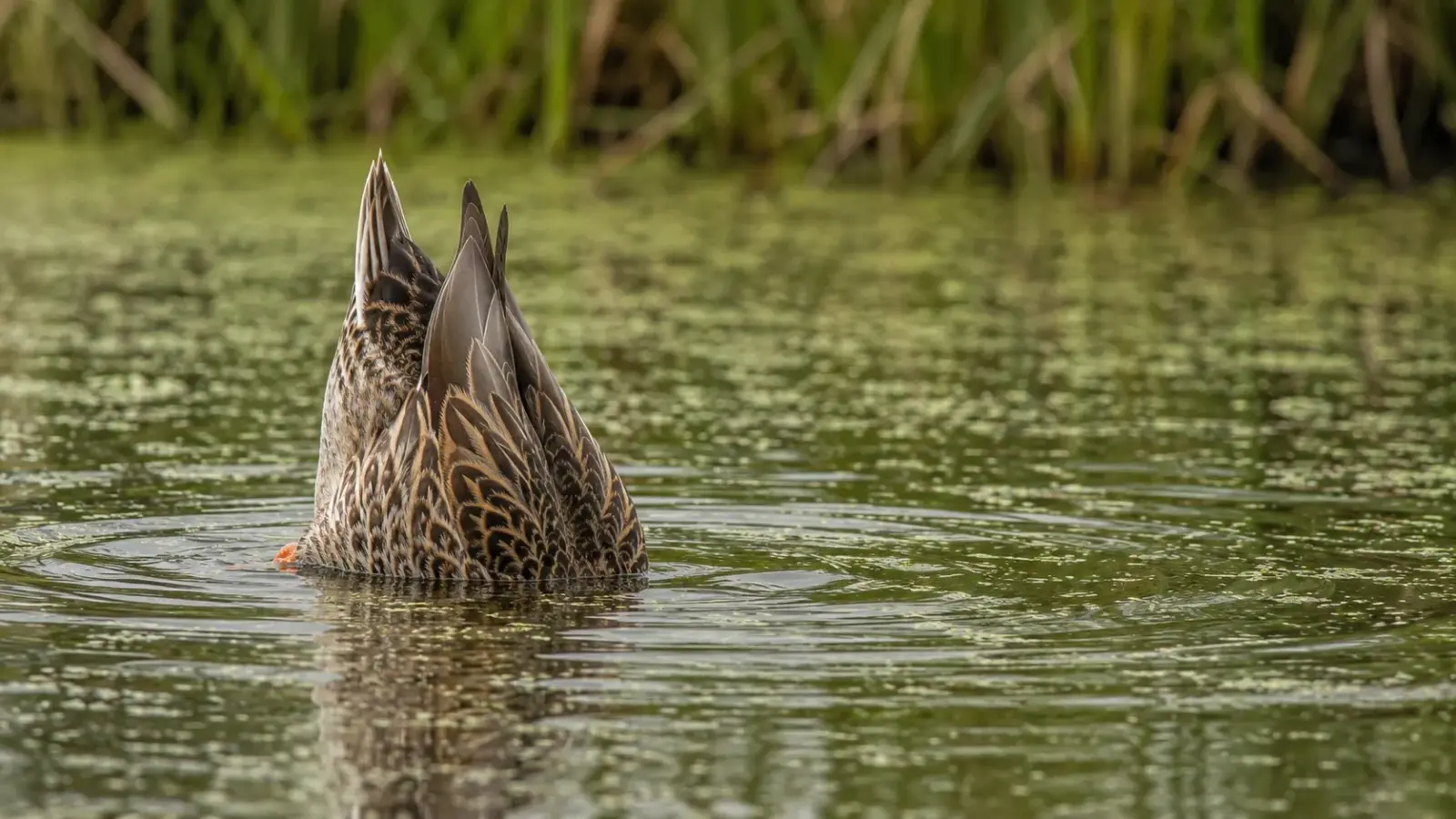
Mallards, teal, wigeon, pintail and shovelers are dabblers. They feed at the surface and just below it, tipping forward so the tail points at the sky — the posture everyone recognises. A dabbling duck’s bill works as a strainer: water and mud go in, and comb-like ridges called lamellae along the edges hold back the seeds, insects and plant fragments while the water runs out. The ridges strain food rather than chew it, and ducks have no teeth at all despite what the bill looks like up close.
Diving ducks
Tufted ducks, pochards, scaup, eiders and goldeneyes dive completely under. They go after things a dabbler cannot reach: mussels and other molluscs, larger crustaceans, and in some species fish. Some of them eat far more animal than plant food — Cornell’s All About Birds puts vegetation at “less than a quarter of the diet” of the common goldeneye — but not all: Ducks Unlimited describes the canvasback, one of the pochards, grubbing out the tubers and roots of aquatic plants, and the redhead browsing on the stems and leaves of submerged plants.
Sea ducks and sawbills
Mergansers — the goosander is the British name for the common merganser — have narrow, serrated bills built to grip fish. They are ducks, but their diet is closer to a heron’s than a mallard’s — a useful reminder that “what do ducks eat” has no single answer.
What changes through the year
A duck’s diet is not fixed. It tracks what the bird’s body is doing.
Spring — protein
Breeding females need protein and calcium to produce eggs, and they get both from invertebrates: Ducks Unlimited says that during the breeding season “nearly all ducks shift to a diet dominated by aquatic invertebrates”, and a US Fish and Wildlife Service handbook chapter (Eldridge, 1990) says “Most species of laying hens rely on calcium from snail shells for egg production.” Early nesters such as mallards and pintails also eat early-emerging midge larvae and earthworms, which Eldridge calls “often the most available food” in temporary prairie wetlands shortly after the snow melts.
Summer — protein for the young
Ducklings live mostly on aquatic invertebrates in their first weeks. Ducks Unlimited says mallard ducklings “require large amounts of protein-rich foods, mostly aquatic invertebrates, to fuel the rapid growth of body tissue, muscle, and feathers”; Audubon’s mallard account puts it more cautiously: young ducklings “may eat mostly aquatic insects”. How ducklings grow is covered properly in our guide to what ducklings are and how they grow.
Autumn — carbohydrate
As the days shorten, ducks switch hard towards seeds, grain and starchy plant material. They are laying down fat, either for migration or for the winter. A mallard in October is a very different eater from a mallard in May.
Winter — whatever is available
Winter feeding is opportunistic. Wild ducks work stubble fields, flooded grassland and any open water they can find. Many simply leave — where ducks go in winter is a question with a longer answer than most people expect.
Feeding ducks at a pond
Park ducks are fed constantly, and New York’s Department of Environmental Conservation says that many of the things commonly thrown to waterfowl, bread and popcorn among them, “are low in protein and are very poor substitutes for natural foods”. The problem is not that bread is toxic — it is that it is filling and low in nutritional value, so a duck that eats a lot of it stops foraging for what it actually needs. The full case is in our article on whether ducks can eat bread.
Good things to bring instead:
- Defrosted frozen peas — on the Canal & River Trust’s list of foods to bring; there is no need to cook them, but defrost them first
- Sweetcorn — tinned (drained) or frozen and thawed
- Chopped lettuce, kale or cabbage — torn small
- Oats — porridge oats, uncooked, scattered rather than dumped
- Birdseed — plain seed mixes are fine
- Duck or waterfowl pellets — the closest thing to a complete food
Things to leave at home: bread, crackers, crisps, popcorn, sugary cereal, anything salted, anything mouldy, and citrus. Mouldy bread in particular carries a real risk of aspergillosis, a fungal lung infection.
And scatter a little, do not dump a lot. New York’s Department of Environmental Conservation warns that food scattered too liberally “piles up and becomes moldy”, and the Canal & River Trust says to stop feeding if the ducks show no interest or leave the food uneaten.
Feeding ducks you keep
A kept duck may survive on what it can forage from a garden, but Cornell’s Duck Research Laboratory says that ducks living that way “will likely grow very slowly and produce a small number of eggs”, so the feed does the work.
Pellets are the base
Use waterfowl or duck pellets where you can find them. Chicken feed is a common substitute, and Cornell’s Duck Research Laboratory calls it a satisfactory one, with one important caveat: Metzer Farms warns that a chick starter made only for laying chickens probably does not have enough niacin (vitamin B3) for growing ducklings, which need roughly twice what a chick needs — the National Research Council figures in the Merck Veterinary Manual are 55 mg per kilogram of feed for Pekin ducklings against 27 for Leghorn-type chicks. Niacin deficiency causes leg weakness — swollen hocks and bowed legs, in Metzer’s description — and Metzer says about 90% of niacin problems occur in the first ten weeks.
Greens and grazing
Ducks graze. Given access to grass, weeds, and a patch of ground to work over, they will forage it, and it genuinely contributes to their diet: Cornell’s Duck Research Laboratory lists green plants, insects and snails among the foods a foraging flock lives on, and Metzer Farms says most yard cuttings such as grass and weeds “are considered good eats”. Chopped greens are a good supplement in winter when there is less to find.
Grit
Because a duck has no teeth, food is ground in the gizzard, with the help of swallowed grit. Ducks with access to bare ground usually find their own: the Open Sanctuary Project says free-range birds “take care of their grit needs on their own”. Whether confined ducks need it provided is where the sources differ. Open Sanctuary says to give them hard grit at least once a month; Metzer Farms says that on mash, crumble or pellets “grit is not needed as the feed mill has ground the feed for them”, and that ducks fed whole corn, wheat or other whole grains do need it. The whole story of the gizzard and the stones is in do ducks eat rocks.
Calcium for layers
A laying duck puts a remarkable amount of calcium into eggshells and needs it replaced, normally through a layer feed: Metzer Farms specifies 3% calcium in a duck layer feed, against 1% or less in its starter and grower feeds. NC State Extension says a layer diet “may be supplemented with free choice ground oyster shell”, while Metzer says most layer feeds already carry enough calcium that extra oyster shell is not needed. Getting this wrong shows up as thin shells. Timing, feed and the first eggs are covered in when ducks start laying eggs, and how the eggs themselves compare is in duck eggs vs chicken eggs.
Water is not optional
Ducks need water deep enough to get the whole head under — the RSPCA’s welfare standards ask for water that can “cover the head fully”, at least 4.5 cm deep even for day-old ducklings — and they need it available whenever food is. eXtension’s guide to feeding small flocks says ducks “should never be given access to feed without water nearby”, and adds: “Without water, ducks can choke on their feed.”
What ducks should never eat
- Bread and baked goods — not toxic, and wildlife bodies disagree about it, but filling, low in nutrition and a mould risk
- Anything salted — crisps, salted nuts, savoury snacks
- Chocolate — toxic to birds
- Avocado — the persin in it is toxic to birds
- Onions — can damage red blood cells and cause anaemia
- Dried beans, uncooked — genuinely dangerous
- Citrus — Metzer Farms says it interferes with calcium absorption; the Canal & River Trust and the Scottish SPCA say it can cause digestive issues
- Mouldy anything — the fungal risk is real and serious
If a duck you keep goes off its food, loses weight, or develops loose droppings that do not clear within a day, treat diet as one possible cause among several and read the guide to common duck health problems — and speak to a vet if the bird seems unwell rather than simply fussy.
Can ducks eat…? Food by food
The questions people actually type are about one food at a time, so we have answered the most common ones on their own pages, each with the nutrition figures, the duck-specific sources and how to serve it: grapes, tomatoes, strawberries, bananas, rice, watermelon, lettuce, apples, carrots, corn, mealworms and cheese. Bread has its own page, and the can-ducks-eat checker covers more than forty foods with a verdict and the sources for each.
A note on how varied this really is
It is tempting to want one list. But a wigeon grazing grass at the water’s edge, an eider crushing mussels in a cold sea and a farmyard Pekin working over a vegetable patch are all ducks, and none of them eats like the others. If you want to know what a particular duck eats, the most useful next step is to work out which duck you are looking at — our guide to telling ducks, geese and swans apart is a good place to start, and the mallard is the species most of these general answers describe.
Frequently asked questions
What is a duck's favourite food?
There is no single answer, because it depends on the species and the season. Ducks Unlimited says that during the breeding season nearly all ducks shift to a diet dominated by aquatic invertebrates, while in winter their food is largely carbohydrate-rich plant material: seeds, grain, roots and rhizomes.
Can ducks eat vegetables?
Yes. Defrosted frozen peas, sweetcorn and torn lettuce or kale are on the Canal & River Trust's list of foods to bring, and the Scottish SPCA adds chopped cucumber, though it says peas, sweetcorn and kale should be given in moderation and in small amounts. Onions are the exception: both bodies say not to feed them.
Do ducks eat fish?
Some do. Diving ducks such as mergansers eat fish regularly, and even mallards will take small fish and tadpoles. But most dabbling ducks eat far more plant matter and invertebrates than fish.
How often do ducks eat?
It depends on the duck. Wild mallards that feed on farmland often make two feeding flights a day, one at dawn and one in the late afternoon, according to the Pennsylvania Game Commission. For kept ducks that can forage, eXtension's guide to small flocks recommends feed on demand for ducklings for the first eight weeks and then two meals a day, first thing in the morning and in the early afternoon.
Sources
- Cornell Lab of Ornithology — All About Birds: Mallard life history
- National Audubon Society — Guide to North American Birds: Mallard
- Pennsylvania Game Commission — Mallard Ducks
- Wildfowl & Wetlands Trust — Ducks found in UK wetlands
- Ducks Unlimited — The Scoop on Duck Bills
- Ducks Unlimited — Understanding Waterfowl: Balanced Diets (Lancaster and Askren)
- Ducks Unlimited — Mallard Annual Life Cycle
- US Fish and Wildlife Service, Waterfowl Management Handbook — Eldridge (1990), Aquatic Invertebrates Important for Waterfowl Production
- Cornell Lab of Ornithology — All About Birds: Common Eider life history
- Cornell Lab of Ornithology — All About Birds: Common Goldeneye life history
- Cornell Lab of Ornithology — All About Birds: Common Merganser life history
- RSPB — Goosander
- RSPB — Grey heron
- New York State Department of Environmental Conservation — Stop Feeding Waterfowl
- Canal & River Trust — What do ducks eat? 6 things you can feed ducks
- Canal & River Trust — Why is bread bad for ducks?
- Scottish SPCA — What to feed ducks
- Merck Veterinary Manual — Aspergillosis in Poultry
- Merck Veterinary Manual — Poisonings in Poultry
- University of Illinois College of Veterinary Medicine — Bad for Birds: Prevent Poisoning in Avian Pets
- The Open Sanctuary Project — Things That Are Toxic To Ducks
- The Open Sanctuary Project — Daily diet, treats and supplements for ducks
- Metzer Farms — Foods Ducks Should Not Eat
- Metzer Farms — Treats Your Ducks Will Love
- Cornell University Duck Research Laboratory — Duck Nutrition
- NC State Extension — Feeding Ducks
- Metzer Farms — Niacin Deficiency and Leg Problems
- Metzer Farms — Niacin: What Is It and Why Do My Ducklings and Goslings Need It?
- Merck Veterinary Manual — Nutrient Requirements of Pekin Ducks (National Research Council, 1994)
- Merck Veterinary Manual — Linoleic Acid, Mineral, and Vitamin Requirements of Leghorn-type Chickens (National Research Council, 1994)
- Metzer Farms — Grit: Do Ducks Need It or Not?
- Metzer Farms — Duck and Goose Feed Nutrition
- Metzer Farms — FAQ
- RSPCA — Welfare standards for domestic/common ducks
- eXtension (Jacquie Jacob, University of Kentucky) — Feeding Ducks for Egg Production in Small Flocks