Quackoria Learn
Northern Pintail: The Long-Tailed Duck Built for Long Flights
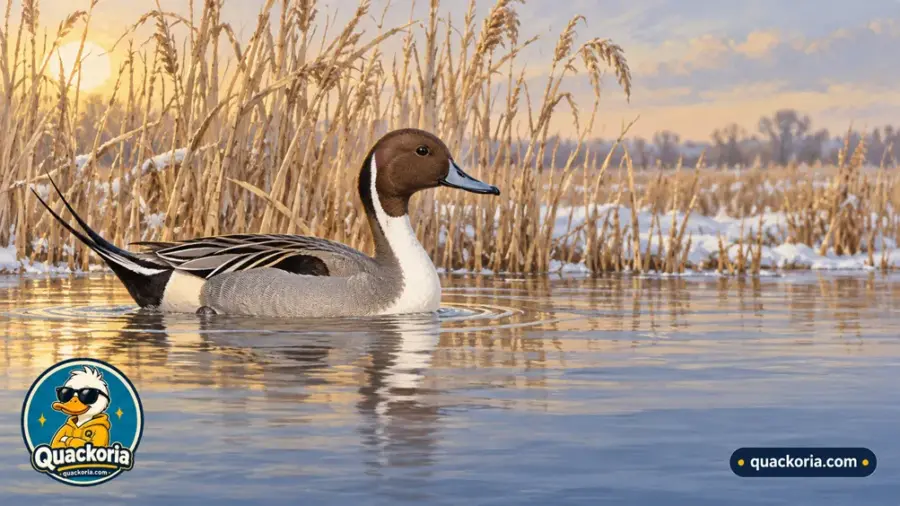
The northern pintail is a slender, long-necked dabbling duck named for the drake's two long black tail feathers. Cornell records a non-stop flight of 1,800 miles, and Ducks Unlimited puts the breeding population at around 2.2 million in 2024, down from 9 to 10 million in the 1950s.
Key takeaways
- Size is disputed: Cornell and the US Fish and Wildlife Service call the pintail smaller than a mallard, while the RSPB says "Slightly bigger than a Mallard".
- The drake's two central tail feathers make up "a quarter of the total length of the drake when in full plumage", according to Ducks Unlimited.
- Cornell says pintails migrate at night at around 48 miles per hour, and the longest non-stop flight on record is 1,800 miles.
- Of 198 pintails fitted with satellite transmitters in Japan, 67% flew to the Kamchatka or Chukotka peninsulas of eastern Russia (study listed by the USGS, 2011).
- For 2025 the US Fish and Wildlife Service estimated 2.2 million pintails, 41% below the long-term average; in the UK the BTO counts 27 breeding pairs and 20 thousand wintering birds.
The northern pintail, Anas acuta, is a slim, long-necked dabbling duck, and the two long black feathers in the drake’s tail are the pin in its name. It is also a long-distance flier: Cornell reports a non-stop flight of 1,800 miles. Americans mostly see it in winter on refuges, shallow lakes and flooded fields, and in Britain it is a winter bird of estuaries and coastal marshes. It is a duck in decline too, one that Cornell says has lost more than half its population in 50 years.
How to recognise a northern pintail
Shape first. Cornell describes “elegant, long-necked ducks with a slender profile”, the tail “much longer and more prominent on breeding males than on females and nonbreeding males.” The breeding drake has “a gleaming white breast and a white line down their chocolate brown head and neck”. Ducks Unlimited’s photo essay says his two central tail feathers make up “a quarter of the total length of the drake when in full plumage”, and that the name pintail and the nickname sprig both “describe the male’s two long black tail feathers, which in flight look like a single pin or twig.” Females and eclipse males are, in Cornell’s words, “mottled in browns and whites with an unmarked pale tan face and a dark bill”; the plain face is the mark. In flight the male shows a green speculum, the female a bronzy one.
Size is disputed. Cornell gives 51-76 cm (20.1-29.9 in), 500-1450 g (17.6-51.1 oz) and a wingspan of 86.4 cm (34.0 in), and calls the pintail “smaller than a Mallard”. The US Fish and Wildlife Service agrees: “The long neck and tail make them appear longer than mallards, but in body size and weight they are smaller.” The RSPB says the opposite: “Slightly bigger than a Mallard”. Cornell describes the male’s call as “a short burst that sounds similar to a wheezy trainlike whistle”; females “often make a rough stuttering quack similar to a Mallard.”
Pintail or female mallard?
The brown female is the difficulty. Cornell’s comparison with the mallard hen: “A female Mallard has an orangish (not dark) bill, a shorter neck, and a darker crown than a female Northern Pintail.” A female gadwall likewise “has an orangish bill, whereas a female Northern Pintail has a black bill.” Tennessee’s wildlife agency sums it up: “no other female dabbling duck has such a long thin neck and a plain tan face.” Blue-winged, cinnamon and green-winged teal are all smaller, Cornell notes, and a female green-winged teal shows “a buffy stripe at the rear not seen on a female Northern Pintail”.
Where and when you will see one
Pintails breed in “the prairie pothole region of the Great Plains, as well as Canada, and Alaska”, in Cornell’s words, and nest “as soon as the ice breaks up”. Ducks Unlimited calls them “often one of the first species to depart breeding areas in August or early September”, and draws the winter range “from coastal British Columbia to California and east across the southern half of the United States to the Atlantic Coast”. In Tennessee, the state wildlife agency says, they “arrive in late August”, and spring migrants come back “by mid-February and most birds depart by late March.” Cornell’s tip for refuges and flooded fields: “look for groups of ducks that stand higher than the rest.”
In Britain, the BTO says, “Pintail are predominantly winter visitors to Britain, preferring sheltered coasts, grazing marshes and estuaries”, “present from late August to May”. As a nesting bird it is “rare and localised”, found mostly in coastal East Anglia and the northern and western isles of Scotland; the BTO counts 27 pairs breeding (2013–17) against 20 thousand wintering birds (2012–17).
What it eats, and how
Pintails are dabbling ducks that also forage on dry land. Cornell’s list is “seeds from aquatic plants, worms, snails, crustaceans, aquatic insects, and grains such as rice, wheat, corn, and barley”. Audubon says the pintail “Forages in shallow water by up-ending with tail up and head down”, on a diet “made up mostly of plant material in fall and winter” with “More animal matter in summer”; Ducks Unlimited puts the winter diet at “80 to 90 percent seeds and vegetation.”
Nesting and ducklings
The nest is a ground scrape, often more exposed and farther from water than other ducks’ nests: Cornell lists “croplands, grasslands, wet meadows, seasonal wetlands, and shortgrass prairies often farther from water than other ducks”, and Audubon says it is “usually near water but can be up to a half mile away”. The figures differ by source. Cornell’s clutch is 3-12 eggs, Audubon’s “7-10 eggs, sometimes 6-12”, the BTO’s 7–9; incubation is 22-24 days for Cornell and the BTO, 21-25 for Audubon; the eggs are “Greenish buff” to Cornell and “pale olive” to Audubon. Cornell says “males leave their mates” while the females are still incubating. In Audubon’s account the female “leads young from nest within a few hours after they hatch”, and they fly at 38-52 days; the BTO’s fledging figure is 40–45 days.
How far does a pintail fly?
Far, fast and by night. Cornell says pintails “migrate at night at speeds around 48 miles per hour” and that “The longest nonstop flight recorded for a Northern Pintail was 1,800 miles.” Ducks Unlimited records a bird banded in Alberta in 1940 and recovered in Mexico in 1954, “roughly 3,000 miles away”; Tennessee’s wildlife agency, a male banded in southern Japan and recovered 7 years later in the Mississippi delta. Audubon notes that “The Northern Pintail populations nesting in Siberia cross the Bering Strait to winter in North America.” Their speed is set against other ducks’ in how fast can ducks fly.
A satellite study published in 2011 and listed by the USGS “marked 198 pintails on their wintering areas in Japan with satellite transmitters”. The result: “most pintails (67%) migrated to the Kamchatka or Chukotka peninsulas in eastern Russia”, and one reached St. Lawrence Island, Alaska. The paper concluded that where the two continents’ pintails meet on the breeding grounds, it is more because North American birds migrate to eastern Russia than because Japanese birds migrate to North America. Migration routes in general are covered in duck migration.
How northern pintails are doing
Ducks Unlimited’s photo essay sums up the fall: “Just a few decades ago, pintails trailed only mallards as the most abundant duck in North America. Now they are among the least abundant dabbling ducks on this continent.” Its species page gives a breeding population that “declined from an estimated 9 to 10 million in the 1950s to around 2.2 million in 2024.” Cornell cites a Breeding Bird Survey decline of 73% between 1966 and 2023, and names drought, “Loss of wetland habitat, cultivation of grasslands, and agricultural practices that destroy nests” as causes.
The 2025 figures are described two ways. The US Fish and Wildlife Service put pintails at “2.2 ± 0.2 million, which was similar to the 2024 estimate and 41% below the long-term average of 3.8±0.03 million.” Ducks Unlimited wrote: “Pintails were estimated at 2.2 million, 13% above 2024, but 41% below the long-term average.” Same estimate, same gap; they differ on whether 2025 was a rise. In Britain the RSPB lists the pintail as Amber because of “The small breeding population and significant winter population”, and the BTO records a 6% decrease in wintering numbers from 1998 to 2023 and rates it Vulnerable in Europe.
Unsure of a long-necked brown duck? Check it in which wild duck did I see, then try bringing a flock south in Flyway, a route-planning game on the four US flyways.
Frequently asked questions
Why is it called a pintail?
For the drake's tail. Ducks Unlimited says the names pintail and sprig both "describe the male's two long black tail feathers, which in flight look like a single pin or twig." The BTO describes the bird as "long-necked, long-billed and long-tailed – the last feature giving the bird its name."
Is a pintail bigger than a mallard?
The sources disagree. Cornell calls the pintail "smaller than a Mallard" and the US Fish and Wildlife Service says it only looks longer, being smaller "in body size and weight"; the RSPB describes pintails as "Slightly bigger than a Mallard".
How far do pintails migrate?
Very far. Cornell says "The longest nonstop flight recorded for a Northern Pintail was 1,800 miles", and Ducks Unlimited reports a bird banded in Alberta in 1940 and recovered in Mexico in 1954, "roughly 3,000 miles away."
Are northern pintails declining?
Yes, over the long term. Cornell says "Though still common, their populations are declining", and the US Fish and Wildlife Service put the 2025 estimate at 2.2 million, 41% below the long-term average. Ducks Unlimited, reporting the same estimate, described it as 13% above 2024.
Do pintails live in the UK?
Mostly as winter visitors. The BTO says "Pintail are predominantly winter visitors to Britain, preferring sheltered coasts, grazing marshes and estuaries", and counts 27 breeding pairs (2013–17) against 20 thousand wintering birds (2012–17).
Sources
- Cornell Lab of Ornithology — Northern Pintail Overview, All About Birds
- Cornell Lab of Ornithology — Northern Pintail Identification, All About Birds
- Cornell Lab of Ornithology — Northern Pintail Life History, All About Birds
- Cornell Lab of Ornithology — Northern Pintail Sounds, All About Birds
- Cornell Lab of Ornithology — Northern Pintail Similar Species, All About Birds
- National Audubon Society — Northern Pintail, Guide to North American Birds
- Ducks Unlimited — Northern Pintail, Waterfowl ID
- Ducks Unlimited — Photo Essay: The Northern Pintail
- Ducks Unlimited — 2025 Duck Numbers
- Ducks Unlimited — Amazing Waterfowl Facts
- U.S. Fish and Wildlife Service — Waterfowl Population Status, 2025
- U.S. Fish and Wildlife Service — Ducks at a Distance
- U.S. Geological Survey — Variation in spring migration routes and breeding distribution of northern pintails Anas acuta that winter in Japan (Journal of Avian Biology, 2011)
- Tennessee Wildlife Resources Agency — Northern Pintail
- RSPB — Pintail
- BTO — Pintail, BirdFacts