Quackoria Learn
Do Ducks Mate for Life?
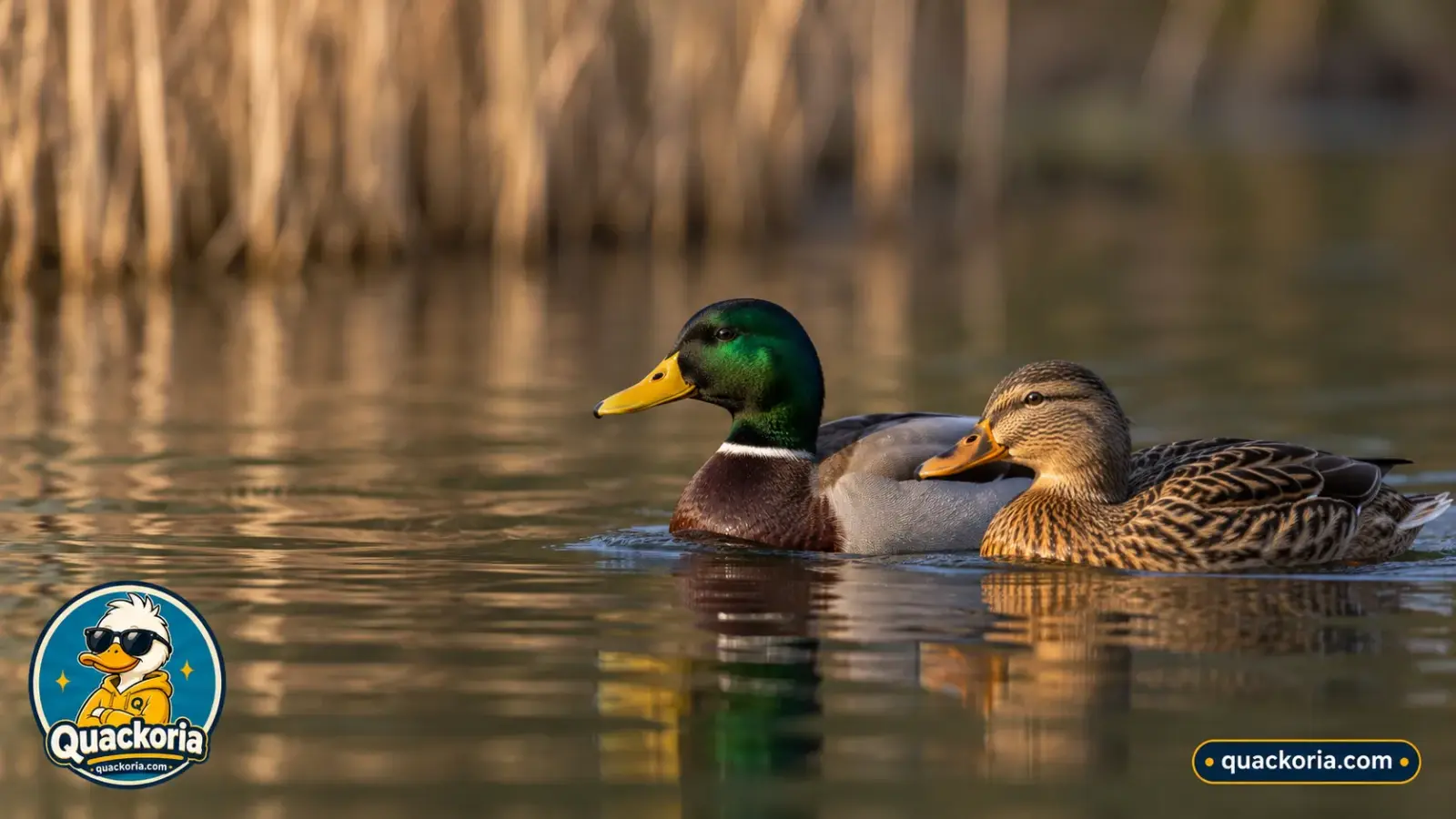
Mostly no. Geese and swans pair for life; most ducks form a bond that lasts four to eight months, usually with a different partner the following year. The drake typically leaves while the female is still sitting on the eggs, and she raises the ducklings alone.
Key takeaways
- Most ducks are seasonally monogamous — a bond of roughly four to eight months, often a new mate each year.
- Geese, swans and whistling-ducks are the long-term pairers. Black-bellied Whistling-Ducks are the standard duck example.
- Pairs form in autumn and winter. Around 75–80% of female mallards are paired by late November.
- The drake usually abandons the female around the time she starts incubating, and she rears the brood alone.
- Muscovies are not monogamous at all — the mating system is polygynous, with a few males mating with most of the females.
Seasonal, not lifelong
The distinction ornithologists use is between perennial and seasonal monogamy. Geese, swans and whistling-ducks are perennially monogamous — the bond persists across years. Most ducks are seasonally monogamous: the pair forms, breeds, and separates, and next winter each bird starts again, usually with someone else.
Ducks Unlimited puts the duration at four to eight months. That is long enough to look like devotion if you watch a pair on a pond in March, and short enough that the same two birds are unlikely to be together the following March.
A caution about the sources here. Much of the accessible writing on duck pair bonding comes from Ducks Unlimited, a conservation organisation that publishes these articles without citations. Their qualitative account is corroborated elsewhere and we are comfortable with it. Their percentage claims about how many waterfowl species fall into each category come without a source, and we have left them out.
The courtship starts in autumn
Which explains something that puzzles people: why a drake gets his brilliant plumage back in autumn, months before there is any nesting to do.
He needs it then. Mallards begin courting in autumn and early winter, earlier than most other ducks. By late November roughly 75 to 80% of female mallards, black ducks and gadwalls are already paired. Wigeon, shovelers and green-winged teal run later, mostly pairing in late January or February. Diving ducks are later still, sometimes not finishing until they reach the breeding grounds.
So the pairing season and the eclipse moult are two halves of one calendar: drab and hidden while flightless in high summer, bright and displaying by autumn, paired by winter, breeding in spring. Telling a drake from a duck goes through that plumage cycle in detail.
The displays
Mallard courtship is a formal repertoire. Groups of drakes perform to a female, often several at once, and the named displays include:
- Grunt-whistle — the drake arches his neck, whistles, dips his bill below the surface and flicks it up towards his breast, throwing an arc of water. It can take a fraction of a second.
- Head-up-tail-up — both ends lifted at once, held briefly.
- Head-shake and tail-shake — shakes of the head and tail by drakes swimming near females, the head-shake often with the breast held clear of the water and the neck stretched out.
- Nod-swimming — the female swims with her neck stretched and her head just above the water, drawing displays from a group of drakes. Cornell notes that males nod-swim too.
- Inciting — the female swims after her preferred mate, giving a rapid staccato series of quacks and flicking her bill back and down to the side.
- Head-pumping — the pair face each other and pump their heads up and down, immediately before mating.
Note who is doing what. The inciting display is the female’s, and it is not passive: she is choosing. Cornell’s guide to duck courtship puts it plainly: “In waterfowl mating, it’s the female’s choice.”
Then he leaves
The pair bond does not survive the nest.
Through laying, the drake stays close and guards the female. Then he becomes steadily less attentive and abandons her around the time incubation begins — mid-incubation for mallards. He may then pair with another female who has lost her nest or her mate, which is sometimes called serial monogamy within a single season.
The female incubates for 23 to 30 days, alone. She built the nest alone and lined it with down plucked from her own breast. The ducklings are ready to leave it within 13 to 16 hours of hatching, and she leads them to water and raises them by herself.
Even her care varies by group: most female ducks stay with the brood until the young are nearly flying, but ruddy ducks, diving ducks and sea ducks may stay only days or weeks. What ducklings are covers the first weeks from their side.
The ducks that do pair for life
The clean exceptions are geese and swans, where pairs typically stay together for life and both parents raise the young, often staying as a family until the next breeding season.
Among ducks proper, whistling-ducks are the classic case. Cornell states that Black-bellied Whistling-Ducks “form lifelong pair bonds and breed in their first year of life”, and both sexes incubate and tend the young — which is unusual enough among ducks to be worth noticing on its own.
Even here, “lifelong” is a tendency rather than a law. Audubon hedges it to “may mate for life”, and there is a 1983 paper in The Auk titled, plainly, “Mate changes by Black-bellied Whistling Ducks”. The title tells you what it found.
Two more ducks keep their bonds through the year: mottled ducks and fulvous whistling-ducks, where males often stay with the female and the brood.
And there is a claim worth flagging in the other direction. Muscovies do not pair for life. Their system is polygynous — a few males mate with most of the females while most males father none. If you have read otherwise, that was wrong.
Do they find each other again?
Sometimes, apparently — and this is where the evidence thins out.
Barrow’s goldeneyes and buffleheads are reported to re-establish bonds with previous partners on the wintering grounds, and goldeneye pairs are said to return together to the same breeding territory. We could only find that in Ducks Unlimited’s uncited writing, so we are reporting it as a plausible claim from a conservation body rather than as an established result, and we will not put a percentage on it.
There is firmer evidence for one sea duck. A 2000 study of harlequin ducks, followed between breeding streams in Alberta and a moulting and wintering area in British Columbia, found that “As long as their mate is alive, Harlequin Duck pairs reunite on the wintering area and return to the breeding stream together.”
What is measurable is the cost of losing a mate at the wrong moment. Among female mallards, losing a partner in late winter is estimated to reduce annual recruitment by as much as 7% — not romance, but arithmetic: an unpaired female in February has lost her place in a schedule that was set in November.
The part that complicates the picture
An honest article on duck mating has to say this, and it can be said briefly.
Not all mating in ducks is by mutual consent. Forced copulation by drakes is well documented in mallards and was the subject of a major review in 1983, McKinney, Derrickson and Mineau’s “Forced copulation in waterfowl”. It is a normal part of the species’ biology, not an aberration, and it has left a mark on duck anatomy: male and female reproductive tracts in waterfowl have co-evolved, with female anatomy in the most affected species developing structures that, in the words of Brennan and colleagues (2007), “appear to function to exclude the intromission of the counter-clockwise spiralling male phallus without female cooperation”. They conclude that their results “suggest that females have evolved a cryptic anatomical mechanism of choice in response to forced extra-pair copulations”.
How much of it results in offspring is disputed. In a wild mallard population, Evarts and Williams (1987) found that “Nine of 298 (3.0%) ducklings appeared to have been fathered by a male other than the female’s mate”, a minimum: they call their observed percentages “most likely underestimates”, and their statistical estimate was that “at least 48% of broods involved multiple mating events”. Denk’s 2005 doctoral study of two wild mallard populations in southern Germany found that at least 14% of fertilised eggs were sired by an extra-pair male, while a 2022 paper by Rohwer and colleagues says forced copulations “generally sire less than 5% of conspecific offspring in waterfowl”. The same paper finds that forced copulation between species produces most of the hybrids among broadly sympatric North American ducks. In US harvest surveys, hybrids between easily identified species were shot at “just under 2 per 10,000 parentals” — roughly one in five thousand.
One claim needs care: it is frequently written that female mallards are drowned during these encounters. The peer-reviewed literature does describe the danger — Evarts and Williams (1987) write that “Females that have been victims of repeated copulation attempts may be injured or even killed as a result” — but we found no authoritative source giving any rate of injury or death, and we are not going to suggest one.
Frequently asked questions
Do ducks mate for life?
Most do not. Typical duck pair bonds last four to eight months, and the following year usually brings a different partner. Geese, swans and whistling-ducks are the waterfowl that genuinely pair long-term.
Do male ducks help raise the ducklings?
In most species, no. The drake usually leaves around the time the female starts incubating, and she nests, incubates and raises the brood alone. Whistling-ducks, mottled ducks and fulvous whistling-ducks are exceptions where the male stays.
When do ducks pair up?
Autumn and winter, well before nesting. Around 75–80% of female mallards, black ducks and gadwalls are paired by late November. Wigeon, shovelers and green-winged teal pair later, and diving ducks later still.
Do Muscovy ducks mate for life?
No — the opposite. Muscovies have a polygynous mating system in which a few males mate with most of the females. If you have read that Muscovies pair for life, that is incorrect.
Do ducks find the same mate again the next year?
Some do. A 2000 study of harlequin ducks found that "As long as their mate is alive, Harlequin Duck pairs reunite on the wintering area and return to the breeding stream together." There are also reports of Barrow's goldeneyes and buffleheads re-pairing with previous partners on the wintering grounds, but we could only trace those to a conservation organisation writing without citations, so we would not state them as established.
Do ducks pair for life?
Most do not. A duck pair lasts a season — four to eight months — and the next year usually brings a different partner. Geese, swans and whistling-ducks pair long-term; among the familiar dabbling and diving ducks, most do not, though harlequin ducks, a sea duck, have been shown to reunite with the same mate each winter while both birds are alive.
Are ducks monogamous?
Seasonally, yes. A mallard pair stays together from courtship through to incubation, then it ends — seasonal monogamy, not lifelong monogamy. Muscovies are the exception in the other direction: their mating system is polygynous.
Sources
- Cornell Lab of Ornithology — Black-bellied Whistling-Duck Life History
- Cornell Lab of Ornithology — Mallard Life History
- Audubon Field Guide — Black-bellied Whistling-Duck
- Ehrlich, Dobkin & Wheye — Duck Displays, Birds of Stanford
- Brennan et al. (2007), Coevolution of Male and Female Genital Morphology in Waterfowl, PLOS ONE 2:e418
- Rohwer et al. (2022), Interspecific forced copulations generate most hybrids in broadly sympatric ducks, PLOS ONE 17:e0274059
- Ducks Unlimited — Understanding Waterfowl: Courtship and Pair Bonding
- Animal Diversity Web, University of Michigan — Cairina moschata
- Cornell Lab of Ornithology — Mallard Overview
- Cornell Lab of Ornithology — How to Recognize Duck Courtship Displays (Barry, 2015)
- Ducks Unlimited — Waterfowl Mating Systems
- Ducks Unlimited — Waterfowl Mating Systems II
- Ducks Unlimited — Parental Care
- Ducks Unlimited — Mallard Annual Life Cycle
- USGS Publications Warehouse — Mate changes by black-bellied whistling ducks, The Auk 100:728–729 (1983)
- Evarts & Williams (1987), Multiple paternity in a wild population of mallards, The Auk 104:597–602
- Smith, Cooke, Robertson, Goudie & Boyd (2000), Long-term pair bonds in Harlequin Ducks, The Condor 102:201–205
- Denk (2005), Male and female reproductive tactics in mallards (Anas platyrhynchos L.), doctoral thesis, LMU Munich