Quackoria Learn
How Do Ducks Sleep? One Eye Open, Half a Brain Awake
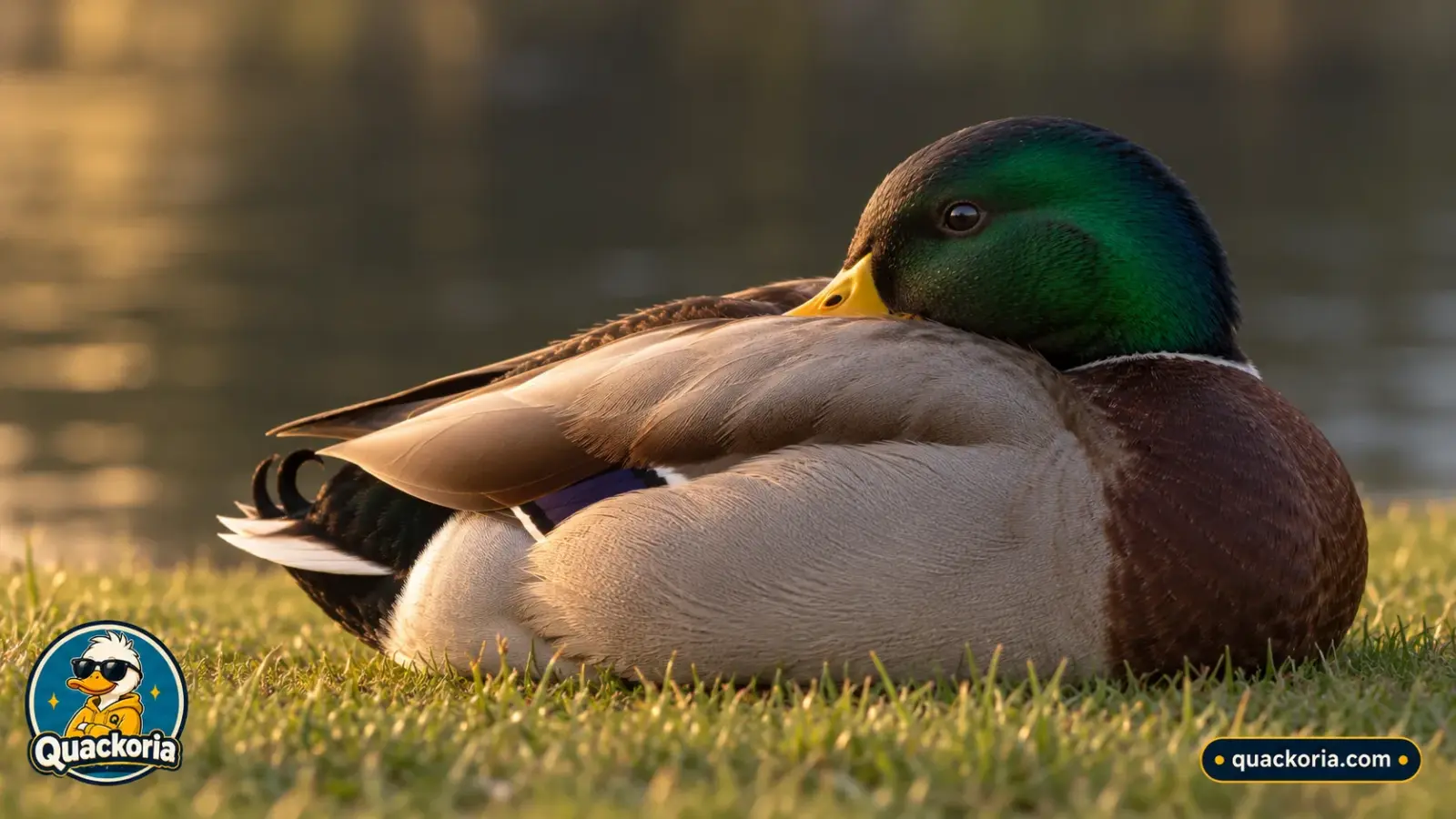
A duck can put half its brain to sleep and keep the other half awake, with the eye connected to the waking half held open and watching. It is called unihemispheric slow-wave sleep, it was demonstrated in mallards in 1999, and the ducks choose when to use it depending on how exposed they are.
Key takeaways
- Ducks at the edge of a sleeping group used one-eye-open sleep for 31.8% of their sleep. Ducks in the middle used it for 12.4%.
- Edge birds pointed the open eye away from the group 86.2% of the time — outward, at the danger.
- A duck in this state reacted to a simulated attack in 0.165 seconds. Half asleep is not defenceless.
- It is not universal among birds. It has been demonstrated in a handful of species and is absent in at least two.
- Ducks are not simply daytime birds. Many species feed at night, and hunting pressure makes them more nocturnal.
The study that proved it
In 1999 Niels Rattenborg, Steven Lima and Charles Amlaner published a short paper in Nature called “Half-awake to the risk of predation”. They recorded EEG from both brain hemispheres of mallard ducks while filming which eye was open, and they arranged the birds in rows of four so that some sat in the middle of the row and some sat at the end.
A duck at the end of a row is exposed on one side. A duck in the middle has neighbours on both sides. If one-eye-open sleep is a response to danger rather than a fixed habit, the end birds should use it more.
They did, and by a lot. The proportion of sleep spent with one eye open rose from 12.4% in the middle of the row to 31.8% at the end. And the direction mattered: edge birds held the open eye pointing away from the group 86.2% of the time. Birds in the middle showed no preference at all — 52.8%, which is a coin toss.
The EEG confirmed what the eyes suggested. When one eye was closed, slow-wave activity was significantly higher in the hemisphere opposite the closed eye. One half was genuinely sleeping while the other was genuinely awake.
Half asleep is not defenceless
The obvious question is whether the watching half of the brain is actually any use. The same study tested it by showing sleeping ducks an expanding image on a screen — a looming shape, the visual signature of something rushing towards you.
Ducks in one-eye-open sleep began escaping in 0.165 seconds.
That is the number that makes the whole thing make sense. The open eye is not decorative. It is a functioning early-warning system, and the reason it works is the way a duck’s eyes are built: set high and to the sides, giving coverage right around the head. How ducks see is the other half of this story.
What the paper does not say
Three things get attached to this study online that are not in it, and they are worth clearing up.
It is not the discovery of one-eye-open sleep. That was already known. What the authors believed they had shown for the first time was that an animal controls it — that a duck uses more or less of it according to how exposed it is.
“150% increase” and “31.8%” are the same finding. The companion paper reports the rise from 12.4% to 31.8% as a 150% relative increase. You will see both quoted as if they were separate results.
“31.8% of the time” is wrong. The figure is the proportion of sleep that was unihemispheric, not the proportion of the day a duck spends with one eye open.
One more caveat, ours rather than the paper’s: these were captive birds in a laboratory row, not ducks on a pond. The behaviour is real; the exact percentages belong to that setup.
Not every bird does this
“Birds sleep with one eye open” is one of those facts that has quietly grown into a claim about all birds. It is not supportable.
A 2016 review in Nature and Science of Sleep puts it plainly: this kind of sleep “has been found only in some species of birds”. It is demonstrated in mallards, gulls, pigeons, blackbirds, domestic chicks, Swainson’s thrush and white-crowned sparrows — and reported absent in malachite sunbirds and fan-tailed widowbirds.
Two further points of precision. It is a form of slow-wave sleep; in the mallard studies, REM sleep occurred with both eyes closed. And modern work treats it as a sliding scale of asymmetry between the hemispheres rather than a clean on-off switch. “One half fully asleep, one half fully awake” is a simplification of something more graded.
Peeking — a different behaviour, often confused with it
There is a second thing ducks do while sleeping, and it is not the same mechanism. In 1983 David Lendrem watched mallards sleeping on a jetty at Folly Bridge in Oxford and counted their “peeks” — brief openings of the eyes to scan for danger, interrupting sleep.
What he found is a small masterpiece of behavioural economics:
- Males in bright breeding plumage peeked 15.02 times a minute; females 12.17.
- Males in drab eclipse plumage dropped to roughly the female rate — a conspicuous bird is a more attractive target, and it behaves accordingly.
- Peeking fell as birds sat further from the bank, and fell further as more birds sat between them and the shore.
- Females reduced their own peeking as the number of vigilant males around them increased. They were letting someone else keep watch.
Position mattered more than flock size. It is the same logic as the edge-of-the-row result, arrived at by a completely different method sixteen years earlier.
Peeking is brief and interrupts sleep. One-eye-open sleep is sustained, one eye, with half the brain genuinely asleep. The two are easy to confuse.
Do ducks sleep at night?
Less than you would think, and it varies by species.
A 1992 review in Biological Reviews found that many waterfowl “regularly feed both during the day and night”, and that a good number are “mainly active and feed at night” — including most whistling-ducks, the shelducks, several dabbling ducks and most pochards. In the four domestic ducks behind the only sleep-duration figure we could trace (see below), sleep was “distributed evenly across the photoperiod” of 11 hours of light, 11 of dark and two of dim light for dawn and dusk.
Two things push ducks towards the dark. One is food — many aquatic invertebrates rise to the surface and become most active at night. The other is us. The review is blunt about it: “the diurnal gregarious habit and nocturnal feeding of ducks and geese seem very much to be a consequence of hunting”, and the same sentence goes on to name agricultural activities and disturbance from people. Wigeon fed by day and night where they were left alone, and only at night where they were disturbed.
If you keep ducks, this is worth knowing when you shut them in: a bird that wants to forage at night is not being difficult. Keeping ducks in winter covers the practical side of long nights.
How much do ducks sleep, and where?
Here the honest answer is that we could find no proper measurement.
The only figure we could trace is 10.8 hours per 24 hours, from a 1984 review of animal sleep across species. It rests on four domestic ducks recorded electrographically, and we could not verify the primary study behind it. We found no EEG-derived sleep figure for wild mallards at all. Treat 10.8 hours as one small measurement rather than a fact about ducks.
And the thing everybody states — that ducks sleep floating on the water — turns out, as far as we could find, to have no study behind it either. Every search returned content sites, none citing a source. The two classic duck sleep studies observed birds on a wooden jetty and in a laboratory row respectively. Ducks are certainly seen resting on water; what is missing is anyone having measured how much of their sleep happens there.
The same applies to sleeping on one leg. It is often explained as heat conservation, and there is comparative evidence across hundreds of bird species pointing that way — but a small New Zealand study found the posture becoming more common as the temperature rose from 8 to 19°C in flamingos and pied stilts, and found waterfowl, mallards included, less likely to stand on one leg than long-legged birds. Why duck feet do not freeze goes through that argument properly.
Ducklings are a complete blank: we found no study of sleep in ducklings. The nearest work is on domestic chicks, where one paper suggests the lateralised brain wiring may be set up by uneven light reaching the embryo inside the egg. Interesting, and not about ducks. What ducklings are covers what is actually known about them.
Frequently asked questions
Do ducks really sleep with one eye open?
Yes, and it is not a figure of speech. EEG recordings show one brain hemisphere in slow-wave sleep while the other stays awake, with the eye connected to the waking hemisphere held open. Mallards at the exposed edge of a group used it for about a third of their sleep.
Why do ducks sleep with one eye open?
To watch for predators. The 1999 mallard study showed ducks used it more when exposed, pointed the open eye outward, and could begin escaping from a looming threat in 0.165 seconds while still half asleep.
Do all birds sleep with one eye open?
No. It has been demonstrated in a small number of species — mallards, gulls, pigeons, blackbirds, chicks and a few others — and found absent in malachite sunbirds and fan-tailed widowbirds. It is common, not universal.
Do ducks sleep on the water?
They are often seen resting on water, but we could not find a single study measuring how much duck sleep happens afloat. The two well-known studies watched ducks on a jetty and in a laboratory. Anyone giving you a percentage is guessing.
How many hours do ducks sleep?
The only figure we could trace is 10.8 hours per 24 hours, from four domestic ducks in a 1984 review. We found no measurement for wild ducks. In those four ducks, sleep was "distributed evenly across the photoperiod" of 11 hours of light, 11 of dark and two of dim light for dawn and dusk.
Sources
- Rattenborg, Lima & Amlaner (1999), Half-awake to the risk of predation, Nature 397:397–398
- Rattenborg, Lima & Amlaner (1999), Facultative control of avian unihemispheric sleep, Behavioural Brain Research 105:163–172
- Lima, Rattenborg, Lesku & Amlaner (2005), Sleeping under the risk of predation, Animal Behaviour 70:723–736
- Mascetti (2016), Unihemispheric sleep and asymmetrical sleep, Nature and Science of Sleep 8:221–238
- Rattenborg et al. (2019), Local aspects of avian non-REM and REM sleep, Frontiers in Neuroscience 13:567
- Lendrem (1983), Sleeping and vigilance in birds I: the mallard, Animal Behaviour 31:532–538
- McNeil, Drapeau & Goss-Custard (1992), The occurrence and adaptive significance of nocturnal habits in waterfowl, Biological Reviews 67:381–419
- Campbell & Tobler (1984), Animal sleep: a review of sleep duration across phylogeny
- Harker & Harker (2010), Why do birds stand on one leg? A pilot study of exotic and native New Zealand birds, Notornis 57:173–177
- Functional Ecology Plain Language Summaries — Pavlovic, Weston & Symonds (2019), Morphology and geography predict the use of heat conservation behaviours across birds