Quackoria Learn
Can Ducks Eat Cheese?
Key takeaways
- Metzer Farms puts dairy on its list of foods ducks should not eat: "Ducks are lactose intolerant."
- Lafeber's avian veterinary guidance: birds cannot digest lactose, and "as the amount of dairy in the diet increases, birds can develop diarrhea."
- Cheddar is 33 per cent fat and carries 653 mg of sodium per 100 g; salt is on every duck avoid list.
- Aged hard cheeses have almost no lactose (cheddar 0.12 g per 100 g, Parmesan none), so the lactose argument is weak for hard cheese — the fat and salt argument is not.
- A dropped crumb is nothing to worry about; for protein give mealworms or a hard-boiled egg, for calcium give oyster shell.
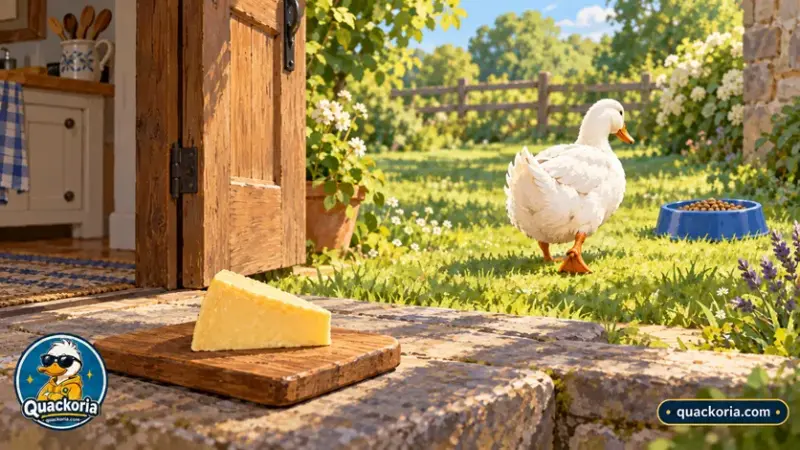
Not really, and there is no reason to try. Ducks are birds, birds have no evolutionary history with milk, and the duck sources say dairy is a bad match. The full picture is a little more interesting than a flat no — hard cheese has almost no lactose left in it, and chickens turn out to make a trace of the enzyme — but the practical answer for a duck keeper is: cheese is not a duck food, and a crumb that falls on the floor is not an emergency.
The short answer
Metzer Farms, a California duck hatchery, puts dairy on its list of foods ducks should not eat and explains why: “Ducks + dairy products are a bad match. Ducks are lactose intolerant. They do not have the necessary enzymes to break down the lactose in milk, so they are ill equipped to digest dairy products properly. The ingestion of large amounts of dairy can lead to painful and uncomfortable digestion problems in waterfowl.” Lafeber, a bird-food maker whose pet-bird pages are co-written by an avian vet and whose veterinary site is vet-reviewed, says the same for pet birds: “Although not technically toxic, studies show that birds cannot digest lactose, which is found in milk and other dairy products”, and “As the amount of dairy in the diet increases, birds can develop diarrhea.” That is the whole case, and it is enough. Our can-ducks-eat checker files milk and dairy under “never” on Metzer’s word — not because cheese is poisonous, but because it does nothing for a duck and can upset it.
Why birds and milk do not mix
Lactose is milk sugar, and Lafeber’s veterinary guide makes the point that it is “the only carbohydrate of mammalian origin” — no bird ever encountered it before people started keeping birds near cows. Digesting it takes an enzyme, lactase, and the guide notes an odd wrinkle: “Although birds are generally considered lactose intolerant, chickens are known to produce a small amount of the enzyme lactase.” Small amounts of lactose have even been studied in commercial poultry as a feed additive. But the same guide’s conclusion is the one that matters for a bowl of scraps: “the potential benefits of lactose are seen with small amounts. As the amount of dairy in the diet increases, birds can develop diarrhea.” We found no duck-specific measurement of any of this, and Metzer’s position for waterfowl is the only duck-specific one there is.
What is in cheese for a duck
Per 100 grams of cheddar, the US Department of Agriculture’s reference data give 403 kcal, 22.9 g protein, 33.3 g fat, 653 mg sodium, 710 mg calcium and only 0.12 g lactose. Three of those numbers tell the story. The fat is enormous by a duck’s standards — a third of the food by weight, many times what a complete feed carries. The sodium is the real problem: 653 mg per 100 g, and salt is on every duck avoid list, with the Open Sanctuary Project’s guidance that ducks’ salt “should be provided in their commercial food” and that keepers should not “give ducks any additional edibles containing much salt”. And the lactose, at 0.12 g, is almost nothing — which is why the lactose argument, on its own, is weak for hard cheese.
Penn State Extension explains the lactose point: “Aged cheeses have more time for the cheese cultures to use up the lactose, so aged cheeses tend to have less lactose than fresh, soft cheeses”, to the point where a hard Parmesan “contains 0 grams of lactose per 1 ounce” while a cup of whole milk contains 12.32 grams. So a crumb of cheddar will not give a duck the lactose upset that a saucer of milk would. It will give it fat and salt it does not need, for no protein it could not get better from its pellets.
Where the sources disagree
Chicken keepers will tell you their birds eat cheese, and some experienced poultry writers agree in moderation. Gail Damerow, writing for Backyard Poultry, notes that chickens “would not normally encounter mammalian milk or products derived from it. Oddly, however, their bodies still produce some lactase. They can, therefore, tolerate small amounts of lactose”, and that “one of the signs of lactose intolerance is diarrhea.” Lafeber’s pet-bird page allows that “not all dairy products contain lactose and/or have very little lactose in them, such as some cheeses and yogurts — still these foods should be fed as an occasional treat and in small amounts.” That is the chicken and parrot position: a little, occasionally. The duck-specific source says no. Given that cheese offers a duck nothing it needs, the duck source is the one to follow.
What to do instead
If the idea was protein, the answer is mealworms, a hard-boiled egg — Metzer suggests it, under a “Dairy” heading that contains nothing but the egg, and ducks “go at it” — or simply the complete feed, which is 16 to 20 per cent protein already. If the idea was calcium for a laying duck, the answer is oyster shell in a separate dish, not cheese; cheddar’s 710 mg of calcium comes wrapped in fat and salt. If the idea was a treat, strawberries, watermelon or a scatter of sweetcorn do the job with none of the downside.
If a duck has eaten cheese
A crumb, a corner of a sandwich, a dropped cube: nothing to do. Watch for loose droppings, which pass. A lot of cheese, or repeated cheese, is a salt and fat problem more than a lactose one; make sure the drinking water is clean and plentiful and stop the source. A duck that is lethargic, off its feed or drinking heavily after any salty food is a vet call — the signs to act on are in common duck health problems. The diet that makes the question unnecessary is in what to feed ducks.
Frequently asked questions
Can ducks eat cheese?
Best not. Metzer Farms lists dairy among foods ducks should not eat because ducks lack the enzymes to digest lactose, and cheese brings fat and salt a duck does not need. A crumb will not hurt; a habit is a bad one.
Are ducks lactose intolerant?
Yes, in the sense that matters. Metzer Farms says ducks do not have the enzymes to break down lactose; Lafeber notes chickens make a small amount of lactase but that diarrhoea follows as dairy increases. We found no duck-specific measurement.
Can ducks eat hard cheese like cheddar or Parmesan?
Aged cheeses have almost no lactose — Penn State Extension notes Parmesan has none — so the lactose upset is unlikely. The fat and the salt remain, and a duck gains nothing from them.
Can ducks drink milk or eat yoghurt?
No. Milk is the high-lactose dairy product, and Metzer's advice on dairy covers it. Sweetened yoghurt adds sugar as well.
What happens if my duck ate cheese?
A crumb or a cube: nothing, beyond possibly loose droppings. A lot, or repeatedly, is a salt and fat problem; clean water, stop the source, and a vet if the duck is lethargic or off its feed.
Sources
- Metzer Farms — Foods ducks should not eat
- Lafeber Vet — Unsafe foods for birds (2019)
- Lafeber — Foods toxic to pet birds
- USDA FoodData Central (SR Legacy) — Cheese, cheddar, FDC ID 173414, as reproduced by tools.myfooddata.com
- Penn State Extension — Selecting cheese for health
- Gail Damerow, Backyard Poultry — Are chickens lactose intolerant?
- The Open Sanctuary Project — Things that are toxic to ducks
- Metzer Farms — Treats your ducks will love
- NC State Extension — Feeding ducks (Ferket & Davis)