Quackoria Learn
Can Ducks Eat Watermelon?
Yes, and in summer it may be the best treat there is: more than nine-tenths water, loved by ducks, recommended by every duck source, and a way to get water into a bird that would rather sit in the shade than walk to the trough.
Key takeaways
- Ducks can eat watermelon. Metzer Farms, the Open Sanctuary Project, Kalmbach's nutritionist and Purina all list it as a treat.
- Per 100 g it is 91.4 per cent water, 6.2 per cent sugar and 0.6 per cent protein — hydration, not nutrition.
- Extension services suggest freezing chopped fruit into a block of water to keep birds cool; the caution is that frozen treats must not be the only food.
- The seeds are harmless and the rind is edible if chopped small; wash the outside before cutting.
- A slice between four ducks on a hot day is plenty; remove uneaten pieces before they ferment.
Yes, and in summer it may be the best treat there is. Watermelon is more than nine-tenths water, ducks love it, every duck source recommends it, and on a hot afternoon it does a job no pellet can: it gets water into a bird that would rather sit in the shade than walk to the trough.
The short answer
Metzer Farms, a California duck hatchery, puts it with some feeling: “I have it on good authority that ducks love watermelon. So when you’re having some during the summer, cut a slice for your ducks!” The Open Sanctuary Project’s duck diet guide lists watermelon and cantaloupe among appropriate treats; Kalmbach Feeds’ nutritionist writes that “melons are also wonderful treats for ducks” and that a large one “will also provide extended entertainment”; Purina’s chicken guidance names watermelon first among healthy snacks. No avoid list we could find mentions it.
What is in watermelon for a duck
Per 100 grams of raw watermelon, the US Department of Agriculture’s reference data give 91.4 g water, 30 kcal, 6.2 g sugars, 0.61 g protein and 0.4 g fibre, with 112 mg potassium, 8.1 mg vitamin C, 28 µg of vitamin A as retinol activity equivalents and 4,530 µg of lycopene, the red pigment. The two numbers that matter to a duck are the water and the protein: it is almost all one, and almost none of the other. A complete duck feed runs at 16 to 20 per cent protein; watermelon is 0.6. As nutrition it is a footnote. As hydration it is the point.
Watermelon in a heatwave
Ducks handle cold far better than heat, and the extension services’ advice for hot weather is built around water and cold treats. The University of Arizona’s poultry extension guidance suggests that “freezing watermelon or other chopped fruits/veggies with water into an ice block works well to keep hens cool and busy without excessively filling them up”, and Mississippi State University Extension poultry specialist Jessica Wells says that “frozen treats can also help keep chickens from overheating, but it is important to make sure that these treats are not the only food chickens are consuming.” Both are written for chickens; a duck in a heatwave has the same needs and a stronger preference for anything wet.
The practical version: a chilled slice in the shade, or chunks frozen into a block of water that the flock has to work at. Keep the drinking water and bathing water clean and topped up regardless — watermelon is on top of that, not instead of it. Our guide to keeping ducks in summer covers shade, water and the signs of a bird in trouble.
How to feed watermelon to ducks
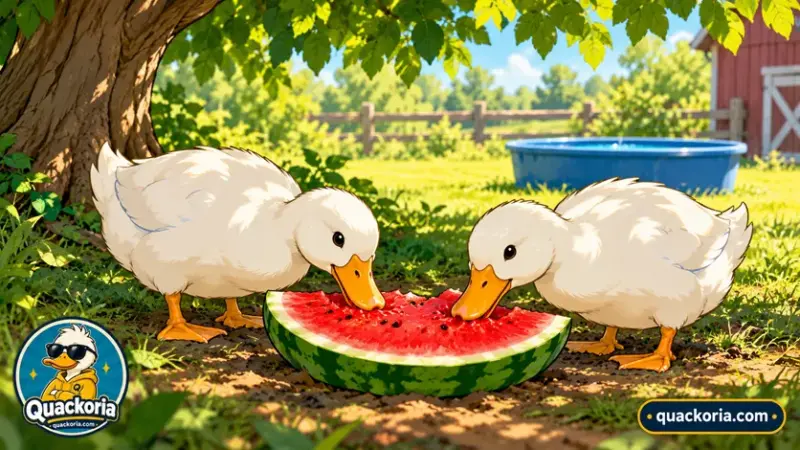
Cut it into chunks a duck can swallow, or give a slice on the rind and let them scoop. Ducks do not chew — see why ducks have no teeth — so what goes in goes down whole, and a duck scooping flesh from a slice takes its own bite-sized pieces. The seeds are not a problem; ducks swallow seeds far harder than watermelon pips. Chilled is welcome. A block frozen solid is for melting in the pen over an afternoon, not for eating as ice — a duck cannot get purchase on it until it softens.
Quantity follows the extension rule that treats of all kinds stay under a tenth of the diet — Colorado State University Extension: “Treats should make up no more than 10% of their daily diet.” Watermelon is mostly water, so the real limit is the sugar and the risk of filling up: a slice between four ducks on a hot day is plenty, and Mississippi State’s caution stands — not the only thing they eat.
The rind
Edible, and mostly ignored. Backyard Poultry’s chicken writers report their birds eating “the flesh, seeds and even the rind” — “If you leave the rind for them, they’ll usually eat that too!” — and ducks are no different if the pieces are small. There is no toxicity in it; there is also not much of anything else, and a big curved piece is an awkward thing for a duck to manage. Chop it small or compost it. Wash the outside of the melon before you cut it, because the knife carries whatever is on the skin into the flesh.
When watermelon is a problem
Rarely. The loose droppings that follow a big feed of any watery fruit are the melon passing through, not illness, and stop when the melon does. Mouldy melon is the real hazard — ducks are unusually sensitive to mould toxins — so a slice left in the sun until it ferments goes in the bin, and the uneaten pieces come out of the pen at the end of the day. Ducklings on starter feed should wait; a few chilled chunks once they are on grower is fine.
Other hot-weather fruit: strawberries are light and low in sugar, tomatoes are fine ripe and dangerous green. The full list of what we have checked is in the can-ducks-eat checker; the diet all of it sits on is in what to feed ducks.
Frequently asked questions
Can ducks eat watermelon?
Yes. Metzer Farms: "I have it on good authority that ducks love watermelon." Cut it into chunks or give a slice on the rind and let them scoop.
Can ducks eat watermelon seeds?
Yes. Ducks swallow harder seeds than watermelon pips every day; there is nothing in them to remove.
Can ducks eat watermelon rind?
Yes, chopped small. It is edible and non-toxic but has little in it, and a big curved piece is awkward for a duck. Most ignore it.
Is watermelon good for ducks in hot weather?
It is the best use for it. Poultry extension services suggest freezing chopped fruit in a block of water to keep birds cool, while keeping the complete feed and clean drinking water available.
How much watermelon can a duck have?
A slice shared between a few ducks. Treats of all kinds stay under a tenth of the diet, and a duck full of melon is not eating its feed.
Sources
- Metzer Farms — Treats your ducks will love
- The Open Sanctuary Project — Daily diet, treats and supplements for ducks
- Kalmbach Feeds — Healthy treats for backyard ducks
- Purina Animal Nutrition — What to feed chickens: treats to feed and avoid
- USDA FoodData Central (SR Legacy) — Watermelon, raw, FDC ID 167765, as reproduced by rawpawiq.com
- University of Arizona Cooperative Extension via poultry.extension.org — Managing backyard chickens during extreme summer temperatures
- Mississippi State University Extension — Protect backyard chickens and livestock from extreme heat
- Backyard Poultry — Can chickens eat watermelon?
- Colorado State University Extension — Raising poultry the organic way: disease control and feeding
- NC State Extension — Feeding ducks (Ferket & Davis)
- The Open Sanctuary Project — Things that are toxic to ducks