Quackoria Care
Collecting, Cleaning and Storing Duck Eggs
Most duck eggs are laid early in the morning. When to collect them, whether to wash them, how to store them, and what the float test really measures.
Key takeaways
- Most duck eggs are laid before 7 a.m. (University of Georgia). Keep the flock in until they have laid and most of the eggs are in the house.
- Do not wash a clean egg — the USDA does not recommend it for consumers, and Penn State says the bloom seals the shell. Dry-clean light dirt.
- If you must wash (Penn State): one egg at a time in water with a food-safe detergent, at least 20 °F warmer than the egg and at least 90 °F; agitate, never submerge, never scrub; rinse in sanitizer; dry, refrigerate.
- Refrigerate at 40 °F or below, pointed end down, in a carton, not in the door. 3–5 weeks (USDA); at least a month (Penn State).
- The float test measures age, not safety (USDA). Crack it into a separate bowl and use your nose.
- Water glassing: not recommended by Penn State.
What you need
- A basket or padded box for collecting
- A dry cloth or soft brush
- Cartons, for storing pointed end down
- A pencil or wax crayon for dating hatching eggs
When ducks lay, and what it means for you
Ducks lay early. The University of Georgia says “Most duck eggs are laid before 7 a.m.”, and Minnesota Extension that “Most eggs are laid in early morning.” For a flock shut in overnight, that means most of the eggs are laid indoors, before you open the door. Minnesota’s routine is to “Gather eggs about 7 a.m. and let the birds out of the house”; keep the flock shut in until they have laid and most of the eggs are in the house where you can find them.
Let them out at first light and a proportion of the eggs will be laid in the run, in the pool, under a bush, and in places you will not find until the smell tells you.
The other consequence of early laying: collect first thing, every day, before the flock has walked over the eggs. The University of Georgia says “Removing the eggs as soon as possible lessens the problems of dirty and cracked eggs.” Collect again later in the day in hard frost or high heat: Penn State notes that “freezing whole-shell eggs will cause the shell to crack”, and the USDA’s rule for eggs is “Don’t keep eggs out of the refrigerator more than 2 hours.”
Where ducks lay, and why they hide it
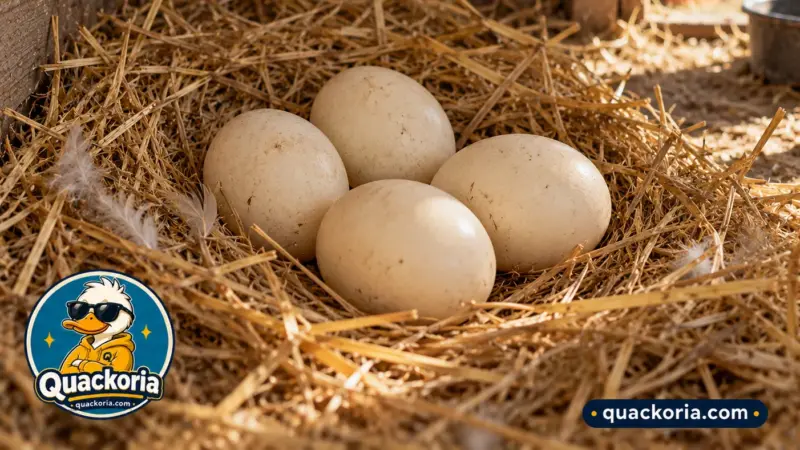
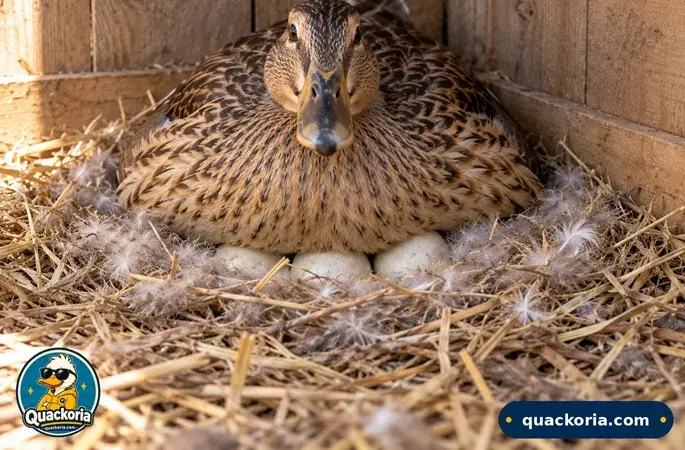
Ducks nest on the floor: Minnesota Extension says “Provide floor level nest boxes.” Some will use a box; the University of Georgia says “Ducks will make their own nest if straw or other litter material is provided”, and Metzer Farms that ducks and geese often pull some of their own feathers to line the nest once they begin laying. However well protected they are, Metzer adds, “their instinct still tells them to hide their nest” — and a duck that goes broody, covered in broody ducks, will sit on it.
What helps:
- Keep them in until they have laid, as above.
- Provide a nest area anyway — a corner with deeper bedding, a low box on its side, something with three walls. Metzer Farms suggests a duck nest of about 12 by 14 inches (30 by 36 cm), with sides and a back, and warns that “Nest-sharing rarely works well”; the University of Georgia gives 12 inches wide, 18 long and 12 deep. None of these sources, nor the UK Code of Recommendations for the welfare of ducks, gives a number of nests per duck — the Code asks only that nest boxes are not so high that birds have difficulty reaching them, and that they have adequate litter — so provide a couple and see who uses them.
- Watch the flock at let-out. A duck that hangs back, or goes purposefully to the same spot, is telling you where her nest is.
- Walk the run once a week looking for a hollow with eggs in it, especially in spring.
A hidden nest found late is a food-safety problem as well as a lost breakfast: the eggs are of unknown age, and the duck may go broody on it and stop laying — Metzer Farms: “Once they start sitting, they stop laying.” When in the year to expect this, and when laying starts and stops with the light, is in a duck keeper’s year.
Duck eggs are dirtier
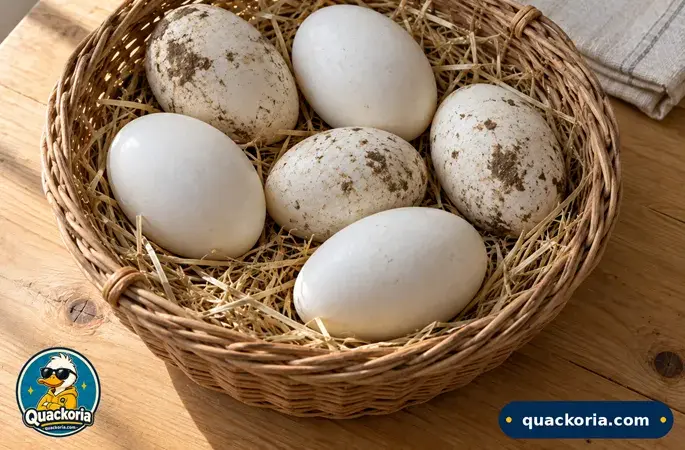
This is not a criticism of ducks. They lay on the floor, and they walk through their own water and back to the nest. Brigid McCrea of the Alabama Cooperative Extension System, writing for Metzer Farms, says dirty eggs are especially an issue with duck eggs “because ducks can be messier than chickens.”
Which brings us to washing, and to what the food-safety guidance actually says.
To wash or not to wash
The short answer, from the USDA’s Food Safety and Inspection Service: “It’s not necessary or recommended for consumers to wash eggs.” Its reason is the important part: washing “increases the risk of contamination because the wash water can be ‘sucked’ into the egg through the pores in the shell”. That page is written for American shoppers buying hens’ eggs, which have usually been washed already: “most eggs undergo a washing process at the plant; this is often followed by a sanitizing step”.
Penn State Extension, writing specifically for home-flock keepers, agrees that washing is not required, and explains what is lost: the cuticle, or bloom, “provides protection by sealing the natural pores in the eggshell”. Penn State adds that the cuticle “loses effectiveness over time and will be damaged or removed by brushing, washing, or rough handling”, which is why its washing method ends with drying the egg and refrigerating it promptly.
So the hierarchy is:
- A clean egg: do not wash it. Wipe any dust off with a dry cloth and leave the bloom intact.
- A lightly soiled egg: dry-clean it. A dry cloth, a soft brush, or fine sandpaper takes off a smear of mud without water, though brushing, as Penn State notes, can also damage the bloom.
- A genuinely dirty egg: wash it properly, or discard it. The UK Food Standards Agency tells caterers “do not use eggs that are cracked, damaged or dirty”.
If you must wash
Penn State’s method, for those who choose to, is specific and every part of it matters:
- Water at least 20 °F (about 11 °C) warmer than the egg, and at least 90 °F (32 °C). Penn State explains the risk of absorbing the water “is increased when the water is colder than the internal temperature of the egg because the contents will contract and pull the water inside.”
- Agitate, do not submerge. One egg at a time, moved through the wash water, never left sitting in a bowl of it. “Submerging eggs introduces a risk that the water — and any chemicals or pathogens in it — will be absorbed.”
- Do not scrub. Penn State: “Do not scrub the shell.”
- A food-safe detergent in the water, then a rinse in water containing an approved sanitizer and slightly warmer than the wash water. Minnesota Extension’s duck fact sheet gives the same rule for soiled duck eggs: washed “in warm water (at least 20°F. warmer than the eggs)” with an egg cleaning and sanitizing compound.
- Dry immediately and refrigerate.
Notice what that rules out: the kitchen-sink soak, and cold water.
Water glassing
The old method of preserving eggs by submerging them in a sodium silicate solution has come back into fashion online. Penn State’s verdict: “not recommended”, because the eggshell membrane lets water through, so the solution and any pathogens in it can enter the egg, and because it is “ineffective at preserving albumen quality at room temperature (40°-95°F)”.
Storing
Unwashed, bloom intact
Neither the USDA nor Penn State gives a keeping time for eggs out of the refrigerator; the USDA’s rule is “Don’t keep eggs out of the refrigerator more than 2 hours.” Brigid McCrea, writing for Metzer Farms, says that “For every day that an egg sits on the counter at room temperature, they age as much as if you had left them in the refrigerator for a week.” Europe does it differently: under the EU’s egg marketing rules (Commission Regulation (EC) No 589/2008), “Class A eggs should not be washed because of the potential damage to the physical barriers, such as the cuticle”, and they “should in general not be refrigerated before sale to the final consumer”, because “Cold eggs left out at room temperature may become covered in condensation”. In the UK the Food Standards Agency still tells caterers to “store eggs in a cool, dry place, ideally keep refrigerated until use”. The bloom does not last for ever either: Penn State says it “loses effectiveness over time”.
Washed, or any egg you want to keep longer
Refrigerate, at or below 40 °F (4 °C) — both USDA and Penn State give that figure — in the body of the refrigerator and not the door — the European Food Information Council notes that “the temperature in fridge doors tends to fluctuate”. Penn State, citing the USDA, says eggs keep “at least one month” refrigerated and covered, while the USDA’s own storage chart gives 3 to 5 weeks for raw shell eggs. Duck eggs are not separately listed by either body. A duck egg’s stronger shell is often said to keep it longer, but no food-safety body publishes a duck-specific figure, and this page does not give one.
Pointed end down, in a carton. The air cell is at the blunt end; the European Food Information Council says that stored pointed end down “the air chamber remains undamaged, and they can last for longer”, and that “As eggshells are naturally porous, they are prone to quickly absorb surrounding odours” — which the carton helps prevent.
Hard-boiled
One week, refrigerated, and into the refrigerator within two hours of cooking (USDA). The USDA explains why a cooked egg keeps less well than a raw one: “The process of hard-cooking eggs leads to a thin layer of water forming on the cooked egg surface under the shell”, and that water favours bacterial growth.
Eggs you did not collect on time
An egg found in a hidden nest is of unknown age and has been sat on, walked on, or rained on — far outside the USDA’s two hours out of the refrigerator. Do not eat it. If the duck is sitting, leave her to it; if she is not, discard the clutch.
The float test — what it does and does not tell you
Everyone knows the float test: a fresh egg sinks, an old one floats. What it is measuring is the size of the air cell, which grows as moisture and carbon dioxide escape through the shell over time. The USDA: “An egg can float in water when its air cell has enlarged sufficiently to keep it buoyant.”
The USDA’s position is precise: a floating egg “is of poor quality, but it may be perfectly safe to use.” The float test measures age, not safety. A floater is an old egg; an old egg is not necessarily a spoiled one, and a fresh egg is not necessarily a clean one.
The test the USDA actually recommends: “Crack the egg into a bowl and examine it for an off-odor or unusual appearance before deciding to use or discard it.” An off smell or an unusual appearance means bin it. A floater that smells fine and looks fine is an old egg to use in something cooked through.
Never crack a questionable egg directly into the mixing bowl with the others.
Eating them
Because this is what people ask next.
Duck eggs are larger, with a bigger yolk relative to the white, more fat and more protein per egg, and a stronger shell that needs a firmer tap. The comparison in detail is in duck eggs vs chicken eggs. In practice:
- Baking: the extra fat in the yolk gives richness, but not necessarily height: in a sponge-cake trial (Hwang et al. 2018), “The sponge cakes elaborated with hen eggs provided softer texture, higher volume and higher overall acceptability”. Use them by weight rather than by count — one duck egg is not one chicken egg.
- Frying and boiling: the white sets firmer than a hen’s — Chaiyasit et al. (2019) found heat-set duck egg white harder than chicken — and can be rubbery if overcooked. Cook until the yolk is solid too (below).
- Meringue and whipped whites: duck whites whip to less volume — 626% foam expansion against 811% for chicken in Chaiyasit et al. (2019), and 408% overrun against 812% in Hwang et al. (2018).
- Cook them through. The Food Safety Authority of Ireland advises “to only eat duck eggs that have been thoroughly cooked, until both the white and yolk are solid”, and the UK Food Standards Agency says “Eggs from species other than chickens carry a higher risk of Salmonella”. The USDA’s advice for all eggs is to cook them “until both the white and yolk are firm”.
Egg problems worth noticing
The egg is a daily report on the duck. The laying guide covers when laying starts and stops; these are the signs on the egg itself.
- Thin or soft shells — check the feed first: a laying duck needs a breeder/layer feed with “more protein, calcium and vitamins” (Metzer Farms), and Metzer says oyster shell is needed only if the feed has less than 2.5% calcium. Heat can play a part: Penn State, writing about poultry, says shell quality may suffer as temperatures approach 85 °F (29 °C); see keeping ducks in summer. In hens the University of Georgia adds older age, and Merck viral diseases, so persistent soft shells on a correct diet want a vet.
- Small, yolkless eggs — Merck, writing about poultry, says these occasionally form around a little leftover egg white in the oviduct. An occasional one is not a problem in itself.
- Double yolks — in hens, “The most frequently double-yolked eggs occur in the first several weeks of laying” (Drabik et al. 2024). Not for hatching: Cornell’s Duck Research Laboratory says not to set double-yolked eggs.
- Blood on the shell — in hens, the University of Georgia says “Bloodstained eggs are more common in young flocks in early lay, especially if the hens are overweight.” Repeated, or a lot, is a vet.
- Misshapen eggs, or a sudden change in the eggs from one duck — Merck, writing about poultry, says many abnormalities have no specific cause, but “the incidence is much higher in hens subjected to stressful management conditions or rough handling”. Worth watching the bird.
- No eggs — before assuming the duck has stopped, check for a hidden nest.
Keeping eggs for hatching
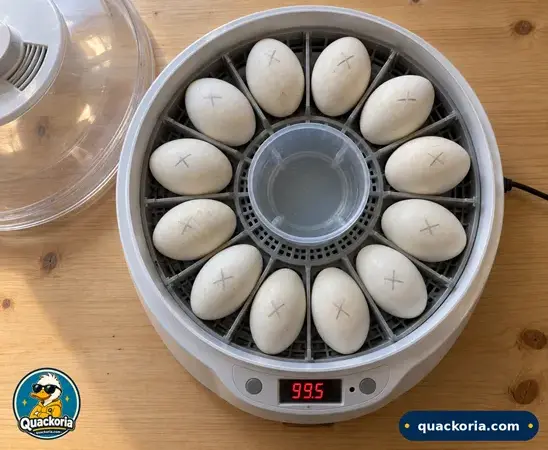
Different rules. A hatching egg is stored cool and humid rather than cold — Cornell’s Duck Research Laboratory says about 55 °F (13 °C) and 75% relative humidity — small end down, and set soon: Cornell’s best results come from setting eggs within 1–3 days of lay. It is not washed unless it must be. The full specification is in incubating duck eggs.
The short version
- Ducks lay early in the morning — most before 7 a.m., says the University of Georgia. Keep them in until they have laid and you will find most of the eggs.
- Collect daily, first thing; twice daily in frost or heat.
- Do not wash a clean egg — the USDA does not recommend it for consumers, and Penn State says the bloom seals the shell’s pores.
- If you must wash (Penn State): one egg at a time, in water with a food-safe detergent at least 20 °F warmer than the egg and at least 90 °F; agitate, never submerge, never scrub; rinse in sanitizer slightly warmer; dry, refrigerate.
- Refrigerate at 40 °F or below, pointed end down, in a carton, not in the door. 3–5 weeks (USDA storage chart); at least a month (Penn State, citing the USDA).
- The float test measures age, not safety. Crack it into a separate bowl and use your nose.
- Water glassing: not recommended by Penn State.
- Cook duck eggs through.
This is husbandry guidance, not veterinary advice. If a bird is ill or injured, find an avian vet.
Frequently asked questions
Should you wash duck eggs?
Not if they are clean. The USDA says washing is not necessary or recommended for consumers because wash water can be drawn into the egg through the shell's pores; Penn State adds that washing removes the cuticle, or bloom, that seals those pores. Dry-clean a light smear, bearing in mind that Penn State says brushing can damage the bloom too. Wash only a genuinely dirty egg, and do it properly.
How do you wash a dirty duck egg safely?
Penn State's method: water at least 20 °F warmer than the egg and at least 90 °F, with a food-safe detergent; agitate one egg at a time without submerging it; do not scrub; rinse in water with an approved sanitizer slightly warmer than the wash water; dry and refrigerate promptly. Cold water and a soak are exactly wrong.
How long do duck eggs last?
Refrigerated at 40 °F or below: 3–5 weeks per the USDA storage chart, or at least a month in Penn State's summary of the same USDA advice. Neither publishes a duck-specific figure; duck eggs are often said to keep a little longer than hen's eggs, but there is no authoritative number. Neither gives a room-temperature keeping time either: the USDA says not to keep eggs out of the refrigerator more than 2 hours.
Does a floating egg mean it is bad?
It means it is old — the air cell has grown as the egg lost moisture. The USDA's position is that a floating egg is of poor quality but may be perfectly safe to use. The test it recommends is to crack the egg into a bowl and check for an off odour or unusual appearance.
Where do ducks lay their eggs?
Early in the morning — the University of Georgia says most duck eggs are laid before 7 a.m. — on the floor, in a box or in a nest they make in the bedding, and sometimes in a hidden nest in the run: Metzer Farms says their instinct is to hide the nest. Keeping the flock shut in until they have laid puts most of the eggs in the house.
Sources
- USDA Food Safety and Inspection Service — Shell Eggs from Farm to Table
- Penn State Extension — How to Safely Handle and Store Eggs from Your Home Flock
- University of Georgia Extension (Cunningham, 2006) — Managing Ducks for Eggs
- University of Minnesota Agricultural Extension Service — Raising Ducks (Poultry Fact Sheet 43)
- Metzer Farms — Duck and Goose Nesting Box: Size, Materials & Setup Guide
- Metzer Farms — Broody Ducks and Geese
- Metzer Farms — FAQ (layer feed, oyster shell)
- Metzer Farms blog (Brigid McCrea, Alabama Cooperative Extension System, 2024) — Dirty Duck Eggs: Should They Be Washed?
- DEFRA — Code of recommendations for the welfare of livestock: ducks
- Commission Regulation (EC) No 589/2008 (egg marketing standards), recitals 7–8 — legislation.gov.uk
- Food Standards Agency (GOV.UK) — Advice on safe storage, handling and use of eggs for catering
- Food Safety Authority of Ireland — Advice on duck eggs
- European Food Information Council (EUFIC) — How to best store raw and boiled eggs to keep them fresh and prevent spoilage
- Hwang, Shyu, Yeh & Sung (2018), Journal of Food and Nutrition Research 6(2):110–115 — Study on Sponge Cake Qualities Made from Hen, Duck and Ostrich Eggs
- Chaiyasit, Brannan, Chareonsuk & Chanasattru (2019), Brazilian Journal of Poultry Science 21 — Comparison of Physicochemical and Functional Properties of Chicken and Duck Egg Albumens
- Penn State Extension — Hot Weather Management of Poultry (written about poultry generally)
- University of Georgia Extension (Dunkley) — A Dozen Egg Abnormalities: How They Affect Egg Quality (written about hens)
- Merck Veterinary Manual — Defective or Abnormal Eggs in Poultry
- Drabik, Wengerska, Kasperek, Knaga & Batkowska (2024), Animals 14(11):1568 — Analysis of the Quality and Chemical Composition of Double-Yolked Eggs Compared to Those of a Normal Structure
- Cornell University Duck Research Laboratory — Hatching Duck Eggs