Quackoria Learn
Duck Eggs vs Chicken Eggs: Size, Taste, Nutrition & Baking
Key takeaways
- Duck eggs are roughly a third heavier than large chicken eggs by eXtension's figures, and more for big breeds such as the Pekin, with a proportionally larger yolk.
- More fat and protein per egg, and a richer flavour that some people love and some find too strong.
- Duck eggshells are noticeably stronger, but we found no food-safety body that publishes a longer shelf life for duck eggs.
- They make richer bakes, but in a sponge-cake trial hen's eggs gave higher, softer cakes, and duck whites whip to less volume.
- Duck eggs are not a safe substitute for anyone with an egg allergy; Anaphylaxis UK advises people allergic to hen's eggs not to eat them.
A duck egg is bigger, richer, and has a proportionally larger yolk than a chicken egg. That drives much of the practical difference — how it tastes and how it cooks — though the white and the shell differ as well.
Size
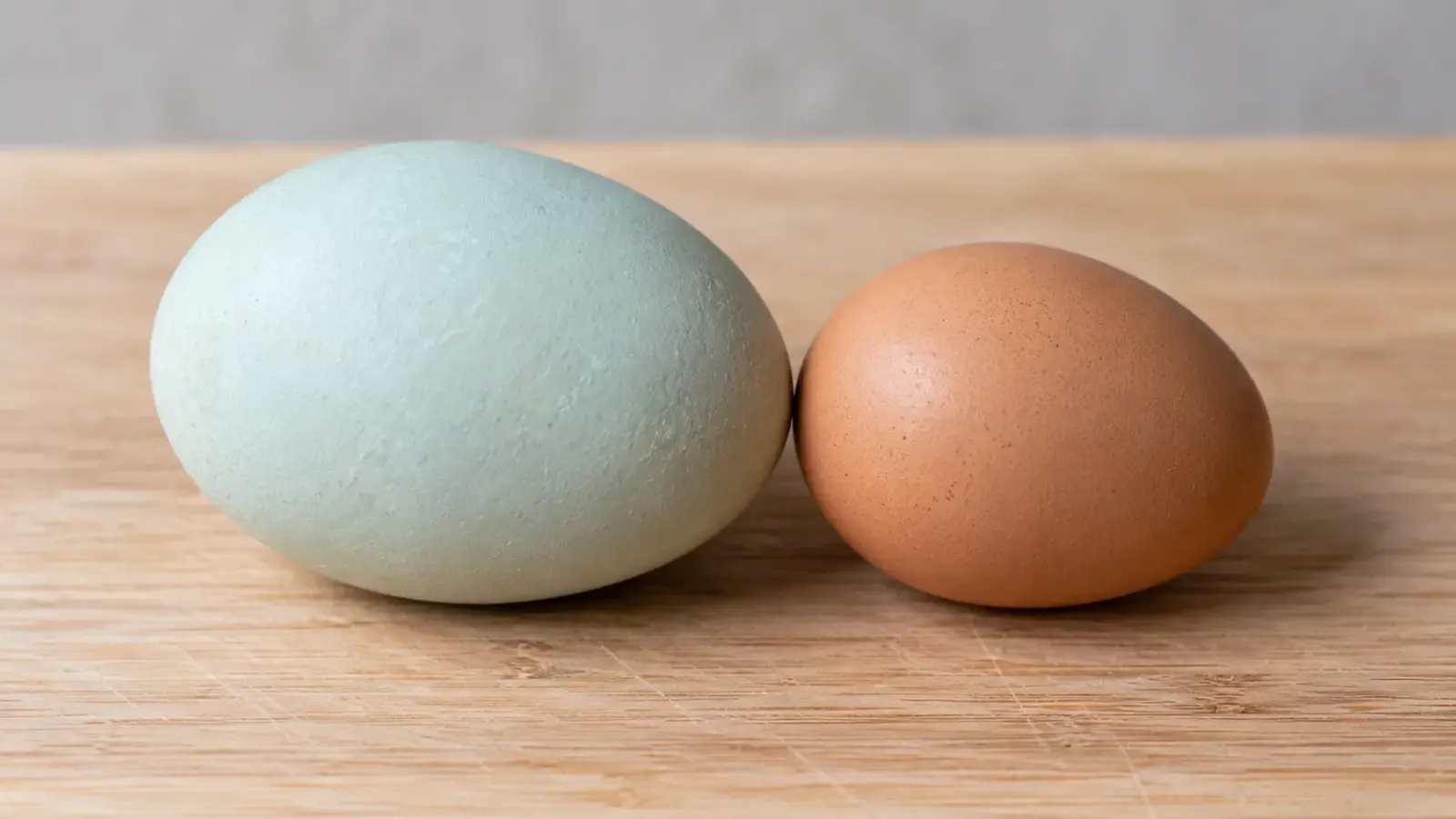
A typical chicken egg weighs around 50–60 g. A typical duck egg weighs around 65–100 g, depending on breed (Metzer Farms’ breed chart). By eXtension’s figures — 32–34 ounces a dozen for duck eggs against 24–26 for large chicken eggs — a duck egg is roughly a third heavier; a Pekin egg, at Metzer’s 90–100 g, is about 60–75% heavier than a USDA large chicken egg of about 57 g in the shell.
More importantly, the extra weight is not distributed evenly. The yolk is proportionally larger, so a duck egg has a higher yolk-to-white ratio: in a comparison of Jinding duck and White Leghorn hen eggs (Sun et al. 2019), the yolk made up 32.4% of a duck egg’s weight against 27.5% of a hen’s. That is part of where the richness comes from, though the white differs too (see Baking), and it is why duck eggs behave differently in cooking rather than simply being “a bigger egg”.
Taste and texture
Many people find duck eggs richer and more savoury; per 100 g they carry about 45% more fat than chicken eggs (USDA FoodData Central). The white is firmer: the thick white of a duck egg stood taller in Sun et al. (2019), 7.36 mm against 6.68 mm, and Chaiyasit et al. (2019) found that boiled duck egg white set markedly harder than hen’s. How deep the yolk’s colour is depends on diet — the USDA says so of hens’ eggs.
Opinions genuinely divide. Some people prefer them; others find them too strong, particularly scrambled, where there is nowhere for the richness to hide.
Diet can change how eggs taste: eXtension’s Jacquie Jacob (University of Kentucky) gives the example of hens that eat too much garlic. No study we could find compares how much diet changes the flavour of duck and hen eggs. What a duck’s diet consists of is covered in what ducks eat.
Nutrition
Per egg, a duck egg contains more of nearly everything, partly because it is a bigger egg. By USDA FoodData Central’s figures, where one duck egg is 70 g of edible egg and one large chicken egg 50 g, roughly:
- More protein — around 9 g against 6 g
- More fat — about 9.7 g against 4.8 g, concentrated in the larger yolk
- More vitamin B12, notably so — about 3.8 µg against 0.4 µg
- More iron, folate and vitamin A
- More calories — about 130 against about 70
- More cholesterol — about 620 mg against 190 mg
Per 100 g the protein is almost identical — 12.8 g against 12.6 g — and the calorie gap shrinks to about 30% (185 against 143 kcal), so for those two most of the per-egg difference is simply that you are eating more egg. For the rest it is not: per 100 g a duck egg still has about 45% more fat (13.8 against 9.5 g), about 2.4 times the cholesterol (884 against 372 mg), about twice the iron and about six times the vitamin B12.
One thing worth stating plainly: duck eggs are not a safe alternative for someone with an egg allergy. Anaphylaxis UK’s advice is: “If you are allergic to hen’s eggs, don’t eat eggs from ducks, geese, quails or other birds because you might react to any egg.” This is a medical question rather than a culinary one.
Shell and shelf life
Duck eggshells are noticeably stronger, though in Sun et al. (2019) barely thicker: duck shells averaged 0.356 mm against 0.343 mm, a difference the study did not find significant, but were about a third stronger to break (5.00 against 3.73 kg). That is why they survive rougher handling. Whether they also keep longer is often said, but no food-safety body we could find publishes a figure for duck eggs; the USDA gives 3 to 5 weeks for raw shell eggs in the fridge and Penn State at least one month. The egg freshness checker works from those figures.
Shell colour varies by breed — white, cream, pale green, pale blue, occasionally very dark grey. Khaki Campbells usually lay white or cream; some Runners lay a distinct pale blue-green. Whether colour changes flavour or nutrition has been tested in hens’ eggs, where brown and white shells make no meaningful difference; we found no such test for duck eggs. Duck egg colours covers the breeds.
Cracking a duck egg takes a firmer knock than you expect if you are used to chicken eggs.
Baking
This is where duck eggs have their reputation, and where the evidence is mixed.
The extra fat in the yolk gives richness. Whether the white carries extra protein is disputed: Chaiyasit et al. (2019) measured 12.15% protein in duck egg white against 10.03% in hen’s, while Sun et al. (2019) found 10.7% against 10.8%. In the one sponge-cake trial we found, Hwang et al. (2018), the cakes made with hen’s eggs had “softer texture, higher volume and higher overall acceptability”; the duck-egg cakes were harder and more yellow.
Substituting: work by weight, not by count. As a working rule, three large chicken eggs (about 170 g in the shell) are two Pekin eggs, or two to two and a half eggs from smaller breeds — so weighing is more reliable, particularly in baking where ratios matter. The duck egg converter works it out by breed.
Meringues are the question people always ask about. Duck egg whites can be whipped, but they whip to less volume: Chaiyasit et al. (2019) measured 626% foam expansion against 811% for hen’s whites, and Hwang et al. (2018) 408% overrun against 812%. On how well the foam holds, the two studies disagree — Chaiyasit found the duck foam drained less, Hwang found hen’s foam more stable. If volume is the goal, chicken eggs give more of it.
Cooking
- Fried — firm white and a rich yolk; fry until the yolk is solid (see below).
- Poached — only until the yolk is solid (see below), so not the usual runny poached egg.
- Scrambled — divisive. Some find them too rich here.
- Boiled — expect a firmer white (Chaiyasit et al. found boiled duck egg white sets harder than hen’s), and boil until the yolk is solid.
- Baking — richer results; see Baking above for what changes.
Cook duck eggs thoroughly, whoever is eating them. The Food Safety Authority of Ireland advises “to only eat duck eggs that have been thoroughly cooked, until both the white and yolk are solid”, and not to use raw duck eggs in dishes such as homemade mayonnaise, tiramisu, icing or hollandaise. The UK Food Standards Agency says eggs from species other than chickens “carry a higher risk of Salmonella” and “should always be cooked thoroughly before being served”. The NHS’s pregnancy advice allows runny hen eggs with the British Lion stamp or from the Laid in Britain scheme, but lists “raw or undercooked goose, duck and quail eggs” among foods to avoid. In the US, the USDA’s advice for all eggs is to cook them “until both the white and yolk are firm”.
Why they cost more
Feed is one reason: eXtension says ducks “consume 20-30% more feed per dozen eggs produced than chickens”, though they can forage for some of what they need. Laying rate is another: on Metzer Farms’ breed chart, every breed except its two hybrid layers tops out at 240 eggs a year or fewer, even with 17 hours of light, against the 250–300 that University of New Hampshire Extension gives for White Leghorn hens.
That said, some laying breeds are genuinely productive, though the figures vary by source. The Livestock Conservancy says Khaki Campbells “will average 250-340 eggs” a year and, quoting Holderread, calls Welsh Harlequins “outstanding layers producing 240-330 white-shelled eggs yearly” — in the same range as those Leghorns. Metzer Farms’ chart is lower, at 165–240 for the Khaki Campbell and 100–150 for the Welsh Harlequin, the upper figures with 17 hours of light.
If you are thinking of keeping ducks for eggs
Two practical points are worth knowing first.
The first is calcium. A laying duck needs a layer or breeder ration, which Metzer Farms describes as having “more protein, calcium and vitamins”. Metzer adds that most layer feeds carry enough calcium that oyster shell is not needed, but if the feed has less than 2.5% calcium a dish of oyster shell can be offered; NC State says the layer diet “may be supplemented with free choice ground oyster shell”.
The second is timing and expectations. Ducks usually start laying at around five to seven months old depending on feed, daylight and season, most lay in the early morning, and output falls, or stops, in autumn and winter unless you extend daylight. All of that, including what a first egg normally looks like, is in when ducks start laying eggs.
And if you are hoping some of those eggs will hatch rather than be eaten, everything about ducklings covers what happens next.
Frequently asked questions
Do duck eggs taste different?
Many people find them richer and more savoury. They have a proportionally larger yolk and about 45% more fat per 100 g than chicken eggs (USDA FoodData Central). Whether that is better is a matter of taste.
Can I substitute duck eggs for chicken eggs in a recipe?
Yes, by weight rather than by count. A rough rule is two Pekin eggs, or two to two and a half eggs from smaller breeds, for three large chicken eggs, but weighing is more reliable.
Are duck eggs healthier?
They have more protein, more fat, more vitamin B12 and more of several minerals per egg — but also more calories and more cholesterol, because they are simply bigger and richer. Per 100 g the protein is almost the same (12.8 g against 12.6 g), but a duck egg still has about 45% more fat, about 2.4 times the cholesterol and about six times the vitamin B12 (USDA FoodData Central).
What colour are duck eggs?
It depends on the breed. White, cream, pale green, pale blue and occasionally charcoal grey are all normal. We found no study testing whether shell colour changes a duck egg's flavour or nutrition; in hens' eggs, brown and white shells make no meaningful difference to either (USDA, University of Kentucky).
Sources
- USDA FoodData Central — Egg, duck, whole, fresh, raw (FDC 172189, SR Legacy)
- USDA FoodData Central — Egg, whole, raw, fresh (FDC 171287, SR Legacy)
- USDA FoodData Central — Egg, yolk, raw, fresh (FDC 172184)
- USDA FoodData Central — Egg, white, raw, fresh (FDC 172183)
- eXtension (Jacquie Jacob, University of Kentucky) — Feeding Ducks for Egg Production Kept in Small Flocks
- Metzer Farms — Compare Duck Breeds
- Metzer Farms — FAQ (layer feed, oyster shell, laying age)
- Sun, Liu, Yang & Xu (2019), Poultry Science 98:4516–4521 — Egg quality and egg albumen property of domestic chicken, duck, goose, turkey, quail, and pigeon
- Chaiyasit, Brannan, Chareonsuk & Chanasattru (2019), Brazilian Journal of Poultry Science 21 — Comparison of Physicochemical and Functional Properties of Chicken and Duck Egg Albumens
- Hwang, Shyu, Yeh & Sung (2018), Journal of Food and Nutrition Research 6(2):110–115 — Study on Sponge Cake Qualities Made from Hen, Duck and Ostrich Eggs
- eXtension (Jacquie Jacob, University of Kentucky) — What Is the Difference Between Brown and White Eggs?
- The Livestock Conservancy — Khaki Campbell duck
- The Livestock Conservancy — Welsh Harlequin duck
- The Livestock Conservancy — Runner duck
- The Livestock Conservancy — Cayuga duck
- University of New Hampshire Extension — Producing Your Own Eggs
- Anaphylaxis UK — Egg allergy
- Food Safety Authority of Ireland — Advice on duck eggs
- Food Standards Agency (GOV.UK) — Advice on safe storage, handling and use of eggs for catering
- NHS — Foods to avoid in pregnancy
- USDA Food Safety and Inspection Service — Shell Eggs from Farm to Table
- Penn State Extension — How to Safely Handle and Store Eggs from Your Home Flock
- NC State Extension (Ferket & Davis) — Feeding Ducks
- Metzer Farms — Why Has My Duck Stopped Laying Eggs?
- University of Georgia Extension (Cunningham, 2006) — Managing Ducks for Eggs