Quackoria Learn
Northern Shoveler: The Duck With the Spoon-Shaped Bill
The northern shoveler is a dabbling duck with an oversized, spoon-shaped bill that works as a sieve, straining tiny crustaceans, zooplankton and seeds out of shallow water through comb-like edges called lamellae. It is common across the southern United States in winter and, in Britain, a scarce breeder joined each winter by continental birds.
Key takeaways
- Cornell counts "about 110" lamellae along a bill "about 2.5 inches long"; the US Fish and Wildlife Service says "hundreds" and Tennessee's wildlife agency "over 100".
- Flocks sometimes swim in "tight circles creating a vortex to bring food to the surface", according to the US Fish and Wildlife Service.
- At 44-51 cm and 400-820 g by Cornell's measurements, it is "Larger than an American Coot, smaller than a Mallard."
- Fledging is disputed: Audubon says the young fly "52-60 days after hatching", while the BTO gives 40–45 days.
- The US Fish and Wildlife Service estimated 2.8 million shovelers in 2025, and the BTO records an 82% rise in UK wintering numbers between 1998 and 2023.
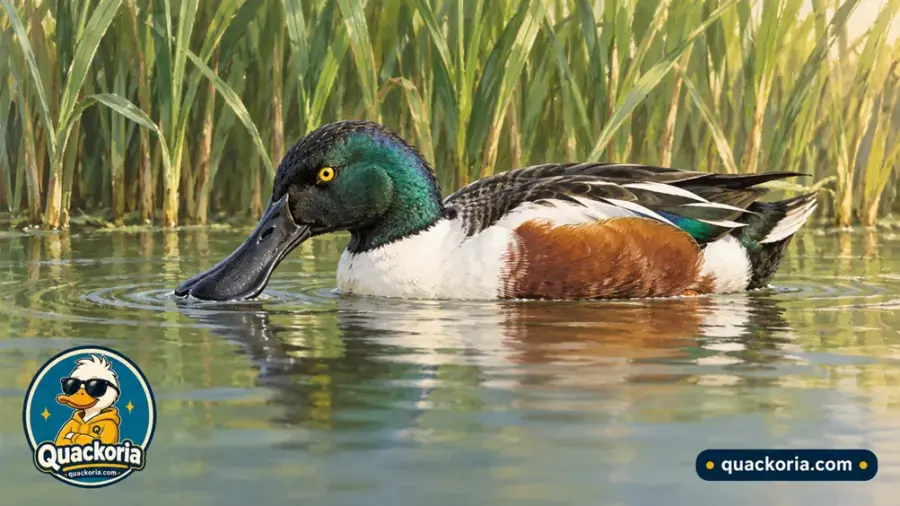
The northern shoveler, Spatula clypeata, is the duck with the outsized bill: Cornell calls it “Perhaps the most outwardly distinctive of the dabbling ducks thanks to its large spoon-shaped bill”. That bill is a sieve, edged with “comblike projections” that strain tiny animals and seeds out of the water, and it has earned the bird the nicknames spoonbill and spoony, as the US Fish and Wildlife Service records. Most people meet it between late summer and spring, head down in a shallow pond, a refuge marsh or a sewage lagoon. In Britain it is a scarce breeder whose numbers swell each winter with birds from the east.
How to recognise a northern shoveler
Look at the bill first. Cornell describes a “shovel-shaped bill that quickly sets it apart from other dabbling ducks”. The breeding male is “bold white, blue, green, and rust, but their most notable feature is their white chest and white lower sides”, in Cornell’s words, with a green head, black bill and yellow eye. The female is mottled brown, and for her “Their very large orange bill is their most notable field mark.” Nonbreeding males are darker but “still easily identifiable by bill shape, yellow eye, and striking wing pattern.” On the water a shoveler “tends to sit with its rear a bit higher out of the water almost like its bill is pulling its front half down.”
By Cornell’s figures it is 44-51 cm (17.3-20.1 in) long, weighs 400-820 g (14.1-28.9 oz) and spans 69-84 cm (27.2-33.1 in), “Larger than an American Coot, smaller than a Mallard.” The drake gives a “wheezy took-took during courtship, in flight, and when alarmed”, Cornell says, and the female a “nasal-sounding quack”.
Shoveler or mallard?
A drake shoveler has a green head, as a drake mallard does, and Cornell separates them by bill and breast: “Breeding male Mallards have a yellow (not dark) bill and a brown (not white) breast compared to Northern Shovelers.” With the females it is the bill again: “Female Mallards have a smaller bill and a darker crown than female Northern Shovelers.” In flight, the US Fish and Wildlife Service says, shovelers can be confused with blue-winged teal “because of similar pale blue shoulder patches, however shovelers are larger in size.” Cinnamon teal and green-winged teal are smaller too, and Cornell notes that female teal of all three species have dark bills where the female shoveler’s is orangish.
Where and when you will see one
The US Fish and Wildlife Service says shovelers breed “from Alaska to northern parts of Manitoba”, mostly in the Prairie Pothole Region, and that “During migration and winter, northern shovelers are common across the southern U.S. and Mexico.” Cornell’s window for seeing them on national wildlife refuges is “from migration throughout the winter months (August–April)”. Ducks Unlimited has them leaving the breeding grounds “in August or early September” and heading back north to “arrive on breeding areas in late April to early May.” Tennessee sees them from late August until early May, by the state wildlife agency’s dates.
In the UK, the RSPB says, shovelers “breed in southern and eastern England, especially around the Ouse Washes, the Humber and the North Kent Marshes”. In winter “breeding birds move south, and are replaced by an influx of continental birds from further north.” The BTO calls the shoveler “a relatively scarce and localised breeder” and counts 1,100 breeding pairs (2013–17) against 20,000 wintering birds (2012–17), the winter visitors coming from “eastern Fennoscandia and the Baltic to western Russia”.
What it eats, and how
The shoveler is a dabbler, but an odd one (the general division is set out in dabbling vs diving ducks). Audubon says it “Seldom up-ends, rarely dives, seldom feeds on land”; it swims and strains instead. Cornell lists “tiny crustaceans, other aquatic invertebrates, and seeds”, the BTO calls it “a rather specialized feeder, as its broad bill might suggest, feeding on zooplankton”, and Ducks Unlimited puts the autumn and winter diet at “35 percent seeds of moist soil plants, and 65 percent invertebrates.” The US Fish and Wildlife Service finds shovelers “noticeably common on sewage treatment lagoons across their range, presumably due to an abundance of invertebrate prey”, and the BTO says they “favour more ephemeral waterbodies where potential competitors (e.g. fish) cannot survive.”
Nesting and ducklings
Shoveler pairs last. Cornell says they “are monogamous and remain together longer than pairs of most other dabbling ducks”, staying together “until just before fall migration”; the wider question is in do ducks mate for life. The nest is a ground scrape “about 8 inches wide”, generally “within 150 feet of water”. The sources disagree on the numbers: Cornell gives 8-12 eggs and 22-25 days’ incubation, Audubon “9-12 eggs, sometimes 6-14” and 21-27 days, the BTO 9–11 eggs and 22–23 days. Cornell also records an odd defence: “When flushed off the nest, a female Northern Shoveler often defecates on its eggs, apparently to deter predators.” Audubon says the female leads the young to water within hours of hatching and that they fly “52-60 days after hatching”; the BTO’s fledging figure is much shorter, 40–45 days.
How does a shoveler’s bill work?
As a sieve. Cornell describes a bill “about 2.5 inches long” with “about 110 fine projections (called lamellae) along the edges that act like a colander, filtering out tiny crustaceans, seeds, and aquatic invertebrates from the water.” Other sources count differently: the US Fish and Wildlife Service writes of “hundreds of comb-like structures called lamellae”, Tennessee’s wildlife agency of “over 100 lamellae (fine tooth-like projections)”. For lamellae and the question of duck teeth, see do ducks have teeth. Audubon puts the shoveler at the far end of a family habit: “Many of the dabbling ducks use their flat bills to strain food items from the water, but the big spatulate bill of the Northern Shoveler is adapted to take this habit to the extreme.”
The method is to keep the bill moving. Cornell describes shovelers swimming “with their bills down in the water, swinging them side to side to filter out tiny crustacean prey”. Flocks go further: Cornell says “Sometimes large groups swim in circles to stir up food”, and the US Fish and Wildlife Service explains the effect: “Groups of birds will sometimes form tight circles creating a vortex to bring food to the surface.” The bill also earned the bird its hunters’ nickname, spoonbill, according to the Oregon Department of Fish and Wildlife, which says shovelers “can be fine table fare despite a bad reputation with many hunters.”
How northern shovelers are doing
Steady, and in Britain rising. Cornell says shovelers “are common, and their populations were stable between 1966 and 2019, according to the North American Breeding Bird Survey”, and that Partners in Flight estimates a global breeding population of 5.9 million, scoring the species 7 out of 20 for continental concern, “indicating a species of low conservation concern.” The US Fish and Wildlife Service’s 2025 survey estimated “2.8 ± 0.2 million”, similar to both 2024 and the long-term average. In Britain the BTO records an 82% increase in wintering numbers between 1998 and 2023, and calls the breeding trend uncertain. The shoveler is still Amber-listed there, and the RSPB explains why: “The UK is home to more than 20% of the north-west European population, making it an Amber List species.”
A brown female seen at a distance can still puzzle; the wild duck identifier walks through the marks that separate her from other dabblers. For a wider test of duck knowledge, try the duck quiz.
Frequently asked questions
Why do shovelers swim in circles?
To feed. The US Fish and Wildlife Service says "Groups of birds will sometimes form tight circles creating a vortex to bring food to the surface", and Cornell says large groups swim in circles "to stir up food."
Why is a shoveler called a spoonbill?
Because of its bill, which Tennessee's wildlife agency describes as "wider at the tip than at the base." The US Fish and Wildlife Service notes: "Because of this unique bill, they have earned the nicknames 'spoonbill' and 'spoony.'"
How many lamellae does a shoveler have?
The sources give different figures. Cornell says "about 110 fine projections (called lamellae)", the US Fish and Wildlife Service "hundreds of comb-like structures called lamellae", and Tennessee's wildlife agency "over 100 lamellae".
Why are shovelers on sewage ponds?
For the food. The US Fish and Wildlife Service says shovelers are "noticeably common on sewage treatment lagoons across their range, presumably due to an abundance of invertebrate prey", and Cornell notes that "They tend to use more stagnant pools of water than other ducks".
Are there shovelers in the UK?
Yes, all year. The RSPB says they "breed in southern and eastern England, especially around the Ouse Washes, the Humber and the North Kent Marshes", and the BTO counts 1,100 breeding pairs (2013–17) and 20,000 wintering birds (2012–17).
Sources
- Cornell Lab of Ornithology — Northern Shoveler Overview, All About Birds
- Cornell Lab of Ornithology — Northern Shoveler Identification, All About Birds
- Cornell Lab of Ornithology — Northern Shoveler Life History, All About Birds
- Cornell Lab of Ornithology — Northern Shoveler Sounds, All About Birds
- Cornell Lab of Ornithology — Northern Shoveler Similar Species, All About Birds
- National Audubon Society — Northern Shoveler, Guide to North American Birds
- Ducks Unlimited — Northern Shoveler, Waterfowl ID
- U.S. Fish and Wildlife Service — Northern Shoveler (Anas clypeata)
- U.S. Fish and Wildlife Service — Waterfowl Population Status, 2025
- Tennessee Wildlife Resources Agency — Northern Shoveler
- Oregon Department of Fish and Wildlife — Northern Shoveler
- RSPB — Shoveler
- BTO — Shoveler, BirdFacts