Quackoria Learn
Do Ducks Have Teeth? How a Duck’s Bill Really Works
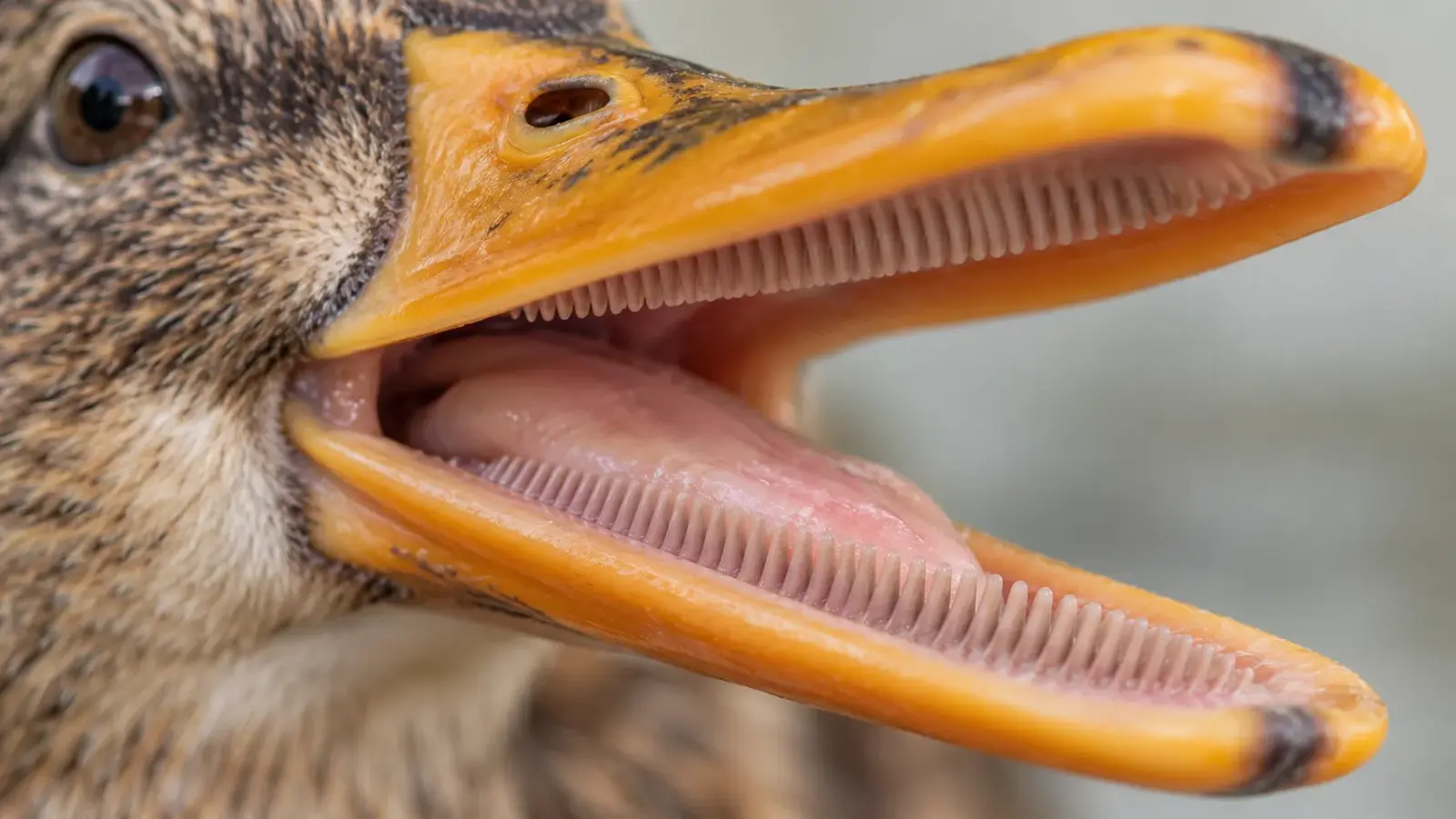
No bird alive has true teeth. What looks like a row of them inside a duck's bill is a set of ridges called lamellae, and they work as a strainer.
Key takeaways
- No living bird has true teeth. Ducks are no exception.
- The ridges inside a duck's bill are lamellae — comb-like plates used to strain food from water and mud.
- Food is ground after swallowing, in the gizzard, using grit the duck has eaten deliberately.
- The bill tip has a dense patch of touch receptors, so a duck can find food it cannot see.
- Mergansers look toothed because their bills have serrated, tooth-like edges and a hooked tip for gripping fish — still not teeth.
No. Ducks have no teeth, and neither does any other living bird. If you have looked closely at a duck’s open bill and seen what appears to be a neat row of small teeth along the edge, what you were looking at is a set of ridges called lamellae — and they do a completely different job.
So what are “duck teeth”?
The rows of fine ridges you can see along the edge of an open bill. Ducks Unlimited’s waterfowl scientists describe them plainly: lamellae “act like sieves and look like teeth, even though ducks and geese don’t chew food.” How many there are depends on the species and its diet — the Cornell Lab notes that a northern shoveler’s bill carries “about 110 fine projections (called lamellae) along the edges that act like a colander, filtering out tiny crustaceans, seeds, and aquatic invertebrates from the water.” (Ducks Unlimited’s count for the shoveler is higher still — about 220 on the lower mandible and 180 on the upper — so treat any single number as a rough one.) A merganser’s are serrated for gripping fish, which is why it looks toothed. All of them are part of the bill’s keratin covering, not enamel set in bone. Nothing about them bites, cuts or chews.
What lamellae actually are
Lamellae are thin, comb-like plates running along the inner edges of both the upper and lower bill. They are made of the same tough material as the rest of the bill covering, they are not set in sockets, they do not have roots, and they are not used to bite or tear anything.
They are a filter.
When a mallard dabbles, it takes in a bill-full of water and mud, and then pumps it through with its tongue: a 2006 study by D. Brent Gurd describes ducks moving the tongue and both halves of the bill to push water one way, from the front of the bill to the back. The lamellae hold back food — seeds, insect larvae, tiny crustaceans — while the water is pushed out, and the ducks are not passive about it: the study’s title sums up its finding, that dabbling ducks “can actively select particles by size”. How much of the straining the lamellae themselves do is less settled: a 1989 study by Kooloos and colleagues found that shortening a mallard’s lamellae did not change how well it filtered, although it did for the northern shoveler, and proposed that small seeds are also separated out of the water flow by small eddies.
The species that look most convincingly toothed are the sawbills — mergansers and goosanders. Britannica describes their bill as having “toothlike edges and hooked tip for catching fish”, and the Wildfowl & Wetlands Trust describes “a hook at the tip of the bill and lamellae along the edges to help grip fish”. They catch fish rather than strain seeds, and a fish needs gripping. It is still not a tooth. It is a ridge shaped for a different job.
So how does a duck chew?
It does not. Chewing happens after swallowing, and it happens in the gizzard.
The gizzard is a thick, muscular chamber in the digestive tract, and it grinds. What it grinds against is grit: small stones the duck has swallowed on purpose and which stay in the gizzard doing the work teeth would otherwise do. The muscle contracts, the grit mills the food, and hard seeds that went down whole come out ground.
This is why grit matters for ducks you keep, though whether you need to provide it depends on the feed. Metzer Farms, a duck hatchery, puts it plainly: “If they are fed a mash, crumble or pellet, grit is not needed as the feed mill has ground the feed for them.” But “if they are fed whole corn, milo, wheat or other whole grains, grit is needed.”
The bill is also a sense organ
The tip of a duck’s bill contains a dense concentration of touch receptors — a structure sometimes called the bill tip organ. It gives the duck fine tactile discrimination at the very end of the bill, which means a duck feeding head-down in muddy water is not guessing. In a 2022 study, Pekin ducks foraging in muddy water separated mealworms from inedible pieces of clay, and learned to tell apart objects that differed only in hardness.
That is what makes dabbling work. The duck is not scooping blindly and hoping. It is reading the mud by touch, straining out what is worth keeping, and pushing the rest back out.
The one exception: the egg tooth
A duckling hatches with a small, hard, pale point on the tip of its upper bill. That is the egg tooth, and it is the only part of a duck that is called a tooth.
It is not a real tooth — Britannica describes the bird version as an “analogous horny structure” — but it does a real job. The duckling strikes the inside of the shell with it until cracks appear, and Ducks Unlimited says hatchlings finally emerge “after about 3 to 24 hours”. Once out, the duckling has no further use for it, and it falls off shortly after hatching.
If you want the rest of what happens in those first weeks, our guide to ducklings covers development from hatching to fledging, and raising ducklings week by week covers it from the keeper’s side.
Why birds lost their teeth at all
Some prehistoric birds did have true teeth. Modern birds do not. They keep what a 2006 study of a mutant chicken called “tooth developmental potential” — the mutant embryos formed crocodile-like first teeth — but a 2014 comparison of 48 bird genomes found that genes needed for dentin and enamel carry inactivating mutations shared by all of them.
Why they went is still argued over. The traditional explanation is weight; as the University of Bonn summarises it, “One assumes that a skull without teeth is lighter and thus better suited for flying.” But beaks also evolved repeatedly in dinosaurs that could not fly. A newer explanation is time: a 2018 study by Tzu-Ruei Yang and P. Martin Sander proposed, in the university’s words, that “The omission of time-consuming tooth formation could have been an effective way to shorten the dangerous incubation period.” Either way, a keratin bill can be shaped by evolution into an enormous variety of tools — a filter for a duck, a chisel for a woodpecker, hooks for a merganser catching fish.
Does this affect how you should feed a duck?
Less than you might expect. The standard advice is about nutrition rather than the bill. The Canal & River Trust suggests sweetcorn, lettuce, defrosted frozen peas, oats, seeds and rice, and says bread “is not particularly nutritional” — one of several reasons bread is a poor thing to bring to a pond. The wider picture is in what ducks eat.
So: no teeth, a filter for a mouth, a stone mill for a stomach, and a fingertip on the end of the bill. It is a stranger and better answer than yes.
Frequently asked questions
Can a duck bite you?
It can. The Open Sanctuary Project notes that some ducks "may be a bit bitey when restrained", and suggests a thick long-sleeved shirt and work gloves when restraining one that tends to bite. But with no teeth, a duck's bite is a grab with the bill.
What are the ridges in a duck's bill called?
Lamellae. They are thin plates along the inner edges of the upper and lower bill, and they act as a sieve.
Do ducklings have an egg tooth?
Yes, and it is the one honest exception. A duckling hatches with a small hard point on the tip of its bill that it uses to break the shell. It is not a real tooth, and it falls off shortly after hatching.
Do any birds have teeth?
Not today. Some prehistoric birds did. Modern birds keep some of the developmental machinery for starting teeth, but genes needed for enamel and dentin carry inactivating mutations in every bird species examined in a 2014 genome study. Bills evolved instead; whether lighter weight or faster incubation drove the change is still debated.
Do ducks chew?
No. There is nothing to chew with. Food is swallowed whole or strained out of water, and the grinding happens later in the gizzard — a muscular stomach that works food against grit the duck has swallowed on purpose.
Sources
- Ducks Unlimited — The Scoop on Duck Bills
- Ducks Unlimited — Waterfowl Feeding Adaptations
- Cornell Lab of Ornithology — Northern Shoveler
- Kooloos, Kraaijeveld, Langenbach & Zweers (1989), Comparative mechanics of filter feeding in Anas platyrhynchos, Anas clypeata and Aythya fuligula, Zoomorphology 108
- Schneider et al. (2017), Molecular basis of tactile specialization in the duck bill, PNAS 114
- Harris, Hasso, Ferguson & Fallon (2006), The development of archosaurian first-generation teeth in a chicken mutant, Current Biology 16
- Ducks Unlimited — The Incubation Period (the egg tooth)
- American Bird Conservancy — What's the Deal with Duck Bills?
- Gurd (2006), Filter-feeding dabbling ducks (Anas spp.) can actively select particles by size, Zoology 109:120–126
- West et al. (2022), Quantitative evaluation of tactile foraging behavior in Pekin and Muscovy ducks, Frontiers in Physiology
- Wildfowl & Wetlands Trust — Ducks found in UK wetlands (sawbills)
- Encyclopaedia Britannica — Merganser
- Encyclopaedia Britannica — Egg tooth
- Metzer Farms — Grit for Ducks and Geese
- University of California, Riverside (via ScienceDaily) — Tooth loss in birds occurred about 116 million years ago (Meredith et al. 2014, Science)
- University of Bonn — Hatching faster without teeth (Yang & Sander 2018, Biology Letters)
- Canal & River Trust — What do ducks eat? Six things you can feed ducks
- The Open Sanctuary Project — Gentle handling and restraint for ducks