Quackoria Care
Keeping Ducks Through Winter
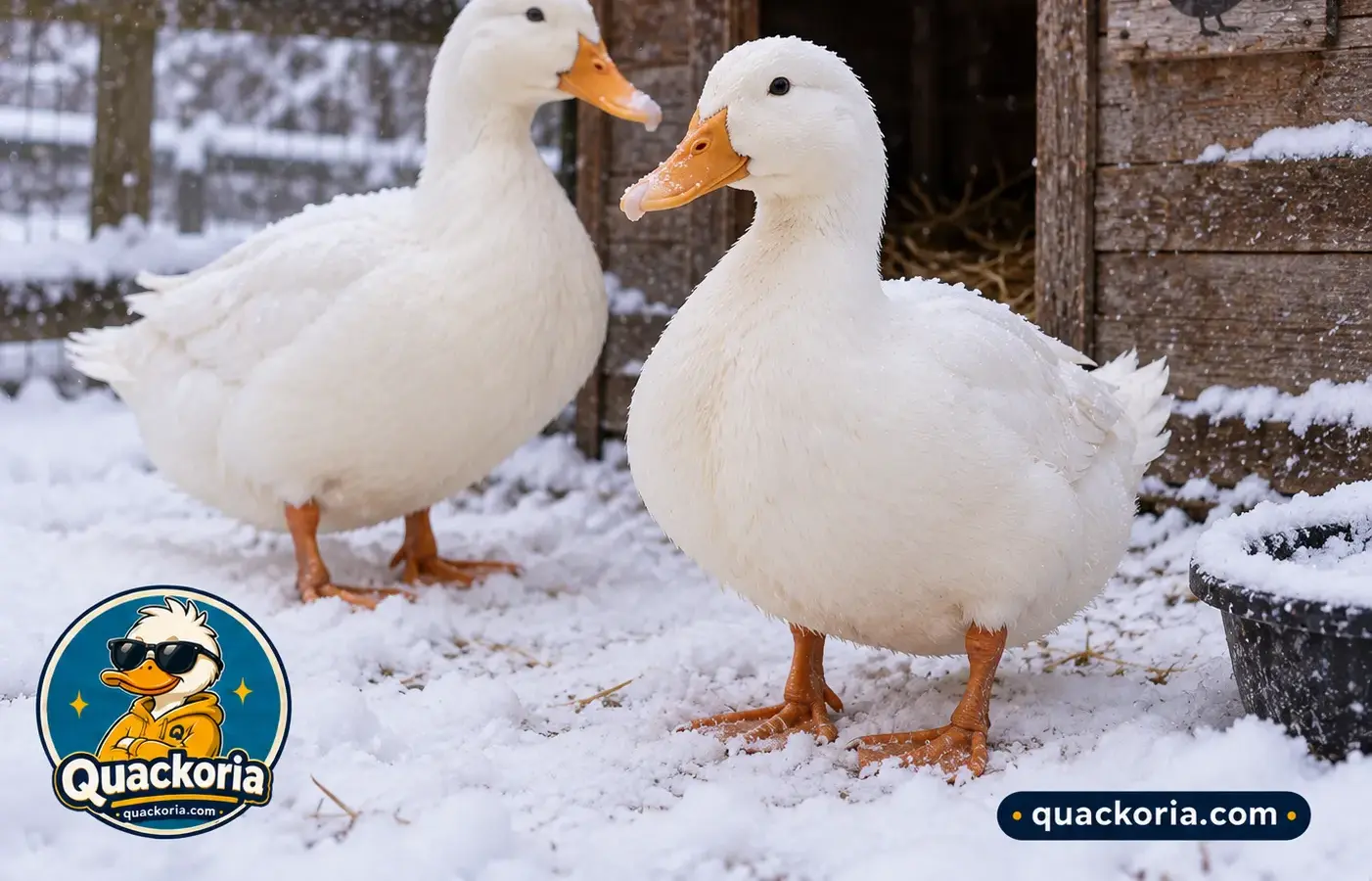
Ducks handle cold far better than the people who keep them. What they actually need in winter is unfrozen water, dry bedding and shelter from wind — and what they do not need is a heat lamp.
Key takeaways
- Adult ducks in good feather cope with hard frost. Wind and damp are the real enemies.
- Avoid heat lamps in a duck house — the Open Sanctuary Project calls them a serious fire risk, and the heat is rarely needed.
- Unfrozen drinking water is the one thing you cannot skip, at any temperature.
- Deep dry bedding helps keep them warm; Metzer Farms adds an extra layer or two in really cold areas.
- Feet are allowed to run cold, but frostbite does happen, usually on the legs and feet (PoultryDVM).
What you need
- A heated drinker base or bowl, positioned outside the house
- Plenty of extra straw or shavings for deep bedding
- A windbreak on the exposed side of the run
- A spare drinker so you can swap a frozen one straight out
- Higher-energy feed such as cracked corn for a late-afternoon top-up
Why ducks are better at this than you are
A duck in good condition is carrying a down jacket and a raincoat at the same time. The down layer traps warm air against the body; the outer feathers, kept waterproof by preening, keep that layer dry. Their feet are allowed to run cold: in the classic study on mallards, the temperature under the skin of one bird’s feet stayed several degrees above freezing even in fluid at -8°C (18°F). The arteries and veins in the leg lie side by side, and the authors judged it probable that the low heat loss is due to reduced blood flow (Kilgore and Schmidt-Nielsen, 1975) — more in why ducks’ feet don’t freeze. That is why a duck can stand on ice for long periods looking unbothered, though not without limit: frostbite does happen, and Metzer Farms notes that a duck whose feet get too cold will sit and bring its legs up close to its body.
What that system cannot handle is being permanently wet, standing in a draught, or having nothing to drink.
The three things that matter
1. Unfrozen water, always
This is the non-negotiable one. Ducks do not eat as much if they cannot drink (eXtension), and a duck cannot clean its eyes and nostrils without dunking its head. In freezing weather the main options are a thermostatically controlled heated bowl or base, or checking, breaking ice and refilling by hand several times a day, which is the University of Maryland Extension’s advice.
Keep the water station outside the house. Water inside means wet bedding, and wet bedding in winter is worse than cold.
2. Dry, deep bedding
Add straw or shavings rather than replacing everything, and keep the layer deep. Dry bedding insulates the floor, absorbs the moisture ducks bring in, and gives them something warm to sit on. Damp bedding is linked to bumblefoot and to aspergillosis, usually a respiratory infection (PoultryDVM, Merck Veterinary Manual).
Check by hand, not by eye. If it feels cold and packed, it needs topping up or changing.
3. Shelter from wind
Still cold is manageable; wind is the bigger problem. The University of Maryland Extension warns that air blowing directly on birds can chill them, and PoultryDVM lists wind and draughts among the risk factors for frostbite. Block the prevailing wind side of the run with boards, straw bales or a tarpaulin, leave the sheltered side open, and keep the house ventilated high up so damp air can leave without a draught blowing across sleeping birds.
Why not a heat lamp
Heat lamps above dry bedding, in a building full of moving animals, can start fires. The Open Sanctuary Project says that heat lamps, “especially those with glass bulbs, pose a serious fire risk”, and even the University of Maryland Extension, which suggests lamps with automatic shutoffs rather than gas heaters, warns that “even heating lamps can cause fires if not properly secured”. If a long spell below freezing does call for heat, the Open Sanctuary Project’s advice is that “ceramic heat panels are a much safer option”.
Ducklings are the exception: they genuinely need controlled heat, as covered in raising ducklings week by week. Healthy adults usually do not; the Open Sanctuary Project notes that Muscovies tend to be more sensitive to cold, and that health problems can affect how well any duck copes.
Feeding in the cold
Birds need extra energy in cold weather, the University of Maryland Extension says, so feed should be available at all times. Keep the normal ration as the base — see what to feed ducks — and add a handful of cracked corn late in the day: the same bulletin suggests high-energy treats and scratch grains in the evening “to help keep them warm all night”. How much corn is sensible is in can ducks eat corn.
Greens get scarce in winter. Metzer Farms lists peas, lettuce, cabbage and other green vegetables as good treats, as long as treats stay a small part of the diet.
Winter jobs, in order
- Check and refill water first thing, before anything else.
- Top up bedding if it feels damp.
- Look at every bird — standing square, bright-eyed, moving normally.
- Corn late in the day.
- Water again, and shut the house at dusk. Metzer Farms calls winter “a prime time for predators”, with fewer wild animals for them to hunt.
Which birds need extra attention
- Young ducks still growing their feathers; Metzer Farms says ducklings should be covered with feathers by seven weeks.
- Older birds and any bird that has been unwell.
- Thin birds — run a hand along the keel bone; a prominent keel means underweight (Open Sanctuary Project).
- Muscovies, which the Open Sanctuary Project says tend to be more sensitive to cold than other breeds and can get frostbite on the caruncles of the face — see keeping Muscovy ducks.
- Any duck that is wet and cannot dry off. A duck with damaged waterproofing in freezing weather needs shelter now.
The autumn checklist, done before the first frost
Everything on this list is easier in October than in January with cold hands.
- Walk the house looking for draughts at bird height. Seal those. Leave the high vents completely open — damp air has to be able to leave.
- Check the roof. One drip onto the bedding ruins a whole corner of it.
- Re-check the predator hardware. Mesh, latches, and the skirt around the base. Metzer Farms advises checking and repairing the run’s fencing before winter, when predators have fewer wild animals to hunt.
- Get the water plan sorted. Heated base, or two drinkers so you can swap a frozen one for a full one without waiting.
- Lay in bedding. More than you think. You will use it faster in winter.
- Put a windbreak on the exposed side of the run, leaving the sheltered side open so it does not become a damp box.
- Sort the mud now. A well-drained bed of shingle where the birds stand at the water (RSPCA), before it turns into a permanent bog.
Ice: the options, compared
- Heated bowl or heated base. The reliable answer: it means the water is liquid at six in the morning whether or not you are awake. Keep it outside the shut house; because of the fire risk, the Open Sanctuary Project suggests a plain bowl at bedtime rather than a heated base or bowl left plugged in overnight where birds are locked in.
- Two drinkers, swapped several times a day. Free, works fine, and utterly dependent on you being there. Keep the spare indoors so it is not frozen when you need it.
- Floating balls on the surface. Metzer Farms suggests a few where there is no electricity outdoors: they “can help keep ice from forming too quickly”. They buy time; they do not stop the water freezing.
Snow, mud and free-ranging
Most ducks are unbothered by snow and will walk straight out into it: Metzer Farms says that “Normally ducks would rather spend their day out in the snow than inside.” Snow is still on PoultryDVM’s list of frostbite risks, so clearing a path and scattering a layer of straw over it gives them somewhere to stand off it.
Winter is also, Metzer Farms says, a prime time for predators, because there are fewer wild animals for them to hunt. If the run has no top to protect against attacks from the air, Metzer suggests giving the ducks cover — bushes, or even a picnic table.
The moult, which always arrives at the worst time
Most domestic ducks descend from the mallard and have inherited aspects of its moult (Metzer Farms). Wild mallards replace their entire plumage after breeding and are flightless for several weeks while new flight feathers grow (30–45 days, Ducks Unlimited; roughly three to four weeks, Metzer); drakes then moult again in autumn, and females in winter, into breeding plumage (Ducks Unlimited). In domestic ducks, breed, daylight, location and breeding history can all shift the timing (Metzer). During a moult a duck looks scruffy and lays less: Metzer describes a female missing her flight feathers as “probably not laying”. Handle a moulting bird as little as possible — Meyer Hatchery warns that the new feathers are sensitive and can break off and bleed.
Signs a duck is genuinely struggling with cold
- Feathers puffed up for long periods — the Open Sanctuary Project names puffed-up feathers as a sign a duck is too cold.
- Trembling or tremors. Do not put these down to cold alone: the health guide linked below lists tremors among the signs that need a vet now.
- Refusing to leave the house on a dry day.
- Wet, matted feathers that do not dry.
- Any limping, or toe tips and webs that are red and swollen, stiff, or black — possible frostbite (Open Sanctuary Project), which PoultryDVM says needs a vet’s advice before any treatment. A limp can also be bumblefoot.
Bring a struggling bird into a dry, draught-free, quiet space with food and water, and read the health guide for what needs a vet rather than a warm corner.
Frequently asked questions
How cold is too cold for ducks?
Healthy adult ducks in full feather cope with temperatures well below freezing. Metzer Farms says most duck houses need no insulation unless winter nights often fall to about -9°C (15°F) or below, and that ducks should have a shelter to go into in especially severe weather; the Open Sanctuary Project advises keeping ducks inside during extreme cold, freezing rain or dangerous windchill. Young birds that are not fully feathered, older birds, Muscovies and any duck in poor health need more care.
Should I put a heat lamp in the duck house?
No. The Open Sanctuary Project calls heat lamps, especially those with glass bulbs, a serious fire risk, and ducks rarely need them. Block draughts and add bedding instead: Metzer Farms says most duck houses need no insulation unless winter nights often fall to about -9°C (15°F) or below. If a long freeze does call for heat, the Open Sanctuary Project recommends ceramic heat panels as a much safer option.
Will my ducks get frostbite?
They can. PoultryDVM says frostbite in ducks usually affects the unfeathered legs and feet, and Muscovies can also get it on the face; the risks it lists include temperatures below freezing, poor shelter, snow, and wind or draughts. Early signs are cold, reddened skin; shrivelled, blackened tissue is advanced. Ask a vet before treating it.
Do ducks still swim in winter?
They will, happily, in water that is not frozen: the University of Maryland Extension says that even in the coldest temperatures ducks and geese seek out water to swim in. Swimming water is optional, though — Metzer Farms says ducks do not need it every day — so it can be skipped in hard frost. Water deep enough to dunk the head cannot.
Do ducks lay in winter?
Most slow down or stop as days shorten. Some laying breeds keep going, especially with supplemental light.
Sources
- Metzer Farms — Getting your ducks and geese ready for winter
- Metzer Farms — Frequently asked questions
- Metzer Farms — Why has my duck stopped laying eggs?
- Metzer Farms — Using lights to increase duck egg production
- Metzer Farms — How to tell which ducks in your flock are laying eggs
- Metzer Farms — The great duck disguise: eclipse plumage
- Metzer Farms — Treats your ducks will love
- Metzer Farms — Best bedding materials for waterfowl
- eXtension (Jacob, University of Kentucky) — Raising meat ducks in small and backyard flocks
- University of Maryland Extension FS-1133 — Winter weather and small flocks: what you need to know
- British Waterfowl Association — Ponds
- RSPCA — Outdoor areas for pet geese and ducks
- RSPCA — Welfare standards for domestic/common ducks (June 2023)
- DEFRA — Code of recommendations for the welfare of livestock: ducks
- The Open Sanctuary Project — Creating a good home for ducks
- The Open Sanctuary Project — Additional care recommendations for older ducks
- The Open Sanctuary Project — How to conduct a duck health check
- PoultryDVM — Frostbite in ducks
- PoultryDVM — Wet feather in ducks
- PoultryDVM — Bumblefoot in ducks
- PoultryDVM — Aspergillosis in pet ducks
- Merck Veterinary Manual — Aspergillosis in poultry
- Kilgore & Schmidt-Nielsen (1975), Heat loss from ducks' feet immersed in cold water, The Condor 77
- Cornell Lab Bird Academy — How feathers are built
- Ducks Unlimited — Mallard annual life cycle
- Meyer Hatchery — Duck molting