
Quackoria Learn
Duck Domestication: How Ducks Became Farm Animals
Almost every farm duck descends from the mallard. The Muscovy does not — it was domesticated separately in the Americas. Here is what the evidence says about when, where and why, and where the experts still disagree.
Key takeaways
- Ducks were domesticated twice: the mallard in Asia and the Muscovy in the Americas, from two unrelated wild species.
- Genomic studies date mallard domestication to roughly 2,200-2,500 years ago; The Livestock Conservancy says over 4,000. Both figures are in circulation and they do not agree.
- Ancient Egypt captured, penned and force-fed wild ducks at scale, but the evidence for domestication there covers geese, not ducks.
- Varro's first-century BC farming manual describes a purpose-built Roman duck yard in detail, down to the overhead net and the plastered walls.
- No verified date exists for Muscovy domestication; the specialist literature says the circumstances are unknown.
- The FAO reports 1.15 billion ducks kept worldwide in 2020, 89 per cent of them in Asia.
Ducks were domesticated twice, on two continents, from two different wild birds that are not close relatives. Almost every farm duck in the world today descends from the mallard. The exception is the Muscovy, which was already being kept in the Americas long before Europeans arrived and which comes from an entirely separate lineage. That double origin is the first thing to understand about duck history, and it explains a great deal about why a Muscovy behaves so differently from a Pekin.
Two wild birds, two separate domestications
The archaeologist Dale Serjeantson, writing in the Encyclopedia of Global Archaeology, describes the situation plainly: there is “the common duck, domesticated from the wild mallard (Anas platyrhynchos), and the muscovy duck (Cairina moschata).” Two domestic species, not one.
The FAO puts the same split in production terms: most breeds descend from the mallard, which was domesticated in southern China, while the Muscovy was domesticated in Latin America, “where it remains ubiquitous.” A 2021 study of three chromosome-level duck genomes in Nature Communications agrees that “almost all varieties are descended from the Mallard.”
This is why the Muscovy sits oddly in every list of duck breeds. It is not a mallard-derived breed at all. Where a mallard-derived duck quacks, the Muscovy is “usually silent”, in the words of Cornell’s Lab of Ornithology: the males hiss and puff in courtship and the females give a quiet quack or croak. It perches in trees, it incubates for 35 days rather than 28, and crossing it with a mallard-derived duck produces sterile offspring. If you have ever wondered why keeping Muscovy ducks feels like keeping a different animal, that is because, taxonomically, it is one.
When did the mallard become a farm bird? The honest answer is that experts disagree
Two genomic studies have tried to date it, and they land close to each other. A 2018 whole-genome resequencing study in GigaScience concluded that domestication occurred 2,228 years ago, with a 95% confidence interval of plus or minus 441 years, placing the origin in southeast Asia. The 2021 Nature Communications genome paper independently put it at “about 2200–2500 years ago” without naming a region.
The Livestock Conservancy, however, states that domestication “started in Southeast Asia over 4,000 years ago.” That is roughly double the genomic figure, and the organisation gives no citation for it. We are not going to pretend one of these is settled. The genomic estimates come from a specific method — modelling how genetic variation accumulated — and the authors of the 2018 paper added their own caution, noting that the real history “is likely to be more complex than the simple demographic scenarios modeled here.”
There is also a third position worth knowing. Rosemary Luff, writing in The Cambridge World History of Food, points out that because the wild mallard is so widespread across the Northern Hemisphere, “it is extremely likely that it was widely utilized by humans and probably domesticated in different areas at different times.” On that view, asking for a single date and a single place is the wrong question.
What the Egyptian evidence actually shows
You will often read that the ancient Egyptians domesticated ducks. The evidence does not support that, and the distinction matters.
Between Heaven and Earth: Birds in Ancient Egypt, published by the Oriental Institute at the University of Chicago, documents what Egyptians genuinely did. They caught waterfowl at scale — the most effective method “required a clap-net and a well-coordinated team of fowlers” — and then a “large proportion of the birds was placed into crates and sent by boat to poultry-yards.” Once there, “ducks and geese were kept in an enclosure surrounding a water basin,” and some birds “were selected to live in smaller enclosures and be force-fed, so as to improve the quality of their flesh.”
That is mass capture, penning and fattening. It is not domestication, which the same volume defines as a slow process that alters an animal’s genetic make-up. And the volume makes the domestication claim for geese only, noting that goslings in New Kingdom farmyard scenes led scholars to conclude some goose species had been domesticated by around 1400 BC. No equivalent statement is made anywhere in it for ducks.
The authors go further and offer a reason: the sheer abundance of wild waterfowl, arriving reliably twice a year on migration, meant Egyptian bird-keepers had little motivation to breed these birds in captivity. Why farm what flies to you?
The Roman duck yard, described in detail
For an unambiguous description of purpose-built duck keeping, the best surviving source is Roman. In Res Rusticae, written in the first century BC, Varro gives instructions for building a nessotrophium, a duck farm, and the detail is startlingly practical.
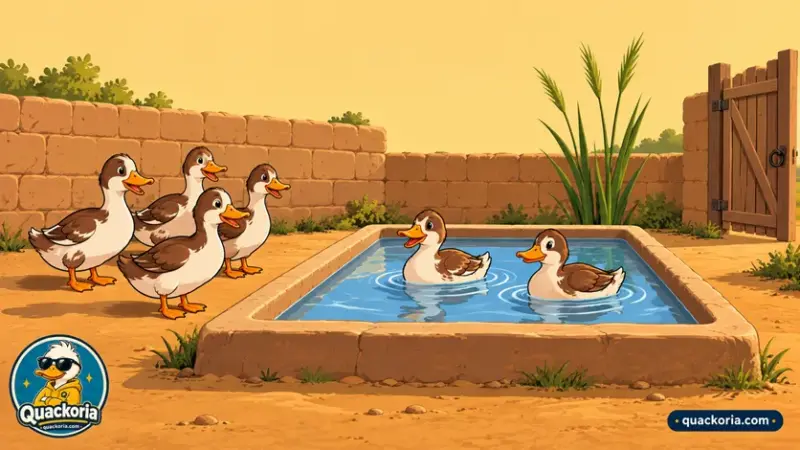
Choose swampy ground if you can, he writes, “for they like this best of all”; failing that, a pond they can walk down into by steps. Build an enclosure about fifteen feet high with a single entrance. Smooth the walls with plaster “so that no weasel or other beast can get in to harm them,” and cover the whole enclosure with a wide-meshed net “so that an eagle cannot fly in or the ducks fly out.” Feed them wheat, barley, grape skins, and sometimes water-crabs.
Predator-proof walls, an overhead net, graded pond access and a mixed diet: a modern keeper reading that list would recognise almost every item, which is roughly the same set of decisions behind a well-built duck house today. What Varro does not say is whether the stock was wild-caught or bred on the farm, so the text proves organised duck husbandry rather than settled domestication.
The Muscovy: an American story with a missing date
The Muscovy’s history is genuinely less well resolved, and the specialists say so. Writing in Diversity in 2009, the archaeologist Peter Stahl states that the Muscovy “is a poorly known domesticate” and that “the area and circumstances surrounding its early domestication are unknown.” What archaeology does record is its presence across western South America, Panama, eastern Bolivia, northwestern Argentina, Venezuela and Trinidad.
Physical evidence exists: Stahl and Norton identified Muscovy remains among the later prehistoric occupations at Salango in Manabí province, Ecuador, published in American Antiquity in 1987. But no source we could verify puts a firm date range on Muscovy domestication, so we are not going to invent one. It was pre-Columbian, it was American, and the rest is open.
Even the name is disputed. Serjeantson records two competing accounts: that it comes from the bird’s musky odour, or from “miskito,” after the Mosquito Coast where Spanish arrivals first met it. Neither explanation involves Moscow.
What people actually kept ducks for
Meat and eggs, obviously — but the historical record is broader than that. Serjeantson notes that both domestic duck species “produce eggs and down as well as meat and both are valuable on farms and smallholdings for reducing pests.” Luff adds a commercial logic that still holds: ducks “have a fast growth rate and can be killed as young as 6 to 7 weeks of age and still be palatable.”
The pest-control role is not a footnote. The FAO describes ducks in Asian rice systems working as pest controllers and fertiliser producers at the same time as they are raised for food. The Livestock Conservancy describes colonial North American keepers valuing ducks as “efficient converters of insects, slugs, snails, grains and plants into rich meat and nutrient-dense eggs,” alongside mosquito control in gardens, rice fields and orchards, plus rendered fat, feathers and down.
That combination — a bird that feeds you, fertilises your ground and eats your slugs — is a large part of why ducks spread so thoroughly, and it is still the case that people weighing ducks against chickens end up talking about foraging behaviour as much as about eggs.
Where duck keeping stands now
The FAO reports that of the 1.15 billion ducks kept worldwide in 2020, 1.0 billion — 89 per cent — were in Asia, with China, Viet Nam, Bangladesh and Indonesia the main producers. Duck keeping never stopped being centred on the region where the mallard was first brought into the farmyard.
How many distinct breeds exist is harder to answer than it sounds. The Livestock Conservancy maintains a Conservation Priority List covering more than 180 breeds across 11 species, with duck breeds ranked from Critical through Threatened to Watch, and the FAO runs the global DAD-IS database. We could not extract a clean, current global duck-breed total from either, so we are not going to publish one. What is clear is that several old breeds are on conservation lists, and that the Cayuga and Welsh Harlequin are among the breeds being actively watched.
Two thousand years or four, one domestication or several — the ducks in the yard are the surviving end of a long experiment, and a surprising amount of what Varro wrote about keeping them still applies.
Frequently asked questions
What wild bird do domestic ducks come from?
Nearly all of them come from the wild mallard, Anas platyrhynchos. The Muscovy is the exception: it descends from Cairina moschata, a separate species domesticated in the Americas.
When were ducks domesticated?
Two genomic studies put mallard domestication at roughly 2,200 to 2,500 years ago. The Livestock Conservancy states over 4,000 years ago. The estimates come from different kinds of evidence and have not been reconciled.
Did the ancient Egyptians domesticate ducks?
The documented evidence shows large-scale capture, penning and fattening of wild ducks rather than domestication. The Oriental Institute volume on birds in ancient Egypt makes the domestication claim for geese only.
Why is the Muscovy so different from other ducks?
Because it is a different species with a separate domestication history. It is usually silent, by the account of Cornell's Lab of Ornithology — the males hiss and puff in courtship and the females give a quiet quack or croak — and it perches in trees, incubates for about 35 days instead of 28, and produces sterile offspring when crossed with mallard-derived ducks.
Where is the name Muscovy from?
It is disputed. One account derives it from the bird's musky odour, another from miskito, after the Mosquito Coast where Spanish arrivals first met it. Neither involves Moscow.
How many duck breeds are there?
There is no single agreed figure. The Livestock Conservancy tracks duck breeds on its Conservation Priority List and the FAO runs the global DAD-IS database, but we could not extract a clean current world total from either, so we do not publish one.
Sources
- Serjeantson, Duck: Domestication, Encyclopedia of Global Archaeology (Springer)
- FAO — Poultry species: Ducks
- Zhang et al., Whole-genome resequencing reveals signatures of selection and timing of duck domestication, GigaScience 2018
- Zhu et al., Three chromosome-level duck genome assemblies, Nature Communications 2021
- Luff, Ducks, The Cambridge World History of Food
- Bailleul-LeSuer (ed.), Between Heaven and Earth: Birds in Ancient Egypt, Oriental Institute, University of Chicago
- Varro, Res Rusticae III.11, Loeb translation at LacusCurtius
- Stahl, Adventive Vertebrates and Historical Ecology in the Pre-Columbian Neotropics, Diversity 2009
- Stahl & Norton, Precolumbian Animal Domesticates from Salango, Ecuador, American Antiquity 1987
- The Livestock Conservancy — Heritage ducks in American history
- The Livestock Conservancy — Conservation Priority List
- Cornell Lab of Ornithology — Muscovy Duck Sounds, All About Birds