Quackoria Learn
Welsh Harlequin Duck: The Calm Layer You Can Sex at Hatch
Key takeaways
- Bred by Leslie Bonnet in Wales from two light-coloured Khaki Campbell ducklings hatched in 1949; to the US in 1968, where by 1980 the descendants of the first imports were down to two small flocks (The Livestock Conservancy).
- Metzer scores it 1.3 for calm and says they "seem to be the calmest bird on our farm"; the Conservancy calls it one of the quieter breeds.
- 100–150 eggs a year on Metzer's chart, 240–330 per the Conservancy; mothering good (Metzer) or poor to good (the Conservancy's chart); does not fly.
- Ducklings can be sexed at hatch by bill colour with about 90% accuracy (Metzer).
The Welsh Harlequin descends from two light-coloured Khaki Campbell ducklings hatched in 1949; Metzer Farms rates it among the calmest ducks on its chart. It is one of the quieter breeds, says the Livestock Conservancy, a layer and a table bird, and — Metzer says — its ducklings can be sexed at hatch by the colour of the bill with about 90% accuracy.
Metzer Farms says Welsh Harlequins “seem to be the calmest bird on our farm”, and the Livestock Conservancy calls them one of the quieter duck breeds — though the breed descends from the Khaki Campbell, which Metzer scores 9.0, at the nervous end of its 1–9 scale. Metzer adds that they are “becoming a very popular breed due to their multipurpose characteristics”.
Welsh Harlequin at a glance
| Trait | Figure | Source |
|---|---|---|
| Origin | Wales, 1949, from two light-coloured Khaki Campbell ducklings; bred by Leslie Bonnet | The Livestock Conservancy |
| To the US | Hatching eggs to Tennessee in 1968; more imports 1982; birds for sale from 1984; APA recognition (Silver) 2001 | The Livestock Conservancy |
| Adult weight | 4.5–5.5 lb (2–2.5 kg) Metzer; males 5–5.5 lb, females 5.5–6.5 lb TLC | Metzer, TLC |
| Eggs a year | 100–150 (Metzer); 240–330 (TLC) | Metzer, TLC |
| Egg weight | 75–85 g (Metzer); white or tinted (eXtension) | Metzer, eXtension |
| Temperament | 1.3 on Metzer’s scale — they “seem to be the calmest bird on our farm” | Metzer |
| Mothering | Good | Metzer |
| Foraging | Good | Metzer |
| Flight | None; “do not truly fly” | Metzer, TLC |
| Sexing at hatch | By bill colour, about 90% accurate | Metzer |
| Fertility | 75% across a season in Metzer’s flocks | Metzer |
| Incubation | 28 days | Cornell |
| Rarity | Watch | The Livestock Conservancy |
The egg figures are far apart, and neither source explains why; Metzer’s note says its lower figure is without artificial light and its upper figure with lights keeping 17 hours of light during lay. The whole chart, on the breed comparison tool, is the place to compare.
Where the Welsh Harlequin came from
The Livestock Conservancy has the dates. In 1949 two light-coloured mutant ducklings hatched from pure Khaki Campbells in the flock of Leslie Bonnet, a British Royal Air Force officer and duck breeder; the British Waterfowl Association says he began breeding selectively for the colour when he moved to Criccieth, in north-west Wales, and adopted the name Welsh Harlequin. The Conservancy says Bonnet and his wife “developed a globally-recognized duck breeding program”. The Harlequin came to North America in 1968, when John Fugate imported hatching eggs to Tennessee; by 1980 the descendants of those first imports were confined to two small flocks, the gene pool was widened with more imports in 1982, birds went on sale in the US in 1984, and the American Poultry Association accepted the Silver variety in 2001. The Conservancy lists the breed as Watch.
The Conservancy’s 240–330 a year is close to the 250–340 its chart gives the Campbell; on Metzer’s chart the Harlequin lays fewer than the Khaki Campbell, 100–150 a year against 165–240. Neither source says why.
What a Welsh Harlequin looks like
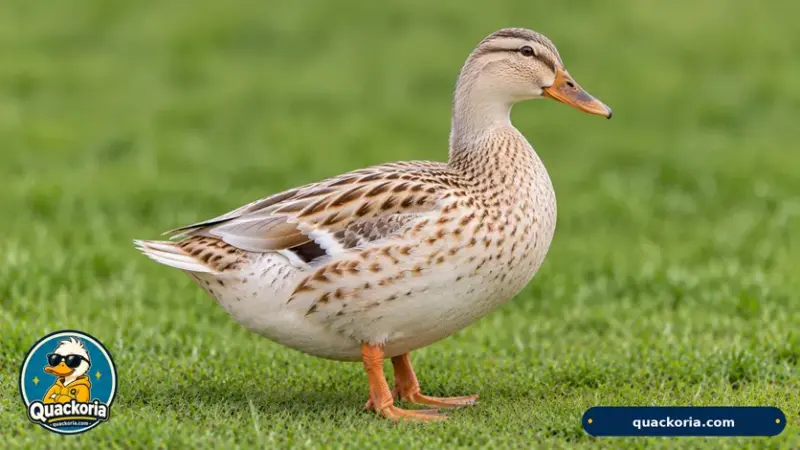
Lighter-coloured than the Campbell it came from. The Livestock Conservancy describes the duck as having “a creamy white head with brown stippling” and a creamy white body “with buff and brown-green or bronze bands on her wings”; the drake’s head is “greenish-black”, his shoulders “reddish-chestnut frosted with white” and his breast “creamy with reddish-chestnut”, and he carries the curled tail feather. Metzer says the drakes get the green head and colourful wings by about 15 weeks, and that adult drakes have a lighter-coloured bill than the ducks. There are two colour variations, Silver and Gold; Metzer calls Silver the more common. The bird is light and neat, at 2–2.5 kg — the British Waterfowl Association calls these “alert and slightly upright ducks” — and it does not fly.
The bill is the breed’s trick. Metzer states that Welsh Harlequin ducklings can be sexed at hatch by bill colour with about 90% accuracy — darker bills mean a male, and lighter bills ending in a dark spot are normally females, a difference that disappears within several days; the Conservancy puts it more cautiously as a subtle sex-linked difference in bill colour at birth. For a keeper who wants ducks rather than drakes, that is worth a great deal; the sexing tool explains what to look for, and male vs female ducks covers the signs that appear later in every breed.
Eggs
White or tinted eggs, in eXtension’s words — white to tinted and large on the Conservancy’s chart — of 75–85 g on Metzer’s chart. How many depends on the source: Metzer’s 100–150 a year at the cautious end, the Conservancy’s 240–330 at the optimistic one, and in the British Waterfowl Association’s words “passably good layers”. Metzer’s fertility figure of 75% across a season is the second-lowest on its chart after the Call, which matters only if you plan to breed. Metzer rates the mothering good and the Conservancy’s chart poor to good; if a Harlequin does go broody, the broody duck guide covers what she needs, and the 28-day timeline on the day-by-day tool applies. When do ducks start laying eggs covers the run-up to the first egg.
Temperament and noise
Metzer scores it 1.3 — only the Silver Appleyard and the five breeds at 1.0 (Muscovy, Call, Saxony, Australian Spotted, Golden Cascade) score lower — and says they “seem to be the calmest bird on our farm”; the Conservancy describes it as docile, active and inquisitive, and “one of the quieter duck breeds”; it adds that they “enjoy interacting with people and are not a flighty breed” and are “easily trained to free range during the day and come to be put up in the evening”. It still quacks: the Conservancy notes that the ducks are noisier than the drakes. Why ducks quack explains the calls.
Keeping Welsh Harlequins
Nothing special is needed, which is part of the appeal: the Conservancy’s chart rates it a breed for novices, and its breed page says it does well in both heat and cold given suitable housing and clean water. It is light, flightless and forages well (Metzer rates it good). Give it the standard things — a house shut at dusk, hardware cloth over the gaps, water deep enough to submerge the head, a ration with enough niacin, and a layer feed, which Metzer says usually carries enough calcium without extra oyster shell — and it will get on with it. The duck house guide, duck predators, duck water needs and what to feed ducks cover each of those, and the space calculator gives the space by number and age.
The breed’s Watch status is worth a thought: the Conservancy’s history shows that by 1980 the US descendants of the first imports were confined to two small flocks.
Is the Welsh Harlequin right for you?
Yes, if you want eggs and a calm, quieter, handsome bird in the same duck, and especially if you want to buy ducklings and have a good idea which are female. Choose something else if you want more eggs (a Khaki Campbell), a big table bird (a Pekin or a Muscovy), a usually silent duck (a Muscovy), or a bantam (a Call). The beginner’s guide to duck breeds sets them side by side, and the breed quiz is the two-minute version.
Frequently asked questions
Can you really sex Welsh Harlequin ducklings at hatch?
Metzer says yes, by bill colour, with about 90% accuracy. The Livestock Conservancy puts it more cautiously as a subtle sex-linked difference in bill colour at birth.
How many eggs does a Welsh Harlequin lay?
Metzer's chart gives 100–150 a year; the Conservancy gives 240–330, and the British Waterfowl Association calls them "passably good layers". The sources do not explain the gap.
Are Welsh Harlequins quiet?
One of the quieter breeds, per the Conservancy, which adds that the ducks are noisier than the drakes; Metzer says they seem to be the calmest bird on its farm.
Can Welsh Harlequin ducks fly?
No. Metzer rates flight as none and the Conservancy says they do not truly fly.
Where did the Welsh Harlequin come from?
From two mutant ducklings that hatched from pure Khaki Campbells in 1949, bred on by Leslie Bonnet and his wife in Wales.
Sources
- Metzer Farms — Compare Duck Breeds
- Metzer Farms — Using Lights to Increase Duck Egg Production
- Metzer Farms — Sexing Ducks and Geese
- Cornell University Duck Research Laboratory — Hatching Duck Eggs
- RSPCA welfare standards for domestic and common ducks
- The Livestock Conservancy — Welsh Harlequin Duck
- Metzer Farms — Welsh Harlequin Ducks
- The Livestock Conservancy — Heritage Duck Breed Comparison Chart
- British Waterfowl Association — Welsh Harlequin
- eXtension — Selecting a Duck Breed for Small or Backyard Poultry Flocks (Jacquie Jacob)
- Metzer Farms — Male vs Female: How to Identify Adult Ducks
- Metzer Farms — FAQ
- Metzer Farms — Niacin: What Is It and Why Do My Ducklings and Goslings Need It?
- eXtension / poultry.extension.org — Predator Management for Small and Backyard Poultry Flocks
- Metzer Farms — Muscovy Ducks
- Cornell Lab of Ornithology — Muscovy Duck Sounds