Quackoria Care
How to Build or Buy a Duck House: Space, Bedding and Predator-Proofing
Key takeaways
- 4-5 sq ft indoors per adult duck. Outdoor figures run from 15 sq ft (Merck) to 50 sq ft (Metzer, for ducks on pasture with no shelter), and a garden run with no rotation is safer near the top of that range.
- Most ducks do not roost (Muscovies are the exception). The house is low and wide with a dry floor, and roosting bars are wasted space.
- Merck says straw and ground corncobs absorb poorly and often mould, and prefers sand, pine shavings, rice and nut hulls. Cornell still beds on straw or shavings: whatever you use must stay dry and mould-free.
- Litter at 20-25% moisture. Squeeze a handful: it should clump briefly, then crumble.
- eXtension: bury hardware cloth at least 12 inches, and note that a least weasel gets through a quarter-inch hole.
- Shut the door at dusk, every night: eXtension's advice is to have the flock roost in a secured location with every door closed and locked.
What you need
- Half-inch welded hardware cloth
- Pine shavings or sand for bedding
- Timber or a bought coop with at least 4-5 sq ft of floor per duck
- A door that latches, ideally an automatic one
- A wire-mesh screen to stand an indoor waterer on
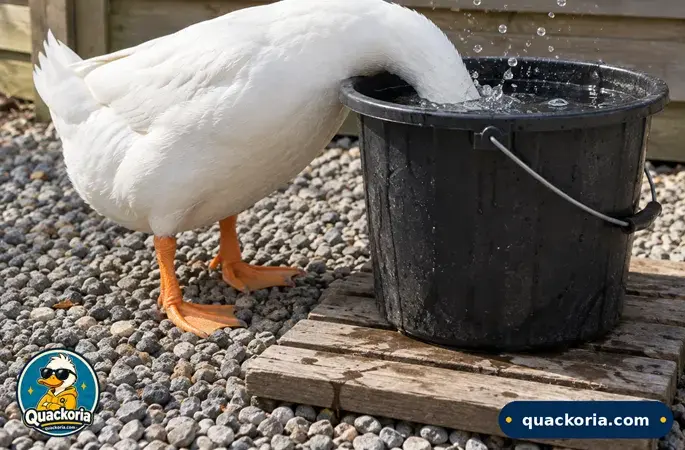
A duck house has one job a chicken coop does not: it has to stay dry underneath a bird that carries water indoors on its feet and bill, every single night. Get that right and most of the rest follows. Get it wrong and you will be fighting wet bedding, ammonia and sore feet all year.
This guide covers how much space a duck actually needs, what the shelter has to do, and how to keep a predator out of it. Where the published figures disagree — and on space they disagree by a factor of three — you get the range and who said what, rather than one confident number we made up.
Most ducks do not roost, and that changes everything
A chicken coop is designed around a bird that goes up. Hens fly to a perch at dusk, sleep off the ground, and drop their droppings below them. That is why a chicken coop has roosting bars, why it can be tall and narrow, and why the floor stays reasonably dry.
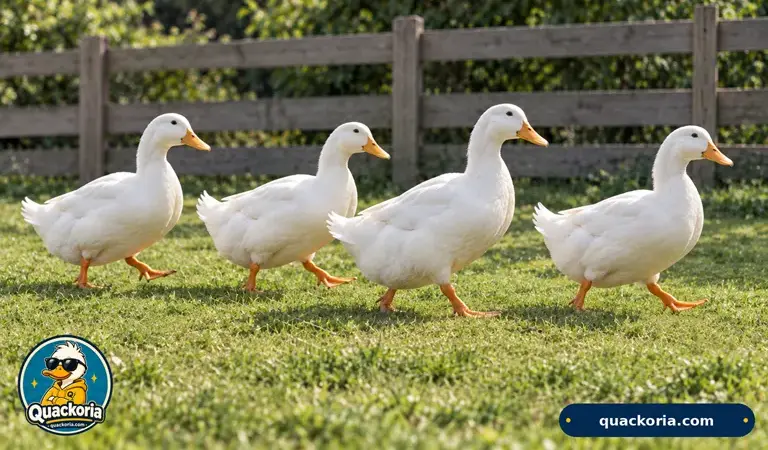
Most domestic ducks sleep on the floor. The Open Sanctuary Project notes the exception: Muscovies typically choose to sleep up off the ground when given the opportunity, and Metzer Farms says they will often perch in trees. Everything a floor-sleeping duck produces overnight lands where it is standing, and it has spent the day dipping its bill in water and shaking it off. A duck house is therefore a low, wide, dry box — and the dryness is the hard part.
This single difference explains most of what follows: the floor area, the bedding, the ventilation, and why a coop sold for chickens is usually the wrong shape.
How much floor space per duck
Here the sources genuinely disagree, and anyone who gives you one number without a source is guessing.
| Source | Indoor, per adult duck | Outdoor run, per duck |
|---|---|---|
| eXtension (space allowances) | 5 sq ft | No figure given — “the larger the run the better” |
| Merck Veterinary Manual | 3–6 sq ft (ducks and geese) | 15–18 sq ft (ducks and geese) |
| Metzer Farms | 4 sq ft (18 weeks+) | 50 sq ft (18 weeks+, on pasture with no shelter) |
| RSPCA welfare minimum | 17 kg/m² maximum stocking density (about 2.2 sq ft for a 3.5 kg bird) | 2.5 m² of range (about 26.9 sq ft); 4 m² (about 43 sq ft) where grass cover is poor |
Indoors, the practical range is 4 to 5 square feet per adult duck. eXtension gives 5 on its space-allowances page and 4 in its meat-duck guide, Metzer gives 4 and Merck’s 3–6 spans the range; the RSPCA figure is a welfare limit for farmed meat ducks rather than a recommendation.
Outdoors is where it gets wide: 15 square feet at one end, 50 at the other. That is not sloppiness on anyone’s part — they are answering different questions. The RSPCA’s 2.5 m² applies to paddocks where pasture management such as rotation keeps a good grass sward, and rises to 4 m² where grass cover is poor. Metzer’s 50 sq ft is for adult ducks kept on pasture with no shelter; for ducks with a house, its 4 sq ft is the enclosure figure, and it says not to count the outside run when working out the enclosure size. For a garden flock with no rotation and no drainage, plan closer to 50 than to 15, and expect the ground to tell you if you were wrong.
If you want the arithmetic done for your own flock and age mix, the duck housing space calculator uses the same figures and shows the range rather than hiding it.
The run does not replace the house
The house is for sleeping and for shelter from weather. Metzer Farms keeps the two allowances separate, and warns that cramped areas can lead to health issues including leg and weight problems, as well as wetter pens and more bedding — so a generous run does not make up for a house that is too small.
Height, shape and the door
The house does not need to be tall. A duck needs enough headroom to stand and turn without brushing the ceiling, and enough for you to reach every corner when you clean it — those are the only two constraints, and the second is usually the binding one. A house you cannot reach into is a house that does not get cleaned.
Wide and low beats tall and narrow. Floor area is the number that matters: every figure above is floor area.
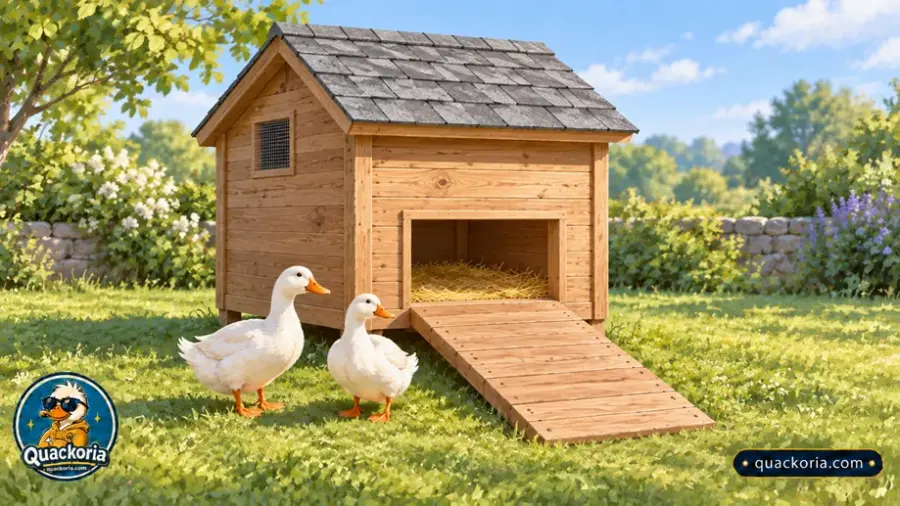
The pop door — the small door the ducks use — should be wide rather than tall. Ducks often travel in groups, and the Open Sanctuary Project warns that a small door suited to a chicken may cause a traffic jam; it advises a wider door so that more than one duck can move through at once.
The Open Sanctuary Project describes ducks as a bit less nimble than chickens, with trouble on big jumps and steep grades. A ramp, if you need one, wants to be wide and on a gentle incline, and it suggests thin horizontal strips of wood across it, about six inches apart. Better still, put the door at ground level and skip the ramp — and avoid a raised threshold, which the same source says can make even a ground-level exit difficult.
Bedding: the part most guides get wrong
Search for duck bedding and you will be told to use straw. Metzer Farms calls it the most common bedding, and Cornell’s Duck Research Laboratory says the earth floor of a shelter “should be bedded with straw, shavings or similarly dry absorbent material”. The Merck Veterinary Manual disagrees, and gives a reason:
“Straw and ground corncobs have poor absorbent qualities and often become moldy.”
Merck’s recommended materials are sand, pine shavings, rice and nut hulls, because they hold moisture. It warns against excessively dry litter such as sawdust for a different reason — the dust can irritate the respiratory tract. The sources do not agree on every material: eXtension’s meat-duck guide lists wood shavings, sawdust and rice hulls as good litter choices; Metzer finds that rice hulls do not absorb moisture well, and that straw used on its own “does not absorb moisture well” either.
This matters more for ducks than for chickens: Cornell’s Duck Research Laboratory says ducks drink and excrete more water than chickens or turkeys, and that their droppings contain over 90% moisture. Cornell also says indoor “waterers should be located on a wire-mesh screen to reduce wetting of the litter”. A material that goes mouldy when wet is a bad choice in a house that is wet by design. Cornell’s advice for preventing aspergillosis, which ducks get by breathing in mould spores, is to avoid mouldy straw and keep feed dry; the Open Sanctuary Project says straw carries an increased risk of aspergillosis; and Metzer says that whatever bedding you use must be free of mould and dry before use. Mouldy feed is a separate danger: Merck says certain moulds can produce aflatoxins in feedstuffs, and that ducks and turkeys are particularly sensitive to aflatoxicosis; Cornell calls ducks highly susceptible.
How to tell when the bedding has had it
Merck gives a target of 20–25% moisture, and a test you can do with your hand: grab a handful, and it should clump briefly and then crumble apart. If it stays in a ball, it is too wet. If it will not clump at all, it is dusty.
That test is worth more than any schedule. How often you change bedding depends on how many ducks, how big the house, and what the weather has been doing — the squeeze test tells you the answer for today.
What wet bedding does
This is not an aesthetic problem. Merck lists the consequences of wet litter and the ammonia it produces:
- ammonia burns to the cornea
- footpad dermatitis
- breast blisters
- skin burns
Ventilation without draught
Ventilation is how the moisture leaves: Merck says adequate ventilation enables the removal of moisture from the bedding. A sealed house with ducks in it is a humidity box, and the bedding will never dry no matter what you put down.
What you want is air moving out at the top, above the birds, while the floor stays still. Vents high in the walls or under the eaves do this: Cornell’s Duck Research Laboratory says window openings and ridge ventilation may provide adequate air exchange, and the Open Sanctuary Project suggests windows above duck height. Openings at duck height put cold air across sleeping birds, which is the definition of a draught — and eXtension asks for a “clean, dry, draft-free shelter”.
Merck adds a placement note for windows: put them on the south or east side, and keep any ledge narrow so birds cannot roost on it.
The test for adequate ventilation is your nose, at duck height, first thing in the morning before you open the door. If you can smell ammonia, there is either too little air moving or too much wet bedding, and usually both.
Predator-proofing
Metzer’s breed chart rates most domestic breeds “None” for flying, and most ducks sleep on the ground, so whatever gets into the house reaches them.
Wire: the mesh size is the whole point
Chicken wire keeps chickens in. It does not keep everything out: eXtension says least weasels typically get through it, and that raccoons sometimes pull a bird’s head through the wires of an enclosure. Use welded hardware cloth instead.
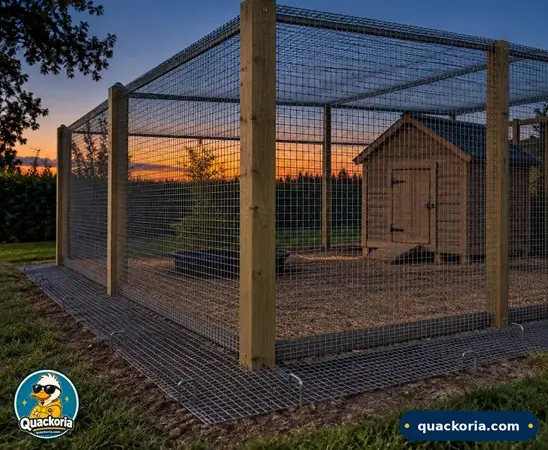
On mesh size, eXtension’s predator guidance is specific and slightly alarming: least weasels can squeeze through holes as small as ¼ inch. Gaps of ¼ inch or smaller do admit snakes, but eXtension notes that snakes entering through openings that small typically cause no damage.
Half-inch hardware cloth is the usual compromise, but it will not stop a least weasel, which gets through holes half that size. The Open Sanctuary Project suggests covering every opening the size of a quarter or larger with ¼ to ½ inch galvanized hardware cloth.
Diggers
Kentucky’s extension service names foxes, coyotes and rats as diggers, and it and eXtension give the same figure for stopping them: bury hardware cloth at least 12 inches (30.5 cm) into the ground.
An alternative that works on the same principle is a skirt — hardware cloth laid flat on the ground, extending outward from the base of the fence and pegged down. Alberta’s agriculture department describes it as a 12 to 18 inch (30–45 cm) wide strip of wire mesh laid on the ground surface around the entire pen, attached to the fence and pegged down. Maryland’s extension service gives a buried version: fencing at least a foot into the ground, then turned outward at a right angle for at least another 8–10 inches. Either way, the vertical wall of the run is not the defence; the ground is.
Climbers and fliers
eXtension notes that gray foxes are the only foxes that readily climb trees. Hawks and owls do not need to climb.
Merck’s guidance is that the top of the enclosure should be covered, both to protect against predators that fly or climb, and to prevent exposure to wild birds that can transmit disease. Avian influenza is one of those diseases: Merck’s page on bird flu for owners says a key way to prevent infection is to keep domestic birds away from wild birds that could carry the virus, and an open-topped duck run beside a pond invites exactly that contact.
Merck adds: avoid water holes and vegetation right around the housing, because they attract wild waterfowl, insects and rodents.
Which predator was it?
If you have already lost a bird, what is left behind narrows it down — though eXtension’s predator management guidance, which this table follows, words each sign as what the predator “probably” or “may” be, not as proof:
| What you find | Likely |
|---|---|
| Adult bird simply gone | Dog, coyote, fox, bobcat, hawk or owl |
| Chicks or ducklings gone (eXtension’s list is for chicks) | Snake, rat, raccoon, house cat |
| Dead but not eaten, bodies bloodied | Weasel |
| Heads missing | Raccoon, hawk or owl |
| Bites all over | Dog |
| Wounds to breast or legs of young birds | Opossum |
| Bites at the hocks of young birds | Rat |
| Eggs gone | Skunk, snake, rat, opossum, raccoon, jay, crow |
Two details from the same source help confirm a guess: raccoons may carry eggs away, usually within about 28 feet of the nest, while skunks rarely move one more than about three feet.
The one measure that costs nothing
Shut the door at dusk, every night, without exception. eXtension’s advice is to have the flock roost inside a secured location at night, making sure to close and lock all doors. A well-built house with the door left open is a well-built house with the door left open.
If you know you will forget, an automatic door closes it for you.
Buying versus building
Most coops sold to backyard keepers are designed for chickens, and they get three things wrong for ducks:
- Too small. A coop sized for six hens at eXtension’s 3–4 square feet per hen has 18–24 square feet, which at 4–5 square feet per duck holds between three and six ducks — six only at the large end of both ranges.
- Roosting bars and nest boxes off the ground. Wasted volume for most ducks. The Open Sanctuary Project says chicken nest boxes are typically too small for ducks and elevated designs are hard for them to get into, and advises ground-level nesting areas for laying ducks.
- A raised floor with a steep ramp. Ducks manage it badly: the Open Sanctuary Project says they can have trouble with big jumps and steep grades.
If you buy, look for floor area and a door you can reach through, and ignore the bird count on the label. If you build, the whole specification is: a dry floor of the right area, low, wide, ventilated at the top, half-inch hardware cloth, wire in the ground, a covered run, and a door that shuts.
What this does not cover
Nest boxes are the part of duck housing with the least published guidance. A university and a hatchery give dimensions — 12 inches wide, 18 long and 12 deep from UGA, roughly 12 × 14 inches from Metzer, which also warns that nest-sharing rarely works well — but none of the sources checked here publishes a ducks-per-box ratio. The “one box per three to five ducks” figure that appears everywhere online has no source behind it that we could find. The DEFRA duck welfare code mentions nest boxes only to say they should not be so high that birds have difficulty or risk injury using them, and should have adequate litter; it gives no size or number.
So: provide boxes at ground level in a quiet, sheltered corner (Metzer advises a quiet, sheltered spot; the Open Sanctuary Project, ground-level nesting areas), and accept that some of your ducks will ignore them — UGA notes that ducks will make their own nest if straw or other litter is provided.
The short version
- 4–5 sq ft indoors per adult duck; outdoors, aim high — published figures run from 15 to 50 sq ft and a garden run with no rotation is safer near the top of that range
- Low and wide, not tall; a wide pop door; no roosting bars, because most ducks do not roost
- Pine shavings, sand or rice hulls, which Merck prefers to straw; whatever you use must stay dry and free of mould
- Squeeze test the bedding: it should clump then crumble
- Ventilate above the birds, never across them; windows south or east
- Half-inch hardware cloth, buried 12 inches or laid as a skirt; cover the top of the run
- Shut the door every night, with the flock locked in a secured house (eXtension)
This is husbandry guidance, not veterinary advice. If a bird is ill or injured, find an avian vet.
Frequently asked questions
How much space does a duck need in its house?
Published figures cluster at 4-5 square feet per adult duck indoors: eXtension gives 5 (4 in its meat-duck guide), Metzer 4, Merck a range of 3-6. The RSPCA's maximum stocking density of 17 kg/m², about 2.2 sq ft for a 3.5 kg bird, is a welfare limit for farmed meat ducks, not a recommendation for a backyard flock.
Can ducks live in a chicken coop?
Only if it is the right size and you ignore half of it. Most ducks do not use roosting bars or raised nest boxes, and a coop sized for six hens at eXtension's 3-4 square feet per hen holds between three and six ducks at 4-5 square feet each. A raised coop with a steep ramp is also awkward: the Open Sanctuary Project says ducks can have trouble with big jumps and steep grades.
What is the best bedding for a duck house?
The Merck Veterinary Manual recommends sand, pine shavings, rice or nut hulls because they hold moisture, and says straw and ground corncobs absorb poorly and often go mouldy; it warns that excessively dry litter such as sawdust is dusty. Other sources differ: Cornell beds on straw or shavings, and eXtension lists sawdust as a good litter. Whatever you use must be dry and free of mould.
Do ducks need a heat lamp in winter?
Adult ducks rarely need one, and the Open Sanctuary Project says heat lamps, especially those with glass bulbs, pose a serious fire risk. What they need is a clean, dry, draught-free shelter (eXtension).
How do I stop a fox digging into the run?
eXtension gives a figure for diggers: bury hardware cloth at least 12 inches into the ground. A flat skirt works on the same principle: Alberta's agriculture department describes a 12 to 18 inch wide strip of wire mesh laid on the ground around the pen, attached to the fence and pegged down.
Sources
- eXtension, Space Allowances in Housing for Small and Backyard Poultry Flocks
- eXtension, Predator Management for Small and Backyard Poultry Flocks
- Merck Veterinary Manual, Management of Backyard Poultry
- eXtension — Raising Meat Ducks in Small and Backyard Flocks
- Metzer Farms — How Much Space Do Ducks Need
- Metzer Farms — Best Bedding Materials for Waterfowl
- Metzer Farms — Duck and Goose Nesting Box: Size, Materials and Setup
- Metzer Farms — Compare Duck Breeds (flying ability)
- Metzer Farms — Muscovy Ducks
- Cornell University Duck Research Laboratory — Duck Housing and Management
- Cornell University Duck Research Laboratory — Duck Health Care
- Merck Veterinary Manual — Poisonings in Poultry
- Merck Veterinary Manual, for bird owners — Avian Influenza (Bird Flu)
- RSPCA — Welfare standards for domestic/common ducks (June 2023)
- DEFRA — Code of Recommendations for the Welfare of Livestock: Ducks
- University of Georgia Extension — Managing Ducks for Egg Production (2006)
- The Open Sanctuary Project — Creating a Good Home for Ducks
- University of Kentucky Extension ID-245 — Predator Management for Small-scale Poultry Enterprises in Kentucky
- University of Maryland Extension FS-1132 — Identifying and Preventing Poultry Predators in the Mid-Atlantic Region
- Alberta Agriculture — Prevention of Predator Damage in Poultry Flocks (Agdex 450/684-1)