Quackoria Learn
Can Ducks Eat Corn?
Key takeaways
- Ducks can eat corn. The Canal & River Trust puts sweetcorn first among the six best pond foods; Metzer Farms and the Open Sanctuary Project list corn as a treat.
- Corn is already the base of duck feed: NC State's example rations are 59 to 74 per cent yellow corn, with soybean meal supplying the protein.
- Corn grain is 9.4 per cent protein and sweetcorn 3.3, against a duck's 16 to 20 per cent requirement — energy, not nutrition.
- Whole kernels need grit (Metzer Farms); scratch stays around 10 per cent of the diet (Open Sanctuary, Purina) and is best given late in the day.
- Popcorn hulls and kernels can lodge in a duck's throat — both the Scottish SPCA and the Canal & River Trust warn against it.
Yes — sweetcorn, cracked corn and whole kernels are all safe, and corn is the one treat that appears on every list from the hatcheries to the wildlife trusts. The catch is that corn is what most duck feed is already made of, so as an extra it adds energy and nothing much else. Popcorn is the exception: the hulls and unpopped kernels are a real hazard.
The short answer
The Canal & River Trust puts sweetcorn first on its list of the six best foods for pond ducks: “It turns out that ducks are quite partial to sweetcorn. Tinned, frozen, or fresh.” Metzer Farms, a California duck hatchery, lists corn among its vegetable treats, and the Open Sanctuary Project’s duck diet guide suggests “warmed frozen corn (not hot!)” and “cracked corn in moderation”. The moderation is the point of this page. The New York Department of Environmental Conservation, which asks people not to feed waterfowl at all, groups “bread, corn, popcorn, etc.” together as “low in protein and are very poor substitutes for natural foods.” Both things are true at once: corn is safe, and corn is not a diet.
Corn is already in the bag
Open a sack of duck feed and the first ingredient is usually corn. North Carolina State University’s extension rations for ducks are built on it: “Yellow corn, #2 dent” makes up 70 per cent of the starter, 73.58 per cent of the grower and 59 per cent of the layer ration, with soybean meal supplying most of the protein on top. That is why a handful of extra corn changes so little — the bird is already getting corn’s energy, balanced with the protein, vitamins and minerals corn lacks. Feed more corn on its own and you dilute the balance.
What is in corn for a duck
Per 100 grams, the US Department of Agriculture’s reference data give raw sweetcorn 76 g water, 86 kcal, 3.3 g protein, 6.3 g sugars and 2 g fibre, with 270 mg potassium and 1.8 mg niacin. Dry yellow corn grain — the cracked corn in scratch — is a different food: 10.4 g water, 365 kcal, 9.4 g protein, 4.7 g fat, 74 g carbohydrate and 7.3 g fibre. Set the protein against a duck’s needs. NC State’s requirements run from 20 per cent protein for a starter to 18 for a grower and 16 for a layer; corn grain is 9.4, sweetcorn 3.3. Corn is energy, mostly starch, and a duck living on it is a duck running short of protein.
How to feed corn to ducks
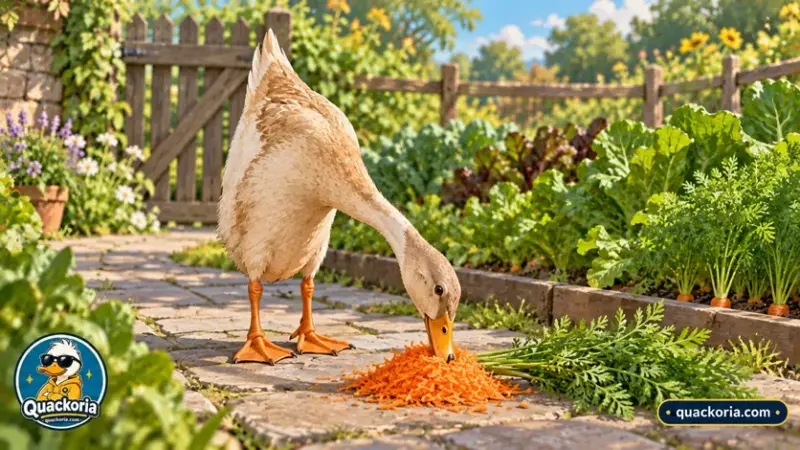
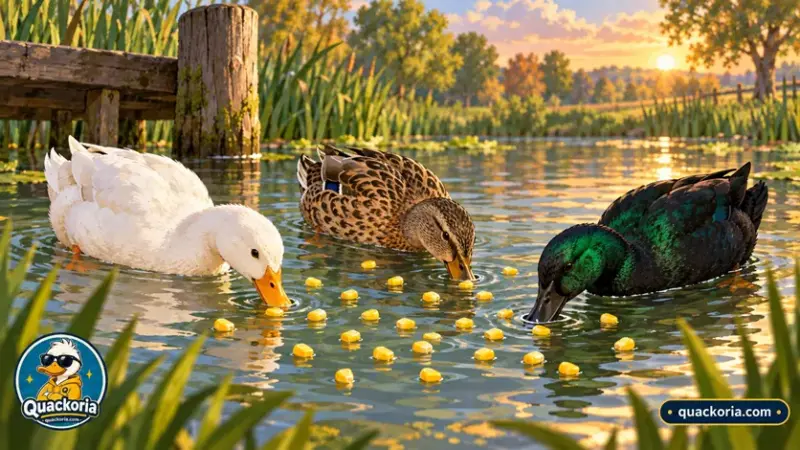
Sweetcorn: tinned and drained, frozen and thawed to room temperature, or fresh off the cob. Kernels are the perfect size for a duck — nothing to cut — and a scatter on the water tub makes the birds work for them. The Scottish SPCA files sweetcorn under vegetables to feed “in moderation and in small amounts”, noting it is “high in starch”. Cracked corn or scratch: on the ground, late in the day, so the birds have already eaten their complete feed. Poultry extension guidance for winter describes exactly that pattern — “A hand full of ‘scratch feed’ (a mix of cracked corn, oats and wheat) per 10 birds can be broadcast on the litter in the late afternoon” — and Dr Jacquie Jacob, a University of Kentucky poultry extension specialist answering on the national Ask Extension service, gives the same timing for treats: “only at night after they have eaten their daily full of the complete feed.”
Whole kernels need grit. Metzer Farms: “If they are fed a mash, crumble or pellet, grit is not needed as the feed mill has ground the feed for them. But if they are fed whole corn, milo, wheat or other whole grains, grit is needed.” Offer it in a separate dish. Quantity follows the rule that every source repeats — Open Sanctuary: “scratch grains should only make up around 10% of a duck’s total diet as they are not nutritionally complete sources of food”; Purina: “provide complete feed for at least 90 percent of the bird’s diet.” A tablespoon of scratch per duck is a treat; a scoop is a meal, and the wrong one.
Does corn keep ducks warm in winter?
It is repeated everywhere and the honest answer is: as an energy source, a little; as a heater, no. Corn is digested quickly and delivers calories, and calories are what a bird burns to stay warm — the University of Maine’s extension bulletin notes that in winter “birds eat more to maintain their body heat.” A feed company’s nutritionist puts the case for corn that way: it is “easily digested and provide[s] a quick energy source.” But no extension service describes corn as warming a bird in any special way, and the same calories come from the complete feed. A small evening scatter in cold weather is a reasonable habit. Replacing feed with corn because “it keeps them warm” is not; it just makes them fat, and the mould risk in a damp winter bag of corn is real. Our guide to keeping ducks in winter covers what actually matters.
Popcorn
Whatever chicken keepers do with plain popcorn, for ducks the two British wildlife bodies both warn against it. The Scottish SPCA: “The kernels and hulls are hard to digest and can get lodged in their throats.” The Canal & River Trust: “Popcorn hulls and kernels are difficult for ducks to digest, and they can become lodged in their throat and decay over time.” Buttered, salted or sweet popcorn adds salt and fat a duck should not have. Leave it out.
At the pond
Sweetcorn is the single best thing to carry to the park, and it is a straight upgrade on the loaf for the reasons in can ducks eat bread. Bring a small tin, drained, and scatter it on the water. The other pond-friendly foods — lettuce, rice, peas and oats — are covered alongside it, and everything we have checked is in the can-ducks-eat checker. For the complete diet corn sits inside, see what to feed ducks and the duck feed calculator.
Frequently asked questions
Can ducks eat corn?
Yes — sweetcorn tinned, frozen or fresh, and cracked or whole corn as scratch. The Canal & River Trust: "It turns out that ducks are quite partial to sweetcorn."
Can ducks eat cracked corn?
Yes, as a treat — Open Sanctuary lists "cracked corn in moderation" and says scratch should be around 10 per cent of the diet. Whole kernels need grit in a separate dish.
Can ducks eat popcorn?
No. The Scottish SPCA: "The kernels and hulls are hard to digest and can get lodged in their throats." Buttered or salted popcorn adds salt and fat a duck should not have.
Does corn keep ducks warm in winter?
Only as calories. Corn digests fast and provides energy, which is what a bird burns to stay warm, but no extension service describes it as warming in any special way, and the complete feed provides the same energy. A small evening scatter is fine; replacing feed with corn is not.
Is corn bad for ducks?
Not in itself. New York's DEC groups corn with bread and popcorn as low-protein substitutes for natural food, which is a warning about quantity: corn is safe, and corn is not a diet.
Sources
- Canal & River Trust — What do ducks eat? 6 things you can feed ducks
- Metzer Farms — Treats your ducks will love
- The Open Sanctuary Project — Daily diet, treats and supplements for ducks
- NC State Extension — Feeding ducks (Ferket & Davis)
- New York State Department of Environmental Conservation — Stop feeding waterfowl
- Metzer Farms — Grit for ducks and geese
- Scottish SPCA — What to feed ducks
- Purina Animal Nutrition — What to feed chickens: treats to feed and avoid
- USDA FoodData Central (SR Legacy) — Corn, sweet, yellow, raw, FDC ID 169998, as reproduced by tools.myfooddata.com
- USDA FoodData Central (SR Legacy) — Corn grain, yellow, FDC ID 170288, as reproduced by foodstruct.com
- Rutgers 4-H, adapted from University of Maine Extension Bulletin 2217 — Winter care of laying hens
- University of Maine Cooperative Extension — Bulletin 2222, feeding poultry
- Kalmbach Feeds — Winter nutritional requirements for backyard chickens
- Ask Extension — Dr Jacquie Jacob (University of Kentucky) on how many mealworms to feed