Quackoria Learn
Why Do Ducks Bob Their Heads?
Key takeaways
- Johnsgard's Handbook of Waterfowl Behavior: "Precopulatory behavior in all the species studied to date consists of mutual vertical Head-pumping."
- Cornell's definition: "Males and females rhythmically bob their heads. This display is often repeated and followed by mating."
- Courtship peaks in winter; Ducks Unlimited reports 75 to 80 per cent of mallard hens paired by late November.
- Ducks are non-bobbing walkers: a 2007 review lists "ducks, geese and swans" among birds that walk without the pigeon's head-bob.
- The head-bobbing of an excited pet duck is real but unstudied — a keeper's reading, not a finding.
Ducks bob their heads to court. The rhythmic up-and-down pumping you see on a pond in winter is a signal that both sexes give, and in the mallard it is the standard prelude to mating; ethologists have a name for it, head-pumping, and have counted it by the thousand. Ducks do not bob their heads when they walk, the way pigeons and chickens do. And the head-bobbing your pet duck does when you arrive with peas is real, but what it means has never been measured.
Head-pumping: the courtship signal
Paul Johnsgard’s Handbook of Waterfowl Behavior, the 1965 reference that still organises the field, describes the surface-feeding ducks in one sentence: “Precopulatory behavior in all the species studied to date consists of mutual vertical Head-pumping.” For the mallard: “In all forms mutual Head-pumping is the precopulatory display.” Cornell’s Lab of Ornithology defines it in plainer words — “Males and females rhythmically bob their heads. This display is often repeated and followed by mating” — and its mallard page adds that “A female encourages a male by nodding her head back and forth or paddling with her head held low.” Mutual is the point: when both birds pump, they have agreed. Domestication has not removed it. A 1977 study of white Pekins in the Journal of Comparative and Physiological Psychology found that “Pumping occurred much more in the males than in the females” and that pumping was followed by copulation about three-quarters of the time.
When you will see it
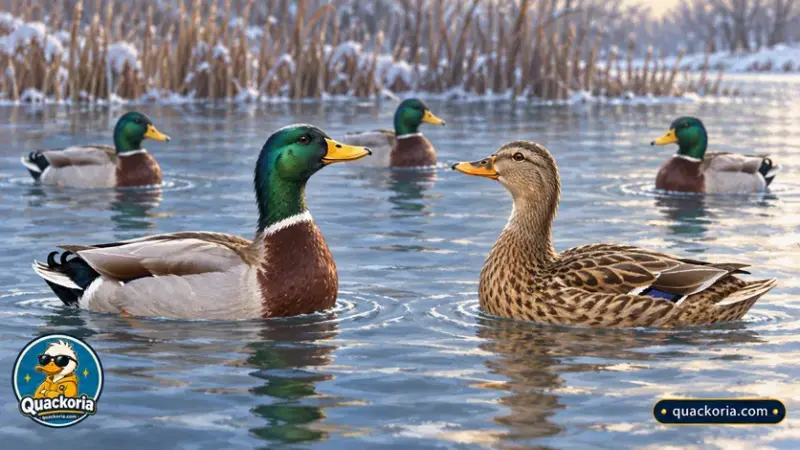
Winter, mostly. Ducks Unlimited reports that “courtship activity in ducks starts gradually on northern staging areas and ultimately reaches a fever pitch during winter and early spring”, with mallards among the earliest: “approximately 75 to 80 percent of females pairing by late November”. Cornell: “Mallard pairs form long before the spring breeding season. Pairing takes place in the fall, but courtship can be seen all winter.” Watch a park pond in December and the head-pumping is part of a longer performance; the bonds it makes last, in Ducks Unlimited’s words, “6–8 months”, which is why do ducks mate for life has a complicated answer.
The rest of the dance
The drake’s other displays are the ones that look like nothing a bird should do. Johnsgard ranks the grunt-whistle as the most common mallard display, one in which “an arc of water is thrown up by the bill on the side toward the courted female”; Cornell describes “A one-second display where the male raises out of the water, pulls his head up, and gives a remarkable whistle, followed by a grunt as he moves back into a normal posture.” The head-up-tail-up shows off the wing patch — “With a loud whistle, the drake pulls his wings and tail up, shows off his purple-blue secondaries and compresses his body” — and the down-up, in Johnsgard’s account, “is the least common display, and the call uttered is a sharp whistle followed by a raeb-raeb’.” The hen has displays of her own: inciting, a rapid staccato call given as she swims after her chosen drake, and nod-swimming, “a rapid swimming with the head stretched out along the water”. None of it is improvised. Johnsgard’s 1960 study on Cayuga Lake in New York logged “over 3000 Mallard and over 1300 Black Duck displays”, found “the largest numbers of birds were displaying sexually during November and December”, and noted that a bout “could range from a single male display to five or more males displaying simultaneously with the same or different movements toward a single female.” Where the displays came from is the odd part: in a 1968 essay Johnsgard argued they “evolved from simpler, non-display responses including body-maintenance, or ‘comfort,’ activities, such as preening or shaking” — the grunt-whistle being a ritualised body shake, the down-up “a similarly exaggerated form of drinking”. Telling the two performers apart is in male vs female duck.
Ducks do not bob when they walk
The head-bobbing of a walking pigeon is a different thing, and ducks do not do it. A 2007 review in the Journal of Comparative Physiology A describes the pigeon’s walk as “a rapid forward movement (thrust phase) which is followed by a phase where the head keeps its position with regard to the environment but moves backward with regard to the body (hold phase)”, and lists the exceptions: “Well-known examples of non-bobbing birds are waterfowls like ducks, geese and swans”, adding that “ducks and geese feed on land without head-bobbing.” Pigeons bob to hold the world still for their eyes — B. J. Frost’s 1978 experiments found that “head-bobbing is abolished when pigeons walk on a treadmill”, which “suggests it is primarily a visual response”. Why waterfowl skip it is not settled; the review only observes that web-footed water birds, whatever family they belong to, tend not to bob. What a duck’s eyes do instead is in how do ducks see. The head does move before flight, though: Johnsgard notes that “Preflight movements include Neck-jerking and lateral Head-shaking, which are typical of nearly all species of Anas.” A duck jerking its neck on the bank is about to leave.
Head-bobbing in the backyard
Kept ducks bob their heads at their people, and every keeper has a translation. One backyard-duck writer’s version: “Ducks bob their head up and down, often excitedly quacking when they are happy – when they see a duck friend they haven’t seen in a while, when they get some tasty treats”, while a slower side-to-side with the head lowered “is more of a reprimand.” Those are observations, not findings; no study has recorded head-bobbing in ducks outside courtship, and the likeliest reading is that the up-and-down bob of an excited pet duck is the same movement the species uses to say yes, borrowed for a bucket of peas. Interpret it kindly and do not build a theory on it. The tail is the other end of the same question — why do ducks wag their tails — and the noise that goes with it is in why do ducks quack. When you have the vocabulary down, the duck quiz is waiting.
Frequently asked questions
Why do ducks bob their heads up and down at each other?
It is head-pumping, the courtship display that precedes mating in mallards and their relatives. Both birds do it; when both pump, they have agreed.
Do ducks bob their heads when they walk like pigeons?
No. Ornithologists class ducks, geese and swans as non-bobbing birds; the pigeon's bob is a way of holding its view steady.
When do ducks do their courtship displays?
Mostly autumn and winter. Cornell: "Pairing takes place in the fall, but courtship can be seen all winter."
What are the other mallard courtship displays?
The drake's grunt-whistle, head-up-tail-up and down-up, and the hen's inciting call and nod-swimming. Johnsgard's 1960 study logged more than 3,000 mallard displays on Cayuga Lake.
My pet duck bobs its head when it sees me. What does it mean?
Keepers read it as excitement, and it may well be the courtship movement borrowed for a bucket of peas — but no study has recorded head-bobbing in ducks outside courtship.
Sources
- Paul A. Johnsgard (1965), Handbook of Waterfowl Behavior — Tribe Anatini, University of Nebraska–Lincoln Digital Commons
- Paul A. Johnsgard (1965), Handbook of Waterfowl Behavior — Summary and synopsis
- Paul A. Johnsgard (1960), A quantitative study of sexual behavior of mallards and black ducks, Wilson Bulletin 72(2)
- Paul A. Johnsgard (1968), The evolution of duck courtship, Natural History 77(2)
- Cornell Lab of Ornithology — How to recognize duck courtship displays (Jessie Barry, 2015)
- Cornell Lab of Ornithology, All About Birds — Mallard life history
- Cornell Lab of Ornithology, All About Birds — Mallard overview
- Ducks Unlimited — Understanding waterfowl: courtship and pair bonding (Mike Brasher)
- Ducks Unlimited — Mallard annual life cycle
- Miller, D. B. (1977), Social displays of mallard ducks: effects of domestication, Journal of Comparative and Physiological Psychology 91(2)
- Ehrlich, Dobkin and Wheye (1988), Duck displays, The Birder's Handbook (Stanford)
- Necker, R. (2007), Head-bobbing of walking birds, Journal of Comparative Physiology A 193
- Necker, R. (2007), Head-bobbing of walking birds — author's full-text copy
- Frost, B. J. (1978), The optokinetic basis of head-bobbing in the pigeon, Journal of Experimental Biology 74
- Library of Congress — Why do pigeons bob their heads when they walk?
- The Cape Coop — Understanding backyard duck behavior (keeper observations)