Quackoria Learn
Can Ducks Drown?
Yes, ducks can drown. A duck floats on trapped air and preen oil, and when either fails it can sink. The real risks are ducklings whose feathers are not yet waterproof, hens held under by gangs of drakes, and any duck trapped in water it cannot climb out of.

Key takeaways
- Hatchery ducklings do not make waterproofing oil for about five weeks; Metzer Farms: "A wet duckling is not likely to survive."
- Supervised paddling from about three weeks in water they can walk out of; no unsupervised swimming until five or six weeks.
- Ducks Unlimited: "hen wood ducks, mallards and Laysan ducks have all been observed drowning while resisting" forced matings; keep about one drake to five hens.
- Buoyancy depends on interlocking feathers and preen oil; wet feather, mud, detergents or a preen-gland infection can sink a duck.
- Pools, steep tanks, buckets, rain barrels and icing ponds trap ducks; a ramp or a knotted rope is the fix. Diving ducks stay under 10–30 seconds and sometimes over a minute by choice.
Yes. A duck floats on trapped air and preen oil, and when either fails it can drown. The real risks are specific: ducklings whose feathers are not yet waterproof, hens held under by gangs of drakes in spring, and any duck trapped in water it cannot climb out of — a swimming pool, a steep-sided tank, a pond icing over. A healthy adult duck floating on open water is in no danger from the water itself.
Ducklings: the risk that matters most
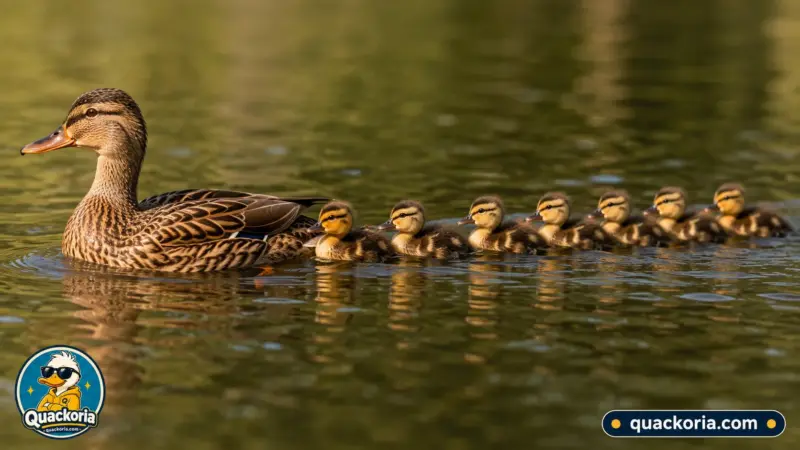
A wild duckling swims on its first day, but it does so under its mother. Ducks Unlimited: “Within 24 to 48 hours after the ducklings hatch, the hen leads them to a nearby wetland to feed.” She keeps them warm, dry and oiled. Metzer Farms, a California hatchery, explains what a duckling without a hen lacks: “In nature, a mother duckling will provide the oil to help waterproof the babies’ feathers”, whereas “Hatchery born ducklings will not start producing the oil required to be waterproof for about 5 weeks.” The rule is stated flatly — “Make sure they can’t get in the water and get chilled” — and so is the verdict: “A wet duckling is not likely to survive.” Meyer Hatchery adds that “Young ducklings and goslings have been known to drown in even a shallow pan of water”, and the Open Sanctuary Project explains why: “until their feathers come in (typically around 6 weeks of age), they are not yet waterproof and can become waterlogged and get sick or drown if left in a water source unattended or one where they can not easily get out.”
The rule that follows: water to dip the whole bill in from day one, supervised paddling in something they can walk out of from about three weeks — Metzer’s threshold is that “they must be able to walk in and out of the water very easily” — and no unsupervised swimming until five or six weeks. In the wild the same danger is filed under weather. Ducks Unlimited’s brood research says “many ducklings die from exposure in cold, wet weather”, that “During the first week following hatch, ducklings are extremely vulnerable to hypothermia and predation”, and that “daily survival of mallard ducklings was nearly nine times greater for older ducklings (those more than seven days old) than for younger ducklings.” Survival to flying age “ranging from less than 10 percent to as high as 70 percent” — and no study we found separates drowning from exposure in that count; a wet, cold duckling dies of both at once. The full timetable is in raising ducklings week by week, and what a brood is up against is the whole point of Duckling Line.
Drakes and hens
The second cause is uglier. Ducks Unlimited reports that “Paired drakes of almost every dabbling duck species attempt forced EPCs” — extra-pair copulations — and that “hen wood ducks, mallards and Laysan ducks have all been observed drowning while resisting EPCs, so clearly the decision to resist is not trivial for hens.” Forced mating is “fairly common among many species of ducks, sometimes accounting for 20 percent of all mating activity”, and is helped along by arithmetic: drakes make up “55 percent of mallard populations”. Cornell’s mallard page notes that “male Mallards often force these copulations, with several males chasing a single female and then mating with her.” In a backyard flock the fix is the ratio. Metzer keeps “a 1:5 ratio of male to female since one male can easily ‘service’ 5 females”, and warns that “if a female has multiple males trying to mate with her, she will be in danger of injury or even death.” How many of each to keep is worked through in how many ducks to keep.
Why a healthy duck floats
A duck is a boat made of feathers. The contour feathers, KQED’s science desk explains, “are loaded with barbicels that interlock the neighboring barbs together like Velcro to form a wind and water-resistant barrier”, and “The oil from their preen gland coats the interlocking barbules of their feathers, rendering them waterproof.” Air stays trapped against the skin, and the bird sits high. Break the seal and buoyancy goes: a wildlife-rehabilitation guide describes contaminated feathers that “become matted and separate from each other”, so that “their skin becomes directly exposed to the water, effectively reducing their buoyancy.” In kept ducks the same failure is called wet feather, a condition in which feathers “become water-logged, and lose their ability to repel water”, brought on by mud without clean water, parasites, detergents or a preen-gland infection, with “an increased risk of drowning because of the affect it has on their ability to float in the water.” A duck that cannot bathe cannot preen, and a duck that cannot preen cannot float; the mechanism is in why ducks don’t get wet, and the water it depends on in duck water needs.
Traps: pools, tanks and ice
Ducks drown in water with no way out. The US Fish and Wildlife Service, on ducklings in swimming pools: “Ducklings are not able to fly out of the water, nor can they step out from the pools tall ledge. The ducklings may drown if they become exhausted because they cannot get out.” Its advice is a ramp — “any surface that’s not too slippery for the ducklings’ feet” — and it is the same advice for adults in a stock tank. The Open Sanctuary Project: “Ducks will need a safe way to get in and out of the water source”, ideally “a gently sloped ramp with proper traction”, or for steep containers “sturdy stacks of large rocks”. The BC SPCA asks whether you have “buckets of water or open rain barrels laying around”, since an animal stuck in water with no way out “can drown due to exhaustion”, and suggests floating ramps or “Knotted nylon ropes along the sides”. Ice is the winter version: the Open Sanctuary Project warns of a bird “trapped under a thick patch of ice and drowning”, and advises watching ponds in freezing weather. The Toronto Wildlife Centre’s objection to a swimming pool is the exit and the menu: a pool “does not provide the plants and microorganisms that ducklings need to eat to grow strong”, and “Ducklings can tire very quickly and even drown.” A pond built for ducks is in do ducks need a pond.
How long can a duck stay under?
Ducks drown from exhaustion or waterlogging, not from diving too deep. Diving ducks are built for it: Ducks Unlimited says “A typical dive takes 10-30 seconds, but diving ducks may remain underwater for a minute or more”, that before diving “the birds compress their feathers against their body, squeezing out air, which further reduces buoyancy”, and that a white-winged scoter “spent an average of 58 seconds underwater during each of six consecutive dives”. Cornell reports long-tailed ducks “able to swim down as deep as 200 feet”, and lesser scaup ducklings that dive “As soon as their down dries” and can stay under “up to 25 seconds” within weeks. Dabbling ducks like the mallard dive only to escape, and how long a mallard can hold its breath has not, as far as we can find, been measured. The two groups are compared in dabbling vs diving ducks, and what else threatens a duck on and off the water is in duck predators.
Frequently asked questions
Can ducks drown?
Yes. Ducklings that are not yet waterproof become waterlogged and chilled, hens can be drowned by groups of drakes, and any duck can drown from exhaustion in water with no way out.
When can ducklings swim?
Supervised, in shallow warm water they can walk out of, from about three weeks; unsupervised only once they are waterproof at five to six weeks. Wild ducklings swim on day one because the hen oils and warms them.
Why would a drake drown a hen?
Forced mating. Several drakes chasing one hen can hold her under; Ducks Unlimited has recorded hens drowning while resisting. In a flock, keep the ratio near one drake to five hens.
Can ducks drown in a swimming pool?
Ducklings can. The US Fish and Wildlife Service: "The ducklings may drown if they become exhausted because they cannot get out." Add a ramp or a non-slip board to the edge.
How long can a duck hold its breath?
Diving ducks typically stay under 10 to 30 seconds and can exceed a minute; long-tailed ducks reach 200 feet. A dabbling duck like the mallard dives only briefly to escape, and its limit has not been measured.
Sources
- Metzer Farms — Brooder setup and care for ducklings, goslings and chicks
- The Open Sanctuary Project — Care recommendations for domesticated ducklings
- Meyer Hatchery — Why open water may mean danger for young ducks and geese
- Ducks Unlimited — Understanding waterfowl: brood ecology (Johann Walker)
- Ducks Unlimited — Duckling survival (John M. Coluccy and Kurt A. Anderson)
- Ducks Unlimited — Extra-pair paternity (J. Jasper Lament)
- Ducks Unlimited — Understanding waterfowl: drakes and ganders (Mike Brasher)
- Cornell Lab of Ornithology, All About Birds — Mallard overview
- Metzer Farms — Male to female ratio
- KQED Science — What actually makes water roll off a duck's back?
- Alberta Institute for Wildlife Conservation — Unveiling the intricate mechanisms of avian waterproofing
- DuckDVM — Wet feather
- US Fish and Wildlife Service — Ducks in your pool
- Toronto Wildlife Centre — Ducks swimming in your pool
- BC SPCA — Pool and water safety for wildlife
- The Open Sanctuary Project — Creating a good home for ducks
- Ducks Unlimited — Diving ducks: into the deep (John M. Coluccy and Heather Shaw)
- Cornell Lab of Ornithology, All About Birds — Long-tailed duck
- Cornell Lab of Ornithology, All About Birds — Lesser scaup