Quackoria Learn
Hooded Merganser: The Duck With the Fan-Shaped Crest
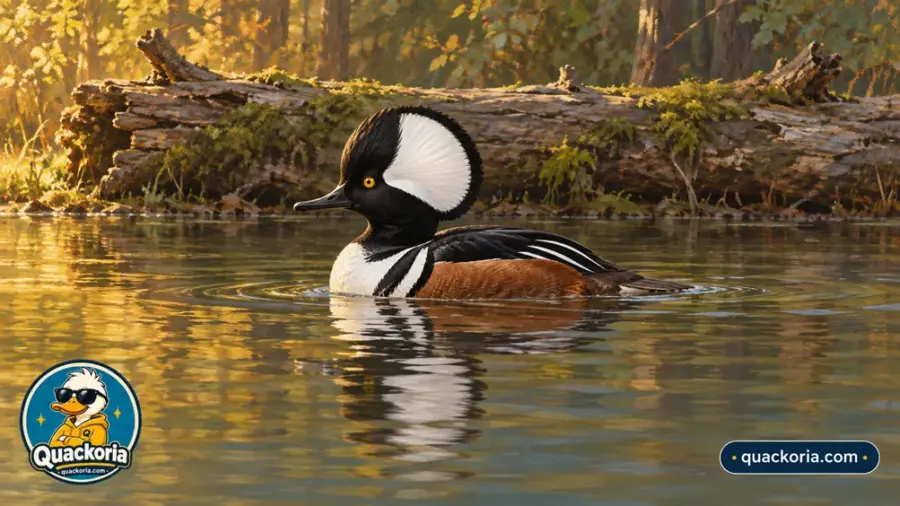
The hooded merganser is a small diving duck of North America's wooded ponds and rivers that hunts small fish, crayfish and insects by sight. The male spreads his crest into a white fan edged in black to court females and face down rivals; the female is grey-brown with a cinnamon crest. It nests in tree holes, and its ducklings drop to the ground within 24 hours of hatching.
Key takeaways
- Cornell gives a length of 40–49 cm and a weight of 453–879 g; among mergansers only the smew of Eurasia is smaller.
- Cornell says hooded mergansers can "change the refractive properties of their eyes to improve their underwater vision".
- Egg-dumping by other females has produced nests with up to 44 eggs, against Cornell's clutch of 5–13.
- The first bird accepted as wild in Britain was on North Uist on 23 October 2000, according to BirdGuides.
- Cornell reports an increase of about 5% a year from 1966 to 2019; Ducks Unlimited estimates 300,000–400,000 in North America, Partners in Flight a global breeding population of 1.1 million.
The hooded merganser, Lophodytes cucullatus, is a small fish-eating diving duck of wooded North American ponds and rivers, known for the fan-shaped crest the male can spread into a black-edged white disc or fold flat. Cornell calls it an “extravagantly crested little duck” and “the second-smallest of the six living species of mergansers”. Look for it on small wooded ponds and streams in summer, and on unfrozen lakes and sheltered bays from autumn to spring. In Britain it is a very rare visitor, and most birds seen there are likely to be escapes.
How to recognise a hooded merganser
Look at the head: Cornell describes “a thin bill and a fan-shaped, collapsible crest that makes the head look oversized and oblong.” The adult male is “black above, with a white breast and rich chestnut flanks”, and his black head carries “a large white patch that varies in size when the crest is raised or lowered, but is always prominent.” Females and immatures are “gray and brown, with warm tawny-cinnamon tones on the head”, and Ducks Unlimited gives the female a “narrow yellow gray bill”. Out of breeding plumage the male is, in Cornell’s photo caption, a “Small, brownish duck” whose “Ragged crest is cinnamon brown”.
Cornell gives a length of 40–49 cm (15.8–19.3 in) and a weight of 453–879 g (16.0–31.0 oz), and measures it against other divers rather than the mallard: “Smaller than a Red-breasted Merganser; larger than a Bufflehead.” The bird is “usually silent”, Cornell says, but a courting male makes “a deep, rolling sound like the call of a pickerel frog, earning it the nickname of ‘frog-duck’ in Georgia”, and the female gives “a hoarse gack call”.
Hooded merganser or wood duck?
It is the brown, crested females that cause doubt, and the Missouri Department of Conservation notes that, “Like wood ducks, they nest in tree cavities”. Tennessee’s wildlife agency gives the difference from the wood duck‘s side: “Female Wood Ducks differ from female Hooded Mergansers as they have a grayish head, a much smaller crest, and a white patch around the eye.” Cornell, on its wood duck page, puts it the other way round: hooded mergansers “have a longer, thinner bill than Wood Ducks and females lack the white eye patch.” So the hen with the bigger crest, the thinner bill and no white around the eye is the merganser.
Cornell’s comparison page for the hooded merganser names three other divers. Female buffleheads, smaller birds, have “a white spot on the face” that female hooded mergansers lack; red-breasted mergansers have “a longer, thinner red bill”; common mergansers are larger, with “paler sides”.
Where and when you will see one
Cornell says hooded mergansers breed “in forested wetlands throughout the eastern half of North America and the Pacific Northwest” and are “most common in forests around the Great Lakes.” It calls the species a “Resident to medium-distance migrant”: in the east many move south and southwest, “but some actually migrate north to spend winters in the Great Lakes and southern Canada”. They leave late, “sometimes moving just ahead of winter ice”, and return early, “within a few days of the ice melting.” In Tennessee, the state agency says, migrants and wintering birds are present “from late October through early May”.
In Britain the BTO calls it “An extremely rare visitor from North America” that “is also popular in waterfowl collections, so most sightings are likely to be of escaped individuals.” The first bird accepted as wild, according to BirdGuides, was “an immature or female” at Trumisgarry, North Uist, on 23 October 2000; it was placed in Category D in 2001 and only later admitted “to Category A of the British List.” Escaped hooded mergansers turned up in Sussex and Anglesey that same October, and “206 Hooded Mergansers were hatched in Britain in 2001.”
What it eats, and how
Fish, but not only fish. Audubon says “Mergansers are our only ducks that specialize in eating fish”, yet Cornell calls the hooded merganser’s diet broader than other mergansers’: “small fish, aquatic insects, crustaceans (especially crayfish), amphibians, vegetation, and mollusks”. It dives in “clear, shallow forest ponds, rivers, and streams”, pushing with its feet and gripping prey with “slender, serrated bills”. It hunts by eye, and Cornell says the birds “can actually change the refractive properties of their eyes to improve their underwater vision”, while a transparent third eyelid, the nictitating membrane, protects the eye “like a pair of goggles.” Divers and dabblers are compared in dabbling vs diving ducks, and duck eyesight is explained in how do ducks see.
Nesting and ducklings
The female chooses a cavity in a live or dead tree near water, typically 10–50 feet up; Cornell’s maximum is “about 90 feet”, Audubon’s “rarely up to 80′ or more”. The eggs are “White, nearly spherical, and unusually thick shelled”, in Cornell’s description. Clutch figures vary: 5–13 eggs from Cornell, 10–12 and sometimes 7–13 from Audubon, an average of 9 to 12 from Ducks Unlimited and 7 to 15 from Animal Diversity Web. Incubation is 26–41 days according to Cornell, Audubon and Animal Diversity Web, “usually about 33 days” in Audubon’s words, while Ducks Unlimited gives 29 to 33.
Many nests hold eggs from more than one female. Cornell says hooded mergansers “often lay eggs in nests of other ducks”, and that other cavity-nesting ducks return the favour; a female lays “up to about 13 eggs in a clutch”, yet Cornell reports nests “with up to 44 eggs.” Within 24 hours of hatching the ducklings leave. The mother calls from the ground, and the young “scramble up to the entrance hole and then flutter to the ground, which may be 50 feet or more below them”, sometimes then walking “half a mile or more with their mother to the nearest body of water.” They fledge about 70 days after hatching, according to Audubon.
Why does the hooded merganser raise its crest?
To court, and to face down rivals. Tennessee’s wildlife agency says the male raises it “during courtship and aggressive interactions with other males”. Raised, it opens “to a nearly circular shape”, in the Missouri Department of Conservation’s words, and the white patch expands with it. In group courtship, Cornell says, males raise their crests “often while shaking their heads”. The climax is head-throwing, “in which they jerk their heads backwards to touch their backs, with crests raised, while giving a froglike croak.” BirdNote, published by Audubon, notes that “By November each year, courtship and pair formation are well under way.”
How hooded mergansers are doing
Well, and increasingly so. Cornell says numbers “increased dramatically by approximately 5% per year between 1966 and 2019”, according to the North American Breeding Bird Survey, and Partners in Flight gives the species 8 out of 20 on its Continental Concern Score, a species of low concern. Partners in Flight, via Cornell, puts the global breeding population at 1.1 million, while Ducks Unlimited gives a North American figure of “roughly 300,000–400,000” and adds that “it is difficult to survey these dwellers of forested wetlands.” The BTO and Animal Diversity Web list it as Least Concern. Cornell says it was overhunted early in the twentieth century. Audubon credits the increase partly to nest boxes, “including those intended for Wood Ducks”, and Cornell names programmes in Missouri, Maine, Iowa and Oregon that have helped local numbers grow.
For a brown, crested duck on a wooded pond, check the eye and the bill, then run it through the wild duck identifier. To try the merganser’s trade for yourself, time your dives for passing fish in the Pond Fisher game.
Frequently asked questions
What does a hooded merganser eat?
Mainly small fish, aquatic insects and crayfish, but Cornell says its diet is broader than other mergansers': "small fish, aquatic insects, crustaceans (especially crayfish), amphibians, vegetation, and mollusks". It dives for its prey and finds it by sight.
Where do hooded mergansers nest?
In tree cavities, usually close to water, and readily in nest boxes. Cornell says cavities are "typically 10–50 feet off the ground, up to about 90 feet", while Audubon gives a maximum of rarely 80 feet or more.
How do hooded merganser ducklings get out of the nest?
They jump. Within 24 hours of hatching, Cornell says, the ducklings "scramble up to the entrance hole and then flutter to the ground, which may be 50 feet or more below them", while their mother calls from below.
Why is the hooded merganser called the frog duck?
Because of the courting male's call. Cornell says he "makes a deep, rolling sound like the call of a pickerel frog, earning it the nickname of 'frog-duck' in Georgia".
Are hooded mergansers in the UK?
Only as a great rarity. The BTO calls it "An extremely rare visitor from North America" and says most sightings are likely to be escapes; the first bird accepted as wild was on North Uist on 23 October 2000.
Sources
- Cornell Lab of Ornithology, All About Birds — Hooded Merganser Overview
- Cornell Lab of Ornithology, All About Birds — Hooded Merganser Identification
- Cornell Lab of Ornithology, All About Birds — Hooded Merganser Life History
- Cornell Lab of Ornithology, All About Birds — Hooded Merganser Similar Species
- Cornell Lab of Ornithology, All About Birds — Hooded Merganser Sounds
- Cornell Lab of Ornithology, All About Birds — Hooded Merganser Range Map
- Cornell Lab of Ornithology, All About Birds — Wood Duck Similar Species
- National Audubon Society — Hooded Merganser, Guide to North American Birds
- National Audubon Society and BirdNote — Hear How the Male Hooded Merganser Courts a Female
- Ducks Unlimited — Hooded Merganser, Waterfowl ID
- Tennessee Wildlife Resources Agency — Hooded Merganser
- Missouri Department of Conservation — Hooded Merganser, Field Guide
- British Trust for Ornithology, BirdFacts — Hooded Merganser
- BirdGuides — Hooded Merganser admitted to the British List
- Animal Diversity Web, University of Michigan — Lophodytes cucullatus (hooded merganser)