Quackoria Learn
Bufflehead: The Tiny Diver That Nests in Woodpecker Holes
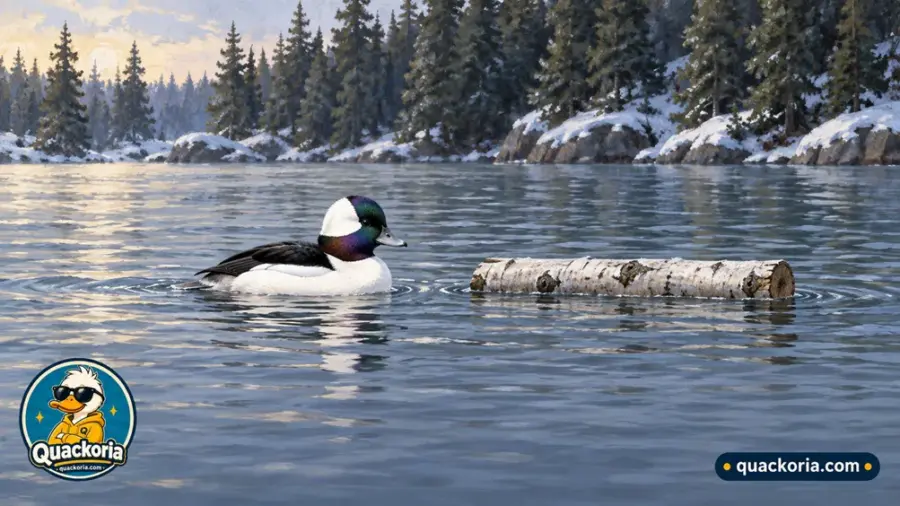
The bufflehead is a tiny black-and-white diving duck that breeds in the northern forests of Canada and Alaska and spends the winter on sheltered coasts and ponds across the United States. It nests almost only in old woodpecker holes, mostly those dug by northern flickers, and Cornell says its breeding range is limited by where the flickers live. In Britain it is a very rare visitor.
Key takeaways
- At 32–40 cm (12.6–15.8 in) and 272–635 g (9.6–22.4 oz) by Cornell's figures, it is North America's smallest diving duck.
- The male's white head patch wraps round the back of the head; on both goldeneyes the white sits between bill and eye (Cornell; Missouri Department of Conservation).
- Dives last about 12 seconds on average and rarely more than 25, according to Cornell's life-history page.
- Cornell's nesting table gives no incubation period; Audubon gives 29–31 days (sometimes 28–33) and Ducks Unlimited 28–33 days.
- Cornell reports a rise of over 3% a year between 1966 and 2019, and Partners in Flight estimates 1.3 million breeding birds.
The bufflehead, Bucephala albeola, is the little black-and-white duck on a winter bay that keeps disappearing: Cornell describes “A buoyant, large-headed duck that abruptly vanishes and resurfaces as it feeds”. It is, by Cornell’s account, the smallest diving duck in North America, and it is famous for its nest, which is almost always an old woodpecker hole, most often one dug by a northern flicker. In the United States it is mainly a winter bird of sheltered coves and inland ponds; in Britain it is a very rare visitor.
How to recognise a bufflehead
Cornell’s summary is “very small, compact ducks with large, rounded heads and short, wide bills”: 32–40 cm long (12.6–15.8 in), 272–635 g (9.6–22.4 oz), with a wingspan of 55 cm (21.6 in). No source we read sets it beside a mallard; Cornell’s yardstick is “Smaller than a Common Goldeneye; larger than a Pied-billed Grebe.” The adult male has “a white body, black back, and a dark head with a large white patch that wraps around the back of the head”, glossed “green and purple” at close range. Ducks Unlimited Canada explains the name: “The name ‘bufflehead’ is derived from ‘buffalo-head’, for the male’s distinct and puffy head shape.”
Females and first-year males share a plainer dress, “gray-brown overall with an oval, white cheek patch” in Cornell’s words, and Cornell describes no separate eclipse plumage for the adult male. BirdGuides adds that adults have “dark brown irises”. In flight, Cornell says, look for “small size, fast wingbeats, and pattern of rocking side-to side as they fly.” The bird is “Usually silent”, according to the US Fish and Wildlife Service’s guide Ducks at a Distance, though males “give a grating or chattering call during their head-bobbing courtship displays” (Cornell) and females give a “soft, hoarse quack” (Audubon).
Bufflehead or goldeneye?
The BTO introduces the bufflehead through its relative: “Related to Goldeneye, but much smaller and with a large white patch on the back of the head”. Where the white sits is the whole test. Cornell: “Common Goldeneyes are larger than Buffleheads. Males have a round white spot behind their bill that male Buffleheads lack.” Barrow’s goldeneye males have “an oval or crescent white spot behind their bill”, and the Missouri Department of Conservation places the white of both goldeneyes “between bill and eye (not on the back of the head).” Female goldeneyes “do not have white on the face like female Buffleheads.” Cornell’s other comparisons are as clean. The male hooded merganser has “cinnamon (not white) sides and a longer, thinner bill”, and the male ruddy duck has “a white patch behind the bill not on the back of the head”.
Where and when you will see one
Buffleheads breed “near ponds and lakes in boreal forest and aspen parkland of Canada and Alaska, with isolated populations in the western United States”, according to Cornell, and come south for the winter. Cornell’s advice is to “look for these tiny, black-and-white ducks in sheltered coves along the Atlantic or Pacific coast, or on inland ponds in southern North America”; Ducks Unlimited traces the winter range “from the Aleutians to Baja, Mexico, and from New Brunswick south to Florida and along the Gulf Coast.” The sources time the journey by the ice rather than the calendar. Audubon says the species “migrates relatively late in fall”, the USFWS that “the largest numbers move just ahead of freezeup”, and Cornell that in spring they stop on rivers and lakes, “often in the first spots to become free of ice.” The wider pattern is in duck migration.
In Britain the two main references grade it differently. The BTO gives its status as “Very rare” and calls it “a very rare visitor from North America”; BirdGuides gives its British and Irish rarity status as “Rare”. BirdGuides’ identification guide counted “17 accepted occurrences in Britain up to 2014, mostly in the period October to April”, and noted that “Ireland has had just two accepted records.” Captive birds muddy the picture: “Bufflehead is popular in captivity and colour-ringed birds are occasionally seen, presumably all escapes”, BirdGuides writes, and the BTO agrees that “separating wild vagrants from escaped individuals is problematic.”
What it eats, and how
This is a diver, not a dabbler; the two ways of feeding are compared in dabbling vs diving ducks. Cornell: “Bufflehead dive for aquatic invertebrates, crustaceans, and mollusks. They typically swallow their food while still underwater.” Its life-history page says dives “last on average about 12 seconds and rarely more than 25 seconds”; a caption on its identification page gives “about 13 seconds”. On freshwater Cornell’s list is led by insect larvae (damselflies, dragonflies, midges, mayflies, caddisflies), with water boatmen, amphipods, and snails and clams in winter, plus “mainly seeds of pondweeds and bulrushes” in autumn and winter. In saltwater Cornell’s list runs from shrimp and crabs to mussels, herring eggs, sculpins and ratfishes. Downy ducklings, it adds, “sometimes dabble at the surface rather than diving.”
Nesting and ducklings
The nest is a tree cavity or nest box “lined with downy feathers from chest of female”; Audubon: “Lining of down is only nest material.” Cornell’s nesting table gives a clutch of 4–17 eggs, “Cream-colored or buff; unmarked”, but no incubation period. Audubon gives “29-31 days, sometimes 28-33” and a usual clutch of 8–10; Ducks Unlimited gives 28–33 days and clutches averaging 6–11. The male leaves during incubation to moult, yet Cornell says males “return to the same mate multiple years in a row (one of the few duck species in which this is true)”; more in do ducks mate for life. Audubon: “Bufflehead leave nest 1-2 days after hatching, are led to water by female.” Of the sources we read, only the University of Michigan’s Animal Diversity Web says how they get out: the chicks “are then encouraged to jump from the nest hole.” Audubon gives the age of first flight as 50–55 days.
Why does the bufflehead nest in woodpecker holes?
Because it fits where bigger ducks do not. Cornell: “Bufflehead are North America’s smallest diving duck; they benefit by using old flicker nests that larger ducks such as goldeneyes and mergansers cannot fit into.” It says the bird “nests almost exclusively in holes excavated by Northern Flickers and, on occasion, by Pileated Woodpeckers”, and Audubon puts the hole “usually 2-10 ft above ground, sometimes up to 50 ft.” The tie is strong enough to draw the map: “The Bufflehead’s breeding range is limited by the distribution of Northern Flickers, which are their main source of nesting cavities.” In summer, Cornell writes, young or failed females “fly around in noisy groups and scope out the available nest holes for the following breeding season.” The supply is shrinking as “loggers clearcut boreal forest, and as agricultural fields replace aspen parklands”, and Cornell’s remedy is nest boxes “with small (2.5-inch diameter) openings”.
How buffleheads are doing
Well, by most measures. Cornell reports that populations “steadily increased over 3% per year between 1966 and 2019” and cites a Partners in Flight estimate of 1.3 million breeding birds, “indicating a species of low conservation concern.” Ducks Unlimited puts the total at about 1.4 million and says surveys “suggest they have increased since the 1950s.” Audubon takes the longer view, calling the species “Evidently much less numerous now than historically, owing to unrestricted shooting early in 20th century and to loss of nesting habitat”, while judging that “Current populations seem stable overall.” BirdGuides gives its IUCN category as Least Concern.
Seen a small black-and-white duck dive and pop up somewhere else? Check where the white sits on its head, confirm the bird with which wild duck did I see, and then test your eye in Spot the Duck.
Frequently asked questions
how big is a bufflehead
Very small. Cornell gives a length of 32–40 cm (12.6–15.8 in), a weight of 272–635 g (9.6–22.4 oz) and a wingspan of 55 cm (21.6 in), and calls the species "North America's smallest diving duck".
where do buffleheads nest
In tree holes. Cornell says the bufflehead "nests almost exclusively in holes excavated by Northern Flickers and, on occasion, by Pileated Woodpeckers", and Ducks Unlimited adds that they "also readily use nest boxes."
why is it called a bufflehead
Because of the male's head. Ducks Unlimited Canada explains: "The name 'bufflehead' is derived from 'buffalo-head', for the male's distinct and puffy head shape."
do buffleheads mate for life
Often for several years, which is unusual for a duck. Cornell: "Unlike most ducks, the Bufflehead is mostly monogamous, often remaining with the same mate for several years." Ducks Unlimited adds that pairs may re-unite on the wintering grounds.
are there buffleheads in the uk
Only as a rarity. The BTO calls it "a very rare visitor from North America" and BirdGuides rates it "Rare", with 17 accepted British records up to 2014. BirdGuides adds that colour-ringed birds, presumably escapes from captivity, are occasionally seen.
Sources
- Cornell Lab of Ornithology, All About Birds — Bufflehead Overview
- Cornell Lab of Ornithology, All About Birds — Bufflehead Identification
- Cornell Lab of Ornithology, All About Birds — Bufflehead Life History
- Cornell Lab of Ornithology, All About Birds — Bufflehead Similar Species
- Cornell Lab of Ornithology, All About Birds — Bufflehead Sounds
- National Audubon Society — Guide to North American Birds: Bufflehead
- Ducks Unlimited — Waterfowl ID: Bufflehead
- Ducks Unlimited Canada — Bufflehead
- U.S. Fish and Wildlife Service — Ducks at a Distance
- British Trust for Ornithology — BirdFacts: Bufflehead
- BirdGuides — Species Guide: Bufflehead
- BirdGuides — Goldeneye and Bufflehead photo ID guide
- Missouri Department of Conservation — Field Guide: Bufflehead
- Animal Diversity Web, University of Michigan — Bucephala albeola