Quackoria Learn
American Black Duck: The Mallard Look-Alike That Is Not a Mallard
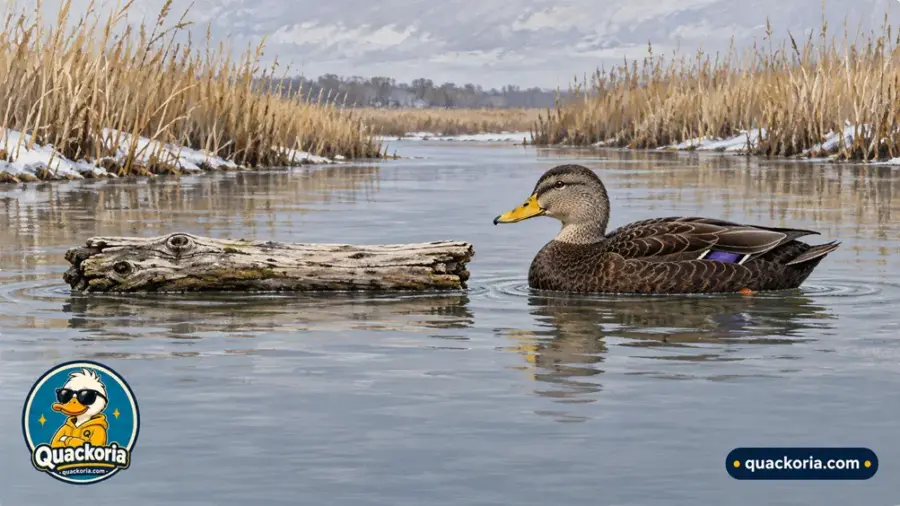
The American black duck is a dark brown dabbling duck of eastern North America, about the same size and shape as a mallard and often in the same flock. Tell it by its darker body, olive-yellow bill and purple speculum without white borders. Its numbers fell by more than half between the 1950s and 1980s and have since stabilised at about half their 1950s level.
Key takeaways
- Cornell rates it about the same size as a mallard, 54–59 cm (21.3–23.2 in) long, with a very dark brown body and a pale grey-brown head.
- Female mallards have paler bodies and orange-and-black bills; the black duck's speculum is purple with no white border, the mallard's blue bordered with white (Cornell).
- Ducks Unlimited's 2020 genetics article found a 25 percent hybridisation rate among birds identified as black ducks; the other 75 percent were pure.
- Ducks Unlimited cites USFWS estimates that black duck numbers fell by more than 50 percent between the 1950s and 1980s; the Black Duck Joint Venture was set up in 1989.
- The BTO rates it very rare in Britain and BirdGuides scarce; a drake at Loch Sunart, first reported on 16 June 2007, had spent 12 years there by BirdGuides' 2019 account.
The American black duck, Anas rubripes, is the dark, mallard-shaped dabbling duck of eastern North America, and despite the name it is not black: Cornell describes “very dark brown bodies with pale gray-brown heads”. It is known for passing as a female mallard, and for a steep decline in the twentieth century in which the mallard is one of the suspects. Look for it in salt marshes, bays and sheltered ponds near the Atlantic coast, often in the same flock as mallards.
How to recognise an American black duck
Cornell puts it at “About the same size as a Mallard; slightly larger than a Gadwall”, with “a profile nearly identical to Mallards”: 54–59 cm long (21.3–23.2 in), 720–1640 g (25.4–57.9 oz), with a wingspan of 88–95 cm (34.6–37.4 in). The male has a “Dark brown body contrasting with a pale brown head and yellow bill”, with a “purple speculum, and red legs”. Females “tend to be slightly paler than males, with duller olive bills”. Cornell gives no separate eclipse plumage, and its verdict on the pair is that “The female has a darker and duller bill than the male, but is otherwise quite similar.” The bill, then, sexes the bird; more in male vs female duck. Voice will not help either: Audubon says the call “sounds like the typical duck quack”.
American black duck or female mallard?
This is the confusion that matters; Cornell says black ducks “look quite similar to female Mallards”. Cornell’s marks: “Female Mallards have paler bodies than American Black Ducks, and their bills are orange and black rather than yellow-olive.” Then the wing: “The speculum on Mallards is blue bordered with white, while the American Black Duck’s is purple without the white border.” In a mixed flock Cornell suggests looking for “a darker, colder-toned duck of similar size”, and in flight “the white underwings of American Black Ducks form a brighter, more contrasting flash than on a flying Mallard.” Hybrids blur all of this. Cornell warns of “individuals with intermediate characters, such as a dark body and a partially green head”, and a hybrid male may show “Mallard’s iridescent green on upper part of head and American Black Duck’s pale cheek.” Of the other look-alikes, mottled ducks “are slightly paler overall than American Black Ducks and have buffy, unstreaked faces”, and Ducks Unlimited notes “very limited range overlap”.
Where and when you will see one
This is an eastern bird. Ducks Unlimited says “Breeding birds occur from southern Hudson Bay east to the Maritime Provinces, and south from Maine to coastal North Carolina”. The USFWS notes that along the Atlantic coast it “frequents the salt marshes and ocean much more than mallards.” Cornell says the birds “mostly spend the winter in saltwater wetlands”. Ducks Unlimited has them leaving the breeding areas “in September or October, depending on latitude”, though “A relatively small portion of the population is nonmigratory and occupies coastal wetlands from New Jersey south to North Carolina.”
In Britain the rarity depends on whom you ask. To the BTO it is “Very rare”, “a rare vagrant”, with a first record in Kent in 1967 and an Irish one in Kilkenny in 1954; to BirdGuides’ species page it is “Scarce”. BirdGuides’ 2014 history found it “recorded in Britain and Ireland in 35 of the subsequent 47 years”, while warning that it “is no doubt rarer than the above statistic suggests”. Not all are escapes: Cornell records that “One female banded in New Brunswick, Canada, turned up later in France.”
What it eats, and how
Cornell: “These are dabbling ducks that tip up instead of dive when they forage”; the difference is set out in dabbling vs diving ducks. The species eats “mostly plant matter, with insects added during the breeding season”, when adults and ducklings take aquatic insect larvae, “crustaceans, mollusks, and sometimes fish”. Audubon, on the coast: “In tidal zones may feed mainly on mussels, clams, snails, small crustaceans, aquatic arthropods.” Inland, Cornell adds, they “fly into agricultural fields to feed on waste corn and grain.”
Nesting and ducklings
The nest is usually on the ground. Cornell: “The female selects a well-concealed site, often on the ground, on wooded or grassy islands, uplands, marshes, cultivated croplands, or cropland borders.” Cornell gives 6–14 eggs, “White, cream-colored, or pale greenish buff”, and 23–33 days of incubation; Audubon says a female “typically lays 7-11 eggs, sometimes 6-12, rarely 4-17”, incubating “typically 26-29” days, and Ducks Unlimited puts incubation at “around 26 days”. Cornell says that “As soon as their down feathers dry, newly hatched ducklings are able to leave the nest”; Audubon adds that the female leads them to water “often after dark”, and that they fly at “about 2 months”.
Do black ducks and mallards interbreed?
Yes, and the mallard has long been blamed for the black duck’s troubles. Audubon: “Clearing of forest has favored invasion by Mallards, which hybridize extensively with American Black Ducks, leading to genetic ‘swamping’ of population.” Cornell adds that “Mallards thrive under urban conditions and may oust their shyer cousins from the habitat”. A 1989 review in the Wildlife Society Bulletin noted that “Black duck x mallard hybrids are fertile” and that “Hybridization could be a result of concomitant mallard increases and black duck decreases, or changes in black duck-to-mallard ratios could be from hybridization and genetic swamping of black ducks.” Genetics has since changed the picture. Ducks Unlimited’s 2020 article on the two species reports: “We discovered a hybridization rate of 25 percent among birds identified as black ducks.” It goes on: “The remaining 75 percent were pure black ducks”, and “Mallard-black duck hybrids rarely breed with black ducks, resulting in little gene flow back into the parental black duck population.” Its conclusion turns the worry round: “Instead of the black duck being faced with genetic extinction, it is the native North American mallard that may be threatened by hybridization with game-farm birds.”
Strays pair with mallards too. BirdGuides reported in 2014 that the drake at Loch Sunart in Highland, Scotland, present “intermittently since 16th June 2007”, was “paired with a female Mallard”. Its 2019 article said “the bird has spent 12 years as a Scottish resident” and had “sired various offspring with the local Mallard population”. None of the sources we read says what became of it after 2019.
How American black ducks are doing
Better than they were, but not back. The Black Duck Joint Venture describes a bird that was “Once the most abundant fresh-water duck in eastern North America” and whose populations “have dropped steadily since the 1950s, reaching all-time lows in the 1980s”; Ducks Unlimited cites USFWS estimates that numbers “fell by more than 50 percent between the 1950s and 1980s.” Cornell records hunters “shooting an estimated 800,000 per year in the 1960s and 1970s”. The causes are argued over. The joint venture lists “Habitat loss, competition with mallards, hunting, changes in nesting and brood-rearing success”; the 1989 review found that the evidence “does not support the contention that hunting is either the sole or most important cause” of the drop in winter counts. The joint venture itself dates from 1989, in Ducks Unlimited’s words “the first species-specific joint venture established under the North American Waterfowl Management Plan”. The USFWS’s 2025 report put black ducks in its eastern survey area at 0.8 ± 0.09 million, “similar to their 2024 estimates and their long-term average”. Even so, the joint venture says, “overall numbers of black ducks are still only at about half the level of the 1950s.”
If a female mallard on a winter marsh looks too dark, check the bill, then the speculum and underwings when it flies, and confirm it with which wild duck did I see. Cornell’s oldest black duck was “26 years, 5 months old” when found in Delaware in 1978; compare that with how long ducks live.
Frequently asked questions
what is the difference between a black duck and a mallard
Body colour, bill and speculum. Cornell: "Female Mallards have paler bodies than American Black Ducks, and their bills are orange and black rather than yellow-olive." It adds that "The speculum on Mallards is blue bordered with white, while the American Black Duck's is purple without the white border."
do black ducks and mallards mate
Yes. Cornell says the two species "frequently hybridize in eastern North America", and a 1989 review found the hybrids fertile. Ducks Unlimited's 2020 genetics article found that hybrids "rarely breed with black ducks", so little mallard ancestry flows back into the black duck population.
are american black ducks endangered
No. The BTO and BirdGuides give its global status as Least Concern, and the USFWS 2025 estimate for the eastern survey area was "similar to their 2024 estimates and their long-term average". But the Black Duck Joint Venture says numbers are "still only at about half the level of the 1950s."
where do black ducks go in winter
Mostly to the coast. Cornell says they "mostly spend the winter in saltwater wetlands, but also in beaver ponds, flooded timber, agricultural fields, and riverine habitats". Ducks Unlimited adds that a small part of the population does not migrate, staying in coastal wetlands from New Jersey to North Carolina.
are there american black ducks in the uk
Only as vagrants. The BTO gives its status as "Very rare" while BirdGuides calls it "Scarce", and a few birds have stayed for years, among them a drake at Loch Sunart in Highland, Scotland, first reported on 16 June 2007.
Sources
- Cornell Lab of Ornithology, All About Birds — American Black Duck Overview
- Cornell Lab of Ornithology, All About Birds — American Black Duck Identification
- Cornell Lab of Ornithology, All About Birds — American Black Duck Life History
- Cornell Lab of Ornithology, All About Birds — American Black Duck Similar Species
- National Audubon Society — Guide to North American Birds: American Black Duck
- Ducks Unlimited — Waterfowl ID: American Black Duck
- Ducks Unlimited — The Surprising Genetics of American Black Ducks and Mallards
- Ducks Unlimited — Understanding Waterfowl: Bringing Back the Black Duck
- U.S. Fish and Wildlife Service — Ducks at a Distance
- U.S. Fish and Wildlife Service — Waterfowl Population Status, 2025
- U.S. Geological Survey — Population ecology and harvest of the American black duck: a review (1989)
- Black Duck Joint Venture — About
- British Trust for Ornithology — BirdFacts: American Black Duck
- BirdGuides — Species Guide: American Black Duck
- BirdGuides — American Black Duck: history & status within the Western Palearctic
- BirdGuides — American Black Duck: a long-distance love affair