Quackoria Learn
Canvasback Duck: The Aristocrat of Ducks and Its Wild Celery
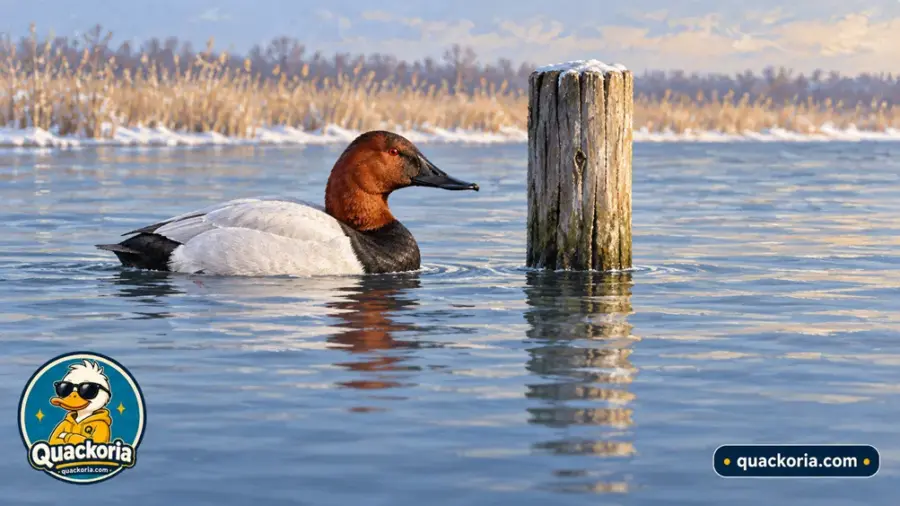
The canvasback duck is a large North American diving duck with a chestnut head, a whitish body and a long forehead that slopes straight into its bill. Its scientific name comes from wild celery, its preferred winter food, and the collapse of wild celery on Chesapeake Bay is part of the species' history. The USFWS put the 2025 breeding population at about 0.7 million, similar to the long-term average.
Key takeaways
- Breeding males have a chestnut head, red eyes and a black chest and rear; Cornell measures the species at 48–56 cm (18.9–22.1 in) and 862–1588 g (30.4–56.0 oz).
- Cornell: redheads are smaller, with a blue rather than black bill, a steeper forehead and a grey rather than white back.
- Cornell says canvasbacks dive to around 7 feet to pull up aquatic plants, and in migration and winter eat mainly rhizomes and tubers.
- Maryland DNR says half the continent's canvasbacks, more than a quarter of a million, wintered on Chesapeake Bay as recently as 1950; the 2023 midwinter survey estimate for the Chesapeake and the nearby Atlantic coast was 57,800.
- Ducks Unlimited dates the first closed season on canvasbacks to 1936; the USFWS 2025 estimate was 690 thousand against a long-term average of 591 thousand.
The canvasback duck, Aythya valisineria, is the big diving duck with a chestnut head, a pale body and a forehead that runs in one straight slope down to the tip of its bill. Cornell notes it is “Often called the aristocrat of ducks”. Its story is tied to a water plant: its scientific name comes from wild celery, the food that once drew huge winter flocks to Chesapeake Bay. In the United States it is most likely to be seen between autumn and spring, rafted on large lakes, rivers and coastal bays.
How to recognise a canvasback
Cornell describes “A large, big-headed diving duck with a gently sloping forehead and a stout neck”, 48–56 cm long (18.9–22.1 in), weighing 862–1588 g (30.4–56.0 oz), with a wingspan of 79–89 cm (31.1–35.0 in). Its size class, in Cornell’s terms, is “between crow and goose”. Breeding males “have a chestnut head and neck set off against a black chest, whitish body, and black rear”, and “Males have red eyes, and females have dark eyes.” Females “are pale brown where males are chestnut and black, and they have a grayish rather than white body”. After breeding the male dulls: “In late summer and early fall, males have brown heads and necks with a paler body.” In flight, Cornell says, “note dark neck, head, and rear with white body and underwings.”
Canvasbacks say little. Cornell calls them “generally silent”, with soft cooing from males and “a guttural krrr-krrr” from females during courtship. The US Fish and Wildlife Service’s guide Ducks at a Distance says hens “have a mallard-like quack”; Audubon’s size guide puts the canvasback between crow and mallard size.
Canvasback or redhead?
Redheads are the bird to rule out, and the two often share the water: Cornell describes canvasbacks “forming large single-species rafts or mixing with Redheads and scaups.” Its comparison is precise: “Redheads are smaller than Canvasbacks with a blue (not black) bill, a steeper forehead, and a gray (not white) back.” For the females, “Female Redheads have a rounder head than the gently sloping heads of Canvasbacks and a darker brown back.” Female scaup have “a white spot behind the bill that female Canvasbacks lack”. In Britain the look-alike is the pochard. The BTO describes the canvasback as resembling “a Pochard but larger and with a white, not grey, back”, and British Birds’ account of the first British records notes a bird “approximately 25% longer than Pochard” with “an entirely black bill”.
Where and when you will see one
Audubon calls the species “a characteristic bird of prairie marshes in summer and saltwater bays in winter”. For readers in the United States, Cornell says, “spring, fall, and winter are the best times to go looking for a Canvasback”, on “deep freshwater lakes and coastal waters including brackish and saltwater estuaries, shallow bays, and harbors.” Outside the breeding season, Cornell adds, “they gather in large rafts by the thousands to tens of thousands.” Chesapeake Bay gives a calendar: Maryland’s Department of Natural Resources says the birds “are usually here in force by Christmas, sometimes by Thanksgiving”, and “stay through early to mid-March, then they’re gone, heading north to nesting grounds.” Audubon writes that “Migrating flocks fly high, often in V-formation”, a habit explained in why ducks fly in a V. Because they are hunted, Cornell warns, they “tend to be wary and readily flush”, so a spotting scope helps.
In Britain the canvasback is a great rarity. The BTO calls it “an extremely rare visitor from North America”, status “Very rare”, with a first record in Kent in 1996. British Birds reported a male at Cliffe, Kent, on 7 December 1996, and “a more settled, and much more widely observed bird in Norfolk in January 1997”.
What it eats, and how
The canvasback is a diver (the two feeding styles are set out in dabbling vs diving ducks). Cornell: “Canvasbacks dive straight down to depths of around 7 feet to extract pieces of aquatic plants with their bill.” Audubon has it feeding “usually in water only a few feet deep”. Cornell calls the species “omnivores, eating everything from seeds to plant tubers and from mussels to insects”, and says that “during migration and winter they primarily eat rhizomes and tubers from aquatic plants.” Audubon lists “pondweeds, wild celery, sedges, grasses, and others”, plus “mollusks, insects, some small fish”.
Nesting and ducklings
The female builds over water. Cornell describes “a large bulky platform of sedges, reeds, cattails, and rushes”, fixed to standing stems “such that the nest floats on the water”. Cornell lists 5–11 eggs, “Greenish drab”, incubated for 24–29 days; Audubon gives 7–12 “olive-gray” eggs and 23–28 days. Audubon says “Several hours after hatching, young are led to open water by female”, and that they fly “roughly 60-70 days after hatching”. Not every egg belongs to the owner. “Female Canvasbacks sometimes lay eggs in another Canvasback’s nest”, Cornell notes, and “Redheads and Ruddy Ducks sometimes lay their eggs in a Canvasback’s nest.” Audubon uses a stronger word: “Redheads often lay eggs in Canvasback nests; when this happens, the female Canvasback is likely to lay fewer eggs.” Cornell’s redhead account says female redheads “are perhaps tops in this department” of laying in other birds’ nests; the ruddy duck is the other intruder Cornell names.
What does wild celery have to do with the canvasback?
Its name, for a start. Cornell: “The species name of the Canvasback, valisineria, comes from Vallisneria americana, or wild celery”, a plant whose “winter buds and stems are the duck’s preferred food during the nonbreeding period.” The English name is another matter; none of the sources we read explains it. The link is clearest on Chesapeake Bay. Maryland DNR writes that “Large beds of wild celery once attracted thousands of the ducks to Susquehanna Flats and elsewhere on the upper Bay”, and that “As recently as 1950, half the continent’s population of canvasbacks – more than a quarter million – wintered in the Chesapeake”. Then the plant went. Cornell blames “pollution, siltation, and eutrophication”; for the bay, Maryland DNR calls Tropical Storm Agnes in 1972 “the final blow”, after which “wild celery was virtually impossible for canvasbacks to find.” The ducks “switched their foraging efforts to small clams on the Chesapeake’s shallow bottom”, a less nutritious diet that, the department says, scientists believe may affect winter survival. The midwinter waterfowl survey flown along the Chesapeake and the nearby Atlantic coast by Maryland DNR and US Fish and Wildlife Service teams sighted 225,450 canvasbacks in 1955; the estimates were 46,900 in 2020 and 57,800 in 2023.
How canvasbacks are doing
Ducks Unlimited’s 2012 article “King Can” describes a bird “long known as the king of waterfowl” that suffered “unregulated, decimating market hunting” in the late 1800s and early 1900s, then drought, the drainage of prairie potholes and the dwindling of wild celery beds: “All of these factors led to the first-ever closed season on canvasbacks in 1936.” Cornell adds that “Low numbers in the 1980s put the Canvasback on species of special concern lists, but numbers increased greatly in the 1990s.” The sources differ on the long-term trend. Audubon says the species “has been generally declining”, while Cornell reports the North American Breeding Bird Survey finding it “stable from 1966 through 2015”. The US Fish and Wildlife Service’s 2025 status report counted 690 thousand in its traditional survey area, against 566 thousand in 2024 and a long-term average of 591 thousand, and judged the estimate “similar to their long-term average”. The BTO gives its global status as Least Concern.
On a winter lake full of diving ducks, look first at the profile: a forehead running straight into the bill means canvasback. Confirm it with which wild duck did I see, and for the words used for ducks massed on the water, see what is a group of ducks called.
Frequently asked questions
what does valisineria mean
It refers to wild celery. Cornell says: "The species name of the Canvasback, valisineria, comes from Vallisneria americana, or wild celery." Audubon calls wild celery "an aquatic plant that is among its favored foods".
what is the difference between a canvasback and a redhead
Size, bill, forehead and back colour. Cornell: "Redheads are smaller than Canvasbacks with a blue (not black) bill, a steeper forehead, and a gray (not white) back." Female redheads have a rounder head and a darker brown back.
do redheads lay eggs in canvasback nests
Yes. Audubon says "Redheads often lay eggs in Canvasback nests; when this happens, the female Canvasback is likely to lay fewer eggs." Cornell says redheads and ruddy ducks sometimes do it, and that female canvasbacks also lay in one another's nests.
are canvasback ducks endangered
No. The BTO gives its global status as Least Concern, and the USFWS 2025 report found the canvasback estimate "similar to their long-term average". Cornell notes that low numbers in the 1980s put it on species of special concern lists before numbers increased greatly in the 1990s.
has a canvasback ever been seen in the uk
Yes, but very rarely. The BTO calls it "an extremely rare visitor from North America", with the first British record in Kent in 1996; British Birds describes a male at Cliffe, Kent, on 7 December 1996.
Sources
- Cornell Lab of Ornithology, All About Birds — Canvasback Overview
- Cornell Lab of Ornithology, All About Birds — Canvasback Identification
- Cornell Lab of Ornithology, All About Birds — Canvasback Life History
- Cornell Lab of Ornithology, All About Birds — Canvasback Similar Species
- Cornell Lab of Ornithology, All About Birds — Canvasback Sounds
- Cornell Lab of Ornithology, All About Birds — Redhead Overview
- National Audubon Society — Guide to North American Birds: Canvasback
- Ducks Unlimited — Waterfowler's Notebook: King Can
- U.S. Fish and Wildlife Service — Ducks at a Distance
- U.S. Fish and Wildlife Service — Waterfowl Population Status, 2025
- Maryland Department of Natural Resources — The Canvasback Still Graces the Chesapeake
- British Trust for Ornithology — BirdFacts: Canvasback
- British Birds — Canvasback in Kent: new to Britain