Quackoria Learn
How to Tell if a Duck Is Male or Female
In mallards and the breeds descended from them, the loud, clear quack belongs to the female. The drake does not quack; he gives a quieter, rasping call.

Key takeaways
- The classic quack is the female. Cornell puts it plainly: the male does not quack.
- Drakes of every breed except Muscovy grow curled sex feathers at the base of the tail. Their presence proves a male; their absence proves nothing, because a young drake has not grown them yet and an older one can lose them in the moult or have them pulled (Metzer Farms).
- In Anas drakes, the mallard's genus, the moult into drab eclipse plumage runs from mid-May to early July (Pyle, 2005), and they look almost like females — but a mallard drake keeps a black-and-white tail and often a trace of green (Cornell), and a uniform yellow bill (Scottish Wildlife Trust).
- Vent sexing can be done from day one, but done improperly it can seriously injure a bird. An extension poultry specialist says he knows of no formal resources for learning it.
- Male Muscovies are much larger than females — almost twice the size by the British Waterfowl Association and Metzer Farms, 30–50% heavier by the Cornell Duck Research Laboratory — and the difference starts showing at about three weeks (Metzer).
Start with the sound. In mallards and every breed descended from them, the loud, clear, unmistakable quack belongs to the female. The drake does not make it — he gives a quieter, rasping, one- or two-note call instead.
Voice: the one nearly everyone gets wrong
Cornell’s Lab of Ornithology states it about as directly as it can be stated: “The quintessential duck’s quack is the sound of the female mallard.” And: “The male does not quack; instead he gives a quieter, rasping, one- or two-noted call.”
So the duck in the cartoon, the duck in the sound effect, the duck everybody imitates — that is a female. The female’s call often comes in a series of two to ten quacks that start loud and get softer.
Drakes do make one striking sound, but not with their voice: they rattle the bill against the flight feathers during a display that looks like stylised preening.
For domestic birds, the hatchery Metzer Farms puts the change at around eight weeks — “after about eight weeks, the males have a deep, raspy voice”, while females have “the typical, loud QUACK” — and Metzer’s blog says eight to ten weeks. University of Minnesota Extension puts it a little earlier: “After about 6 weeks of age the sounds ducks make can be a clue to their sex.” The sex difference itself is solidly sourced; the exact week is not. Why ducks quack covers what the calls are actually for.
The sex feather
Drakes grow a small number of curled feathers at the base of the tail. Poultry Extension, the US Cooperative Extension resource, gives the rule cleanly: “For all breeds except the Muscovy, male ducks have curled feathers at the base of the tail (called sex feathers), whereas females do not.”
That single sentence answers three things at once — the feather’s proper name, that it appears in every breed except one, and that Muscovies do not have it. The names themselves — drake, hen, duckling — are on what a male duck is called.
Read it in one direction only. A curl means a drake. No curl does not mean a female: Metzer Farms says a missing curl “does not indicate a female as it could have been pulled or molted”, and a young drake has not grown it yet.
On timing, the figure comes from a hatchery: Metzer Farms says the curly feather “appears within about eight weeks”. That is a hatchery’s practical experience rather than a published result.
Eclipse plumage, and why your drake looks like a female in August
At the end of the breeding season a drake sheds all his flight feathers at once and is flightless for a period — Cornell says three to four weeks, Ducks Unlimited says thirty to forty-five days, and those two ranges do not overlap, so expect anything from about three weeks to six. By then — on the specimen dates in Pyle’s study, below — his body feathers have already moulted into a drab, female-like plumage, and he wears it while he cannot fly. That is eclipse. The Scottish Wildlife Trust notes that ducks moulting their flight feathers are “very vulnerable to predators”, and Pyle suggests the drab summer plumage may have evolved in species that benefit from camouflage at that time.
The peer-reviewed timings, from Pyle’s 2005 study of 2,227 duck and goose specimens: body moult in male Anas runs from mid-May to early July, and the wing moult from early July to early September. In practice a Northern Hemisphere mallard drake can start to look scruffy from mid-May — Metzer Farms says the moult often begins around June — wears his eclipse plumage through the flightless weeks of July and August, and regains his colours in a body moult that Pyle dates, for most Anas ducks, between late August and early November.
An eclipse drake is not identical to a female. Cornell gives two of the tells: he is browner, “but retains its black-and-white tail and often shows at least a trace of green on the head”. The Scottish Wildlife Trust adds the third: in eclipse “he has a uniform yellow bill (compared to her orange bill with black markings)”. Check the bill and the tail first.
One piece of terminology worth knowing if you read further: Ducks Unlimited calls the drab plumage the basic plumage and the bright one the alternate, but Pyle’s 2005 study argues the reverse — that “the bright feathering of male ducks should be considered the basic plumage”. Either way the oddity is the same: as Pyle puts it, “males of many species acquire brightly pigmented plumages in autumn rather than in spring”, and Ducks Unlimited says mallards “begin courting and selecting mates during fall and early winter”. Do ducks mate for life explains why the timing works that way.
Vent sexing — and why this article will not teach it to you
Male waterfowl have a phallus, which few birds do: Herrera and colleagues (2013) put it at only about 3% of birds. Gently everting the cloaca reveals it. It can be done from day one — University of Minnesota Extension says it “requires some experience and may be more easily done with day-old birds or during the breeding season”.
Cornell Cooperative Extension describes the handling, and then says this: “If done improperly, vent sexing can result in serious injury to the waterfowl.” Young birds are “especially delicate and susceptible to injury”, and their recommendation is to “learn from an experienced handler before attempting on your own.”
Oregon State University Extension’s poultry specialist goes further, and his answer is the reason this article stops here. Asked how to learn it, he replied: “There are no formal resources that I know of to learn vent sexing with ducks or chickens either.” He added that while learning, “either with your own birds or others”, some ducklings may be injured “until you learn how much pressure is needed.”
An extension poultry specialist who knows of no formal resource for learning it is a clear signal, and Metzer Farms puts it plainly: “It can only be learned if someone is showing you the steps.” Find someone who does it and watch them, or leave it and wait for the voice.
Plumage and bill colour, by breed
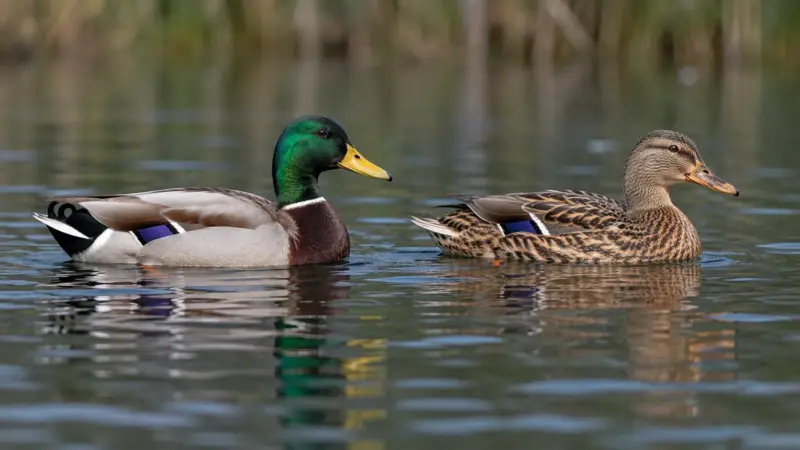
In wild mallards, Cornell’s identification guide gives it simply: the male has “a dark, iridescent-green head and bright yellow bill”, grey body, brown breast, black rear; females and juveniles are “mottled brown with orange-and-brown bills”. The RSPB describes the same bird in British terms and notes both sexes show the purple wing flash.
For domestic breeds the useful markers, from Metzer Farms, are:
- Six weeks — in Rouens and Mallards the drake’s bill turns dull green, while the female’s is normally dark brown and orange.
- About fifteen weeks — the drake’s green head and coloured wings in Rouen, Mallard and Welsh Harlequin.
- Males generally have larger heads and thicker necks.
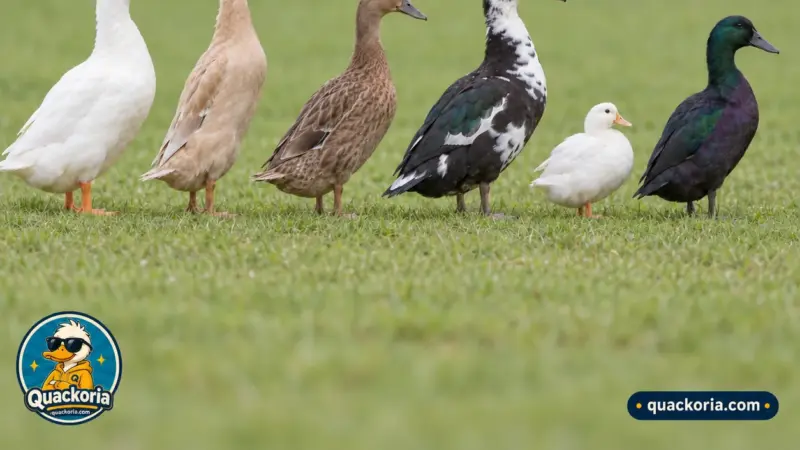
Beyond that, Metzer Farms notes that Khaki Campbell and Welsh Harlequin drakes have a lighter-coloured bill than the females, and Cornell Cooperative Extension tells keepers to “research your particular breed”. If you are still working out what breed you have, the beginner’s guide to duck breeds is the place to start.
Muscovy is a different problem, and an easier one
Muscovies are not mallard-derived — they are a separate species — and their sexes differ far more obviously in size.
Three independent sources put the size difference at about two to one. The British Waterfowl Association: drakes are “considerably larger than the ducks, almost twice the size.” Cornell’s Lab of Ornithology: “The male Muscovy Duck is the largest duck in North America, but the female is only half his size.” Metzer Farms adds the practical timing: “By three weeks the two sexes are beginning to differentiate by size.” Not every source puts the gap that high: the Cornell Duck Research Laboratory has “the male weighing 30-50% more than the female”.
A peer-reviewed study of 1,020 adult Muscovies in Nigeria confirmed the dimorphism formally — sex affected every body measurement, and body weight combined with wing and body length classified birds correctly 98.5% of the time. Its males averaged 2.64 kg against 1.60 kg for the females — about 65% heavier.
Caruncles — the red fleshy growths on the face — differ too: the British Waterfowl Association says they “develop as they age, especially in the drakes”, and notes that they have become more exaggerated in domestic birds. Size is the reliable one. And remember Muscovies have no sex feather at all, so that method is simply unavailable.
What works, and when
Putting it together, in the order it becomes available:
- Day one — vent sexing. The most accurate method, says Cornell Cooperative Extension, and genuinely risky in untrained hands.
- Three weeks — Muscovy size difference starts to show.
- Six weeks — bill colour in Rouens and Mallards.
- Six to ten weeks — voice (about six weeks by University of Minnesota Extension, eight to ten by Metzer Farms), and by about eight weeks the sex feather (Metzer). The most useful pair for most keepers, and completely safe.
- About fifteen weeks — the drake’s green head and coloured wings in Rouen, Mallard and Welsh Harlequin.
One overall caution about that list: apart from University of Minnesota Extension’s day-old vent sexing and six weeks for the voice, every age in it comes from a hatchery, Metzer Farms, rather than from a university or a journal. The differences themselves are well established. The timing is practical experience, and your birds may not read the schedule.
If the reason you are asking is that you want eggs, when ducks start laying is the next thing to read — and it will settle the question for you eventually, whatever the feathers say.
Frequently asked questions
Do male or female ducks quack?
Female. Cornell's Lab of Ornithology states that the male mallard does not quack at all — he gives a quieter, rasping, one- or two-note call. The loud clear quack everyone imitates is a female's.
What is a drake feather?
A small number of curled feathers at the base of a drake's tail, properly called sex feathers. Every breed except Muscovy has them. Their presence proves a male; their absence proves nothing, because a young drake has not grown them yet and an older one can lose them in the moult or have them pulled (Metzer Farms).
Why does my male duck look like a female in summer?
Eclipse plumage. After the breeding season drakes moult into drab, female-like body feathers — mid-May to early July in male Anas ducks, the mallard's genus, by Pyle's 2005 study — and keep them through the flightless wing moult that follows, roughly early July to early September. In a mallard drake look at the bill and tail: Cornell says he keeps a black-and-white tail and often a trace of green on the head, and the Scottish Wildlife Trust notes his uniform yellow bill.
At what age can you tell if a duck is male or female?
Vent sexing can be done from day one, but done improperly it can seriously injure the bird. The voice changes from about six weeks (University of Minnesota Extension) to eight to ten weeks (Metzer Farms), and Metzer says the sex feather appears within about eight weeks; both are completely safe to check. Muscovies start showing a size difference at about three weeks (Metzer).
How can you tell a male Muscovy from a female?
Size. Males are much larger — almost twice the size of females by the British Waterfowl Association and Metzer Farms, 30–50% heavier by the Cornell Duck Research Laboratory — and the difference begins showing at about three weeks (Metzer). Muscovies have no sex feather, so that method does not apply to them.
Sources
- Cornell Lab of Ornithology — Mallard Sounds
- Cornell Lab of Ornithology — Mallard Identification
- Poultry Extension — External Anatomy of Ducks
- Cornell Cooperative Extension — Sexing Waterfowl
- Oregon State University Extension — Ask Extension, vent sexing
- Pyle (2005), Molts and Plumages of Ducks (Anatinae), Waterbirds 28:208–219
- British Waterfowl Association — Muscovy
- Oguntunji & Ayorinde (2014), Sexual size dimorphism in Muscovy duck, Acta Agriculturae Slovenica 104:15–24
- Metzer Farms — Sexing Birds
- Metzer Farms — Male vs Female: How to Identify Adult Ducks
- Metzer Farms — Muscovy Ducks
- University of Minnesota Extension — Raising Ducks (Poultry Fact Sheet 43, Hamre, revised 1974)
- Ducks Unlimited — Mallard Annual Life Cycle
- Scottish Wildlife Trust — Everything you needed to know about eclipse plumage!
- RSPB — Mallard
- Cornell Lab of Ornithology — Muscovy Duck overview
- Cornell University Duck Research Laboratory — Domestic Ducks
- British Waterfowl Association — Muscovy (domestic)
- Herrera, Shuster, Perriton & Cohn (2013), Developmental Basis of Phallus Reduction during Bird Evolution, Current Biology 23:1065–1074
- eXtension — James Hermes, Extension Poultry Specialist, Oregon State University
- Metzer Farms — The Great Duck Disguise: What's Really Going on with Eclipse Plumage