Quackoria Learn
Duck, Goose or Swan? How to Tell Them Apart
All three are waterfowl in the same family, but neck length, feeding style and voice separate them long before you get close enough to count feathers.
Key takeaways
- All three belong to the family Anatidae — they are relatives, not distant strangers.
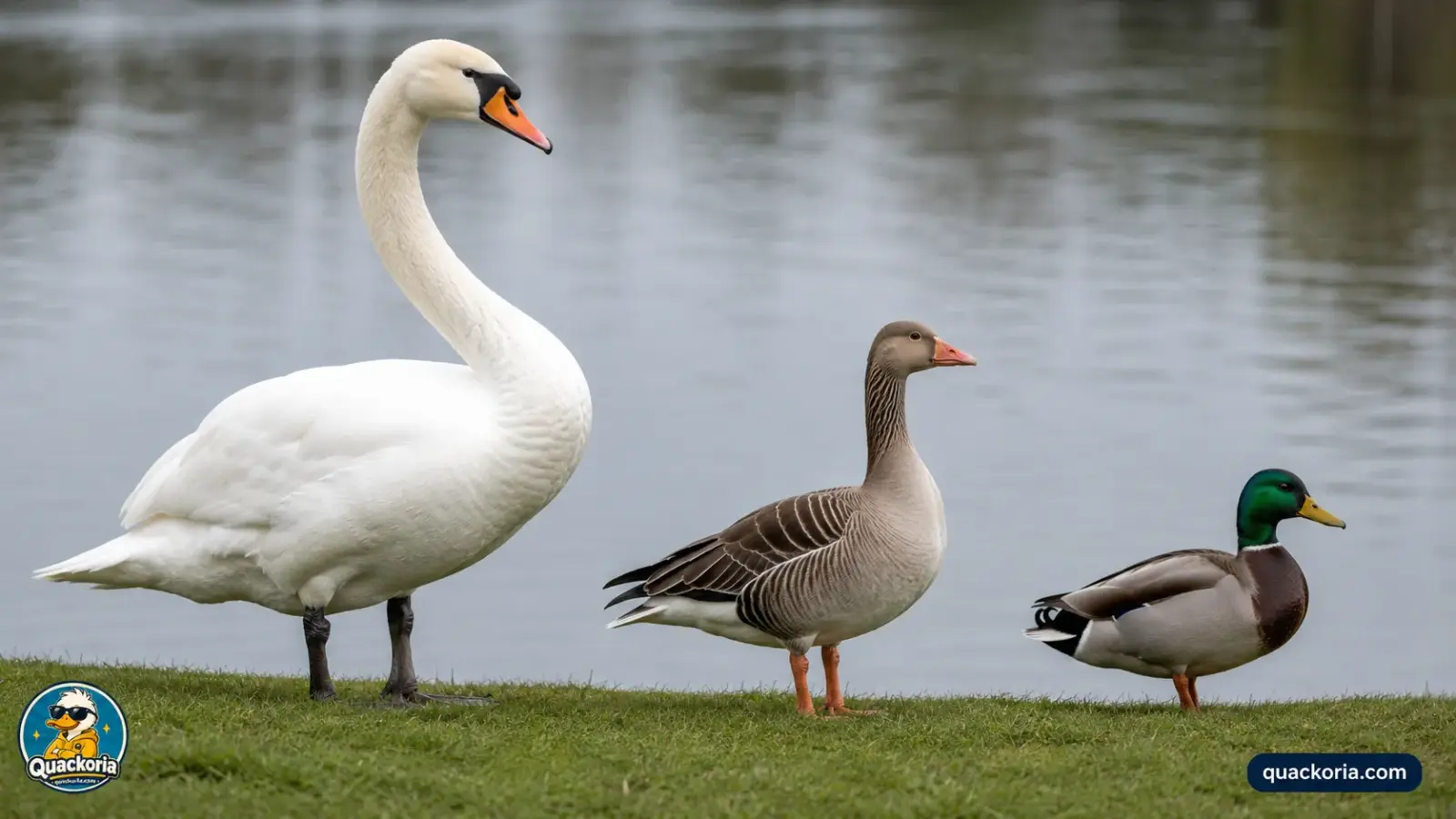
- Neck length is one of the quickest field marks: swans longest, geese medium, ducks shortest.
- Ducks mostly feed in water; geese graze on land far more.
- Swans and geese usually pair for many years; most ducks pair for a single season.
- In ducks the sexes often look completely different; in geese and swans they usually look alike.
- A swan is not a duck: swans and geese share one subfamily (Anserinae), and most ducks sit in another (Anatinae), inside the same family.
Ducks, geese and swans all belong to the same family, Anatidae. They are genuine relatives, which is why they look alike enough to cause confusion. But once you know what to look at, telling them apart from a distance takes about two seconds.
The quick version
| Duck | Goose | Swan | |
|---|---|---|---|
| Size | Small | Medium to large | Very large |
| Neck | Short | Medium, held upright | Very long; S-curved in mute swans, straighter in others |
| Bill | Usually broad and flat (narrow in sawbills) | Deep at the base, tapering to the tip | Broad, often with a knob or coloured base |
| Feeds | Mostly in water | Mostly grazing on land | Mostly in water; some graze fields in winter |
| Sexes | Often look very different | Usually alike | Usually alike |
| Pairs | Usually one season | Often many years | Often for life |
| Voice | Quack, whistle, grunt | Honk | Trumpet, snort, hiss |
Is a swan a duck?
No. A swan is not a duck, and it is not a goose either — but it is a close relative of both. All three belong to one family, Anatidae, which Britannica defines as the bird family “that includes ducks, geese, and swans”. Inside that family, swans and typical geese are grouped together in one subfamily, Anserinae, and the dabbling and perching ducks — the mallard, the pintail, the teal, the wood duck — in another, Anatinae. So a swan shares a subfamily with the geese and only a family with the typical ducks. In plain terms: cousins, not the same bird, and not a bigger version of one.
Is a swan a goose?
Closer, but still no. Swans and geese share the subfamily Anserinae, which is why they have so much in common — the sexes look alike, both parents raise the young, and pairs stay together for years. What separates them is size, neck and feeding: a swan is far larger, carries a neck long enough to reach water plants beyond the reach of a dabbling duck, and feeds mainly on water plants, though whooper, Bewick’s, tundra and trumpeter swans also feed in fields, especially in winter; a goose does most of its feeding on land. Britannica’s annotated classification counts 24 species in the swan-and-goose subfamily against 69 in Anatinae, the subfamily of the dabbling ducks, pochards and wood ducks, and gives the sea ducks, stiff-tailed ducks, shelducks and whistling ducks subfamilies of their own.
How big is a swan compared with a goose or a duck?
The size gap is larger than most people expect, and it is the easiest thing to check against a bird in front of you. These are the Cornell Lab of Ornithology’s published measurements for seven common North American species, from the largest swan to a small teal, rounded.
| Species | Group | Length | Weight | Wingspan |
|---|---|---|---|---|
| Trumpeter swan | Swan | 138–158 cm (54–62 in) | 7.7–12.7 kg (17–28 lb) | 203 cm (80 in) |
| Mute swan | Swan | 127–152 cm (50–60 in) | 5.5–14.3 kg (12–32 lb) | 208–238 cm (82–94 in) |
| Canada goose | Goose | 76–110 cm (30–43 in) | 3.0–9.0 kg (6.6–20 lb) | 127–170 cm (50–67 in) |
| Snow goose | Goose | 69–83 cm (27–33 in) | 1.6–3.3 kg (3.5–7.3 lb) | 138 cm (54 in) |
| Mallard | Duck | 50–65 cm (20–26 in) | 1.0–1.3 kg (2.2–2.9 lb) | 82–95 cm (32–37 in) |
| Wood duck | Duck | 47–54 cm (18.5–21 in) | 454–862 g (1.0–1.9 lb) | 66–73 cm (26–29 in) |
| Green-winged teal | Duck | 31–39 cm (12–15 in) | 140–500 g (0.3–1.1 lb) | 52–59 cm (20–23 in) |
Two things stand out. A mute swan at the top of its range weighs 14.3 kg — eleven mallards. And the ranges overlap only where you would expect: a big Canada goose outweighs a small mute swan, though it is still shorter and has a much smaller wingspan. Colour causes mix-ups too: the Trumpeter Swan Society lists the snow goose among the large white birds that “may be confused with swans”. Cornell’s own size notes put it simply: a mute swan is “more than double the size of a Snow Goose”, a Canada goose is “larger than a Mallard, smaller than a Mute Swan”, and a mallard is “much smaller than a Canada Goose”.
Neck length is the field mark
If you learn one thing, learn this. Neck length is one of the most reliable ways to separate the three groups, and it works at a distance, in poor light, and on a bird that is swimming away from you.
A duck has a short neck. Even stretched, it looks compact relative to the body.
A goose has a distinctly longer neck, usually carried upright, which gives it an alert, upright bearing on land.
A swan has a neck that is unmistakable — long enough to hold in an S-curve, and long enough to reach water plants about a metre down while the body stays on the surface.
How each one feeds
Feeding style follows from that neck, and it is another strong clue.
Ducks
Ducks feed mostly in water. Dabblers tip forward, tail in the air, and strain food from the surface layer and the mud below it. Divers go under entirely. Most of the food is aquatic: seeds, water plants, insects, snails and, for the sawbills, fish. Not all of it, though: wigeon graze grass beside the water in dense flocks, and on migration many mallards eat largely grain from fields. The detail is in what ducks eat.
Geese
Geese are grazers. Their legs are set further forward than a duck’s, which is why a goose walks easily on land, while a duck’s gait is more of a waddle. A goose’s bill is deep at the base and tapers to the tip, with edges adapted for gripping grasses and sedges. Most of a goose’s diet is grass, grain, roots and leaves, much of it taken on land, though geese also feed in shallow water, and in winter brant rely heavily on eelgrass along the coast.
Swans
Swans use that neck as a tool. They upend and reach down to submerged plants up to about a metre below the surface, deeper than any dabbling duck can reach. Whooper, Bewick’s, tundra and trumpeter swans also feed in fields, especially in winter, on grass, grain and leftover crops.
Do the sexes look alike?
This one is genuinely useful, and it catches people out.
In many ducks, the male and female look like different species. A male mallard has a green head, white collar and chestnut breast; the female is mottled brown throughout. That is not unusual — it is usual among dabbling ducks, though not universal: a female American black duck looks much like the male. The female incubates alone, often on a nest hidden in vegetation, and Britannica links the male’s bright breeding plumage to keeping species apart where many ducks live side by side.
In geese and swans, the sexes generally look the same. Males are usually larger, but there is no colour difference to speak of. In geese the female incubates while the male stands guard, and in both groups the parents raise the young together.
If you are looking at two obviously different-looking birds behaving like a pair, you are almost certainly looking at ducks. The mallard version of this is set out in our mallard profile.
Voice
Ducks are varied. The famous quack is really a female mallard; males rasp, and plenty of other species whistle, coo, grunt or growl instead. Why ducks quack covers what the sounds mean.
Geese honk — carrying, rhythmic, and usually given in flight or as a group alarm. A group of geese on the ground is a gaggle and in flight a skein; the words for ducks and swans are in what a group of ducks is called.
Swans depend on species. Mute swans are not actually mute but are relatively quiet, using snorts and a loud hiss when threatened, plus a distinctive throbbing wingbeat in flight. Whooper swans genuinely trumpet, Bewick’s swans have a softer, bugling call, and both call a great deal in flight.
Pair bonds and family life
Most ducks pair for a single breeding season. In mallards the male typically leaves once incubation is under way and plays no part in raising the brood, which is why you see females alone with ducklings. What happens next is in everything about ducklings.
Geese and swans commonly pair for many years, often for life, and both parents stay with the young. A family group of geese moving together through autumn and winter is usually exactly that — parents and their offspring of the year.
A note on temperament
All three defend nests, and all three can be assertive. Swans deserve genuine respect: a defending mute swan is a very large, very strong bird, and it is capable of injuring an adult; the US Department of Agriculture’s wildlife service notes that mute swans can inflict “bruises, sprains and bone fractures”. Geese are noisy, bold and persistent, and Cornell notes that Canada geese “can be aggressive when threatened”. Some ducks are assertive too: Britannica notes that the drakes of most shelduck species are aggressive year-round.
Common mix-ups
- Shelducks — ducks of somewhat goose-like build, with long legs and an upright stance; the common shelduck, boldly patterned in black, white and chestnut, is bigger than a mallard but smaller than a goose.
- Muscovy ducks — big, red-faced, usually silent, and long-necked enough to look like small geese. They are ducks, but domestic Muscovies descend from the wild Muscovy, while every other domestic duck breed comes from the mallard; more in the Muscovy duck.
- Cygnets — young swans are usually grey or grey-brown for most of their first year (some mute swan cygnets are white), and by autumn they are nearly as large as their parents.
- Farmyard mallard crosses — domestic ducks interbreeding with wild ones produce birds of unusual size and pattern that fit no field guide illustration.
The one-glance summary
Long neck reaching underwater, very large: swan. Upright neck, grazing on grass, honking: goose. Short neck, tail-up in the water, male and female looking nothing alike: duck.
Once you have settled which of the three you are looking at, the rest of the identification gets much easier — and if it is a duck, the mallard is the species most general duck facts are actually describing.
Frequently asked questions
Are swans just big geese?
No, though they are close relatives. Swans are their own group within the same family, larger and longer-necked. They feed mainly on water plants, but whooper, Bewick's, tundra and trumpeter swans also feed in fields on grass, grain and leftover crops, especially in winter.
What is the quickest way to tell a goose from a duck?
Neck and legs. A goose has a noticeably longer neck, and its legs are set further forward than a duck's, so it walks and grazes with ease. A duck's legs sit further back: dabbling ducks still walk well, but diving ducks are clumsy on land.
Can ducks, geese and swans interbreed?
Sometimes. Hybridisation is common in waterfowl: a 2016 review reports that over 60% of waterfowl species have hybridised with at least one other species, and Cornell notes that mallards are particularly known for it. Swan × goose hybrids are on record too — a 1960 survey of waterfowl hybrids, counting captive as well as wild birds, found many — and a mallard has even been crossed with a greylag goose. In the wild, even crosses between two swan species are rare, according to the Trumpeter Swan Society.
Which is the most aggressive?
It depends on the species and the season. Nesting mute swans are among the most aggressive waterfowl and can inflict bruises, sprains and even broken bones, and Canada geese can be aggressive when threatened. Give any nesting swan or goose plenty of space.
Is a swan a duck?
No. Swans, geese and ducks are one family, Anatidae, but swans sit with the geese in the subfamily Anserinae, while most ducks belong to the subfamily Anatinae. A swan is a cousin of a duck, not a large one.
Is a swan a goose?
No, though swans are closer to geese than to ducks — swans and typical geese share the subfamily Anserinae. Swans are much larger and longer-necked and feed mostly on water plants, though several species also graze fields in winter; geese do most of their feeding on land.
Which is bigger, a swan or a goose?
The swan, by a wide margin. Cornell's measurements put a mute swan at 5.5–14.3 kg and a Canada goose at 3–9 kg, with a mallard at 1–1.3 kg. Only the largest geese overlap the smallest swans.
Sources
- Cornell Lab of Ornithology — Mute Swan identification and measurements
- Cornell Lab of Ornithology — Trumpeter Swan
- Cornell Lab of Ornithology — Canada Goose
- Cornell Lab of Ornithology — Snow Goose
- Cornell Lab of Ornithology — Mallard
- Cornell Lab of Ornithology — Wood Duck
- Cornell Lab of Ornithology — Green-winged Teal
- Encyclopaedia Britannica — Anseriform, annotated classification
- Encyclopaedia Britannica — Anatidae
- The Wildfowl & Wetlands Trust — Ducks found in UK wetlands
- Encyclopaedia Britannica — Goose
- Encyclopaedia Britannica — Duck
- Encyclopaedia Britannica — Shelduck
- Encyclopaedia Britannica — Gaggle
- Encyclopaedia Britannica — Merganser
- Cornell Lab of Ornithology — Tundra Swan life history
- Cornell Lab of Ornithology — Mute Swan sounds
- Cornell Lab of Ornithology — Mallard overview
- Cornell Lab of Ornithology — Mallard life history
- Cornell Lab of Ornithology — Canada Goose life history
- Cornell Lab of Ornithology — Brant life history
- Cornell Lab of Ornithology — American Black Duck identification
- Cornell Lab of Ornithology — Muscovy Duck identification
- Cornell Lab of Ornithology — Muscovy Duck sounds
- Cornell Lab of Ornithology — Muscovy Duck overview
- Cornell Lab of Ornithology — Mute Swan overview
- RSPB — What's that swan? Your guide to the UK's swan species
- RSPB — Whooper Swan
- RSPB — Bewick's Swan
- RSPB — Shelduck
- BTO — BirdFacts: Mute Swan
- The Wildfowl & Wetlands Trust — Feeding in the fields (swans)
- The Trumpeter Swan Society — Juvenile swan identification
- The Trumpeter Swan Society — Similar species to swans and hybrids
- USDA APHIS Wildlife Services — Mute Swans (Wildlife Damage Management Technical Series, 2018)
- Indiana Department of Natural Resources — Mute swan questions and answers
- Tatu, Anderson, Hindman and Seidel (2007), Journal of Wildlife Management — Mute swans' impact on submerged aquatic vegetation in Chesapeake Bay
- Ottenburghs et al. (2016), Frontiers in Zoology — Hybridization in geese: a review
- Ducks Unlimited — Understanding waterfowl: courtship and pair bonding
- Ducks Unlimited — Waterfowl mating systems
- Paul A. Johnsgard (1960), The Condor 62 — Hybridization in the Anatidae and its taxonomic implications