Quackoria Learn
Duck Breeds: A Beginner’s Guide
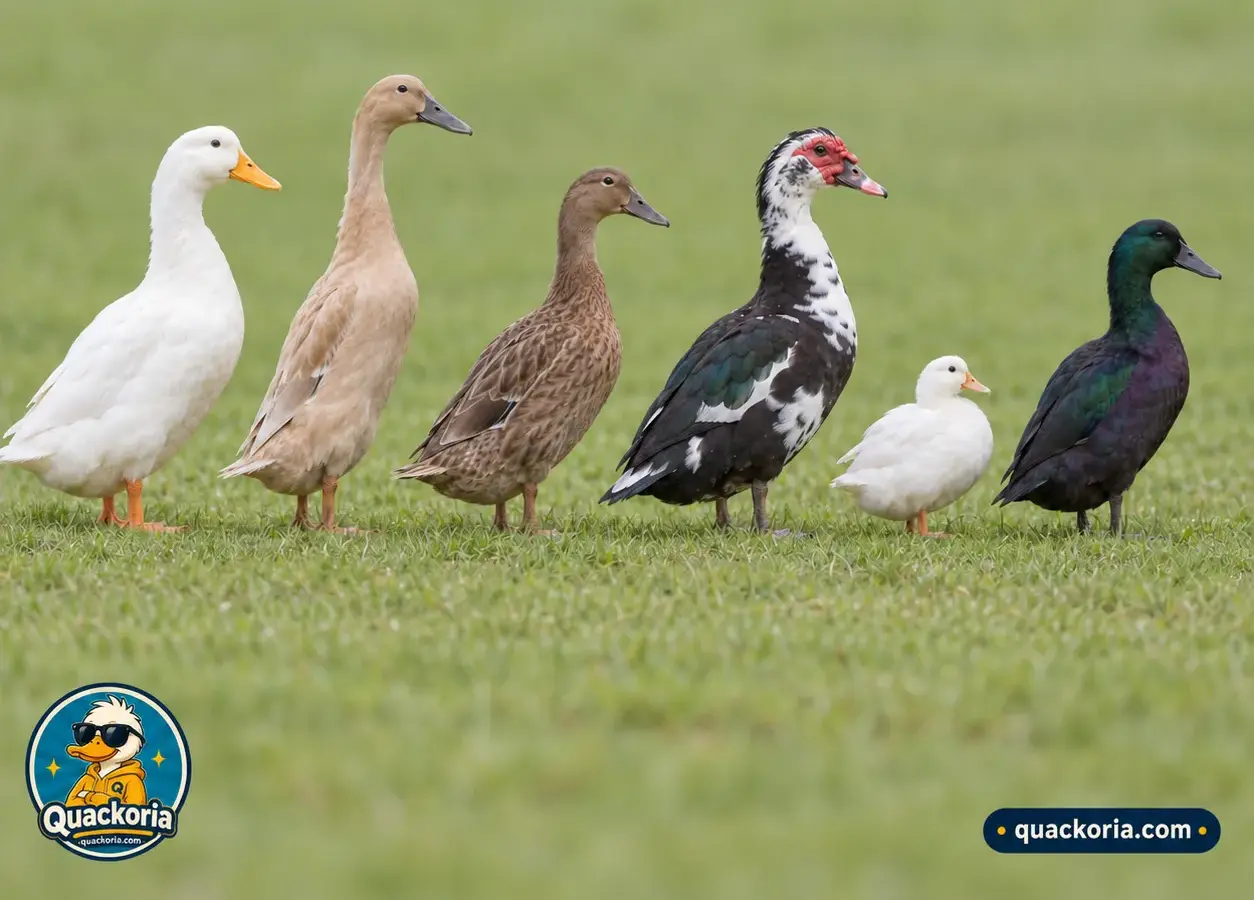
Every domestic duck breed except the Muscovy descends from the wild mallard. Here is how the common breeds compare on size, eggs, noise and temperament.
Key takeaways
- All domestic breeds except Muscovy are mallard-derived. Muscovy is a separate species — about 35 days to hatch (Cornell Duck Research Laboratory), perches in trees, and usually silent rather than quacking.
- The loud quack belongs to the female in every mallard-derived breed. Drakes are quieter and hoarser.
- Noise varies widely. Call ducks were bred to call wild mallards into traps, and the females have a very loud quack (British Waterfowl Association).
- Much of their care is shared. The RSPCA's space figures do not vary by breed name — indoors a weight per square metre, which allows fewer heavy birds, outdoors a flat area per bird — but feed intake does vary by breed (Metzer Farms).
- Male Muscovies are much larger than females — almost twice the size by the British Waterfowl Association and Metzer Farms, 30–50% heavier by the Cornell Duck Research Laboratory — and it starts showing at about three weeks (Metzer).
Every domestic duck breed except one descends from the wild mallard. Most of those breeds hatch in about 28 days (Cornell Duck Research Laboratory) and share much of their care; this guide compares them on size, eggs, noise and temperament, where the published sources often disagree.
One ancestor, one exception
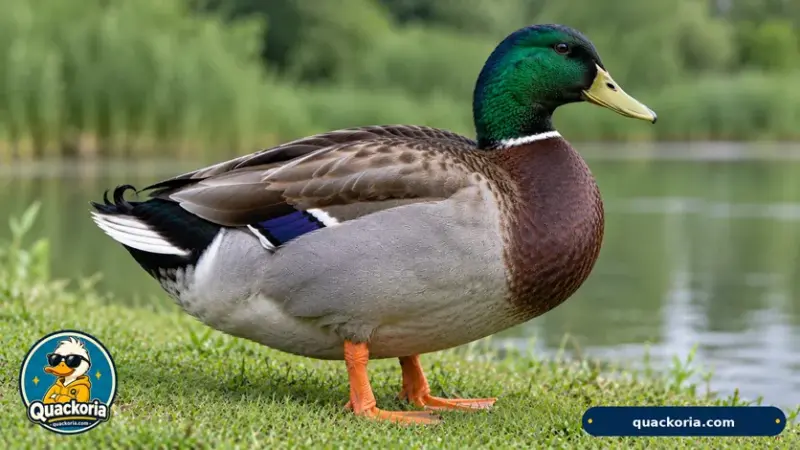
Pekin, Rouen, Khaki Campbell, Indian Runner, Cayuga, Welsh Harlequin, Aylesbury, Buff, Swedish, Magpie, Call — all of them descend from Anas platyrhynchos, the wild mallard on your local pond. The Cayuga’s line may include another wild species: Metzer Farms says the breed “is thought to have been developed from the wild Black Duck”, and Oklahoma State says it “was developed from a wild black duck, the Black East India, and the Rouen.” Centuries of selection have changed size, colour, posture and laying rate without changing what they fundamentally are.
The Cornell Duck Research Laboratory notes that the breeds can interbreed and produce fertile offspring, and that their eggs take about 28 days to hatch — though Metzer Farms gives 26.5–27 days for Mallards and 28.5–29 for Runners. Welfare standards such as the RSPCA’s treat the common breeds together.
Muscovy is the exception, and it is a real one. Cairina moschata is a separate species from a separate lineage. Its eggs take about 35 days to hatch rather than about 28 (Cornell Duck Research Laboratory) — which the hatch date calculator accounts for. It perches and roosts in trees. It has bare red facial skin. It is usually silent: Cornell’s Lab of Ornithology says the males “hiss and puff during courtship” and the females give “a quiet quack or croak when frightened”. And it has no sex feather, so the usual way of telling drakes from ducks simply does not apply.
The breeds you are most likely to meet
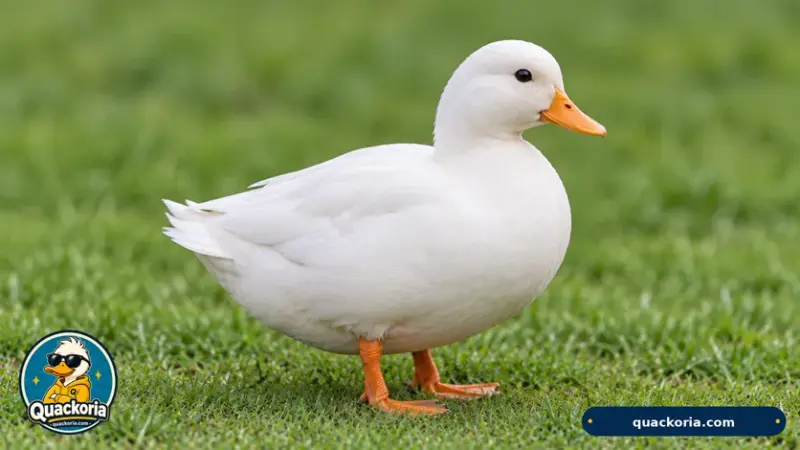
Pekin. Large, white and orange-billed, and the meat duck of the United States: eXtension says “Around 90 percent of the duck meat produced in the United States is from the Pekin.” It cannot fly, and eXtension counts it a general-purpose breed because the hens also lay fairly large numbers of eggs — 140–175 a year on Metzer Farms’ chart for its Jumbo Pekin, 100–180 in the University of Kentucky’s table. Metzer scores its temperament 5.5, mid-way on its scale from 1 (very calm) to 9 (more nervous).
Indian Runner. Stands upright and does not waddle so much as hurry — eXtension says Runners “stand upright like penguins” and “run rather than waddle”. The Livestock Conservancy traces them to ducks herded in India and Indonesia, driven out to rice paddies and fields by day “to glean scattered grain, weed seeds, snails, insects, larvae, small reptiles, and the like.” Strong layers by some counts — over 250 eggs a year from good strains, says the Conservancy, against 100–180 on Metzer Farms’ chart and 100–150 in the University of Kentucky’s table — and rarely still: the Conservancy calls them “the most active forager of all breeds”. Their incubation runs slightly longer than the usual 28 days — Metzer Farms gives 28.5 days on its hatching page and 29 in its FAQ — while the Cornell Duck Research Laboratory gives one figure, about 28 days, for all common ducks.
Khaki Campbell. The laying breed. A light breed — the Livestock Conservancy calls it “a lightweight bird” of around 4–4.5 lb — and unshowy. Metzer Farms’ chart gives it 165–240 eggs a year, the highest of the breeds on this page; the University of Kentucky gives 200–300 and the Conservancy an average of 250–340. It is not a calm bird: Metzer scores it 9.0 on its 1 (very calm) to 9 (more nervous) scale, and Kentucky says Campbells and Runners “tend to be nervous and flighty”.
Cayuga. Black at a glance, with what the Livestock Conservancy calls “an iridescent green/blue/purple sheen” in sunlight. The Conservancy describes it as calm, quiet and one of the hardiest of the domestic ducks; Metzer Farms, though, scores its temperament 8.8 on its 1 (very calm) to 9 (more nervous) scale.
Call duck. Small and remarkably loud: the British Waterfowl Association calls it “the smallest breed of domestic duck, weighing less than a kilo”, and says the females “do have a very loud quack”. They were developed, the Association says, “to call down the wild Mallard to the great traps or decoys” of the UK Fenlands and the marshes of Holland, and Metzer Farms says they were bred to lure wild ducks “into traps or nets”. The Association advises against keeping female Calls if you have close neighbours. Metzer also notes they sometimes need help out of the shell, because of their short necks and bills.
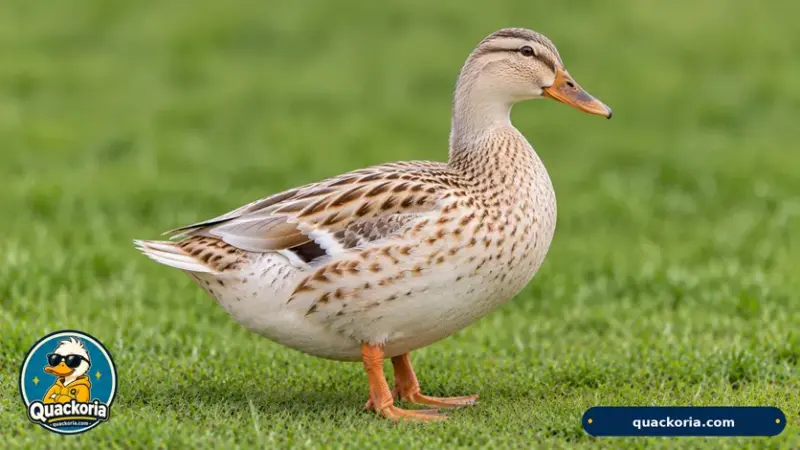
Rouen. Mallard-coloured but much larger and heavier — 8–10 lb in the University of Kentucky’s table, against 1.9–2.5 lb for the mallard. In Rouens and Mallards the drake’s bill turns dull green at about six weeks while the female’s is normally dark brown and orange (Metzer Farms).
Welsh Harlequin. Developed from Khaki Campbells — the Livestock Conservancy dates it to 1949, from two light-coloured ducklings hatched from pure Campbells. The sources disagree widely on its laying: 240–330 eggs a year by the Conservancy, 100–150 on Metzer Farms’ chart. Metzer scores it 1.3 on its temperament scale, near the calm end, and gives about fifteen weeks for the drake’s green head and coloured wings.
Muscovy. Covered above, and worth repeating that it is not really in the same category as the rest.
Side by side
| Breed | Size | Eggs | Noise | Notable |
|---|---|---|---|---|
| Pekin | Heavy (Metzer); 8–10 lb (Kentucky) | 140–175 (Metzer, Jumbo Pekin); 100–180 (Kentucky) | Females have the loud quack, drakes a deep, raspy voice (Metzer) | About 90% of US duck meat (eXtension) |
| Indian Runner | Light (Metzer); 3.5–4.5 lb (Kentucky); upright | 100–180 (Metzer); 100–150 (Kentucky) | Females generally louder than drakes (Livestock Conservancy); drakes “limited to a hoarse whisper” (Kentucky) | Runs rather than waddles (eXtension) |
| Khaki Campbell | Light (Metzer); 3.5–4.5 lb (Kentucky) | 165–240 (Metzer); 200–300 (Kentucky) | Females have the loud quack, drakes a deep, raspy voice (Metzer) | Temperament 9.0, the nervous end of Metzer’s 1–9 scale |
| Cayuga | Medium (Metzer); 6–8 lb (Kentucky) | 130–180 (Metzer); 60–100 (Kentucky) | A quiet breed (Livestock Conservancy) | Black with a green/blue/purple sheen (Livestock Conservancy) |
| Rouen | Heavy (Metzer); 8–10 lb (Kentucky) | 140–180 (Metzer); 40–60 (Kentucky) | “not as noisy as some other breeds”, though the females can be talkative (Livestock Conservancy) | Coloured like the wild mallard (eXtension) |
| Call duck | Bantam (Metzer); 1.1–1.6 lb (Kentucky) | 25–50 (Metzer); 20–50 (Kentucky) | Females have “a very loud quack” (British Waterfowl Association) | Bred to call wild ducks into traps (British Waterfowl Association, Metzer) |
| Muscovy | Heavy (Metzer); ducks 5–7 lb, drakes 10–14 lb (British Waterfowl Association) | 100–150 (Metzer); 60–120 (Kentucky) | Usually silent (Cornell Lab of Ornithology) | Separate species; about 35 days to hatch (Cornell Duck Research Laboratory) |
Where the figures come from: size class is Metzer Farms’ (its American Poultry Association class column) and weights are female to male from the University of Kentucky’s Selecting Ducks table, except the Muscovy (British Waterfowl Association). Eggs a year are Metzer’s chart — the lower figure without artificial light, the upper with 17 hours of light through lay — against Kentucky’s table. Metzer’s own weights, used in the breed comparison, are its breeders’ weights in lay, which it says have been controlled for egg production.
Two columns need a warning attached.
Noise is unevenly distributed — a Call duck and a Muscovy sit at opposite ends of a very wide range. And in every mallard-derived breed the loud, clear quack belongs to the female; drakes are quieter and hoarser. Telling a drake from a duck goes through it.
Eggs is a comparison, not a promise. The sources disagree widely for the same breed — the Livestock Conservancy gives the Khaki Campbell an average of 250–340 and the Rouen 35–125, against Metzer’s 165–240 and 140–180 — and light matters as well as breed: Metzer’s figures run from no artificial light at the lower end to 17 hours of light at the upper. When ducks start laying covers what actually drives it.
What genuinely differs, and what does not
Breed genuinely affects: adult size, laying rate, noise, temperament, whether the bird flies, which sexing signs apply, and incubation length — about a week longer for Muscovy (Cornell Duck Research Laboratory), and a day or so either side of 28 for Mallards and Runners (Metzer Farms).
Much of the rest is shared. The RSPCA’s welfare standards, written “specifically for domestic/common meat duck breeds” and excluding Muscovies, do not vary by breed name: indoors the limit is a stocking density of 17 kg per square metre, which allows fewer heavy birds than light ones on the same floor, and outdoors it is a flat minimum of 2.5 m² of range per bird on good pasture. Feeding is not identical, though: Metzer Farms charts feed intake by breed and says intake will “vary according to temperature, exercise, and genetics” — the duck feed calculator uses its figures. For lifespan, how long ducks live covers what breed and care each contribute.
So if you are choosing between two breeds and worrying about which is harder to keep, the differences are mostly the ones above. Whatever the plumage, you are keeping a duck. The housing and space calculator gives you the numbers for the flock size you have in mind, and they do not change when you change your mind about the breed.
Sexing, by breed
The methods and when they become available:
- Voice — the most useful and completely safe. Females give the loud clear quack; drakes are raspy and quiet. A clue from about six weeks by University of Minnesota Extension’s figure; by eight to ten weeks, Metzer Farms says, males have the deep, raspy voice. Muscovies are the exception: usually silent, with males that hiss and puff in courtship (Cornell).
- Sex feathers — drakes of every breed except Muscovy grow curled feathers at the base of the tail. Presence proves a male; absence proves nothing, because a young drake has not grown them yet and an older one can lose them in the moult or have them pulled (Metzer Farms).
- Bill colour — in Rouens and Mallards, the drake’s bill turns dull green at about six weeks (Metzer Farms).
- Size — decisive for Muscovy; in other breeds Metzer Farms says only that males are “usually bigger” than females. Muscovy drakes are almost twice the size of ducks by the British Waterfowl Association and Metzer, 30–50% heavier by the Cornell Duck Research Laboratory, and the difference starts showing at about three weeks (Metzer). A study of 1,020 adult Muscovies in Nigeria (Oguntunji and Ayorinde, 2014) classified birds correctly 98.5% of the time from body weight plus wing and body length.
- Full plumage — the drake’s green head and coloured wings by about fifteen weeks in Rouen, Mallard and Welsh Harlequin (Metzer Farms).
One honest caveat about that list: apart from University of Minnesota Extension’s six weeks for the voice, every age in it comes from a hatchery’s practical experience — Metzer Farms’ — rather than from a university or a journal. The differences themselves are well established; the timings are not published research, and your birds may not read the schedule.
Choosing
Three questions settle most of it.
How much noise can your situation absorb? Muscovy and Cayuga at the quiet end — Cornell calls Muscovies “usually silent”, and the Livestock Conservancy calls the Cayuga a quiet breed good for urban or suburban settings. Call duck at the other, where the British Waterfowl Association advises against keeping females if you have close neighbours.
How much ground do you have? The Livestock Conservancy says centuries of herding selected Runners as good walkers and foragers, and that they prefer a large space; it says Khaki Campbells “need plenty of space to graze and forage”.
Eggs, or company? Both is a fine answer, but it changes the shortlist. Khaki Campbell if eggs are the point, with the Runner close behind on the Livestock Conservancy’s figures; for a calm bird, Metzer Farms’ lowest temperament scores (1.0 to 1.3) include the Muscovy, Silver Appleyard and Welsh Harlequin, and the Livestock Conservancy calls the Cayuga docile and calm; Muscovy if you want something genuinely different and do not mind it roosting somewhere you did not intend.
If you want a lighter way into six of these breeds, the breed quiz introduces them through six questions and tells you at the end that it is a quiz on a duck website. And once the bird arrives without a name, the name generator is two clicks away.
Frequently asked questions
What is the best duck breed for beginners?
The sources used here do not name a single best breed, so it depends on what you want. For eggs, the Khaki Campbell: 165–240 a year on Metzer Farms' chart. For a calm bird, Metzer's lowest temperament scores (1.0 to 1.3 on its 1–9 scale) include the Muscovy, Silver Appleyard and Welsh Harlequin; it scores the Pekin 5.5 and the Khaki Campbell 9.0, and the University of Kentucky calls Campbells and Runners "nervous and flighty". Call ducks are very loud — the British Waterfowl Association advises against keeping females if you have close neighbours.
Which duck breed lays the most eggs?
Of the breeds on this page, the Khaki Campbell: 165–240 eggs a year on Metzer Farms' chart, 200–300 in the University of Kentucky's table and an average of 250–340 by the Livestock Conservancy. Runners vary widely by source, from 100–150 (Kentucky) and 100–180 (Metzer) to over 250 for good strains (Livestock Conservancy), and Metzer rates its own hybrid layers at 200–290. Light matters as well as breed: Metzer's lower figures assume no artificial light, the upper ones 17 hours of light through lay.
Are Muscovy ducks really ducks?
Yes, but not mallard-derived ones like every other domestic breed. They are a separate species, Cairina moschata. Their eggs take about 35 days to hatch instead of about 28 (Cornell Duck Research Laboratory), they perch in trees, they have no sex feather, and they are usually silent: Cornell's Lab of Ornithology says males hiss and puff during courtship and females give a quiet quack or croak when frightened.
Do different duck breeds need different care?
Partly. The RSPCA's welfare standards, written for common meat-duck breeds and excluding Muscovies, use the same figures whatever the breed: indoors a stocking density of no more than 17 kg per square metre, which allows fewer heavy birds than light ones on the same floor, and outdoors at least 2.5 m² of range per bird on good pasture. Feed is not identical — Metzer Farms charts intake by breed — and Muscovy eggs take about 35 days to hatch against about 28 for the rest (Cornell Duck Research Laboratory).
Which duck breed is the quietest?
Of the breeds here, the Muscovy: Cornell's Lab of Ornithology says Muscovies are "usually silent", and Metzer Farms says the females have no loud quack. The Livestock Conservancy calls the Cayuga a quiet breed good for urban or suburban settings, and the Welsh Harlequin "one of the quieter duck breeds". At the other end, the British Waterfowl Association says female Call ducks "do have a very loud quack" and advises against keeping them if you have close neighbours.
Sources
- Cornell Lab of Ornithology — Muscovy Duck
- Cornell Lab of Ornithology — Mallard Sounds
- Poultry Extension — External Anatomy of Ducks
- British Waterfowl Association — Muscovy
- Oguntunji & Ayorinde (2014), Sexual size dimorphism in Muscovy duck, Acta Agriculturae Slovenica 104:15–24
- RSPCA welfare standards for domestic and common ducks
- Cornell University Duck Research Laboratory — Hatching Duck Eggs
- Metzer Farms — Sexing Birds
- Metzer Farms — Compare Duck Breeds
- Metzer Farms — Hatching Instructions
- Metzer Farms — FAQ
- Metzer Farms — Muscovy Ducks
- Metzer Farms — Call Ducks
- Metzer Farms — Male vs Female: How to Identify Adult Ducks
- Metzer Farms — How Much Will My Ducks Eat?
- University of Kentucky Cooperative Extension — Selecting Ducks (ASC-198, Jacob and Pescatore)
- eXtension — Selecting a Duck Breed for Small or Backyard Poultry Flocks (Jacquie Jacob)
- eXtension — Raising Meat Ducks in Small and Backyard Flocks
- The Livestock Conservancy — Khaki Campbell Duck
- The Livestock Conservancy — Runner Duck
- The Livestock Conservancy — Cayuga Duck
- The Livestock Conservancy — Rouen Duck
- The Livestock Conservancy — Welsh Harlequin Duck
- British Waterfowl Association — Domestic Ducks
- British Waterfowl Association — Call Ducks
- British Waterfowl Association — Muscovy (domestic)
- British Waterfowl Association — Pekin
- Cornell University Duck Research Laboratory — Domestic Ducks
- Cornell Lab of Ornithology — Muscovy Duck Sounds
- Cornell Lab of Ornithology — Muscovy Duck overview
- University of Minnesota Extension — Raising Ducks (Poultry Fact Sheet 43, Hamre, revised 1974)
- Zhang et al. (2018), Whole-genome resequencing reveals signatures of selection and timing of duck domestication, GigaScience 7(4):giy027
- Metzer Farms — Cayuga Ducks
- Oklahoma State University — Breeds of Livestock: Cayuga Ducks