Quackoria Care
Incubating Duck Eggs: Temperature, Humidity and the 28 Days
Duck eggs are larger than hen's eggs, need more humidity and take about 28 days. The figures, and where the published sources disagree.
Key takeaways
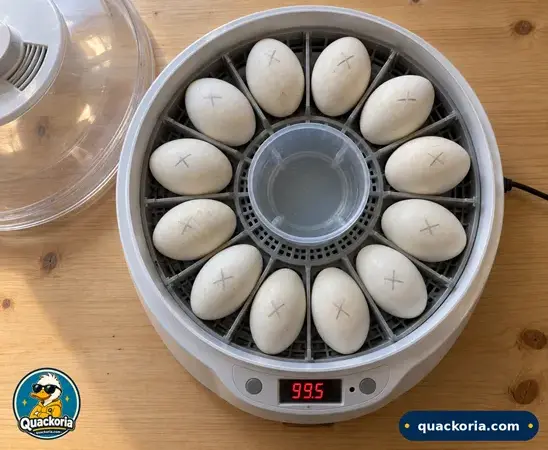
- Forced air 99.25–99.5 °F — Cornell, Kansas State, Metzer and the BWA cluster there; Mississippi State says 100 °F.
- Humidity 55–58% for the run, then 55–81% at lockdown (Cornell 65% rising to 80% at pipping; Metzer 81%; Cackle 55–65%) — but weigh the eggs: about 14% loss by day 25 (Cornell), about 13% from lay to day 25 (Metzer) or about 15% across incubation (BWA).
- Turn at least 3–4 times a day until lockdown; Metzer turns an odd number of times, 3–7, so the egg never rests the same side overnight.
- Candle at day 7 (Cornell, Metzer) or day 10 (Meyer, BWA). Clear distinct veins = probably alive (Metzer).
- Lockdown day 25 (Cornell, Cackle, Mississippi State) or day 26 (Metzer, Meyer). Then do not open the lid.
- Pip, then 12–24 hours of rest, then 1–3 hours of zipping (Metzer). Help only at a visible hole with no progress for 12 hours.
- Muscovy: 35 days in the incubator; Cornell Lab gives 30–31 for the wild nest — an unresolved gap.
What you need
- A forced-air incubator with a reliable thermometer
- An automatic turner, if the budget allows one thing
- A separate calibrated hygrometer
- Kitchen scales reading to a gram
- A bright candling torch
- Pencil or wax crayon for marking
Duck eggs are not chicken eggs with a longer clock. They are larger, they need more humidity, and they hatch on a different day. This is the 28 days, with the figures, and with the places where the published sources disagree marked as disagreements rather than settled.
The hatch date calculator gives you the calendar for your set date. This is what happens on each of those days, and why.
Before an egg goes in
Several of the causes of a failed hatch in Mississippi State’s troubleshooting table are settled before incubation starts: the breeders, and how long and how well the eggs were stored.
Choose the eggs
- From healthy, vigorous, properly fed breeders. Mississippi State lists improper nutrition of the breeders among the causes of early embryo deaths and of weak or small hatchlings, and no incubator setting will fix that. The feeding guide covers breeder rations.
- Fertile. A duck lays without a drake; the eggs simply will not hatch. One drake to several ducks is enough — the number is discussed in how many ducks to keep.
- Normal shape, normal size, clean, uncracked. Cornell’s Duck Research Laboratory: “Do not set eggs that are cracked, double yolked, misshapen, oversized, undersized or dirty.”
- Fresh. Set within a week: Mississippi State says “do not store eggs more than 7 days before incubating”, and California’s ANR 8127 says the same for duck eggs. Cornell sets within one to three days of lay for the best results, and reports hatchability about 3% lower after 7 days of storage and about 10% lower after 14.
Store them properly
Between collection and setting: cool and humid, pointed end down, turned once a day. Cornell and Mississippi State store at about 55 °F (13 °C) and 75% relative humidity, Metzer at about 60 °F (16 °C), and the British Waterfowl Association at around 15 °C; Metzer says “A refrigerator is too cold.” Mississippi State stores eggs small end down and turns them daily if they will not be set within 4–6 days. Mark each egg with the date laid, in pencil or wax crayon.
To wash or not
Lightly soiled eggs are better dry-cleaned than washed. Mississippi State: “Do not wash dirty eggs” — the washing and rubbing can force disease organisms through the pores of the shell — though slightly soiled eggs can be set without causing hatching problems. California’s ANR 8127 says to dry-clean eggs and, if they are washed, to use water at 110–120 °F (43–49 °C), never cold water. Heavily soiled eggs are not worth setting: Cornell does not set dirty eggs.
Temperature
The number that matters most, and the one where chicken settings do the most damage.
The duck-specific sources cluster tightly for a forced-air incubator: 99.25–99.5 °F (37.4–37.5 °C) — Cornell, Kansas State, Metzer and the British Waterfowl Association all sit in that range (99.5, 99¼–99½, 99.5 and 37.4 °C, about 99.3 °F). Mississippi State’s species table gives 100 °F for ducks in a forced-air incubator — the same figure it gives for chickens — and Cackle Hatchery’s chart also gives 100 °F.
For a still-air incubator — no fan — the figures are higher, because the temperature is not uniform through the box. Kansas State gives 100¼, 101½, 102½ and 103 °F for the first, second, third and fourth weeks for duck and goose eggs in small still-air incubators. Mississippi State adds 2–3 °F to its forced-air figure for still air, and its general poultry guidance holds a still-air machine at 102 °F, measured at the top of the eggs, “to compensate for the temperature layering within the incubator”. Metzer measures halfway up the side of the egg in an incubator without a fan.
Metzer’s own hatchery runs a single-stage profile — starting at 100.3 °F and dropping gradually to 97.0 °F by hatch, with the vents closed for the first 14 days to let carbon dioxide build — and reports “improved hatches of 2-15% of fertile eggs” from it. That is a commercial technique with a controlled machine; it is included here because it is real and published, not as advice for a tabletop incubator, where holding one steady temperature is achievement enough.
Whatever the target, hold it steady. Oklahoma State: “Variations of more than one degree from the optimum will adversely affect the number of eggs that will successfully hatch.” An incubator that holds 99.3 °F all day is better than one that averages 99.5 °F by swinging between 98 and 101.
Humidity — where the sources part company
Duck eggs need more humidity than chicken eggs: Kansas State says the humidity requirements of waterfowl eggs rule out satisfactory results if they are set in a large incubator with chicken eggs. In Mississippi State’s troubleshooting tables, too little humidity goes with small or weak hatchlings and with embryos stuck to the shell; too much goes with sticky embryos, and with a chick that can “drown in the water remaining in the shell at hatching”.
The published ranges are wide and honest reporting means giving them as ranges:
| Period | Published range | Duck-specific cluster |
|---|---|---|
| Days 1–25 (main incubation) | 45% (Cackle) to about 63% (Kansas State’s 86–88 °F wet bulb) relative humidity | 55%–58% (Cornell, the BWA and Meyer 55%; Metzer 57–58%) |
| Lockdown to hatch | 55%–81% (Cackle 55–65%; Metzer 81%) | Two stages: 65–70%, then about 80% at pipping (Cornell, Meyer); or one setting of 81% (Metzer) |
Fifty-five to fifty-eight percent for the main run, then up sharply at lockdown, is where Cornell, the British Waterfowl Association, Meyer and Metzer sit. There is also a check that does not depend on the hygrometer at all.
Weigh the eggs
An egg should lose a fixed fraction of its weight to evaporation over incubation — about 14% by day 25 (Cornell), about 13% from the day it was laid to day 25 (Metzer), or about 15% across incubation (British Waterfowl Association). Weigh a tray of eggs at setting, weigh again on day 7, 14 and 21, and plot the line. If weight loss is running ahead of the target, raise the humidity; if it is behind, lower it.
Kitchen scales that read to a gram are enough.
Turning
Cornell: “Eggs must be turned, either automatically or by hand, a minimum of 4 times a day.” Mississippi State lists improper egg turning among the causes of early embryo deaths.
- How often: Kansas State says at least three times a day, Cornell at least four, Mississippi State four to six and Metzer three to seven; the British Waterfowl Association says a couple of times a day. Metzer turns an odd number of times, reasoning that an odd count stops the egg resting in the same position overnight, the longest gap.
- How: in alternate directions at each turn, as the British Waterfowl Association advises. Mark an X on one side and an O on the other so you can see at a glance which eggs have been turned.
- Until when: lockdown — see below. After that, turning is stopped while the embryo moves into its hatching position (Mississippi State).
An automatic turner takes the job out of human hands, and if the budget stretches to one thing beyond the incubator, this is it.
Cooling and misting — contested
Metzer says a regime of cooling and spraying sometimes gives better hatches: start after about 10 days, cool the eggs until the shell surface reaches 86 °F (or until an egg held to the eyelid feels neutral rather than warm), spray them with room-temperature water and return them — and “Do not spray and cool after day 25.” Kansas State sprinkles duck and goose eggs with lukewarm water twice a week up to day 25 to raise the humidity. The British Waterfowl Association notes that some incubators can schedule a brief cooler spell, replicating the time the bird spends off the nest.
Against that, Kansas State warns that too much water during incubation increases the number of eggs that rot, and Florida’s troubleshooting circular CIR1112 lists “Water sprayed, fogged, or splashed on eggs” among the causes of exploding eggs.
The sources are divided, and this page does not settle it. Cornell, Mississippi State and Meyer do not include it in their duck instructions. If you try it, follow Metzer’s method from about day 10 and stop by day 25.
Candling
Candling — shining a bright light through the egg in a dark room — tells you what is alive. The sources split on the first date:
- Day 7 — Cornell, Metzer (its FAQ)
- Day 10 — Meyer Hatchery, British Waterfowl Association (which also candles again at day 20)
Metzer: “By seven days, you should see a darker yolk, veins under the shell and the beginnings of an embryo.” The British Waterfowl Association counts eggs still clear after 10 days as infertile. Candle at 7 if you want early information, and again at 10 if you are unsure.
What you are looking for, by day:
- Day 7–10: a network of veins spreading from a dark spot — Meyer’s “tiny “spider” with veins radiating from the dark spot”. Metzer’s viability test: clear, distinct veins mean probably alive; no clear distinct veins mean probably not. Cornell removes eggs that are clear (infertile) or cloudy (a dead germ).
- Day 12: you can probably see movement if you hold the egg still (Metzer).
- Day 22: the embryo fills the egg; the light shows only the air cell and a dark mass.
- Day 26–27: you will often see the bill moving inside the air cell — internal pipping (Metzer).
Remove clear and dead eggs when you find them. Florida’s CIR1112 lists contamination from earlier exploders, leakers or broken eggs among the causes of eggs that burst in the incubator.
Lockdown
The last stage: turning stops, humidity goes up, the lid stays shut. The date is another place the sources differ by a day:
- Day 25 — Cornell (transfer to the hatcher), Cackle Hatchery, and Mississippi State, whose species table says not to turn duck eggs after the 25th day
- Day 26 — Metzer, Meyer
Either is defensible for a 28-day egg. For Muscovies, at 35 days, Cackle Hatchery and Mississippi State both stop turning at day 31; Cornell gives the Muscovy’s length but no transfer day.
At lockdown: raise the humidity to the lockdown figure, and then leave the incubator shut. Every opening from here drops the humidity, and a duckling that has pipped into dry air gets its membrane dried onto it and cannot turn — Mississippi State says this can happen within one or two minutes of the incubator being opened. Mississippi State also says never to close the vents at hatching to raise the humidity: the chick needs the air.
The hatch
A duck hatch is slow and it does not look like a chicken hatch. Do not measure it against one.
Internal pip — the bill breaks into the air cell, and the duckling starts breathing air. You may hear it: the British Waterfowl Association says ducklings can be heard calling inside the eggs up to 48 hours before they are due to hatch.
External pip — a small crack or hole in the shell, usually at the blunt end. Then — and this is where nerves fail — nothing, for 12 to 24 hours. Metzer: “After pipping, the chick will rest for 12 to 24 hours.” The blood vessels in the membrane are closing down in that time. This pause is normal.
Zipping — the duckling turns inside the shell, cracking it in a ring. This takes 1 to 3 hours of work, with rests (Metzer).
Out — a mighty shove, and a wet, exhausted duckling. Leave it in the incubator to dry and fluff up. Mississippi State says the incubator “should never be opened until after all chicks are hatched and ready for placement in the brooder”; Cornell takes the ducklings out when 90–95% of them are dry.
A batch does not hatch together: the British Waterfowl Association says it may take 72 hours for all, or most, of the eggs to hatch.
Do not help — and the narrow exception
The instinct to help a struggling duckling out of the shell is strong and usually wrong. Metzer: “It is best to allow them to do the hatching themselves”, and “If you help before the network of blood veins has completely broken down, you can cause the chick to bleed to death.”
The exception is Metzer’s threshold: a visible hole, and no progress at all for 12 hours — “If an actual hole is made and you can see the duckling, but no progress is made for 12 hours, you can gingerly help the duckling.” If blood appears where you break the shell, stop and wait several hours. Metzer also notes that Call ducklings, because of their short necks and bills, sometimes need a little assistance getting out of the shell. And accept that a duckling that needed help may not survive anyway.
If many ducklings pip and fail to get out, Mississippi State says the problem is usually poor ventilation or the wrong humidity. Fix the machine before the next hatch, not the ducklings during this one.
Why a hatch fails
The causes the troubleshooting tables list — Mississippi State’s, written for poultry eggs in general — grouped for a home incubator:
- Infertile eggs — no drake, too few drakes, old or undernourished drakes, or eggs stored too long or incorrectly. Shows as clear eggs at candling.
- Temperature too high or unsteady — early deaths, or ducklings that hatch early and small or weak. California’s ANR 8127: 1 °F above 99.5 °F brings the hatch about 24 hours early.
- Humidity wrong — too dry: small or weak ducklings, and ducklings stuck to the shell that pip and cannot turn. Too wet: sticky ducklings, or ducklings drowned in the shell.
- Not turned enough — early embryo deaths; eggs set the wrong way up give malpositioned embryos that pip and die.
- Eggs stored too long, or badly — poor development from the start.
- Dirty eggs or a dirty incubator — Florida’s CIR1112 lists dirty eggs and nests, badly washed eggs and contaminated equipment among the causes of exploding eggs. Mississippi State: “Thoroughly clean and disinfect the incubator and hatcher before each usage.”
- Poor breeder nutrition — early deaths and weak hatchlings that no incubator setting can fix.
- Ventilation — an embryo breathes through the shell; Mississippi State says to open the vents more at hatching, never less, or the chicks suffocate.
California’s ANR 8127 says the hatch of fertile eggs “should be above 85%”; Metzer hatches 70–75% of all eggs set in its large commercial incubators. The alternative, if you have one and can spare her, is letting a broody duck do it.
Muscovy eggs
Everything above, with one change and one caveat. The change: 35 days, not 28 — Cornell, Penn State, Metzer and Mississippi State (which gives 35–37). Adjust every date accordingly: candle on day 7–10 as usual, but lockdown around day 31 (Cackle, Mississippi State) and hatch at 35. The caveat: Cornell Lab of Ornithology gives 30–31 days for the wild bird in the nest, which is a real discrepancy with the hatchery figure, and one the sources do not explain — treat 35 as the incubator figure and do not be surprised by an early pip. More on the breed in keeping Muscovy ducks.
Other breed-specific figures are thin. Metzer gives 28.5–29 days for Runners and 29 for Cresteds, 26.5–27 for hatchery Mallards; none of the other sources here breaks those out, and everything else is about 28. The full table and its sources are in the calculator.
After the hatch
Dry, fluffy ducklings go to a brooder with heat, water they cannot drown in, and starter feed with the right niacin — the first week is covered in raising ducklings week by week. The incubator gets stripped, scrubbed and disinfected, including the fan and the heater — Mississippi State cleans and disinfects incubator and hatcher before each use.
The short version
- Forced air: 99.25–99.5 °F (Mississippi State 100 °F). Hold it steady.
- Humidity 55–58% for the run, 55–81% at lockdown — but weigh the eggs
- Turn several times a day until lockdown — Metzer says an odd number, 3–7. Buy a turner if you can.
- Candle at day 7 or 10 — the sources split. Clear distinct veins = probably alive.
- Lockdown day 25 or 26 — the sources split by a day. Then do not open the lid.
- Pip, then 12–24 hours of nothing, then 1–3 hours of zipping. That pause is normal.
- Help only at a visible hole with no progress for 12 hours (Metzer), and stop at any blood
- Muscovy: 35 days; clean and disinfect the machine before each use
This is husbandry guidance, not veterinary advice. If a bird is ill or injured, find an avian vet.
Frequently asked questions
What temperature do you incubate duck eggs at?
In a forced-air incubator, 99.25–99.5 °F (37.4–37.5 °C) — Cornell, Kansas State, Metzer and the British Waterfowl Association all sit in that range; Mississippi State's species table says 100 °F. Still-air incubators run warmer: Kansas State gives 100¼ °F in the first week rising to 103 °F in the fourth for duck and goose eggs, and Mississippi State adds 2–3 °F for still air.
What humidity do duck eggs need?
Published figures run from 45% to about 63% for the main incubation, with Cornell, the BWA, Meyer and Metzer at 55–58%, then 55–81% at lockdown. Weight is a check that does not depend on the hygrometer: the eggs should lose about 14% by day 25 (Cornell), about 13% from the day it was laid to day 25 (Metzer) or about 15% across incubation (BWA). Weigh a tray at setting and weekly, and adjust humidity to hit the line.
When do you candle duck eggs?
The sources split: day 7 (Cornell, Metzer) or day 10 (Meyer Hatchery, British Waterfowl Association). Metzer's viability test is that clear, distinct veins mean probably alive and no clear veins mean probably not. Remove clear and dead eggs when found.
When do you stop turning duck eggs?
At lockdown — day 25 according to Cornell, Cackle Hatchery and Mississippi State, or day 26 according to Metzer and Meyer. Either is defensible for a 28-day egg; for Muscovies, Cackle and Mississippi State say day 31.
Should you help a duckling out of the egg?
Almost never. Metzer warns that helping before the network of blood veins has broken down can make the duckling bleed to death. Its threshold: a visible hole and no progress at all for 12 hours — then help gingerly, and stop and wait several hours if blood appears. If many ducklings pip and fail, Mississippi State says the cause is usually poor ventilation or the wrong humidity.
How long do Muscovy duck eggs take to hatch?
35 days in an incubator — Cornell's Duck Research Laboratory, Penn State, Metzer, and Mississippi State (35–37). Cornell Lab of Ornithology gives 30–31 days for the wild bird on its nest, a real discrepancy the sources do not explain. Plan for 35 and do not panic at an early pip.
Sources
- Cornell University Duck Research Laboratory — Hatching Duck Eggs
- Mississippi State University Extension — Important Incubation Factors
- Mississippi State University Extension — Care and Incubation of Hatching Eggs
- Mississippi State University Extension — Trouble Shooting Failures with Egg Incubation
- Mississippi State University Extension — Pipped Eggs That Do Not Hatch
- Kansas State University — Incubation and Reproduction
- Penn State Extension — Incubation period of other species
- Oklahoma State University Extension AFS-8100 — Artificial Incubation
- University of California ANR Publication 8127 — Common Incubation Problems: Causes and Remedies
- University of Florida IFAS Extension CIR1112 — Hatchability Problem Analysis
- Metzer Farms, hatching instructions
- Metzer Farms, How to Improve Your Duck Egg and Goose Egg Hatch Rate
- Metzer Farms — Candling Pictures
- Metzer Farms — FAQ
- Metzer Farms — Hatching Process and When to Help
- British Waterfowl Association — Incubation
- Meyer Hatchery — Guide to Incubating and Hatching Duck Eggs
- Cackle Hatchery — Egg Hatch Guide (incubation chart)
- Cornell Lab of Ornithology, Muscovy Duck