Quackoria Care
How Many Ducks Should You Keep? Flock Size, Drakes and Introductions
One is lonely, two is fragile, and the drake question has two published answers. Here is what the sources say, and how to size a flock that stays peaceful.
Key takeaways
- Never one duck. Three is the practical minimum, and the RSPCA's — two becomes one the day something goes wrong.
- Size by the run: 50 sq ft per duck for a garden flock (Metzer, on pasture with no shelter), about 27 at the RSPCA welfare floor; the house at 4–5 sq ft per bird.
- Three or four good layers is a household's eggs — Metzer's best strains lay 200–290 a year with lights.
- Minnesota Extension gives one drake to five or six females for a breeder flock; Metzer keeps one to five. The failure mode shows on the females' backs.
- A first flock should be all female. Add one drake, to plenty of females, only when you want ducklings.
- Quarantine at least two weeks (eXtension) or 30 days (USDA), then side by side, then together on neutral ground with two of everything.
What you need
- A tape measure for the run
- A second feeder and waterer for introductions
- A separate quarantine space
Never one
Ducks are social birds. The RSPCA recommends that you “keep at least three birds who get on well together”, and RSPCA Australia says it is best “to always have more than one duck or at least other poultry species, such as chickens, so that they can keep each other company.” Metzer Farms, a hatchery, is the dissenting voice: asked whether a single duck will be happy living with its keeper, its FAQ answers “Yes, especially if it has not grown up with other waterfowl as it thinks it is human.”
If you have ended up with a single duck — an Easter duckling, a survivor — the answer is company, and quickly. Another duck is best. Failing that, RSPCA Australia names other poultry, such as chickens, as company.
Why three, not two
Two ducks is a pair, and a pair works until it does not. The failure is not the pair; it is what happens the day one of them dies, is taken by a fox, or has to go to the vet. You are left with one duck at no notice, and finding a companion at short notice is not easy.
Three is the practical minimum, and the RSPCA’s: a flock that survives one loss without becoming an emergency. Four is more comfortable still.
That is the floor. The ceiling comes from three things: space, eggs, and what happens with drakes.
Sizing by space
The published figures for space per duck are in the duck house guide, and they disagree with each other by a factor of three — so here is the range and where each number comes from:
| Source | Indoor, per adult | Outdoor run, per adult |
|---|---|---|
| eXtension | 5 sq ft | no figure — “the larger the run the better” |
| Merck Veterinary Manual | 3–6 sq ft (ducks and geese) | 15–18 sq ft (ducks and geese) |
| Metzer Farms | 4 sq ft (18 weeks+) | 50 sq ft (18 weeks+, on pasture with no shelter) |
| RSPCA welfare minimum | ~2.2 sq ft (17 kg/m² maximum, for a 3.5 kg bird) | ~27 sq ft (2.5 m² of range; 4 m² where grass cover is poor) |
Work backwards. Measure the run you can actually give them, divide by 50 (Metzer Farms’ figure from 18 weeks) for a comfortable garden flock or by 27 for the welfare floor (the RSPCA’s minimum range for commercial meat ducks), and that is your maximum. A 6 m × 5 m run — about 320 sq ft — is six ducks comfortably, twelve at the minimum. The space calculator does the sum, and shows the range.
Metzer Farms says cramped pens mean wetter pens and dirtier birds, and the RSPCA raises its range minimum to 4 m² per bird where grass cover is poor. If in doubt, fewer ducks and more space.
Sizing by eggs
Metzer’s published figures put its best laying strains at 200–290 eggs a year, Campbells at 165–240, and most other breeds between 100 and 200 (Pekins 150–200, Mallards and Calls far fewer) — the lower figure without artificial light, the upper with 17 hours of light during lay. Three Khaki Campbells at 165–240 eggs a year each would average roughly 9 to 14 eggs a week.
If eggs are the point, three or four good layers is a household. If the ducks are the point and the eggs are a bonus, size by space and by what you can bear to lose.
Drakes: the arithmetic, and the published sources
This is the question that decides whether a flock is peaceful, and it deserves a straight answer about what the evidence is.
What the problem is
Metzer Farms says males can become violent when mating, and that a female with several males trying to mate with her is in danger of injury or even death; the case it describes had lost an eye and had bald spots and missing feathers. Its FAQ gives the reason for keeping males few: “The problem with too many males is they will become very aggressive sexually and will harm some of the weaker females.”
Metzer also says problems typically occur when there are two or more males and an equal number of females or fewer.
What the evidence is
Two published figures exist. University of Minnesota Extension’s fact sheet on raising ducks (Poultry Fact Sheet 43, Hamre, rev. 1974), under breeder flock management, says: “Keep one male for each 5-6 females.” Metzer Farms keeps one male to five females on its own farm; its FAQ says ten ducks or fewer can be kept in pairs, and that in a flock of more than 25 or 30, unless the pen is large with plenty of hiding places, the ratio should be one male to every three to five females.
What the sources do support:
- The direction is not in doubt: Metzer’s reason for its ratio is that too many males harm the weaker females.
- A duck lays without a drake. Metzer Farms, asked whether poultry lay without males: “Yes. The eggs will not be fertile, however.”
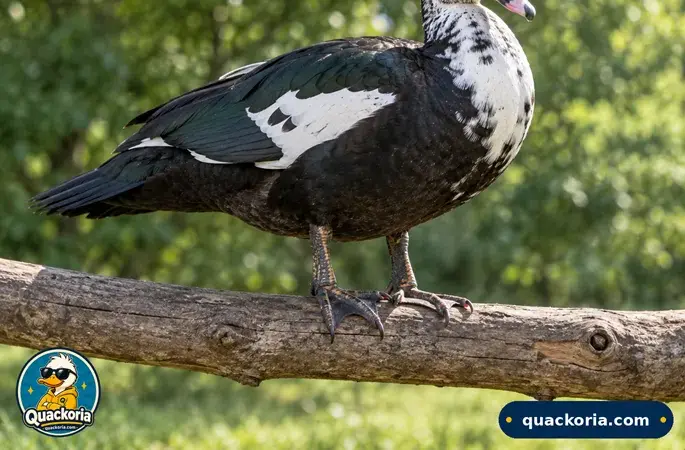
- Muscovies are a case of their own. Metzer Farms says Muscovies and Pekins kept together are unlikely to cross, that Pekin males catch Muscovy females more easily than Muscovy males catch Pekin females, and that the offspring of any cross cannot reproduce.
- The failure mode is visible on the females, which means you do not need a ratio to know when yours is wrong.
What to do with that
For a first flock: no drake. All female. You get eggs, no mating injuries, no drake fights, and — since it is the female that quacks loudly and the drake that rasps — the noise is the same either way. Add a drake later if and when you want ducklings, and add him to a flock that already has enough females to share him.
If you want fertile eggs: one drake to at least five or six females, Minnesota Extension’s figure for a breeder flock. Watch their backs and necks from spring onwards; the first bare patch is your signal that the ratio is wrong or the drake is too rough, and the fix is more females or a different drake.
If you have ended up with extra drakes — unsexed ducklings are roughly half male — you have four honest options: rehome them, keep them in a separate all-drake group, keep them for the table, or accept a much larger female flock. What does not work is keeping them all together and hoping.
Mixing breeds
Mallard-type breeds mix freely and will interbreed freely; a mixed flock with a drake produces mixed ducklings, which may or may not be what you want. Metzer Farms says any breed will cross with any other, though they will probably prefer ducks of similar size. Sizes vary, and the RSPCA advises against mixing birds of very different body sizes, which can lead to bullying — so keep drakes and females within a size class of each other.
Muscovies are the exception: Metzer Farms says the offspring of a Muscovy crossed with any other domestic breed are infertile and cannot reproduce — mules from a Muscovy drake on a Pekin duck, hinnies the other way round. Details in keeping Muscovy ducks.
Introducing new ducks
The RSPCA says to be careful introducing ducks and geese that do not know each other, RSPCA Australia that they should be introduced slowly, and Metzer Farms that birds introduced as adults have to work out their pecking order. eXtension goes further and recommends not adding new birds to an existing flock at all; where they must be added:
- Quarantine first. eXtension’s biosecurity guidance: at least two weeks, separate, before any new bird meets the flock, to see whether it develops signs of disease. USDA’s backyard-flock guidance says at least 30 days, and GOV.UK asks for separate, cleaned and disinfected housing, separate equipment, and a change of overalls and footwear between the groups. GOV.UK also warns that ducks do not always show signs of bird flu. This applies to every new duck, from any source.
- Then side by side. A week where the new birds are in a pen inside or beside the run, seen and heard but not reached.
- Then together, supervised, on neutral ground — let them out onto the range or into the pool together rather than putting the newcomer into the house.
- Two waterers, two feeders for the first weeks, so the newcomer is not kept from either.
- Introduce more than one at a time where possible.
Expect some chasing while the pecking order is worked out. Intervene only for actual injury, or for a bird being kept from food and water.
The full pre-purchase process — what age, what to check, where to buy — is in buying your first ducks.
Ducks with chickens
Keepers do mix them — University of Vermont Extension notes that many people keep ducks and chickens in the same coop, though opinions vary — but GOV.UK’s bird flu guidance says to keep ducks and geese in a separate pen or building away from other birds, because they do not always show signs of bird flu and can quickly pass it on. Where the two do share a yard:
- Separate housing is the usual answer, and GOV.UK’s. Cornell’s Duck Research Laboratory says duck droppings “contain over 90% moisture”, which means more management of the house; separate houses keep that away from the hens.
- Separate feeders and drinkers. Ducks “make a mess in the water drinker”, University of Vermont Extension notes. The feeding guide covers the duck side.
- The pool is a hazard to hens. Steep-sided pools need to be somewhere the hens cannot reach, or need a ramp.
- Disease goes both ways: GOV.UK warns that ducks and geese do not always show signs of bird flu. Quarantine applies to a new hen joining ducks as much as the reverse.
The fuller comparison — which bird for which keeper — is in ducks or chickens.
Ducks with geese
Usually fine: Metzer Farms says ducks and geese should get along, especially if they grew up together, and that adults introduced later have to work out a pecking order, which is no problem with plenty of room. The University of Kentucky notes that some geese are kept as guard animals because they readily detect unusual sounds; see the predator guide. Geese are much bigger — eXtension puts their space allowance at about three times a duck’s — the RSPCA warns that mixing very different body sizes can lead to bullying, and Metzer says to watch them in the breeding season, when geese may become more protective of their nests and area. Space is the fix.
A worked example
A family with a 25 sq m (about 270 sq ft) run, a 2 m × 1.5 m house, and a wish for eggs:
- House: 3 sq m ≈ 32 sq ft ÷ 4–5 sq ft = six to eight ducks maximum indoors
- Run: 270 sq ft ÷ 50 = five comfortably; ÷ 27 = ten at the welfare floor
- Eggs: three or four good layers is plenty
Answer: four female ducks, of a laying breed, no drake. Room to add a couple later, or a drake if ducklings become the plan, without rebuilding anything. What the first year with them looks like, in order, is in a duck keeper’s year.
The short version
- Never one. Three is the practical minimum, and the RSPCA’s; four is comfortable.
- Size by the run: 50 sq ft per duck for a garden flock (Metzer, on pasture with no shelter), 27 at the welfare floor (RSPCA). The house at 4–5 sq ft per bird.
- Three or four good layers is a household’s eggs.
- Minnesota Extension gives one drake to five or six females for a breeder flock; Metzer keeps one to five. The failure mode shows on the females’ backs.
- A first flock should be all female. Add one drake, to plenty of females, only when you want ducklings.
- Extra drakes: rehome, a bachelor group, or the table. Not “together and hope”.
- Quarantine at least two weeks (eXtension) or 30 days (USDA), then side by side, then together on neutral ground with two of everything.
- With chickens: GOV.UK says a separate pen or building; at the least, separate houses, separate feeders and a ramp on the pool.
This is husbandry guidance, not veterinary advice. If a bird is ill or injured, find an avian vet.
Frequently asked questions
Can you keep just one duck?
The welfare bodies say no: the RSPCA recommends at least three birds who get on well together, and RSPCA Australia more than one duck, or other poultry such as chickens for company. Metzer Farms, a hatchery, says a single duck can be happy living with its keeper, especially one raised without other waterfowl. If you have ended up with one, the safer answer is company — another duck by preference.
How many ducks should a beginner start with?
Three at minimum, the RSPCA's figure, four comfortably. Two is a pair that becomes a lone duck at no notice the first time one is lost. Size upward from there by the run — about 50 sq ft per duck for a garden flock (Metzer) — and by how many eggs the household actually eats.
How many ducks per drake?
University of Minnesota Extension says to keep one male for each five or six females in a breeder flock; Metzer Farms keeps one to five on its farm, allows pairs in flocks of ten or fewer, and gives one male to three to five females above 25 or 30 birds. Too many males harm the weaker females, which shows as feather loss and injury. A first flock should have no drake at all.
How do you introduce new ducks to a flock?
Quarantine at least two weeks (eXtension) or 30 days (USDA), then a week side by side where they can see but not reach each other, then together on neutral ground — the range or the pool — with two feeders and two waterers so the newcomer is not kept from either. Introduce more than one at a time if you can.
Can ducks and chickens live together?
Many keepers do it, but GOV.UK's bird flu guidance says to keep ducks and geese in a separate pen or building away from other birds, because they do not always show signs of bird flu. Where they share a yard, give them separate houses and separate feeders, and a ramp on any steep-sided pool.
How many ducks are in a flock?
For a kept flock, the RSPCA recommends at least three that get on well together; three to six is easy to house and feed. Wild ducks gather in far larger numbers: Ducks Unlimited says 5–15 million ducks and geese stage each spring on the wetlands of the Rainwater Basin and the Platte River.
How many male ducks per female?
Turn it round — it is females per drake that matters. University of Minnesota Extension says one male for each five or six females in a breeder flock; Metzer Farms keeps one to five. Too many males shows as feather loss and injuries on the females. More females per drake is safer, one drake per small flock is plenty, and a first flock is better with none.
Sources
- eXtension, Space Allowances in Housing for Small and Backyard Poultry Flocks
- eXtension, Biosecurity for Small Poultry Flocks
- Merck Veterinary Manual, Management of Backyard Poultry
- Metzer Farms — Compare Duck Breeds
- Ducks Unlimited — Southern Great Plains (spring staging on the Rainwater Basin)
- University of Minnesota Poultry Fact Sheet 43, Raising Ducks (Hamre, rev. 1974, jointly with the University of Wisconsin)
- Metzer Farms — FAQ
- Metzer Farms — Male to Female Ratio: How Many Males and Females Should You Have for Ducks?
- Metzer Farms — How Much Space Do Ducks Need
- Metzer Farms — Sexing Ducks and Geese
- Metzer Farms — Mule Ducks
- Metzer Farms — Muscovy Ducks
- RSPCA — Keeping ducks and geese as pets
- RSPCA Australia — How should I care for my pet ducks?
- RSPCA welfare standards for ducks (2023)
- USDA APHIS NAHMS — U.S. Backyard Poultry Flocks: Biosecurity Resources, Practices, Risks and Perceptions (2024)
- GOV.UK — Bird flu (avian influenza): how to prevent it and stop it spreading
- University of Vermont Extension via Ask Extension — Ducks and chickens together
- University of Kentucky — Poultry Types: Waterfowl
- Cornell University Duck Research Laboratory — Duck Housing and Management