Quackoria Care
Do Ducks Need a Male to Lay Eggs? Fertile vs Unfertilised Eggs
No: female ducks lay eggs without a drake. A male is needed only for fertilisation. This guide separates laying, fertility, development and hatching, then explains the welfare decisions behind keeping a drake.
Key takeaways
- A female duck does not need a drake to lay; eggs laid with no male are unfertilised and cannot hatch.
- Fertile does not mean developing: suitable incubation is still required, and fertility never guarantees a hatch.
- The float test measures the size of an older egg's air cell, not fertility or food safety.
- A broody duck can sit on unfertilised eggs; broodiness is not a fertility test.
- You do not need a drake for table eggs, and adding one does not start or restore laying.
- Published breeder ratios vary by purpose and breed; none is a universal backyard-welfare promise.
What you need
- A clean basket for table eggs
- A pencil for dating hatching eggs
- A separate pen available if a drake puts females under pressure
No: a female duck does not need a male duck to lay eggs. She needs a drake only if the goal is fertile eggs that could develop into ducklings. Laying, fertilisation, incubation and hatching are four separate steps, and confusing them causes most of the worry around this question.
The four steps
| Step | Does it require a drake? | What it means |
|---|---|---|
| The duck forms and lays an egg | No | Female poultry can lay whether or not a male is present |
| The egg is fertilised | Yes, through mating before the egg is laid | The egg has the potential to begin embryonic development |
| Development begins and continues | No additional mating; it requires suitable incubation | A fertile egg does not become a duckling on the kitchen counter |
| A duckling hatches | No additional role for the drake | The embryo must complete normal incubation and hatch successfully |
The FAO states the principle directly: an egg from a female bird kept without a male is non-fertile. The RSPCA’s duck-care guidance likewise notes that some domestic duck breeds lay without a drake and those eggs are unfertilised. The presence of eggs is therefore not evidence that a hidden male exists.
What a drake changes — and what he does not
A drake makes fertilisation possible. He does not switch egg production on. Breed, age, day length, nutrition, health, season and individual biology affect laying; adding a male is not a treatment for a female that has not started or has stopped. Use when ducks start laying for the normal variables before changing the flock.
A no-drake flock can therefore produce eggs for the kitchen. It also avoids mating pressure from a male, although the females still need duck company: “no male required” does not mean “one duck can live alone.” The flock-size guide explains why ducks should be kept socially.
Unfertilised, fertile and developing are not synonyms
An unfertilised egg cannot develop into a duckling. A fertile egg has that biological potential, but development still depends on suitable, sustained incubation. An egg can therefore be fertile and show no developed embryo because it was collected promptly and kept for eating, or because incubation conditions were never established.
That distinction also explains why “fertile” does not mean “about to hatch.” Cornell’s Duck Research Laboratory gives specific storage and incubation guidance for hatching eggs because temperature, humidity, turning, egg condition and time all matter after fertilisation. Even a fertile egg does not guarantee a hatch.
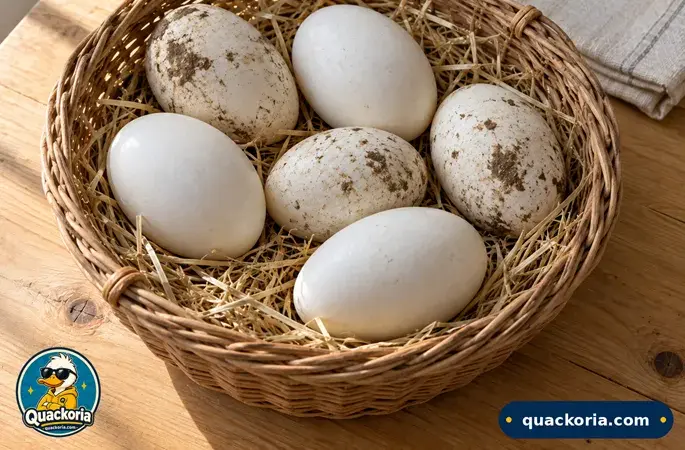
For eggs intended as food, follow collection, cleaning, refrigeration and local food-safety rules. The collecting and storing guide separates clean, dirty, cracked, old and hatching eggs and explains what the float test can and cannot show.
Can you tell whether a freshly laid egg is fertile?
Not with the float test. Floating reflects the enlarged air cell of an older egg; it is not a fertility test. Shell colour, shell texture, egg size and the behaviour of the female do not prove fertility either.
Keepers sometimes inspect the small white spot on a cracked yolk and compare its appearance, but a kitchen observation is not a promise of a viable embryo or a flock fertility rate. If the egg is being eaten, there is no reason to incubate it to answer the question. If the goal is hatching, the meaningful check is development after incubation has begun.
Candling reveals changes produced by development; it cannot make a newly laid egg declare its future. Cornell’s guidance describes normal development and the air cell during incubation. Use the day-by-day egg guide and the candling schedule in incubating duck eggs, and remove failed eggs according to that guide rather than repeatedly handling the clutch.
A broody duck does not prove the eggs are fertile
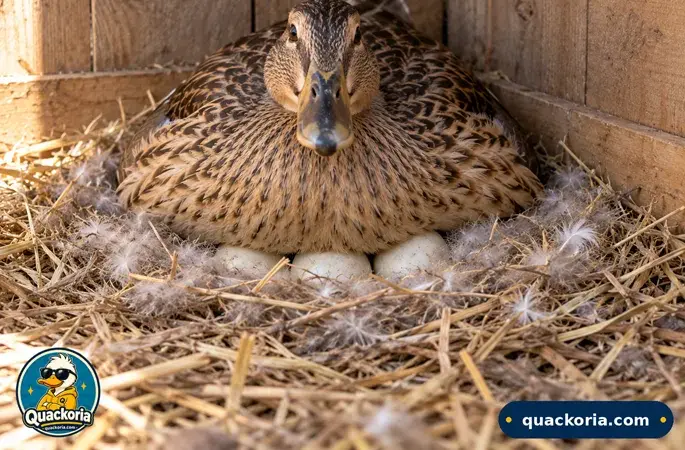
Broodiness is the female’s decision to sit; it is not a fertility detector. A duck may become broody with unfertilised eggs, mixed eggs, or in uncommon cases almost no clutch at all. Without mating, sitting longer will not turn an unfertilised egg fertile.
If there is no drake and no possibility that the eggs came from another flock, a broody cannot hatch her own clutch. Decide whether to break the broodiness or manage her safely using the broody duck guide. Do not leave her losing condition on eggs that cannot develop.
Do you need to keep a drake?
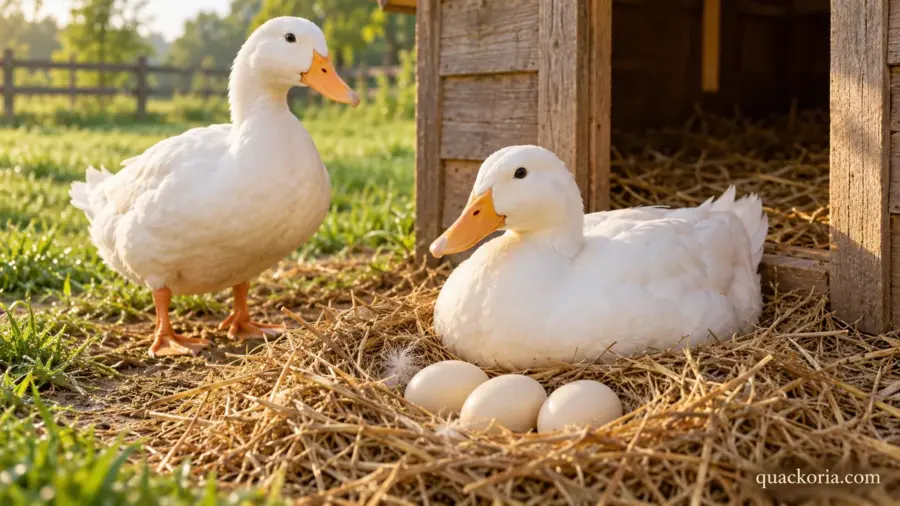
Keep one only for a reason you can manage: breeding, a planned mixed flock, or a particular social arrangement that works for the birds. You do not need one for table eggs, and a drake should not be added simply because a seller says females cannot lay alone.
A mixed flock needs active observation. Repeated mounting can damage feathers and skin or keep a female under pressure. Space, water access, escape routes, breed size and the behaviour of the individual birds matter. Separate a male who is injuring or relentlessly targeting a female and seek experienced welfare or veterinary advice for injuries.
There is no single drake-to-female ratio that applies to every purpose and breed. Published breeder-flock recommendations themselves vary: NC State’s breeder management guide gives four or five hens per drake as adequate for fertility, while an FAO duck-production manual gives different ranges for layer and meat breeding. Those are breeding-management figures, not a promise that a backyard group with that arithmetic will be peaceful. Quackoria does not average them into a universal welfare rule.
If you want hatching eggs
- Plan the homes first. A successful hatch creates more ducks, including males, and the sex ratio will not arrange itself around the space you have.
- Choose healthy breeding birds. Do not breed simply because a drake and a female are available, and do not pair birds where size creates an injury risk.
- Collect and mark dates. Keep hatching eggs separate from kitchen eggs and follow appropriate storage rather than normal refrigerator storage.
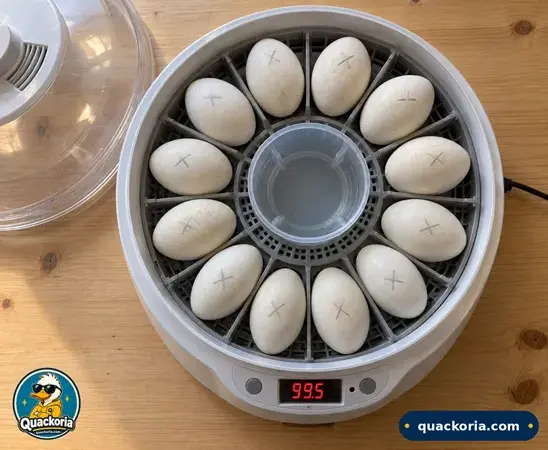
- Use species-appropriate incubation. Common domestic ducks and Muscovies do not share the same incubation length. Start with the hatch-date calculator, then use measured weight loss and the complete incubation guide.
- Treat candling as observation, not certainty. A clear egg at the wrong moment, a damaged embryo and an infertile egg are different possibilities; the source-backed timeline helps avoid early guesses.
If you want eggs only
A female-only flock is a straightforward option. Provide a complete laying ration appropriate to ducks, constant suitable water, safe floor-level nesting areas and enough space. Collect early because most duck eggs are laid in the morning, and record real production rather than assuming every female lays daily.
The egg production calculator uses published breed ranges as a planning estimate, not a promise. A sudden or prolonged change belongs in the flock record and may need investigation; it is not solved automatically by bringing in a male.
Common questions, answered plainly
Will eggs laid without a drake hatch? No. They are unfertilised.
Will a broody female make them fertile? No. Incubation supports development that fertilisation made possible; it does not cause fertilisation.
Does one mating make every future egg fertile? No. Fertility is not permanent, and the useful interval varies. Do not publish a hatch plan from an assumed number of days; verify development during incubation.
Can a female live without a male? Yes, but not without suitable duck companionship. Keep a social group and manage its welfare and space.
Should I add a drake because laying stopped? No. Investigate season, daylight, age, molt, nutrition, stress and health instead.
The decision in one sentence
If you want eggs to eat, you do not need a drake. If you want ducklings, a drake is one part of a much larger breeding, incubation and welfare plan.
Frequently asked questions
Can ducks lay eggs without a male?
Yes. The laying cycle does not require a drake. Without mating, the eggs are unfertilised and cannot hatch.
Can you eat a fertilised duck egg?
Fertility is separate from food handling. An egg collected promptly for food has not been incubated into a duckling; follow the same collection, refrigeration, local-law and thorough-cooking guidance used for duck eggs generally.
Can the float test tell if a duck egg is fertile?
No. Floating reflects an enlarged air cell as an egg ages. It does not prove fertility, development or safety.
Can candling tell on the day an egg is laid?
Candling is useful after incubation has produced visible development. A fresh egg cannot be guaranteed viable by shell colour, size or a first-day candle.
Will a broody duck hatch eggs if there is no drake?
Not eggs from that no-drake flock. She may still sit, because broodiness does not test fertility, but unfertilised eggs cannot develop.
Do I need a drake for a happy flock?
No. A female-only flock can work well, but ducks still need suitable duck companionship, space, water and management.
How many females should one drake have?
There is no one ratio for every breed, purpose and flock. Breeder-production sources publish different figures, while welfare also depends on size, behaviour, space and whether any female is being repeatedly targeted.
Sources
- RSPCA Knowledgebase, How should I care for my pet ducks?
- FAO, Chapter 6: Chickens and ducks
- NC State Extension, A Management Program for Raising Breeder Duck Flocks
- FAO, Good Practices in Poultry Production in South Asia (duck section)
- Cornell University Duck Research Laboratory, Hatching Duck Eggs
- Metzer Farms, Broody Ducks and Geese: What It Means and How to Help
- USDA FSIS, Shell Eggs from Farm to Table