Quackoria Care
Duck Water Needs: Drinking, Head-Washing, Bathing and the Mud
"Do ducks need a pond?" has a short answer — no — and it is the wrong question. The right one is what water a duck needs, how deep, how much, and what to do about the mud that follows it everywhere. This is the practical set-up: the depth that is a health requirement, the arrangement that keeps the ground from turning to soup, and the difference between what a duck needs and what it would like.
Key takeaways
- Three jobs, three depths: drinking, head-washing, bathing. A chicken drinker does only the first.
- Head-washing is a health requirement: the RSPCA farm standard asks for water that covers the head fully — at least 4.5 cm deep for day-old ducklings, and deeper as the bird grows. Without it, ducks cannot keep their eyes and nostrils fully clean.
- Bathing: at least 50 × 100 cm and 10 cm deep from 21 days (RSPCA farm standard) — a floor for commercial flocks, with an easy way out.
- Waterfowl drink up to 5–6 times the water-to-feed ratio of other poultry (Merck). We found no adult volume; a seven-week Pekin drinks about 1.5 litres a day.
- Drainage under the water station: a wire-covered frame or slats (Minnesota Extension, Metzer) over a well-drained bed such as shingle (RSPCA), and move it regularly.
- Head-washing water stays liquid all winter; bathing water can pause in hard frost.
What you need
- A bucket or trough deep enough to cover the whole head, rim at lower-neck height
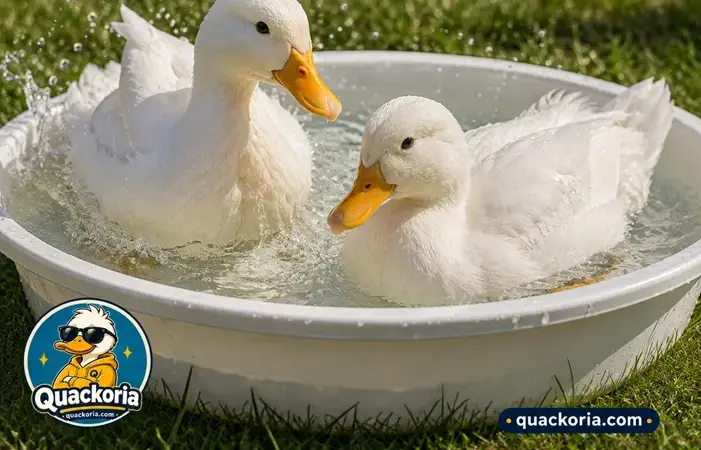
- A paddling pool or tub, ideally at least 50 × 100 cm and 10 cm deep (the RSPCA farm minimum), with a way out
- A wire-covered frame or slatted platform, and a bed of shingle, for under the water station
- A heated base or heated bucket for winter
The yes-or-no version is in do ducks need a pond?. This is the article for once you have decided to keep them and are standing in the run with a bucket.
Three different jobs
Water does three things for a duck, and they need three different depths.
- Drinking. Constant, and more than you expect.
- Washing the head. A duck clears its eyes and nostrils by dunking its whole head under. Without water deep enough to do it, ducks cannot keep their eyes and nostrils fully clean (Jones, Waitt and Dawkins, 2009). The RSPCA’s farm standard makes it a welfare requirement, not a preference.
- Bathing. Full-body access. RSPCA Australia says being able to preen and bathe in water is very important for ducks to keep their eyes, nostrils and feathers clean.
A drinking dish covers only the first. A bucket covers the first two. A pool covers all three. The rest of this article is about getting all three without flooding the run.
Drinking: how much, and why the ground gets wet
Ducks drink a lot, and they drink messily. Merck’s backyard poultry guidance puts standard poultry at roughly 1.5–3.5 parts water to 1 part feed — and says waterfowl require up to five or six times that amount.
Metzer Farms publishes the only actual volumes we could find, for Pekin ducklings, from Cornell Duck Research Laboratory data: 0.06 US gallons, about 0.23 litres per bird per day in week one, rising to 0.40 gallons, about 1.5 litres per bird per day by week seven. We found no authoritative figure for adult ducks, and we are not going to invent one — but a seven-week Pekin already drinks about a litre and a half a day, so a flock drinks buckets.
The mess comes from how they eat and drink. eXtension says ducks should never be given access to feed without water nearby, because without water they can choke on their feed — so they go back and forth between the two. Feed goes into the water, water goes onto the ground, and the ground around the feeder and the waterer becomes the wettest place in the run.
The waterer is therefore the thing to design around. NC State’s feeding guidance says a duck’s attraction to water “can cause a serious wet litter problem if the waterer is not designed properly”, and gives a placement rule: waterer pan height should be even with the lower neck area of the average duck.
Head-washing depth: the requirement
A duck’s eyes and nostrils are cleaned by immersion. In a study of ducks reared for meat, birds without the chance to at least dip their heads and splash their feathers with water could not keep their eyes, nostrils and feathers fully clean (Jones, Waitt and Dawkins, 2009). RSPCA Australia notes that dirty eyes and nostrils, with sneezing, head shaking or difficult breathing, can indicate a respiratory tract disease — a vet matter.
The RSPCA’s welfare standard for farmed ducks puts numbers on it, and they are small:
- From day one: water that “allow[s] water to cover the head fully”, with a channel at least 4.5 cm wide and 4.5 cm deep
- From 21 days: full-body access, in water at least 10 cm deep (the bathing facility, below)
The UK welfare code recommends the same thing in words, without a figure: “Consideration should be given to the provision of water troughs which are deep enough to allow the ducks to get their heads completely under water.” RSPCA Australia suggests shallow water of 10–20 cm where ducks can dabble and submerge their heads.
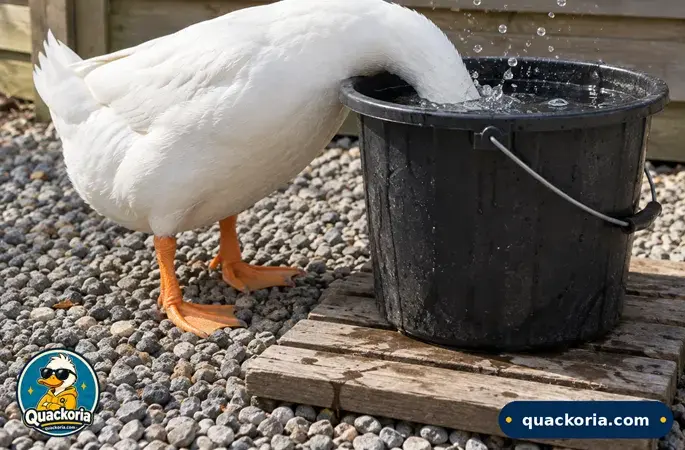
The test is the RSPCA’s: water that covers the whole head. A bucket does it. What does not do it: the shallow tray that came with the chicken waterer, the nipple drinker, or the hanging bell drinker with a lip an inch deep. Those give a duck a drink. They do not let it put its head under.
The simplest thing that works
A bucket, or a deep trough, with the rim at about the height of the lower neck (NC State’s guide for waterer pans), and the water deep enough to cover the whole head. Minnesota Extension asks for a waterer “wide enough and deep enough for a bird to dip its bill and head”, and for waterers the birds cannot get into.
Change it every day: the RSPCA’s advice for pet ducks is to clean the open water container at least once a day before refilling it.
Bathing: what full-body access means
The sources do not agree that bathing water is essential: Metzer Farms says ducks do not have to have swimming water, and that if you provide it they do not need it every day. The RSPCA’s farm standard does require it.
The RSPCA standard requires full-body access to water “as early as possible and, in any case, from no later than 21 days of age”, in a facility that measures “at least 50cm x 100cm (internal measurements)” with “a water depth of at least 10cm throughout the facility”. That is the floor for commercial flocks — roughly a large storage tub or a children’s paddling pool, which is what the RSPCA suggests for pet ducks where there is no pond.
What we found no authoritative source publishing is a volume per duck, or a pond size, for a garden flock. The farm standard gives figures per 100 ducks — at least 50 cm of usable open water facility space and at least 833 cm² of open water area — which for a backyard flock simply means: big enough that they are not queueing.
Options, cheapest first
- A large plant saucer or mortar tub — 10 cm deep, easy to tip out, fine for a few ducks.
- A children’s paddling pool, the rigid kind — the RSPCA’s own suggestion for pet ducks without a pond.
- A stock tank — heavier, longer-lasting, needs a ramp in and out.
- A dug pond with a liner — the most work; see below.
Whatever it is, ducks must be able to get in and out easily: the RSPCA’s advice is water “deep enough for them to wash their head and body, but shallow enough that they can get out easily”. A pool with a steep side is a pool a tired bird cannot leave — the US Fish and Wildlife Service warns that ducklings in a swimming pool “may drown if they become exhausted because they cannot get out”, and the British Waterfowl Association that birds struggling to get ashore may become exhausted and perish. A ramp with cross-strips, or a brick step, or a pool sunk to ground level, fixes it.
Mud: the actual problem
Everything above produces the same by-product. Water carried on feet and feathers, water slopped from the bucket, water flung from the pool, and a flat webbed foot working it all into the ground. The RSPCA’s advice is to prevent the ground around the water from becoming wet and muddy, by moving the water facilities regularly or standing the container over a well-drained area.
Nothing eliminates duck mud. These reduce it:
Drainage under the water station
Minnesota Extension says to place waterers over low, wire-covered frames to help reduce wet litter problems; Metzer Farms says “a slatted or wire floor under the waterer works wonders”, with openings large enough for water and manure to drop through. The RSPCA’s farm standard puts water facilities over perforated flooring and properly constructed drainage, and its pet advice is to stand the container over a well-drained area, “such as a bed of shingle”. Spillage falls through and drains away instead of pooling.
The same works under the pool: a bed of shingle under the area the birds stand on to get in and out.
Move it
If the water station cannot have drainage, move it. The UK welfare code says drinking facilities should be moved every one or two days to keep the area around them from becoming contaminated, and the RSPCA to move water facilities regularly to let the area recover. Rotate the pool’s position too.
Keep water out of the house
The duck house guide covers this: every litre that goes into the house has to be absorbed by bedding, and Merck’s list of what wet litter and ammonia do — ammonia burns of the cornea, footpad dermatitis, breast blisters — is the list of things you are trying to avoid. The RSPCA’s farm standard puts water facilities in dedicated areas out of the main house, or on raised perforated flooring, so that spilt water does not reach the litter. If a drinker does stay inside, stand it on a wire-covered frame.
Keep the feed beside the water, not in it
eXtension says it is best to place the waterer directly next to the feeder, because without water ducks can choke on their feed, and the British Waterfowl Association notes that they nearly always wish to drink when feeding. Keep the feeder beside the water station, not in its splash, and put the drainage under the water.
Accept it
A duck run in a wet winter is muddy. If you have a small paved yard or a lawn you care about, this is a thing to weigh before you get ducks; the wider comparison is in ducks or chickens.
Emptying and refilling
Pool water goes dirty quickly: the RSPCA says open water sources can become dirty very quickly, advises cleaning the container at least once a day, and asks for a separate supply of fresh drinking water. Empty it away from the run, so the water you tip out does not add to the mud.
A pool with a bung or a tap at the bottom saves a great deal of lifting; the British Waterfowl Association describes small ponds being bailed out with a bucket, or fitted with a drain pipe. A siphon hose does the same for a pool without one.
Fish and plants are the other consideration. Metzer Farms says ducks will probably not cause a problem with any fish over 3 inches long; the British Waterfowl Association warns that waterfowl will uproot and nibble any plants in and around a pond, and that their feet and probing bills can be very destructive. A garden pond you care about is better kept apart from the duck pool.
Do not let ducks in the family pool
The risk is getting out, not the water itself: Metzer Farms answers “Can my ducks and geese drink and swim in chlorinated water?” with “Yes.” But ducklings cannot step out over a pool’s tall ledge, and the US Fish and Wildlife Service warns that they may drown if they become exhausted. This is a real hazard where ducklings can get through a fence to a neighbour’s pool.
Winter: keeping it liquid
The head-washing requirement does not stop in January. University of Maryland Extension: be sure to provide liquid water deep enough for the birds to dunk and wash their heads, and check or replace the water several times a day, because birds cannot break through ice to reach it. The UK welfare code asks for particular attention to water in freezing conditions.
- A heated base or heated bucket — Maryland Extension suggests a heater under the waterer; choose one that will not melt the container or start a fire if it touches litter.
- Fresh water several times a day — the labour-intensive answer: check, break the ice and refill, as Maryland Extension advises.
- Moving water — Maryland Extension suggests keeping the water agitated, for example with floating ping-pong balls.
- Black rubber tubs — Maryland Extension: stood in sunlight they absorb the heat, will not crack, and are easy to break the ice out of.
Bathing water can stop in hard frost; Metzer Farms says the birds do not need it every day. Head-washing water cannot. The rest of the season is in keeping ducks in winter, and the summer side — when the same pool is what keeps a duck alive — in keeping ducks in summer. When to build the drainage, and when to move the bucket, is in the keeper’s calendar.
Water and ducklings
Ducklings are not fully waterproof. Minnesota Extension says they are easily chilled when they become wet while still in the down stage, and asks for waterers the birds cannot get into; the RSPCA says young birds should not have access to deep water for swimming until they have developed enough waterproofing, and gives ducklings very shallow troughs for their first few weeks. The RSPCA’s day-old figure — 4.5 cm — is for head-dunking. On swimming the sources differ: eXtension says not to let ducklings swim for the first three weeks, and Metzer Farms that the safest is to wait until they are five weeks or more. The week-by-week detail is in raising ducklings week by week.
The short version
- Three jobs: drinking, head-washing, bathing — three depths
- Head-washing is a health requirement: water that covers the whole head — at least 4.5 cm deep for day-old ducklings, deeper as the bird grows (RSPCA). A bucket does it; a chicken drinker does not
- Bathing: the RSPCA farm minimum from 21 days is 50 × 100 cm and 10 cm deep, with an easy way out — a floor, not a target
- Waterfowl drink up to 5–6 times the water-to-feed ratio of other poultry (Merck); we found no adult volume, but a seven-week Pekin drinks about 1.5 litres a day (Metzer)
- Mud is managed, not prevented: a wire or slatted platform over a well-drained base under the water station, move the bucket, keep spilt water off the bedding, feeder beside the water but out of its splash
- Waterer rim at lower-neck height so they can dip but not stand in it
- Head-washing water stays liquid all winter; bathing water can pause in hard frost
This is husbandry guidance, not veterinary advice. If a bird is ill or injured, find an avian vet.
Frequently asked questions
How deep does duck water need to be?
Deep enough to submerge the whole head — the RSPCA farm standard asks for water that can cover the head fully, at least 4.5 cm deep from day old, and full-body access in water at least 10 cm deep from 21 days; the UK welfare code recommends troughs deep enough for ducks to get their heads completely under water. A bucket does it; a shallow tray does not.
How much water does a duck drink a day?
We found no authoritative adult figure. Merck says waterfowl need up to five or six times the water-to-feed ratio of standard poultry, and Metzer's published Pekin duckling figures, from Cornell data, rise from about 0.23 to 1.5 litres a day by week seven. Plan for buckets per flock.
Do ducks need a pond to be healthy?
No. They need water to drink and water deep enough to dunk the head. The RSPCA's farm standard also requires full-body access to at least 50 × 100 cm of water 10 cm deep from three weeks, and its pet advice is a paddling pool or trough where there is no pond; Metzer Farms says swimming water is not essential. A pond is what they would like.
How do you stop ducks making mud?
You reduce it; nothing prevents it. A wire-covered frame or slatted platform over a well-drained base such as shingle under the water station, move the water regularly (every one or two days, in the UK code's words), keep spilt water off the bedding, and keep the feeder beside the water but out of its splash.
How do you keep duck water from freezing?
A heated base or heated bucket, chosen so it cannot melt the container or start a fire; or checking, breaking the ice and refilling several times a day, as University of Maryland Extension advises. Head-washing water must stay liquid all winter — bathing water can stop in hard frost.
Sources
- RSPCA welfare standards for domestic/common ducks (2023)
- DEFRA — Code of recommendations for the welfare of livestock: ducks
- Merck Veterinary Manual, Management of Backyard Poultry
- NC State Extension, Feeding Ducks
- Metzer Farms — Daily Feed and Water Consumption and Manure Output of Pekin Ducklings (Cornell Duck Research Laboratory data)
- Metzer Farms — How do I keep it dry around my duck and goose drinkers?
- Metzer Farms — Frequently asked questions
- RSPCA — Outdoor areas for pet ducks and geese
- RSPCA Australia — How should I care for my pet ducks?
- Jones, Waitt & Dawkins (2009), Water off a duck's back: showers and troughs match ponds for improving duck welfare, Applied Animal Behaviour Science 116:52–57
- University of Minnesota Extension — Raising Ducks (Poultry Fact Sheet 43)
- eXtension (Jacquie Jacob, University of Kentucky) — Feeding Ducks for Egg Production Kept in Small Flocks
- eXtension — Raising Meat Ducks in Small and Backyard Flocks
- British Waterfowl Association — Ponds
- US Fish and Wildlife Service — Ducks in your pool
- University of Maryland Extension FS-1133 — Winter weather and small flocks: what you need to know