Quackoria Learn
Why Don’t Ducks’ Feet Freeze on Ice?
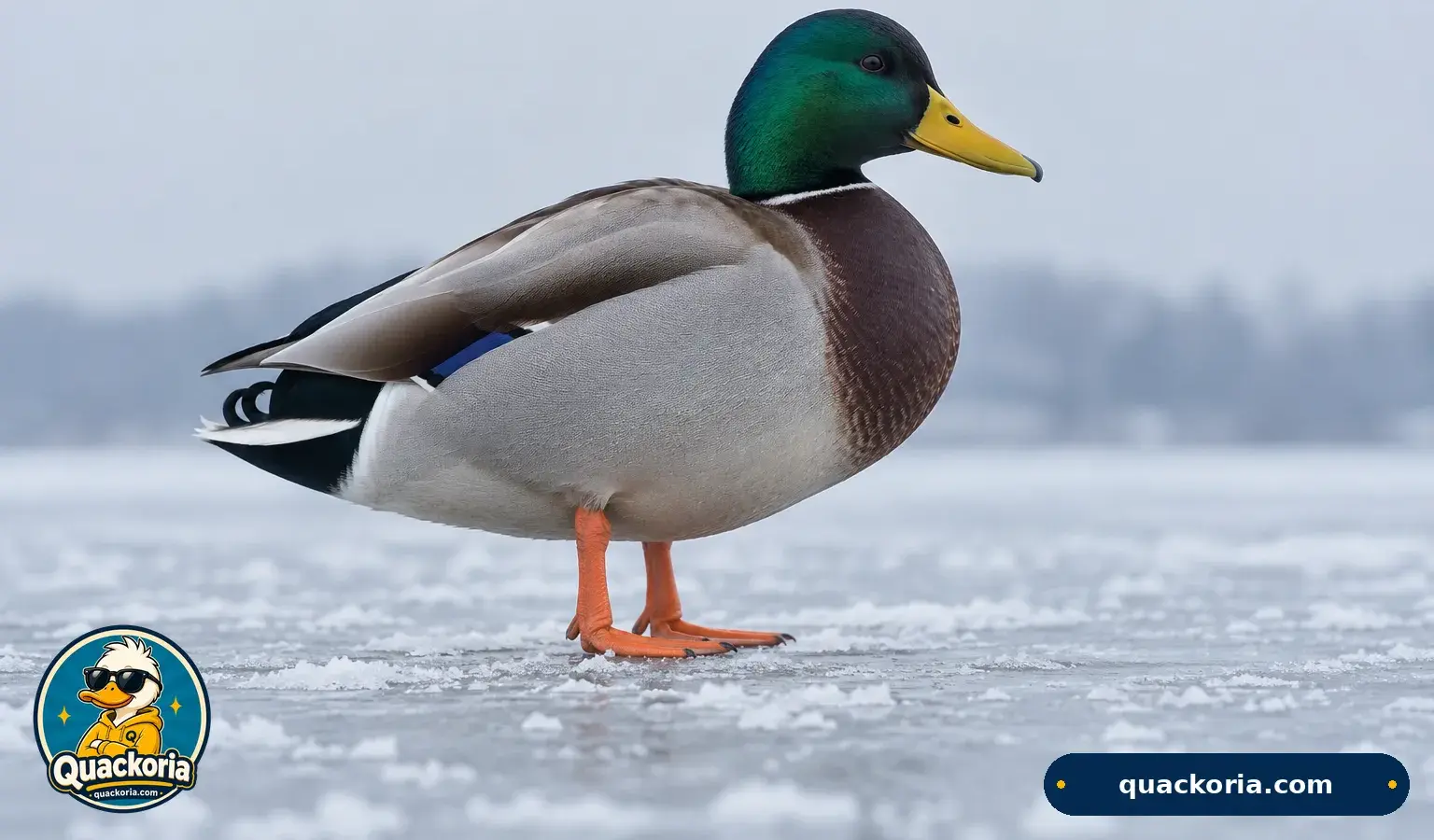
A duck on ice keeps its body near 40°C and its feet just above freezing. Vessels in the leg trade some heat, and less blood is probably sent down.
Key takeaways
- Measured mallard core temperature is 39.9°C. In one bird, the temperature under the skin of the foot stayed several degrees above zero even with the feet in fluid at −8°C.
- Between 0°C and 20°C the feet lose only 3–6.6% of the duck's heat production. At −8°C the highest loss recorded was 18.3%. The famous “5%” is not a constant.
- The primary duck study found no rete in the mallard's lower limb and judged reduced blood flow the probable reason so little heat is lost. Later anatomical work describes one in the leg. Both matter.
- Duck feet are mostly bone and tendon, with little muscle or nerve tissue. The muscles that work the toes sit higher up the leg.
- Frostbite in ducks is real, though uncommon in waterfowl, and vets treat it. “Ducks can stand on ice indefinitely” is an overstatement.
A duck on ice runs a body temperature near 40°C and feet just above freezing, and it can do that for long periods. Two things make it possible: some heat passes between the arteries and veins in the leg before the blood reaches the foot, and, probably, less blood is sent to the foot in the first place.
The counter-current exchange, and what it actually does
In a duck’s leg the arteries carrying warm blood down and the veins carrying cold blood back up run pressed against each other. Heat crosses from the artery into the vein on the way down, so the blood arriving at the foot has already given up some of its heat — and the blood returning to the body has been pre-warmed before it gets there.
The effect is that the duck is not pumping warm blood into a foot standing on ice and losing it to the environment. It is running the foot cold on purpose. Cornell’s ornithology team calls this regional heterothermy: the core is held steady while the extremities are allowed to drift.
The counter-intuitive part is that a cold foot loses heat slowly. Heat flows in proportion to the temperature difference between two surfaces, so a foot at 1°C standing on ice at 0°C has almost no gradient to lose heat across. A foot at 39°C would haemorrhage heat.
Where the popular explanation goes wrong
A common explanation is that ducks have a rete mirabile — a dense network of intertwined vessels — in their feet. The primary experimental paper on duck feet found none in the lower limb.
Kilgore and Schmidt-Nielsen, writing in The Condor in 1975, immersed the feet of seven adult mallards in fluid at temperatures from −8°C to +24°C and measured the heat coming out. Their conclusion: “Although the arterial and venous supplies to the lower limb of Mallards are juxtaposed there is no rete mirabile present. The lack of a vascular rete makes it probable that the low rate of heat loss is due to a reduction in blood flow.”
Later anatomical work by Uffe Midtgård does describe a structure in the mallard hind limb — the rete tibiotarsale — and calls it “the main arterio-venous heat exchange system in the Mallard”, with shunt vessels that let blood bypass it. So the picture is: the vessels are juxtaposed and there is an exchange structure, and Kilgore and Schmidt-Nielsen judged it probable that the low heat loss is due to reduced blood flow. Neither study measured how the work is shared between the two.
Say counter-current exchange and restricted blood flow, and you have both parts of the answer.
The numbers
From the 1975 mallard study:
- Core temperature: 39.9°C, varying by less than 0.1°C through the experiment.
- Foot temperature: several degrees above 0°C under the skin, measured in one bird, even with the feet in fluid at −8°C.
- Heat lost through the feet between 0°C and 20°C: 3–6.6% of the duck’s metabolic heat production — a mean of 0.48 watts.
- At −8°C: 18.3% at the highest rate recorded, 3.23 watts.
That last pair matters. The famous “only 5% of a duck’s heat escapes through its feet” is a fair rounding of the 0–20°C range; at −8°C the highest loss recorded was more than three times that. It is not a fixed property of ducks.
For a sense of scale in the other direction: a 2004 study in the Journal of Experimental Biology of two- and three-day-old mallard ducklings found that swimming ducklings lose a minimum of 70% of their heat production to the water, yet most of them held their body temperature above 39°C for an hour on water as cold as 5°C.
Why the foot survives being that cold
A duck’s foot can sit just above freezing without harm, and the reason is what is inside it.
Bird feet are mostly bone and tendon. Cornell’s ornithologists note that bird feet “can also withstand low temperatures without damage because there are mostly tendons and bones with little muscle or nerve tissue” — and the muscles that move a bird’s limbs, in Britannica’s words, “are concentrated on the girdles and the proximal parts of the limbs”, so the toes are worked from higher up the leg through long tendons, the way a puppet is worked by strings. There is little muscle or nerve tissue down there to damage.
There is also almost no insulation on the legs and feet, which is exactly why the vascular arrangement has to do the work.
One more piece: the blood flow is not simply shut off. Below 0°C, the heat lost from the feet and the duck’s own heat production both rose substantially in the 1975 study, and Kilgore and Schmidt-Nielsen suggest that “additional heat flow to the feet may be necessary to prevent freezing damage to the tissues.” The protection is a managed trade-off, not a switch.
We could find no authoritative source for the commonly repeated claim that duck feet contain little fat. The sourced explanations are about muscle, nerve and tendon.
Can duck feet freeze? Yes.
Frostbite is a documented veterinary condition in ducks. PoultryDVM describes it in the unfeathered legs and feet, often spreading from the toes into the webs, and progressing from mild redness to swelling and then to shrivelled, blackened tissue. In the hard Minnesota winter of 2013–14 a wildlife rehabilitation centre took in swans stranded by frozen lakes; one arrived with frostbitten feet and had part of a toe and some webbing amputated. The centre’s veterinarian explained that the birds “have to stand on ice a lot more than they usually would have to.”
The primary literature says the same thing in physiological language: freezing can be prevented by increasing blood flow, “but at the expense of a substantially increased amount of heat lost from their feet.” The system has a cost and it can be overwhelmed.
So the accurate version is: ducks routinely stand on ice for long periods without harm, and officials at a Minnesota rehabilitation centre told CBS Minnesota that it is “uncommon for waterfowl to suffer from frostbite”. It can happen, they say, “when a bird is injured, sick or suffering from lead toxicity so it’s not moving around”, and it can happen when birds have to stand on ice far more than usual. If you keep ducks through hard winters, that is a real thing to watch for — the signs above are the ones to look for, and common duck health problems covers foot problems and when a duck needs a vet.
Standing on one leg — a genuinely open question
Ducks do tuck one foot up into their body feathers in cold weather, and the obvious explanation is that halving the exposed surface halves the loss. There is real comparative evidence behind it: a 2019 study across 852 bird species found one-leg standing recorded in 33% of them, more often in colder places and in species with relatively long legs.
But a 2010 pilot study in New Zealand found that captive flamingos and wild pied stilts, taken together, stood on one leg more as the temperature rose from 8°C to 19°C — the opposite of the prediction. For mallards the trend was not significant, and mallards and black swans were less likely to stand on one leg than the long-legged waders. Most birds on one leg appeared to be resting, which the authors took to suggest a link with sleep rather than heat.
Both are real findings from real studies. The honest position is that the heat explanation is well supported across birds generally and has been contradicted in at least one small field test, in flamingos and stilts, and that ducks are not the best example of it. Anyone telling you a duck saves exactly half its heat loss by lifting a foot is quoting a figure we could not find a source for.
Who else does this
The same trick appears in many warm-blooded animals that keep bare extremities in the cold. Among birds, Midtgård examined the leg vessels of 66 species and found networks ranging from a very simple one in tinamous and owls to the most elaborate, with more than 60 arteries and 40 veins, in flamingos; ducks, arctic eiders included, have elaborate ones. Where there is no network, veins run alongside the single artery instead — up to eight surrounding it in ravens and crows, “resembling the pattern described in fins of whales”. Penguins have the network too, and the Humboldt penguin’s leg exchanger has been described as a supreme example of the design.
Among mammals: reindeer, whose legs are long enough that the main artery and vein do the job between them; and seals, whose flippers are so short that the vein is split into many vessels running alongside the artery. Arctic wolves and foxes keep the skin of their feet within a degree of freezing on ground at −50°C, though Blix attributes that to a network of small vessels in the paw and toe pads.
If you want the other half of how a duck survives cold water, it is the plumage — why ducks do not get wet is the companion to this article, and the two mechanisms together are what let a bird sit on a freezing pond for long periods. And if the leg itself puzzles you — the joint that seems to bend backwards — do ducks have knees sorts it out.
Frequently asked questions
Why don't ducks' feet freeze?
The duck lets them run cold, just above freezing, which saves heat: the artery and veins in the leg exchange some heat, and the primary study judged it probable that less blood is sent down. When the feet are exposed to temperatures below freezing, more blood appears to be sent down to keep the tissue from freezing, at the cost of more heat lost. And the feet are mostly tendon and bone, with little muscle or nerve tissue to damage.
How cold do a duck's feet actually get?
Just above freezing. In the 1975 study, the temperature under the skin of one mallard's foot stayed several degrees above 0°C even when the feet were immersed in fluid at −8°C, while the birds' core stayed at 39.9°C.
Do ducks lose heat through their feet?
Some, and how much depends on the temperature. Between 0°C and 20°C the feet account for 3–6.6% of the duck's heat production. At −8°C the highest loss recorded was 18.3%. The often-quoted “5%” is only true for the milder end of that range.
Can a duck get frostbite?
Yes. PoultryDVM describes it in ducks' unfeathered legs and feet, often spreading from the toes into the webs, and a Minnesota wildlife rehabilitation centre has treated frostbitten swans in hard winters. Officials at a Minnesota centre call it uncommon in waterfowl, but say it can happen when a bird is injured, sick or suffering from lead toxicity and is not moving around.
Why do ducks stand on one leg in the cold?
The usual explanation is heat conservation, and comparative work across 852 bird species supports it in general. But one small field study found captive flamingos and wild pied stilts stood on one leg more as it got warmer, and found mallards and black swans used the posture less than long-legged waders. It is not settled.
Sources
- Kilgore & Schmidt-Nielsen (1975), Heat Loss from Ducks' Feet Immersed in Cold Water, The Condor 77:475–478
- Cornell Lab of Ornithology — How Do Gulls Deal With Cold Feet?
- Cornell Lab of Ornithology — Why don't birds get cold feet?
- Blix (2016), Adaptations to polar life in mammals and birds, Journal of Experimental Biology 219:1093–1105
- Midtgård (1980), Blood vessels in the hind limb of the Mallard (Anas platyrhynchos): anatomical evidence for a sphincteric action of shunt vessels in connection with the arterio-venous heat exchange system, Acta Zoologica 61:39–49
- Midtgård (1981), The rete tibiotarsale and arteriovenous association in the hind limb of birds: a comparative morphological study on counter-current heat exchange systems, Acta Zoologica 62:67–87
- Midtgård (1989), Circulatory Adaptations to Cold in Birds, NATO ASI Series 173
- Kazas, Benelly & Golan (2017), The Humboldt penguin (Spheniscus humboldti) rete tibiotarsale – a supreme biological heat exchanger, Journal of Thermal Biology 67:67–78
- Britannica — Bird: muscles and organs
- Banta, Lynott, VanSant & Bakken (2004), Partitioning heat loss from mallard ducklings swimming on the air–water interface, J. Exp. Biol. 207:4551–4557
- Pavlovic, Weston & Symonds (2019), Morphology and geography predict the use of heat conservation behaviours across birds, Functional Ecology 33:286–296
- Functional Ecology Plain Language Summaries — Morphology and geography predict the use of heat conservation behaviours across birds
- Harker & Harker (2010), Why do birds stand on one leg? A pilot study of exotic and native New Zealand birds, Notornis 57:173–177
- PoultryDVM — Frostbite in pet ducks
- MPR News — Frozen lakes, deep winter take a toll on swans, other wildlife (2014)
- CBS Minnesota — Wildlife rehab center treating trumpeter swan with frostbite (2018)