Quackoria Learn
Can Ducks Eat Tomatoes?
Key takeaways
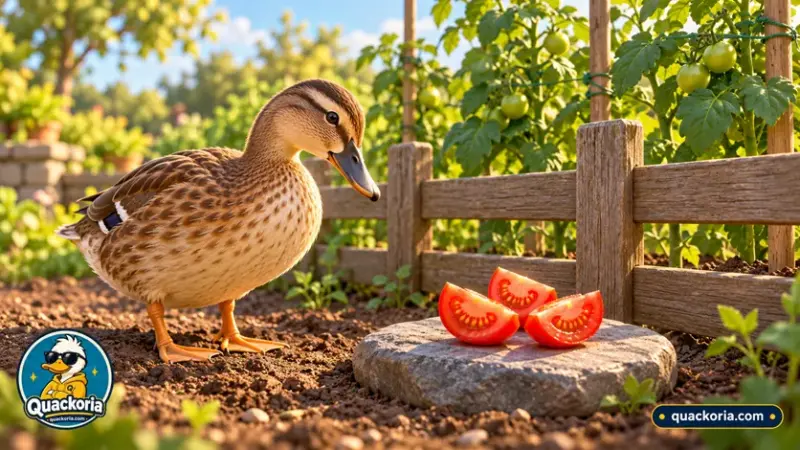
- Ripe tomato flesh is a safe, watery treat for ducks; the Open Sanctuary Project's advice is to "only offer ripe tomatoes as treats".
- Green tomatoes, leaves, stems and vines contain tomatine, a solanine-like glycoalkaloid. Metzer Farms lists green tomatoes among foods ducks should avoid.
- Open Sanctuary says the duck evidence on tomatine is thin but to avoid every part of the plant to be safe; for its relative solanine, in green potato, it lists diarrhoea, respiratory trouble, convulsions and paralysis.
- A tomato is 94.5 per cent water and under 1 per cent protein — one of the least sugary fruits a duck can be given.
- Halve cherry tomatoes and cut large ones into swallowable pieces; fence the tomato bed if ducks free-range.
Ripe red tomato, yes. Green tomato, the leaves, the stems and the vine, no. That split is the whole answer, and it exists because a tomato plant is a nightshade: the green parts carry a natural pesticide, tomatine, that every duck source says to keep out of the bowl, and the ripe fruit has almost none of it.
The short answer
A ripe tomato is a safe, watery, mildly useful treat for a duck. The plant it grew on is not. Metzer Farms, a California duck hatchery, puts green tomatoes with potatoes, rhubarb and eggplant in its list of foods ducks should avoid, and explains why: “tomatoes that are not fully ripe contain solanine which is lethal to waterfowl if ingested in large amounts.” The Open Sanctuary Project’s guide to things that are toxic to ducks names the chemical more precisely — the green fruit, “as well as leaves and stems of the plant, contain a solanine-like glycoalkaloid, tomatine” — and then gives the rule that matters: “To be safe, avoid providing green tomatoes and any part of the plant and only offer ripe tomatoes as treats.”
Why the green parts are different
Tomatine is the plant’s own defence, and the honest position on it is cautious rather than alarmed. Open Sanctuary’s entry on green tomatoes admits that there “isn’t much evidence of it being toxic to ducks” — the study it cites was on chicken embryos — and then gives the rule anyway: “To be safe, avoid providing green tomatoes and any part of the plant and only offer ripe tomatoes as treats.” The concentration falls as the fruit ripens: “The amount of tomatine reduces drastically as the fruit matures though there are certain specialty varieties that have higher levels of tomatine than others, even when they are ripe.” Its close relative solanine, in green potato skins and sprouts, is the better-documented one: Open Sanctuary describes it as “part of a natural defense against insects and fungus” that “acts as a neurotoxin in ducks and can cause serious illness and even death in high enough amounts”, with signs that “include diarrhea, respiratory issues, convulsions, and paralysis.” Metzer uses that word for unripe tomatoes too, and treats the nightshade plants as one group. VCA Animal Hospitals’ list of plants toxic to birds carries the same entry in five words — “Tomato Plant, Green Parts Only” — and the ASPCA’s tomato plant entry, written for dogs, cats and horses, ends with the line that applies to every species on the list: “ripe fruit is non-toxic.”
Not every avian source draws the line in the same place. Lafeber, a bird-food maker whose toxic-foods page is co-written by an avian vet, writes that “Birds can eat green tomatoes, potatoes, peppers, and eggplant; however these plants are all members of the nightshade family. This means that the fruits are safe to eat, but the plants themselves are toxic.” That is a pet-bird page, and it disagrees with the two duck-specific sources on green fruit. With a duck, take the duck sources: ripe only.
What is in a tomato for a duck
Per 100 grams of raw ripe tomato, the US Department of Agriculture’s reference data give 94.5 g water, 18 kcal, 2.6 g sugars, 0.88 g protein and 1.2 g fibre, with 237 mg potassium, 13.7 mg vitamin C and 42 µg of vitamin A as retinol activity equivalents. It is one of the least sugary fruits a duck will be offered, which is a point in its favour, and it is essentially water — useful on a hot day, useless as a source of the protein a duck needs. A complete duck feed runs at 16 to 20 per cent protein; tomato is under 1.
How to feed tomatoes to ducks
Ripe, red all the way through, and cut into pieces a duck can swallow: wedges for a big Pekin, chunks or cherry-tomato halves for a small breed. Ducks do not chew, so the piece has to be swallowing-sized on the way in. Pull off any bit of stem or calyx. Wash the skin. Then treat it as a treat: the poultry extension rule is that everything outside the complete feed stays under a tenth of the diet — Colorado State University Extension: “Treats should make up no more than 10% of their daily diet” — and Metzer’s warning about all treats applies, that they “should not be a large part of your ducks’ daily feed.”
Cherry tomatoes floated whole in a tub of water are a favourite trick with keepers, and a bad one: a whole cherry tomato is exactly the size that lodges. Halve them.
When tomatoes are a problem
Anything green: unripe fruit, the leaves, the stalks, the vine after you clear the bed. If ducks range in a garden, fence the tomato patch — a free-ranging duck will strip low foliage, and that foliage is the most toxic part. Cooked tomato in a sauce is a different problem: the salt, onion and garlic that usually go with it. Onions are on every duck avoid list, so leftover pasta sauce is not a duck food. Mouldy or split tomatoes go in the bin; ducks are unusually sensitive to mould toxins. And a duck that is off its feed and eating only treats is a duck heading for trouble, whatever the treat.
Peppers, potatoes and the rest of the family
The same logic covers the tomato’s relatives. Ripe pepper flesh is fine; the plant is not. Potato is where the sources part company: Lafeber treats it as safe for pet birds, while both duck sources say avoid it, and Open Sanctuary notes that solanine “is heat stable, meaning just boiling won’t necessarily reduce the solanine”. Green or sprouting potato and the skins are the worst of it — Open Sanctuary: “Green potatoes, particularly the skins and ‘eyes’, contain solanine (as do any green bits from peppers, tomatoes, and eggplant, which are in the same family), which can be poisonous to ducks.” Our can-ducks-eat checker has the family listed together.
For what a balanced duck diet looks like in the first place, start with what ducks eat and the keeper’s version in what to feed ducks. Safer summer fruit, if you want one: watermelon.
Frequently asked questions
Can ducks eat tomatoes?
Yes, ripe ones — red all the way through, cut into pieces a duck can swallow. Not green tomatoes and not any part of the plant.
Are tomato plants poisonous to ducks?
Treat them as such. The leaves, stems and unripe fruit contain tomatine. Metzer Farms says unripe tomatoes "contain solanine which is lethal to waterfowl if ingested in large amounts", the Open Sanctuary Project says the duck evidence is thin but to avoid every part of the plant to be safe, and VCA lists the green parts of tomato plants as toxic to birds.
Can ducks eat cherry tomatoes?
Yes, halved. A whole cherry tomato is exactly the size that lodges in a duck's throat.
Can ducks eat cooked tomatoes or pasta sauce?
Plain cooked tomato is fine. Sauces usually carry salt, onion and garlic, and onion is on every duck avoid list, so leftover sauce is not a duck food.
What about peppers and potatoes?
Same family, same rule. Ripe pepper flesh is fine; the plants are not. Green or sprouting potato and potato skins contain solanine and should never be fed.
Sources
- Metzer Farms — Foods ducks should not eat
- The Open Sanctuary Project — Things that are toxic to ducks
- The Open Sanctuary Project — Daily diet, treats and supplements for ducks
- VCA Animal Hospitals — Plants that are toxic to birds
- ASPCA — Tomato plant (toxic and non-toxic plants)
- Lafeber — Foods toxic to pet birds
- USDA FoodData Central (SR Legacy) — Tomatoes, red, ripe, raw, year round average, FDC ID 170457, as reproduced by rawpawiq.com
- Colorado State University Extension — Raising poultry the organic way: disease control and feeding
- NC State Extension — Feeding ducks (Ferket & Davis)