Quackoria Learn
Duck Egg Colors: Why They Are White, Blue, Green or Black
Every eggshell colour in every bird comes from just two pigments, laid down in the final hours before the egg arrives. Here is which duck breeds lay what, why Cayuga eggs can start the season black and then fade, and why shell colour tells you nothing about the egg inside.
Key takeaways
- The Cornell Lab describes just two pigments at work in any eggshell: protoporphyrin for browns and reds, biliverdin for blues and greens.
- Between 50 and 74 per cent of pigment is deposited in the last five hours before the egg is laid, and both pigments are made in the shell gland rather than filtered from the blood.
- The common claim that brown pigment sits only on the surface is contested: one study found 80 to 87 per cent of it inside the calcareous shell.
- Runner, Ancona, Saxony, Dutch Hookbill, Australian Spotted and Swedish ducks are the breeds most likely to lay blue-green eggs. Khaki Campbell is not one of them.
- Cayuga eggs can start the season black: the Livestock Conservancy describes them lightening to grey or greenish-blue and finally white, and Metzer Farms calls a pure black egg rare. That the colour fades is documented; why it happens is not.
- Shell colour does not affect nutrition or taste. Every study confirming that was done on chickens, so strictly speaking it remains untested in ducks.
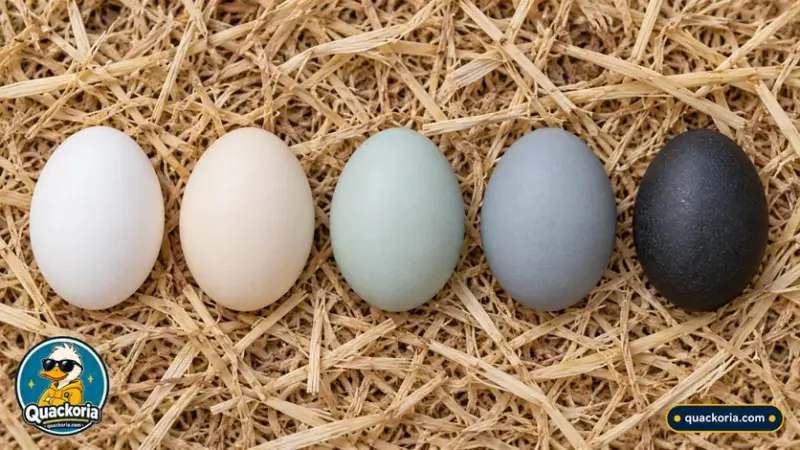
Crack open a carton of duck eggs from a mixed flock and you may find white, cream, pale green, blue-grey and, if you keep Cayugas early in the season, something close to charcoal. All of it comes from two pigments, applied in the last few hours before the egg is laid. Neither pigment has anything to do with what is inside the shell.
Two pigments do all the work
The Cornell Lab of Ornithology puts it simply: “Only two pigments are at work. Protoporphyrin produces reddish-brown colors. Biliverdin produces shades of blue and green.” Every eggshell colour in every bird species is some combination of those two, plus the white calcium carbonate underneath.
The timing is late and it is fast. A 2015 review in Poultry Science found that 50 to 74% of pigment is deposited in the final five hours before the egg is laid. Cornell describes the shell gland applying pigment near the end of the process, with an overall protein coating added last of all. The egg spends around a day being built and gets its colour in the closing hours.
A detail that surprises people: the pigments are not filtered out of the bird’s blood. A 2017 study in Physiological and Biochemical Zoology found no meaningful association between a female’s faecal biliverdin and how blue-green her eggs were, and actually a negative relationship between circulating protoporphyrin and shell pigmentation. Both pigments are made fresh in the shell gland itself.
Where the colour sits — and where the usual explanation goes wrong
The standard line you will read everywhere is that brown pigment sits on the surface while blue goes all the way through. Half of that is contested by the people who measured it.
A 2013 study in Poultry Science examined where protoporphyrin actually sits in brown chicken eggshells — the closest well-measured case — and found “the majority of the protoporphyrin pigment was located in the calcareous part of the eggshell (80–87%) with a minority contained within the cuticle (13–20%).” The authors noted this contradicted earlier work suggesting most pigment accumulates in the cuticle, and the 2015 review acknowledges the conflict openly, saying different studies reached different findings depending on method.
So: brown pigment is mostly in the shell, not on it. As for the claim that biliverdin permeates the entire shell in blue and green eggs, we could not find a peer-reviewed source confirming it for duck eggs, only hobby-press assertions, so we are flagging it as unconfirmed rather than repeating it as fact.
What colour a wild duck lays
The baseline is unglamorous. Cornell describes mallard eggs as “unmarked creamy to grayish or greenish buff” — pale, plain, slightly variable. Domestic breeds have been selected away from that in both directions, some towards reliable chalk-white, others towards stronger blue-green.
Which breeds lay coloured eggs
The Livestock Conservancy’s heritage duck comparison chart gives egg colour breed by breed. A selection, in the Conservancy’s own words:
- Ancona — “White, tinted, blue-green, or spotted,” 210–280 eggs a year
- Runner — “White to bluegreen,” 200+
- Saxony — “White to bluegreen,” 190–240
- Dutch Hookbill — “White to bluegreen,” 100–225
- Australian Spotted — “Cream, blue, green,” 50–125
- Swedish — “White, green, tinted,” 100–150
- Cayuga — “Black fading to blue-gray and then white by end of lay season,” 100–150
- Campbell — “White to tinted,” 250–340
- Welsh Harlequin — “White to tinted,” 240–330
- Silver Appleyard — “White,” 200–270
Two corrections are worth making because they contradict things commonly said online. The Khaki Campbell is not a blue-egg breed — the Conservancy lists it as white to tinted, and Metzer Farms’ own Khaki Campbell page gives no egg colour at all. And the Conservancy contradicts itself on the Magpie: its comparison chart says “White,” while its own Magpie breed page says “White, green, blue” and describes “greenish-blue, brown speckled eggs.” We are reporting the disagreement rather than picking a side.
Hatchery figures give a sense of how variable this is within a breed. John Metzer, quoted with a Metzer Farms table, reports the proportion of coloured eggs as under 2% for Pekins, 35% for Fawn and White Runners, 70% for Black Runners and 75% for Chocolate Runners. His explanation for why Runners lead is geographic: “in Indonesia, they like blue-green eggs so the Runner ducks have a higher percentage because, my guess is, they were selected for blue-green color when the runners were developed in Southeast Asia.” Colour preference in a distant market, bred into a bird, still showing up in a nest box today.
The Cayuga’s black eggs, and what happens to them
The Cayuga is the only duck most keepers will meet that lays something genuinely dark, and when it does, the colour does not last. The Livestock Conservancy describes the pattern precisely: “Eggs are initially black in color, but as the season progresses, egg color lightens to gray or greenish-blue, and eventually they become white.” Metzer Farms adds that many Cayuga eggs have varying degrees of grey and that “on rare occasions they will lay a pure black egg.”
That the fade happens is well documented. Why it happens is not. We could not find a peer-reviewed or university source explaining the mechanism behind the Cayuga’s seasonal fade, and we are not going to guess at one. If you keep Cayugas, the practical consequence is simply that the striking dark eggs are an early-season thing, and a keeper using a freshness check in July should not be alarmed that the colour has gone.
Can you wash the colour off?
Here the answer depends on which colour and which source. A peer-reviewed study of commercial egg washing in the Journal of Food Protection found “no evidence could be found to suggest that the washing procedure used in this investigation irreversibly changed the quality of the cuticle” — electron microscopy could not distinguish washed from unwashed eggs. The British Waterfowl Association says the Cayuga’s earlier eggs have “a washable dark pigment on the shells”, but we found no measurement of how much of it comes off.
The well-supported part is this: since 80–87% of brown pigment is inside the calcareous shell, you cannot wash most of it away even if you abrade the surface. A blue-green tint behaves similarly. The dark pigment on early Cayuga eggs is the exception: the British Waterfowl Association calls it washable.
Does shell colour change the egg inside? No
This is the question people actually want answered, and the research is unambiguous — though all of it was done on chickens.
Dr Jacquie Jacob of the University of Kentucky states that “the only difference between brown and white eggs is the color of the shell. They basically taste the same and have the same functional properties,” with taste varying by the hen’s diet rather than by shell colour. University of Illinois Extension is blunter: “The color of the shell means nothing… all egg shell colors are nutritionally identical.” A 1986 Poultry Science study comparing brown and white eggs found the only significant compositional difference was albumen solids — 11.2% against 10.8% — and called the differences “too small to be of practical value.” Cornell’s own write-up is slightly softer, allowing that brown eggs “may have more omega-3 fatty acids, but the difference is slight, and there is no difference in yolk color or taste.”
We could find no equivalent study testing whether duck shell colour affects nutrition, so strictly speaking that remains untested. What is established, and what does change with diet, is yolk colour: Metzer Farms notes that “egg yolk color is strictly dependent on a duck’s diet,” which is a matter for what you feed your ducks, not for the shell. If you are comparing duck and chicken eggs for cooking, the real differences are covered in duck eggs vs chicken eggs, and none of them is the shell.
Why eggshell colour evolved at all
For wild birds the question is more interesting than for farm ducks. A major 2006 review in Biological Reviews concluded that ancestral bird eggs were probably white and unmarked, and that nest vulnerability explains much of the variation since: species with safe nests kept white eggs, while species nesting in exposed places tend towards brown speckling. Blue eggs “might be cryptic in a subset of nests built in vegetation.” The review weighs five competing hypotheses — camouflage, signalling female quality, protection from sunlight, structural strength where calcium is scarce, and the arms race with brood parasites — without declaring a single winner.
A 2020 study in Nature Ecology & Evolution added a thermal argument: birds in colder regions with sun-exposed nests lay darker eggs, and darker eggs heat more rapidly under solar radiation. Cornell also notes a trade-off between shielding the embryo from ultraviolet damage and overheating it, and mentions in passing that most ducks do not see ultraviolet light at all — which limits how much of this a duck could be selecting for visually.
One tempting explanation does not hold up for ducks. Wood ducks are heavily parasitised by other females dumping eggs in their nests, but the genetic study documenting it makes no mention of egg appearance, and a female was recorded incubating a clutch containing eggs from at least four different birds. Whatever ducks use to sort out their nests, it does not appear to be shell colour.
Frequently asked questions
What makes duck eggs different colours?
Two pigments, according to the Cornell Lab of Ornithology. Protoporphyrin produces reddish-brown shades and biliverdin produces blues and greens. They are made in the shell gland and applied mostly in the last few hours before the egg is laid.
Which duck breeds lay blue or green eggs?
The Livestock Conservancy lists Runner, Ancona, Saxony, Dutch Hookbill, Australian Spotted, Swedish and traditional Aylesbury as laying white to blue-green eggs. Metzer Farms reports the proportion of coloured eggs ranging from under 2 per cent in Pekins to 75 per cent in Chocolate Runners.
Do Cayuga ducks really lay black eggs?
Sometimes, early in the season. The Livestock Conservancy describes eggs that are initially black, lightening to grey or greenish-blue and eventually white. Metzer Farms says many Cayuga eggs have varying degrees of grey and that a pure black egg is rare.
Does shell colour affect nutrition or taste?
No. University of Kentucky and University of Illinois Extension both state that shell colour makes no nutritional difference, and a 1986 study found the only measurable difference between brown and white eggs too small to matter. All of that work was done on chicken eggs.
Can you wash the colour off a duck egg?
Not the pigment set into the shell. A study of commercial egg washing found no irreversible change to the cuticle. The British Waterfowl Association says the dark pigment on early Cayuga eggs is washable, though we found no peer-reviewed measurement of it.
What colour are wild duck eggs?
Plain. The Cornell Lab describes mallard eggs as unmarked creamy to greyish or greenish buff.
What decides yolk colour?
Diet, not breed or shell colour. Metzer Farms states that yolk colour is strictly dependent on what the duck eats.
Sources
- Cornell Lab of Ornithology — The beauty and biology of egg color
- Samiullah & Roberts, The location of protoporphyrin in the eggshell of brown-shelled eggs, Poultry Science 2013
- Samiullah, Roberts & Chousalkar, Eggshell color in brown-egg laying hens: a review, Poultry Science 2015
- Hargitai et al., Physiological and Biochemical Zoology 2017
- Cornell Lab of Ornithology — Mallard life history
- The Livestock Conservancy — Heritage Duck Breed Comparison Chart
- The Livestock Conservancy — Cayuga duck
- The Livestock Conservancy — Ancona duck
- Metzer Farms — Cayuga ducks
- Metzer Farms — Fresh duck eggs
- Leleu et al., Effect of egg washing on the cuticle quality of brown and white table eggs, Journal of Food Protection 2011
- Jacquie Jacob, University of Kentucky — Brown and white eggs
- University of Illinois Extension — Eggs-actly right
- Curtis, Gardner & Mellor, Poultry Science 1986
- Kilner, The evolution of egg colour and patterning in birds, Biological Reviews 2006
- Wisocki et al., The global distribution of avian eggshell colours, Nature Ecology & Evolution 2020
- British Waterfowl Association — Cayuga