Quackoria Learn
Khaki Campbell Duck: The Egg Breed, Its History and Its One Drawback
The Khaki Campbell is the egg duck: a small, plain, brown bird that a Gloucestershire breeder put together in the 1890s and that has out-laid nearly everything since. It is busy, a good forager, not especially cuddly, and the breed to choose when eggs are the point.
Key takeaways
- Developed by Adele Campbell from Runner and Rouen stock and introduced in 1898; in the US from 1929 (The Livestock Conservancy).
- Eggs are the point: 165–240 a year on Metzer's chart, an average of 250–340 per the Conservancy, first eggs at five to seven months.
- Metzer scores its temperament 9 — the most nervous on the chart — and the Conservancy calls it high-strung. Give it room and something to do.
- Light (3.5–4.5 lb) and a very good forager; Metzer rates it a good mother and its flight "Maybe", though eXtension says Campbells seldom go broody.
The Campbell is kept for the egg basket, though The Livestock Conservancy says Adele Campbell set out to give her family “a consistent supply of roast duckling”. What a keeper gets is a light frame, restless foraging and a laying record that hatcheries still quote. It is also a breed with a real history, a real set of numbers behind its reputation, and one or two real drawbacks, which are set out here in that order.
Khaki Campbell at a glance
| Trait | Figure | Source |
|---|---|---|
| Origin | England; developed by Adele Campbell, introduced 1898 (TLC and Metzer’s breed guide; Metzer’s sales page gives 1901) | The Livestock Conservancy, Metzer |
| Adult weight | 3.5–4.5 lb (1.6–2 kg) Metzer; 4–4.5 lb Livestock Conservancy | Metzer, TLC |
| Eggs a year | 165–240 (Metzer); an average of 250–340 (TLC) | Metzer, TLC |
| Egg weight | 75–85 g | Metzer |
| Egg colour | White or tinted (TLC); fewer than 5% bluish (Metzer) | TLC, Metzer |
| Temperament | 9 on Metzer’s 1–9 scale — the nervous end | Metzer |
| Mothering | Good (Metzer); “seldom become broody” (eXtension) | Metzer, eXtension |
| Foraging | Very good | Metzer |
| Flight | “Maybe” | Metzer |
| First eggs | Most at 5–7 months | The Livestock Conservancy |
| Incubation | 28 days | Cornell |
| Rarity | Watch | The Livestock Conservancy |
The two egg figures disagree: Metzer’s range runs from a flock with no artificial light to one lit for 17 hours a day, while the Conservancy says most Campbells “will average 250-340 eggs” a year. Metzer’s lower figure, 165, is the one for a flock without lights. The whole chart is on the breed comparison tool.
Where the Khaki Campbell came from
The Livestock Conservancy tells the story plainly. In the late 1800s Adele Campbell of Gloucestershire crossed Fawn and White Indian Runners with a Rouen, looking for a duck that would lay well and still make a meal. The Campbell was introduced to the public in 1898, and the khaki-coloured strain that followed was named, the Conservancy says, for its resemblance to British army uniforms. The breed reached the United States in 1929 through Perry Fish of Syracuse, New York, was recognised by the American Poultry Association by 1941, and, after numbers that “languished for many years”, grew sharply in the 1970s, which the Conservancy puts down to the back-to-the-land movement, demand for duck eggs among Asian immigrants after the Vietnam War, and a productive strain imported in 1977.
The laying reputation rests on more than anecdote. Metzer’s breed page records the 1950s Jansen flocks in Holland averaging 335–340 eggs in 365 days with eggs averaging 72 grams. That is historical and commercial — Metzer’s own chart gives 165–240 — and Metzer adds that in egg-laying contests the breed “averaged up to 39 more eggs laid than the second best breed”.
What a Khaki Campbell looks like
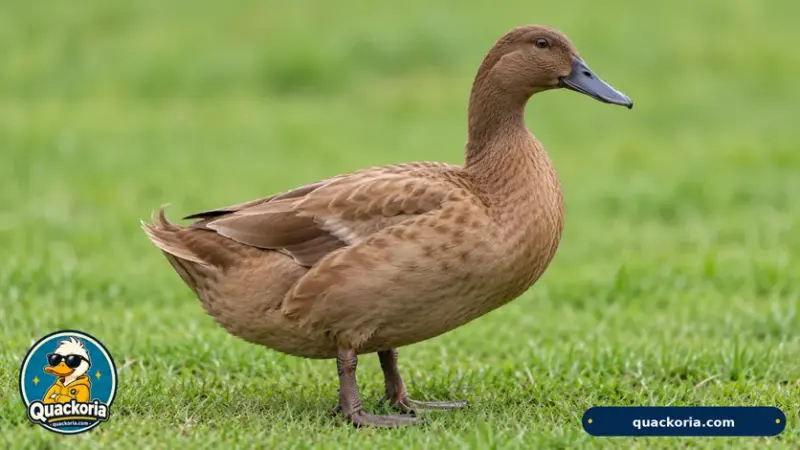
Small and neat. The Conservancy describes a lightweight bird with a modestly long head, bill, neck and body, carried 20–40 degrees above horizontal. The duck is khaki with a seal-brown head, upper neck and lower back; the drake is a warm khaki with a brown-bronze head, upper neck, lower back and tail coverts, and he carries the curled tail feather that marks a male of any mallard-descended breed.
Metzer’s signs work for Campbells as for most breeds — the drake’s deep, raspy voice by eight to ten weeks and the curled feather within about eight — and Metzer adds that Campbell drakes have a lighter bill than the ducks; the sexing tool walks through the signs. At 1.6–2 kg the Campbell is one of the lighter breeds on Metzer’s chart, and Metzer rates its flight “Maybe”, so a clipped wing or a taller fence is worth planning for.
Eggs
This is the section the breed exists for. Metzer’s chart gives 165 eggs a year without lights and up to 240 with 17 hours of light; the Conservancy says most will average 250–340; and the eggs themselves are a moderate 75–85 g, white or tinted, fewer than 5% of them bluish on Metzer’s chart. The Conservancy notes that most lay their first eggs at five to seven months. When do ducks start laying eggs covers the signs that laying is close, and the flock planner turns the eggs you want into the number of birds.
Whether a Campbell will sit is disputed. Metzer rates its mothering as good, and its FAQ names the Khaki Campbell, with the Muscovy and the Mallard, as “very good at sitting on their own eggs”; eXtension says Campbells “seldom become broody as this characteristic was sacrificed in exchange for a high level of egg production”. A hen that does go broody can be left to it. The broody duck guide explains what she needs.
Temperament and noise
Here is the drawback. Metzer scores the Khaki Campbell 9 on its temperament scale — the most nervous rating on the chart, shared only with the White Crested — and the Conservancy calls the breed energetic and high-strung, needing ample space to graze and forage. A Campbell is not a lap duck: the University of Kentucky says Campbells and Runners “tend to be nervous and flighty and will stampede when startled”.
Noise is ordinary for a mallard-type: the females have what Metzer Farms calls “the typical, loud QUACK”, and the drakes a deep, raspy voice.
Keeping Khaki Campbells
Give them room and something to do. Metzer rates the breed’s foraging very good, Oklahoma State’s breed register calls Campbells “extremely hardy, excellent foragers”, and The Livestock Conservancy calls them “active foragers” and says they “need plenty of space to graze and forage”. The University of Kentucky, though, says Runners and Campbells are good foragers that “also do well in confinement when a good layer ration is provided”. The space calculator gives the published figures per bird; for a Campbell, treat the minimum as a minimum.
A laying Campbell needs a layer ration; Metzer says most layer feeds have enough calcium without oyster shell, and that if the feed has less than 2.5% calcium you can provide a dish of it. That, enough niacin, and clean water deep enough to wash the head in are the basics; what to feed ducks has the figures. The frame is light: on Metzer’s chart a Campbell weighs 3.5–4.5 lb against 8–12.25 lb for its Grimaud Pekin. Housing and predator protection are the same as for any duck — the duck house guide and duck predators.
Is the Khaki Campbell right for you?
Yes, if eggs are the point and you have space to let a busy duck be busy. It is hardy — “Good in both hot and cold climates”, says The Livestock Conservancy — and on Metzer’s chart only Metzer’s two hybrid layers out-lay it. Choose something else if you want a calm bird or a bird for a small paved run. On Metzer’s temperament scale the Saxony scores 1.0, the Welsh Harlequin (developed from the Campbell) 1.3 and the Pekin 5.5, against the Campbell’s 9. The beginner’s guide to duck breeds sets them side by side.
Frequently asked questions
How many eggs does a Khaki Campbell lay?
Metzer's chart gives 165 a year without artificial light and up to 240 with 17 hours of light; The Livestock Conservancy says most will average 250–340. Metzer's lower figure, 165, is for birds kept without artificial light.
Are Khaki Campbells friendly?
They share the most nervous score on Metzer's chart (9 on a 1–9 scale, with the White Crested), the Conservancy calls them energetic and high-strung, and the University of Kentucky says Campbells and Runners tend to be nervous and flighty and will stampede when startled.
Can Khaki Campbell ducks fly?
Possibly. Metzer's chart rates its flight "Maybe", so a clipped wing or a taller fence is worth planning for.
Do Khaki Campbells go broody?
The sources disagree. Metzer rates their mothering good and says Khaki Campbells are very good at sitting on their own eggs; eXtension says they seldom become broody, a trait given up for high egg production.
Where did the Khaki Campbell come from?
Gloucestershire, England, in the late 1800s, from Adele Campbell's crosses of Fawn and White Indian Runners with a Rouen. The khaki colour was named for its resemblance to British army uniforms.
Sources
- Metzer Farms — Compare Duck Breeds
- Metzer Farms — Using Lights to Increase Duck Egg Production
- Metzer Farms — Sexing Ducks and Geese
- Cornell University Duck Research Laboratory — Hatching Duck Eggs
- RSPCA welfare standards for domestic and common ducks
- The Livestock Conservancy — Khaki Campbell Duck
- Metzer Farms — Khaki Campbell Ducks
- Metzer Farms — Khaki Campbell Ducks (breed guide)
- Metzer Farms — Male vs Female: How to Identify Adult Ducks
- Metzer Farms — FAQ (sitting on eggs, oyster shell)
- eXtension (Jacquie Jacob, University of Kentucky) — Selecting a Duck Breed for Small or Backyard Poultry Flocks
- University of Kentucky Cooperative Extension — Selecting Ducks (ASC-198, Jacob and Pescatore)
- The Livestock Conservancy — Conservation Priority List
- The Livestock Conservancy — Welsh Harlequin Duck
- Oklahoma State University breed register — Khaki Campbell Ducks