Quackoria Learn
Indian Runner Duck: The Duck That Stands Up
Key takeaways
- Runner-type ducks existed 2,000 years ago, by the evidence of Javan temple carvings, and were herded to forage in rice paddies in India and Indonesia; in Britain from about 1835 (British Waterfowl Association) or 1850 (The Livestock Conservancy); in the US, popular with homesteaders in the late 1800s by the Conservancy's account, but little known before 1900 according to Oklahoma State University.
- Typically upright at 45–75 degrees, 3–5 lb, and "the most active forager of all breeds". It cannot fly.
- 100–180 eggs a year on Metzer's chart, over 250 for good strains per the Conservancy; 35–75% of eggs bluish by variety (Metzer).
- Active and can be high-strung: give it room. Poor to fair mothering, and a term of about 29 days rather than 28.
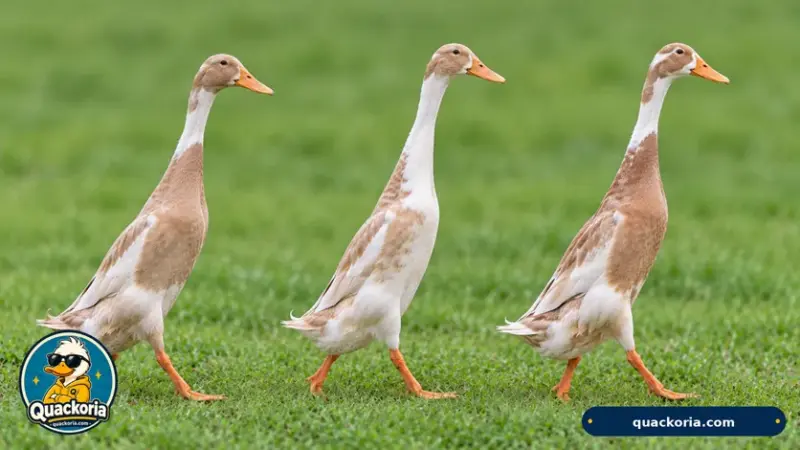
The Indian Runner is the duck that stands up. Tall, thin and bottle-shaped, it walks instead of waddling, forages harder than any other breed, lays a great many eggs, and has been herded across rice paddies for hundreds of years.
The Livestock Conservancy says high egg production and a unique appearance made Runners widely popular once they reached Britain. The upright stance makes a flock of them look like a row of wine bottles on the move, and their ancestors were herded for centuries to forage in rice paddies; the Conservancy calls the Runner the most active forager of all breeds.
Indian Runner at a glance
| Trait | Figure | Source |
|---|---|---|
| Origin | East Indies (BWA); herded in India and Indonesia (TLC). To Britain about 1835 (BWA) or around 1850 (TLC); in the US, popular by the late 1800s (TLC breed page) or little known before 1900 (OSU) | BWA, The Livestock Conservancy, Oklahoma State University |
| Adult weight | 3.25–4 lb (1.5–1.8 kg) Metzer; males 3.5–5 lb, females 3–4 lb TLC | Metzer, TLC |
| Posture | Typically 45–75 degrees above horizontal; some stand fully upright when agitated | The Livestock Conservancy |
| Eggs a year | 100–180 (Metzer); good strains “over 250” (TLC) | Metzer, TLC |
| Egg weight | 65–80 g | Metzer |
| Egg colour | White or blue-green (TLC); 35–75% bluish, by colour variety (Metzer) | TLC, Metzer |
| Temperament | 3.5–7.5 on Metzer’s scale, by colour variety | Metzer |
| Mothering | Poor to fair | Metzer |
| Foraging | Excellent — “the most active forager of all breeds” | Metzer, TLC |
| Flight | None | Metzer |
| Incubation | About 29 days — Metzer’s two pages say 28.5 and 29 | Metzer |
| Rarity | Recovering | The Livestock Conservancy |
Metzer lists Runners by colour variety — Black and Fawn & White among them — with temperament from 3.5 for the Black to 7.5 for the Fawn & White and bluish eggs from 35% to 75%, so the figures above span the varieties. The full chart is on the breed comparison tool.
Where the Indian Runner came from
The Livestock Conservancy cites ancient Javan temple carvings as evidence that Runner-type ducks existed in Indochina 2,000 years ago, and describes how for centuries people in India and Indonesia herded flocks of them to forage in rice paddies, the ducks “trained to stay in sight of a herder’s long bamboo pole with cloth strips attached to one end”. That life selected for birds that were, in the Conservancy’s words, good walkers, excellent foragers and prolific layers.
The Conservancy says a ship’s captain brought the breed to the United Kingdom from Malaysia around 1850, where it became widely popular; the British Waterfowl Association dates its first import into Britain to about 1835. In the US, the Conservancy’s breed page says, it was a popular breed with homesteaders in the late 1800s, and when first imported there it was often known as “Penguin Ducks”; Oklahoma State University’s breed register says it was little known in the United States before 1900, and the Conservancy’s own priority list groups the Runner with breeds imported after 1900. It almost disappeared as a breed in Europe by the early 1900s through crossing with other domestic ducks — the BWA says the Runner contributed to the ancestry of nearly all the light duck breeds, and the Conservancy’s account of the Khaki Campbell begins with Fawn and White Runners crossed with a Rouen — and the BWA credits the purists who championed the breed with its survival. The Conservancy now lists it as Recovering, and eight colour varieties are recognised in the American Standard of Perfection.
What an Indian Runner looks like
The body is long and narrow and typically carried at 45 to 75 degrees above the horizontal — some Runners stand fully upright when agitated, the Conservancy says, and it repeats the description of a “wine bottle (or bowling pin) with a head and legs”. The neck is long, the head is slender with the eyes set high, and the bird moves at a walk or a run rather than the side-to-side waddle of a heavier duck: eXtension says Runners “run rather than waddle”. The colours recognised in the American Standard are Fawn & White, White, Penciled, Black, Buff, Chocolate, Cumberland Blue and Gray, and whatever the colour, the Conservancy says, they have pink skin; the British Waterfowl Association counts fourteen standard colours in the UK, among them Fawn, Mallard and Trout. Drakes grow the curled tail feather (Metzer Farms); male vs female ducks has the rest.
A Runner cannot fly: Metzer rates its flight as none, and eXtension says Runner ducks cannot fly. The British Waterfowl Association puts it more cautiously — not much given to flying.
Eggs
Runners are kept for eggs — the University of Kentucky says the Runner is often referred to as the Leghorn of the duck family — but the figures vary by source. Metzer’s chart gives 100–180 a year across the colour varieties, the lower figure without artificial light and the upper with 17 hours of light through lay; the Conservancy says good strains lay over 250 white, hen-sized eggs. The eggs are on the small side for a duck at 65–80 g, and Metzer gives 35% to 75% of them as bluish, depending on the variety. Mothering is another matter: Metzer rates it poor to fair, and the Conservancy says Runners rarely go broody. Use an incubator, or a broody of another breed, and the hatch date calculator for the Runner’s slightly longer term — Metzer’s own pages give 28.5 days on one and 29 on the other, while the Cornell Duck Research Laboratory gives a single figure, 28 days, for common ducks such as Pekins.
Temperament and noise
Docile and active, and able to be high-strung, is the Conservancy’s summary, and Metzer’s scores spread widely by colour: 3.5 for Black Runners and 7.5 for Fawn & White, on a scale where 1.0 is very calm and 9.0 more nervous. The University of Kentucky says Runners and Campbells “tend to be nervous and flighty”. A Runner does not stand still to be admired; it is off across the garden after something, and trained Runners are often used at herding competitions, the Conservancy notes — eXtension says herders tend to choose more highly strung breeds such as Runners or Campbells, because the dogs can move them with less force. The Conservancy says they need work from the time they are ducklings if you want them to be comfortable with people, and that they can easily panic at any real or perceived danger.
The Conservancy says the ducks are generally louder than drakes and make a distinctive quack sound, and that Runners will be vocal if they are not given a large space. The University of Kentucky says only the females quack; the drakes are limited to a hoarse whisper.
Keeping Indian Runners
The sources differ on room. The Livestock Conservancy says that although Runners can be kept in a run, they prefer a large space; the University of Kentucky says they are good foragers but also do well in confinement when a good layer ration is provided. Given ground, they work it: Kentucky says they will eat worms and slugs, and the British Waterfowl Association says they are used on organic farms and vineyards for pest control and that, content in a large flock and not much given to flying, they are easy to manage. The space calculator gives the RSPCA welfare minimum alongside the recommended figures; give a Runner well over it.
Feed is covered in what to feed ducks, including niacin, which matters while ducklings grow — Metzer Farms says that once they are grown, a niacin deficiency is very rare. The University of Kentucky says Runners eat less feed than meat ducks because of their small size, and eXtension says a laying duck’s intake varies with the level of production and how much there is to forage, which the feed calculator notes. Kentucky also advises confining Runners kept for eggs overnight, to make egg collection easier. The duck house guide and duck predators cover the rest.
Is the Indian Runner right for you?
Yes, if you have space, want eggs and slug control, and enjoy a duck with character rather than a duck that sits still. It is hardy — the Conservancy says it does well in both cold and hot climates — and, by the University of Kentucky’s account, eats less feed than meat ducks because of its small size. Choose something else if you have a small run, want a calm bird that comes to be stroked, or want a duck that hatches its own young — for calm, Metzer’s lowest temperament scores include the Muscovy, Silver Appleyard and Welsh Harlequin; for mothering, Metzer rates the Muscovy excellent. The beginner’s guide to duck breeds compares them, and the breed quiz is a lighter way to the same answer.
Frequently asked questions
Why do Indian Runner ducks stand upright?
The sources used here describe the posture but do not explain it. The Livestock Conservancy says centuries of herding selected ducks that were good walkers, excellent foragers and prolific layers, and gives typical carriages of 45–75 degrees above horizontal — some stand fully upright when agitated — repeating the description of a wine bottle with a head and legs.
How many eggs do Indian Runners lay?
Metzer's chart gives 100–180 a year across the colour varieties; the Conservancy says good strains lay over 250. Eggs are 65–80 g, white or blue-green.
Can Indian Runner ducks fly?
No. Metzer rates their flight as none.
Are Runner ducks good pets?
They can be. The Livestock Conservancy says trained Runners are friendly, but the breed is active and can be high-strung, so the birds need work from the time they are ducklings if you want them comfortable with people, and they prefer a large space. The British Waterfowl Association says many enthusiasts keep Runners as pets and slug-eaters.
How long do Runner eggs take to hatch?
About 29 days — Metzer's two pages give 28.5 and 29, while the Cornell Duck Research Laboratory gives one figure, 28 days, for common ducks such as Pekins. The hatch date calculator uses Metzer's window.
Sources
- Metzer Farms — Compare Duck Breeds
- Metzer Farms — Using Lights to Increase Duck Egg Production
- Metzer Farms — Sexing Ducks and Geese
- Cornell University Duck Research Laboratory — Hatching Duck Eggs
- RSPCA welfare standards for domestic and common ducks
- The Livestock Conservancy — Runner Duck
- Metzer Farms — Hatching Instructions
- Metzer Farms — FAQ
- The Livestock Conservancy — Khaki Campbell Duck
- British Waterfowl Association — Runner Duck
- Oklahoma State University — Breeds of Livestock: Runner Ducks
- University of Kentucky Cooperative Extension — Selecting Ducks (ASC-198, Jacob and Pescatore)
- eXtension — Selecting a Duck Breed for Small or Backyard Poultry Flocks (Jacquie Jacob)
- eXtension — Feeding Ducks for Egg Production in Small Flocks (Jacquie Jacob)
- Metzer Farms — Niacin: What Is It and Why Do My Ducklings and Goslings Need It?
- The Livestock Conservancy — Conservation Priority List