Quackoria Learn
Pekin Duck: The White Duck Everyone Knows, and Why
The Pekin: big, white, calm by Metzer Farms' account and the main US meat duck. A reasonable layer for a heavy breed, but a poor mother, and it cannot fly.
Key takeaways
- Arrived in Britain in 1872 and the United States in 1873 from China (Oklahoma State, Metzer), and now supplies around 90 percent of US duck meat (eXtension).
- 8–12 lb, 150–200 eggs a year of 90–100 g — the largest eggs on its chart — by Metzer's figures; a meat bird reaches weight at six to seven weeks.
- Calm by Metzer's account, but the females are loud, and it is a poor mother and unable to fly.
- Heavy for its frame: ducklings need at least 55 ppm of niacin in their feed from day one, or their hocks swell and their legs bow (Metzer).
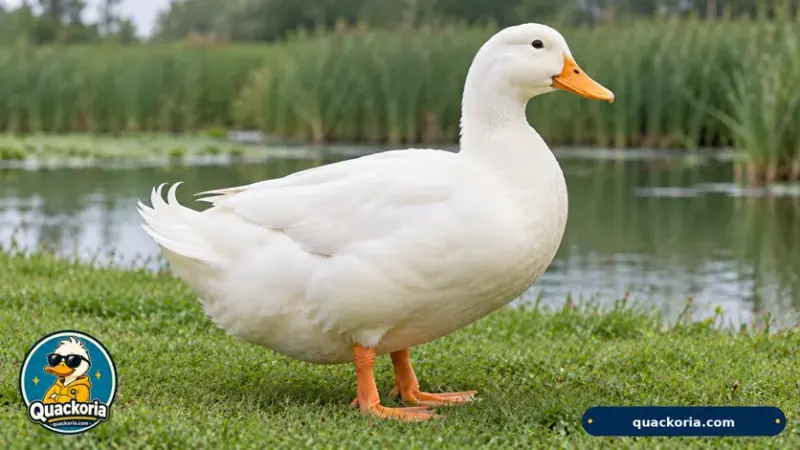
The Pekin is big, white, orange-billed and, by Metzer Farms’ account, calm, and a 2021 review in Poultry Science calls it the predominant breed of meat duck, followed by the Muscovy and the Mule. It lays well, grows fast and cannot fly.
If you have eaten duck in an American restaurant, it was very probably Pekin. The breed came out of China in the 1870s and, in Metzer Farms’ words, “has since taken over the US market as the go-to commercial meat duck”; eXtension puts its popularity down to “its fast growth rate and yellow skin”. What it does not do well is sit on its own eggs, and it cannot get off the ground; both are worth knowing before you buy.
Pekin duck at a glance
| Trait | Figure | Source |
|---|---|---|
| Origin | China; to Britain in 1872, to the United States in 1873 | Oklahoma State, Metzer |
| Adult weight | 8–12 lb (3.6–5.4 kg); a Jumbo strain 9–13.5 lb | Metzer |
| Eggs a year | 150–200 (Grimaud strain); Jumbo 140–175 | Metzer |
| Egg weight | 90–100 g — the largest on Metzer’s chart | Metzer |
| Egg colour | White; fewer than 2% bluish | eXtension, Metzer |
| Temperament | 5.5 on Metzer’s 1–9 scale (mid-scale); “Calm” on its Pekin page | Metzer |
| Mothering | Poor | Metzer |
| Foraging | Fair | Metzer |
| Flight | None | Metzer |
| Incubation | 28 days | Cornell |
| Rarity | Abundant on Metzer’s Pekin page; not on The Livestock Conservancy’s Conservation Priority List | Metzer, The Livestock Conservancy |
Metzer’s weights are breeder weights during lay and its egg figures give a range from no artificial light to 17 hours of light; the lower figure is for birds kept without artificial light. The comparison table with all twenty-one of Metzer’s breeds is on the breed comparison tool.
Where the Pekin came from
Ducks of the Pekin type have been kept in China for a very long time — Metzer Farms puts records back to the 1300s — and the breed as the West knows it arrived in a rush. Oklahoma State’s breed register has it imported to Great Britain in 1872 and to the United States about 1873, after which, in its words, it was “developed into different strains across Europe and the United States”. Within about twenty years it had displaced the Cayuga in New York: The Livestock Conservancy records that Cayugas were raised in large numbers on duck farms throughout the state until, in the 1890s, “duck production shifted to the white-feathered Pekin duck, leading to the decline of the Cayuga duck breed”, which the Conservancy still lists as Watch.
Today the Pekin is, in Oklahoma State’s phrase, “the most popular market duck in America”, and the commercial strains — Metzer sells a Grimaud hybrid — have been bred for growth so effectively that, by Metzer’s figures, a meat bird reaches processing weight at six to seven weeks on 2.4 pounds of feed per pound of gain. That history matters to a garden keeper because the Pekin is a bird built to put on weight: Metzer controls its own breeders’ weight for maximum egg production.
What a Pekin looks like
Creamy white feathers all over, an orange-yellow bill and orange legs and feet, and a body that Oklahoma State describes as “long, broad, deep and full breasted”. The British Waterfowl Association notes that “major differences now exist between the American and German forms”: the upright stance is the mark of the German Pekin, the exhibition strain in Britain, while American breeding concentrated on the table bird. Oklahoma State’s breed register says the bill “should be rich yellow in color, and black in the bill or bean is a serious defect” — the bean being the protrusion on the bill’s upper tip. Ducklings are yellow. Adult drakes and ducks look alike apart from size and the drake’s curled tail feather, so the voice test and the tail are how you tell them apart; male vs female ducks has the details and the ages each sign works from.
A well-fed Pekin is heavy for its frame, and the RSPCA’s welfare standards, written for meat breeds like it, require management plans that “aim to prevent ducks from suffering chronic joint disease or leg deformation”. Ducklings need enough niacin in their ration from the first day: at least 55 parts per million, Metzer Farms says, and without it their hocks swell and their legs bow. The niacin calculator works out what to add, and Common duck health problems covers the signs.
Eggs
The British Waterfowl Association calls Pekins “reasonable layers for a heavy breed”. Metzer’s chart gives its Grimaud strain 150–200 eggs a year and the Jumbo 140–175, about level with the Rouen (140–180) and the Cayuga (130–180) on the same chart and below the Khaki Campbell (165–240), and the eggs are the largest on the chart at 90–100 g — about 60–75% heavier than a USDA large hen’s egg of about 57 g in the shell. By weight, two Pekin eggs are roughly three large chicken eggs (about 170 g in the shell), and the egg converter does it by weight. Shells are white.
What the Pekin will not reliably do is hatch them: Metzer rates its mothering as poor. If you want Pekin ducklings from your own flock, an incubator or a broody of another breed does the sitting — incubating duck eggs and the day-by-day timeline take you through the 28 days.
Temperament and noise
Metzer scores the Pekin 5.5 on its temperament scale, where 1 is very calm and 9 more nervous — mid-scale, though Metzer’s own Pekin page describes its temperament as calm. It is not quiet. As in the other mallard-derived breeds, the females have what Metzer Farms calls “the typical, loud QUACK”, and the drakes, after about eight weeks, a deep, raspy voice. If neighbours are close, look at the Cayuga, which The Livestock Conservancy calls “a quiet breed that is good for urban or suburban settings”, or the Muscovy, which Cornell’s Lab of Ornithology calls “usually silent”; why ducks quack explains what the noise is for.
Keeping Pekins
Nothing about a Pekin’s care is different in kind from any other duck, but three things are different in degree. It is heavy, so it wants ramps rather than steps, deep clean bedding, and a house it can walk into. It is a weaker forager than a Runner or a Campbell — Metzer rates it fair, against excellent and very good — so it relies more on the feed you give it. And it cannot fly, which makes fencing easy but means it cannot fly away from a fox, so the door you shut at dusk matters all the more. Duck predators and the duck house guide cover the rest.
The RSPCA’s space figures do not vary by breed name — indoors a stocking density of no more than 17 kg per square metre, which allows fewer heavy birds such as Pekins than light ones on the same floor, and outdoors a minimum of 2.5 m² of range per bird on good pasture — and the space calculator works out the figures for a flock of any size. Feed is a waterfowl or all-flock ration with enough niacin; what to feed ducks has the figures and the feed calculator the quantities, from Metzer Farms’ breed-by-breed figures.
Is the Pekin right for you?
Yes, if you want a big, productive duck that Metzer calls calm, that is easy to find and easy to fence, and you are not relying on it to raise its own young or forage its own living. For meat it is one of the two usual choices: eXtension says “Pekin and Muscovy ducks are typically the breeds of choice for meat production”. Choose something else if you want a quiet bird, a good mother, a strong forager, or a duck that can escape a predator on its own. For the alternatives, the beginner’s guide to duck breeds compares the common ones and the breed quiz matches a breed to what you want from it.
Frequently asked questions
Are Pekin ducks good egg layers?
Reasonable for a heavy breed: Metzer's chart gives its Grimaud strain 150–200 a year and the Jumbo 140–175, with the largest eggs on the chart at 90–100 g, and the British Waterfowl Association also gives 150–200.
Do Pekin ducks sit on their eggs?
Not reliably. Metzer rates their mothering poor; use an incubator or a broody of another breed.
Can Pekin ducks fly?
No. Metzer rates their flight as none, and eXtension says Pekins cannot fly. Fencing is easy, but a Pekin cannot fly away from a predator, so shut it in a secure house at dusk.
Are Pekin ducks noisy?
The females are. Metzer Farms says females have the typical, loud quack and males, after about eight weeks, a deep, raspy voice. The Livestock Conservancy calls the Cayuga a quiet breed, and Cornell's Lab of Ornithology says Muscovies are usually silent.
How big do Pekin ducks get?
Metzer gives 8–12 lb (3.6–5.4 kg) for its Grimaud strain and 9–13.5 lb for the Jumbo; Oklahoma State's breed register and the British Waterfowl Association put the duck at about 8 lb and the drake at 9.
Sources
- Metzer Farms — Compare Duck Breeds
- Metzer Farms — Using Lights to Increase Duck Egg Production
- Metzer Farms — Sexing Ducks and Geese
- Cornell University Duck Research Laboratory — Hatching Duck Eggs
- RSPCA welfare standards for domestic and common ducks
- Oklahoma State University breed register — Pekin Ducks
- Metzer Farms — Pekin Ducks breed guide
- The Livestock Conservancy — Cayuga Duck
- Metzer Farms — How Much Will My Ducks Eat?
- British Waterfowl Association — Pekin
- eXtension (Jacquie Jacob, University of Kentucky) — Selecting a Duck Breed for Small or Backyard Poultry Flocks
- eXtension — Raising Meat Ducks in Small and Backyard Flocks
- Chen et al. (2021), Centennial Review: History and husbandry recommendations for raising Pekin ducks in research or commercial production, Poultry Science 100(8):101241
- The Livestock Conservancy — Conservation Priority List
- Cornell Lab of Ornithology — Muscovy Duck Sounds
- Metzer Farms — Why Niacin Deficiency Leads to Leg Problems in Ducklings
- USDA Food Safety and Inspection Service — Shell Eggs from Farm to Table
- Poultry Extension — External Anatomy of Ducks