Quackoria Care
Protecting Ducks from Predators: What Did It, and What Stops It
Most people search for this after losing a bird, so it starts with what the remains can tell you. Then the defences, starting with a door shut every night.
Key takeaways
- Most ducks sleep on the ground, and Metzer's breed chart rates most domestic breeds "None" for flying.
- eXtension's guidance, hedged as "probably" and "may be": bird gone = dog, coyote, fox, bobcat, hawk or owl; heads missing = raccoon, hawk or owl; bloodied but uneaten = weasel; bites at the hocks = rat.
- Least weasels can squeeze through a quarter-inch hole (eXtension), so they typically get through chicken wire; raccoons pull birds' heads through the wires of an enclosure.
- Bury hardware cloth at least 12 inches (eXtension), or lay a flat skirt outward from the fence (Alberta: a 12 to 18 inch strip).
- Cover the run: Merck says the top should be covered against predators that fly or climb and against wild birds that can transmit disease, avian influenza among them.
- Shut the door at dusk, every night: eXtension's advice is to have the flock roost in a secured location with every door closed and locked.
What you need
- Half-inch welded hardware cloth
- Screws and washers, or plenty of staples
- Wire for a buried apron or skirt
- Netting or mesh for the run roof
- An automatic door, if you will ever forget
Why ducks are the easy target
Two things about most ducks make them easy to reach.
Most ducks do not roost. A hen goes up to a perch at dusk and sleeps off the ground. Most domesticated ducks, the Open Sanctuary Project says, sleep on the ground (Muscovies, which Cornell’s Lab of Ornithology says roost high in trees at night in the wild, are the exception) — in a huddle, at exactly the height of everything that hunts at night.
Most domestic ducks cannot fly. Metzer Farms’ breed table lists Pekins, Runners, Cayugas, Swedish, Buffs, Welsh Harlequins and most others as “None” for flying. The exceptions are Mallards, Calls and Australian Spotted (“Very Good”) and Muscovies (“Excellent”), with Khaki Campbells and Rouens rated “Maybe”.
What did it? Reading the evidence
The eXtension predator-management guidance says what each kind of evidence may point to. Its own words are “probably”, “may be” and “often”, and several signs fit more than one animal. What is left, and what it may mean:
| What you find | Likely predator |
|---|---|
| Adult bird simply gone, no trace | Dog, coyote, fox, bobcat, hawk or owl |
| Chicks or ducklings gone (eXtension’s list is for chicks) | Snake, rat, raccoon, house cat |
| Birds dead but not eaten, bodies bloodied | Weasel |
| Heads missing, body left | Raccoon, hawk or owl |
| Bites all over the body | Dog |
| Wounds to the breast or legs of young birds | Opossum |
| Bites at the hocks of young birds | Rat |
| Intestines pulled out through the vent | Weasel family, or cannibalism within the flock — and eXtension adds that an opossum usually begins feeding at the vent |
| Eggs gone or broken | Skunk, snake, rat, opossum, raccoon, jay, crow |
Two details that separate the egg-thieves, from the same source: a raccoon may carry eggs off, usually within about 28 feet (9 m) of the nest, and eats them there; a skunk rarely moves one more than about 3 feet (1 m).
A few more, from other sources:
- Birds gone, lots of feathers left behind — coyote, fox or hawk, in Virginia Tech’s table. eXtension adds that a fox carries the dead bird away, often to a den, leaving only a few drops of blood and feathers.
- Birds mauled and left lying — dog. Maryland’s extension service says dogs often chase and maul birds and leave them lying around the yard.
- Ducklings vanishing on open water — Ducks Unlimited lists fish (largemouth bass and northern pike), bullfrogs, snakes and snapping turtles among the predators of ducklings, as well as birds such as gulls and herons.
- Bird dead in the house, no marks, others fine — probably not a predator at all: Virginia Tech’s table gives dead intact birds as “No predation, but possible disease or due to piling”. An unexplained death is a matter for a vet.
Which predator does what
Defences work only against the way a particular animal gets in, so it helps to know the methods.
Diggers: Kentucky’s extension service names foxes, coyotes and rats, and Maryland’s says a coyote often tunnels under the pen. They go under the fence, not through it.
Climbers: eXtension notes that gray foxes are the only foxes that readily climb trees, and Merck’s advice on covering the run is aimed at predators that fly or climb. A fence with no roof is a fence with a door in it.
Squeezers: the least weasel gets through a hole ¼ inch (6 mm) across, per eXtension. eXtension also notes that snakes small enough to enter through gaps of ¼ inch or less typically cause no predation damage; the size of the hole a snake needs depends on its size, and it is rat snakes that eat eggs and young chicks.
Reachers: eXtension says raccoons sometimes pull a bird’s head through the wires of an enclosure and eat only the head, leaving most of the body behind. This is why chicken wire is not a predator barrier.
Fliers: hawks by day, owls by night. Nothing on the ground stops them.
Dogs — eXtension says domestic dogs allowed to run free in a neighbourhood can be a problem for poultry flocks, and that they often kill simply for the fun of it.
The defences — and what each one stops
1. The door, shut, every night
eXtension’s advice is to have the flock roost inside a secured location at night, making sure to close and lock all doors. A shut door on a solid house stops whatever hunts after dark.
The cheapest defence there is costs nothing: shut the ducks in at dusk, every day, without exception. Not “when I remember”. Not “except in summer”. A predator only needs the one night you forgot.
If you will forget — and everyone does eventually — an automatic door on a light sensor or timer shuts it for you.
2. The house itself
A shut door is only as good as the box it is on. The duck house guide has the full specification; the predator points are:
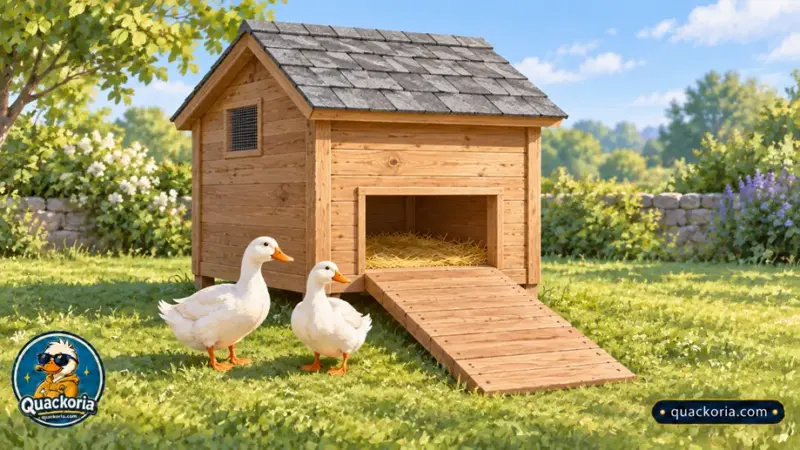
- Solid walls and floor, or a floor of hardware cloth on a frame. The Open Sanctuary Project warns that a dirt floor, though easiest on feet, will not protect against predators, especially those that dig.
- Every opening covered in hardware cloth — vents, windows, gaps under the eaves. The Open Sanctuary Project says a regular window screen is not enough to keep predators out.
- A latch a raccoon cannot open. Maryland’s extension service says raccoons can open simple latches and advises locking the doors; the Open Sanctuary Project suggests extra measures such as bungee cords.
- Nothing to dig under. A house on a solid base, or with hardware cloth under the floor, or with a wire skirt around it.
3. Wire that is actually a barrier
Chicken wire keeps chickens in. It does not keep anything out. eXtension says least weasels typically get through it, and raccoons pull birds’ heads through the wires of an enclosure.
Welded hardware cloth, ½-inch (12 mm) mesh, is the standard; the Open Sanctuary Project suggests ¼ to ½ inch galvanized hardware cloth on every opening the size of a quarter or larger. No common mesh is a complete answer to a least weasel, which eXtension says can squeeze through holes as small as ¼ inch: where weasels are a known problem, the house has to be shut tight with the smallest mesh, and half-inch is the usual compromise for the run.
Fix it with screws and washers, or staples driven every few centimetres — not the occasional staple that a determined animal can work loose.
4. Wire in the ground
Diggers start at the base of the fence. eXtension’s figure: bury hardware cloth at least 12 inches (30 cm) into the ground. Kentucky’s extension service gives the same depth.
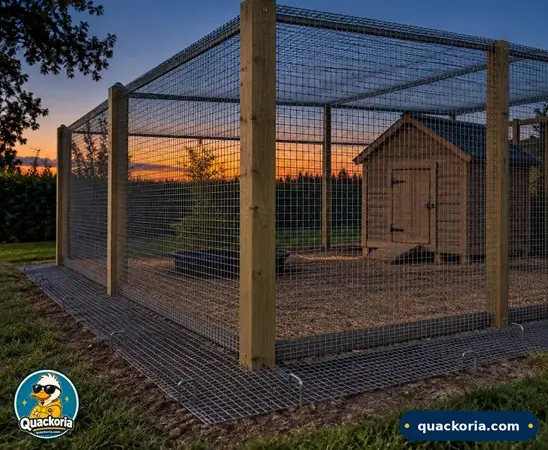
An alternative that works on the same principle is a skirt: hardware cloth laid flat on the ground outward from the base of the fence. Alberta’s agriculture department describes a 12 to 18 inch (30–45 cm) wide strip of wire mesh laid on the ground surface around the entire pen, attached to the fence and pegged down. It does not need a trench. Maryland’s extension service gives a buried version: fencing at least a foot into the ground, then turned outward at a right angle for at least another 8–10 inches.
Either way, the vertical wall is not the defence against a digger. The ground is.
5. A roof on the run
Merck’s guidance is that the top of the enclosure should be covered — against predators that fly or climb, and to prevent exposure to wild birds that can transmit disease. Avian influenza is one of those: Merck’s page on bird flu for owners says a key way to prevent infection is to keep domestic birds away from wild birds that could carry the virus, and Merck adds that water and vegetation around the housing should be avoided because they attract wild waterfowl, insects and rodents.
For a small run, hardware cloth or welded mesh over the top. For a large one, Maryland’s extension service says stringing a thin wire or even fishing line over the pen or run makes it hard for predators to fly in; that does nothing against climbers. eXtension’s advice where a persistent hawk or owl is about is a covered run. If the run is too large to roof, the house is the night defence and the day-time risk is accepted.
6. Removing the perches
Hawks and owls hunt from a perch. eXtension’s advice is to eliminate perch sites near the flock by removing isolated trees and other perching surfaces; Kentucky’s extension service suggests removing perches within 100 yards of the flock.
7. Cover for the ducks
The opposite of removing the predator’s perch: give the ducks somewhere to go. A few dense shrubs in the run, a low table, an upturned crate — something a duck can get under in a hurry.
8. Electric fencing
Where coyotes are digging under the fence, Alberta’s agriculture department suggests adding one electrified high-tensile wire 6 inches (15 cm) above ground level, outside the fence. Maryland’s extension service says electric netting made for poultry “may work well for containing the flock”, provided an adequate charge is kept along the whole fence line, and eXtension that the charge should be enough to stun but not kill an animal. It is not a barrier — an animal that ignores it gets through.
9. Dogs and geese
A livestock guardian dog is the traditional answer. eXtension says that, if well trained, these dogs are extremely effective at deterring predators, day and night, but that the approach requires the dogs to stay with the flock at all times. Geese are an alarm, not a guard: Metzer Farms says they can serve as a personal alarm system when predators enter a property, but warns, “Do not expect geese to fight off a predator to protect smaller birds.”
What does not work as a guard: a family dog that lives indoors and is out with you occasionally, since it is not with the flock at all times. eXtension adds that whether a dog attacks a flock depends on its breed, the presence of other dogs and its past experience.
Ducklings and eggs
The threats are smaller and get in through smaller holes. Rats and snakes are both on eXtension’s lists for missing chicks and missing eggs, and it says rat snakes eat eggs and young chicks less than a month old. A brooder for ducklings needs quarter-inch mesh, a lid, and to be indoors or in a shut building. Eggs left in the nest overnight are an invitation — collecting them daily, covered in collecting, cleaning and storing duck eggs, is also predator control.
When the risk changes
It is not constant. Maryland’s extension service says foxes are often more of a problem in spring, when they are raising young and other food sources are in short supply; and the door-at-dusk rule is hardest to keep in midsummer, when dusk comes late. The seasonal pattern, with the rest of the year’s jobs, is in a duck keeper’s year.
After a loss
Before the next night:
- Work out what it was from the table above. The defence depends on it.
- Find the way in. There is one. Walk the fence line at ground level looking for a dig, a gap, a torn corner. Check the house latch, the vents, the floor. If there is no way in, the birds were outside — which means the door.
- Fix that, tonight. eXtension notes that a dog that has once got food by attacking a flock is more likely to do it again.
- Shut the survivors in early, before dusk, for a week.
- Check the survivors — a bird that was grabbed and got away may have puncture wounds under the feathers that go bad. Turn each one over (see how to hold a duck), and take any wounded bird to a vet.
The short version
- Most ducks sleep on the ground, and most domestic breeds cannot fly away.
- Shut the door at dusk, every night, with the flock locked in a secured house (eXtension). If you will forget, buy an automatic door.
- Hardware cloth, ½-inch, on everything; a least weasel still gets through ¼ inch. Chicken wire is not a barrier.
- Wire in the ground — 12 inches down (eXtension) or a flat skirt — for the diggers.
- A covered run, for hawks and for avian influenza.
- Identify from the evidence, then find the way in, then fix it before the next night.
This is husbandry guidance, not veterinary advice. If a bird is ill or injured, find an avian vet.
Frequently asked questions
What killed my duck?
Read what is left, as a clue rather than proof. eXtension's guidance: an adult bird gone without trace is probably a dog, coyote, fox, bobcat, hawk or owl; chicks or ducklings gone may be a snake, rat, raccoon or house cat (eXtension's list is for chicks); birds dead but not eaten and bloodied may be a weasel; heads missing may be a raccoon, hawk or owl; bites all over may be a dog; bites at the hocks of young birds often mean a rat.
Does chicken wire keep predators out?
No. It keeps chickens in. eXtension says least weasels typically get through it and raccoons sometimes pull a bird's head through the wires of an enclosure. Half-inch welded hardware cloth is the usual barrier, though a least weasel can squeeze through holes as small as a quarter-inch.
How deep should you bury wire to stop foxes?
eXtension's figure for stopping diggers is to bury hardware cloth at least 12 inches (30 cm); Kentucky's extension service gives the same depth and names foxes, coyotes and rats as diggers. A flat skirt of wire pegged out from the base of the fence works on the same principle without a trench: Alberta's agriculture department describes a strip 12 to 18 inches wide.
Do ducks need a covered run?
Merck's guidance is that the top of the enclosure should be covered, against predators that fly or climb and to prevent exposure to wild birds that can transmit disease. Avian influenza is one: Merck says a key way to prevent it is to keep domestic birds away from wild birds that could carry the virus.
What is the best way to protect ducks at night?
A solid house with a door that is shut at dusk, every night, without exception. eXtension's advice is to have the flock roost inside a secured location at night, making sure to close and lock all doors. If you will ever forget, an automatic door on a timer or light sensor shuts it for you.
Sources
- eXtension, Predator Management for Small and Backyard Poultry Flocks
- Merck Veterinary Manual, Management of Backyard Poultry
- Metzer Farms, duck breed comparison
- Merck Veterinary Manual, for bird owners — Avian Influenza (Bird Flu)
- University of Kentucky Extension ID-245 — Predator Management for Small-scale Poultry Enterprises in Kentucky
- University of Maryland Extension FS-1132 — Identifying and Preventing Poultry Predators in the Mid-Atlantic Region
- Virginia Tech Extension APSC-192P — Predators for Free-Ranging Poultry
- Alberta Agriculture — Prevention of Predator Damage in Poultry Flocks (Agdex 450/684-1)
- The Open Sanctuary Project — Creating a Good Home for Ducks
- Metzer Farms — Guard Geese: Traits, Breeds and Behavior
- Ducks Unlimited — Duckling Survival
- Cornell Lab of Ornithology — Muscovy Duck life history