
Quackoria Learn
Where Do Ducks Live? Duck Habitats Around the World
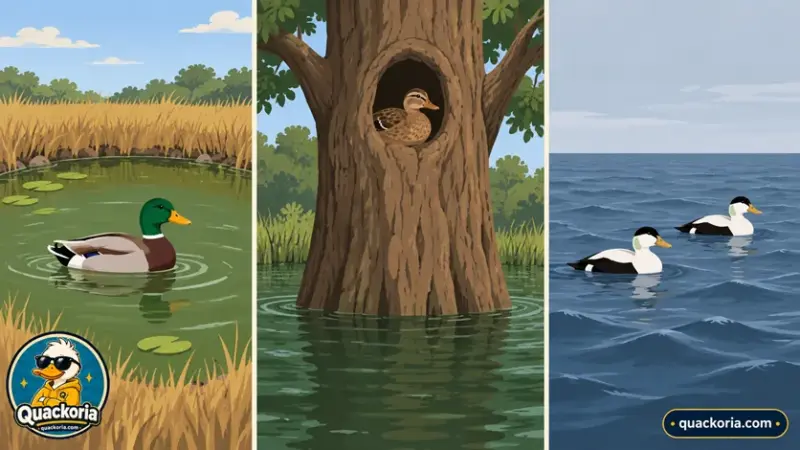
Ducks live wherever there is water, but the waters are wildly different: a mallard on a park pond, a wood duck in a tree hole over a swamp, an eider drinking seawater on the winter Atlantic. Here is the range, and the habitat that is disappearing under it.
Key takeaways
- Mallards use almost every wetland type there is, which is part of why they became the ancestor of nearly every farm duck.
- Wood ducks need mature trees with cavities, and will nest up to 1.2 miles from water.
- The Prairie Pothole Region is the single most productive duck ground in North America, but the USFWS and Ducks Unlimited give different figures for how much of the continent's duck production comes from it.
- Sea ducks handle salt water using salt glands above the eyes that drain into the nasal cavity, secreting roughly 500 to 1,000 millimolar sodium chloride.
- A 16-year Berlin study found urban mallards nesting mostly on balconies, roof terraces and courtyards, with about 22.8 per cent reusing the same site.
- The Ramsar Convention's 2025 outlook reports about 411 million hectares of wetland lost since 1970; its 2018 edition put the loss higher. Name the edition when quoting either.
The short answer is that ducks live wherever there is water, which sounds like a non-answer until you look at how different those waters are. A mallard will nest in a city park. A wood duck nests in a tree hole in flooded forest. An eider spends its winter on open salt water, drinking seawater and excreting the salt through a gland above its eyes. Calling all of them “ducks” hides an enormous range of habitat specialism.
The generalist: why mallards are everywhere
The Cornell Lab of Ornithology’s account of the mallard reads almost like a list of every wet place there is. Mallards “can be found in almost any wetland habitats, including permanent wetlands such as marshes, bogs, riverine floodplains, beaver ponds, lakes, reservoirs, ponds, city parks, farms, and estuaries,” and they also feed along roadside ditches, pastures, croplands and rice fields.
That breadth is unusual and it is the reason the mallard is the duck most people picture. It is also, not coincidentally, the wild bird behind nearly every farm duck — a bird already adapted to almost any water was a good candidate for the farmyard, as the story of duck domestication shows.
The specialist: a duck that needs trees
The wood duck is the counter-example. Cornell describes them thriving “in bottomland forests, swamps, freshwater marshes, and beaver ponds,” and being common along streams of all sizes. What makes the habitat work is a specific structure: the best sites are where “open water alternates with 50–75% vegetative cover.”
And they nest in holes. The US Fish and Wildlife Service confirms that wood ducks “nest primarily in tree cavities,” and Cornell notes the nest tree is normally near or over water, “though Wood Ducks will use cavities up to 1.2 miles from water.” A duck that needs mature trees with cavities in them is a duck whose fortunes are tied to how forests are managed, not just to how wetlands are.
The American black duck splits the difference seasonally. Cornell records it breeding mostly in freshwater — beaver ponds, alder-lined brooks, reedy shallow lakes, boreal bogs and wooded swamps — and then spending winter mostly in saltwater wetlands. Same bird, two habitat strategies, six months apart.
The Prairie Pothole Region: the most productive duck ground in North America
If one landscape deserves singling out, it is the prairie pothole country. These are shallow depressional wetlands left behind by retreating glaciers roughly 10,000 years ago, scattered in their millions across the northern plains. The Prairie Pothole Joint Venture describes a region of about 300,000 square miles, with a third of it in Montana, North Dakota, South Dakota, Minnesota and Iowa and the remaining 200,000 square miles in Manitoba, Saskatchewan and Alberta.
How much of the continent’s duck production comes from there depends on who you ask, and the two most authoritative sources do not agree. The US Fish and Wildlife Service states that the prairie potholes “account for just 10 percent of North America’s waterfowl breeding habitat, but the region produces nearly half the continent’s ducks.” Ducks Unlimited puts it higher, saying that “in many years it supports more than half of North America’s breeding ducks.” Both organisations know this landscape intimately; the difference is real and we would rather show it than average it away.
The scale in a wet year is remarkable: the Joint Venture reports that in the late 2000s, when the entire US portion was wet, the region supported nearly 14 million ducks. The losses are equally stark. More than half the historic wetlands are gone, nearly 70% of the original grasslands now grow crops, and as of 2021 only 34% of the remaining US wetlands there were protected. A Fish and Wildlife Service assessment found wetlands in the region declined by an estimated 74,340 acres between 1997 and 2009 — an average net loss of 6,200 acres a year.
Flyways: the routes that connect the habitats
A duck’s habitat is not one place. It is a breeding wetland, a wintering wetland, and a chain of stopover sites in between, which is why duck migration and duck habitat are really the same subject viewed from different ends.
In North America, the US Fish and Wildlife Service maintains four administrative flyways — Atlantic, Mississippi, Central and Pacific — each with a council of state, provincial and territorial agency representatives advised by technical committees of biologists. The Mississippi Flyway Council organised in 1952; the Central Flyway formed in 1948.
Elsewhere the frameworks differ. The African-Eurasian Migratory Waterbird Agreement, an intergovernmental treaty administered by UNEP, covers a range stretching from northern Canada and Russia to the southern tip of Africa. Its own pages give slightly different tallies — one states 119 Range States and 254 species, another 118 countries and 255 species — and the agreement entered into force on 1 November 1999. Along the East Atlantic route, monitoring runs from the Baltic and North Seas down the Atlantic coast to South Africa, tracking 81 relevant populations of 67 species across thousands of count sites, run jointly by the Wadden Sea Flyway Initiative, Wetlands International and BirdLife International. In Asia and Oceania, the East Asian–Australasian Flyway Partnership covers 22 countries and more than 50 million migratory waterbirds of over 210 species.
Salt water, and the gland that makes it possible
Roughly a third of the duck species breeding in North America are sea ducks, and the Fish and Wildlife Service’s Sea Duck Joint Venture counts 15 North American species out of 21 worldwide: the eiders, scoters, goldeneyes, mergansers, the harlequin and long-tailed ducks, and the bufflehead. Most winter along northern Atlantic and Pacific coasts and breed inland across Arctic tundra and taiga. The Joint Venture also notes something worth sitting with — sea ducks make up more than a third of North America’s breeding duck species “yet they are the most poorly understood group of waterfowl.”
Living on salt water requires equipment that a park mallard does not need. Sea ducks have specialised salt glands. Sturkie’s Avian Physiology places them “in depressions usually in or above the orbits,” with their final ducts draining into the nasal cavity, and describes the mechanism as secondary active transport of chloride across the cell membrane with sodium following passively. The secretion is concentrated: across species, roughly 500 to 1,000 millimolar sodium chloride, with the higher values in species taking in the most salt.
Which is to say a sea duck drinks seawater and drips the salt out of its nose. It is one of the better answers to the question of why some ducks can live where others cannot, and it sits alongside the other pieces of duck engineering covered in why ducks do not get wet and why their feet do not freeze.
Cities count as habitat, and the data says so
Park ducks are easy to dismiss as a curiosity. The research does not support that. A 2025 study in the Journal of Urban Ecology analysed 16 years of data from a Berlin mallard relocation programme, covering 1,634 breeding events from around 795 individual birds. The nest sites are startling: balconies 32.7%, roof terraces 29.6%, courtyards 23.9%. About 22.8% of mallards reused the identical breeding site, and at least 28.7% of ringed females bred more than once, some as many as 13 times.
Ducks Unlimited reports banding work pointing the same way — urban mallards are recovered by hunters at rates comparable to the broader midcontinent population, with around a quarter moving 10 to 60 miles from where they were banded. With US Forest Service projections of a two-fold increase in urban landscapes over the next 20 years, the number of ducks raised in suburban ponds is not a footnote to waterfowl management.
The habitat that is disappearing
Wetland loss is the single largest pressure on duck habitat, and here too the headline figure has moved. The Convention on Wetlands’ Global Wetland Outlook 2025 states that since 1970 an estimated 411 million hectares of wetlands have been lost, “approximately 22% of the global total,” at an average annual loss of 0.52%. The 2018 edition of the same report was more pessimistic, putting the loss at roughly 35% between 1970 and 2015. Both are Ramsar figures from different editions using different accounting, and anyone quoting one should name which.
The 2025 report adds that around 25% of remaining wetlands are in poor ecological condition and that restoring at least 123 million hectares would be needed to meet current global targets. Whatever the exact percentage, the direction is not in dispute — and for ducks, wetland is not scenery. It is the whole address.
Frequently asked questions
Where do wild ducks live?
In almost any wetland: marshes, bogs, river floodplains, beaver ponds, lakes, reservoirs, estuaries and coastal waters, plus farmland, rice fields and city parks. Different species specialise in different parts of that range.
Do ducks live on salt water?
Some do. The Sea Duck Joint Venture counts 15 sea duck species in North America out of 21 worldwide, including eiders, scoters, mergansers and the long-tailed duck. They cope with salt water using a specialised salt gland.
What is the Prairie Pothole Region?
A landscape of shallow glacial depression wetlands covering roughly 300,000 square miles across Montana, the Dakotas, Minnesota, Iowa, Manitoba, Saskatchewan and Alberta. The US Fish and Wildlife Service says it produces nearly half the continent's ducks from just 10 per cent of its breeding habitat.
What are flyways?
Broad migration routes and the management frameworks built around them. North America has four administrative flyways defined by the US Fish and Wildlife Service: Atlantic, Mississippi, Central and Pacific. Other regions use their own frameworks, such as the African-Eurasian agreement and the East Asian-Australasian Flyway Partnership.
Can ducks really live in cities?
Yes, and it is documented rather than anecdotal. A 2025 study in the Journal of Urban Ecology analysed 1,634 breeding events from around 795 Berlin mallards over 16 years, with nests on balconies, roof terraces and courtyards.
How much duck habitat has been lost?
The Convention on Wetlands reported in 2025 that an estimated 411 million hectares of wetlands, about 22 per cent of the global total, have been lost since 1970, and that around 25 per cent of what remains is in poor ecological condition.
Sources
- Cornell Lab of Ornithology — Mallard life history
- Cornell Lab of Ornithology — Wood Duck life history
- Cornell Lab of Ornithology — American Black Duck life history
- US Fish and Wildlife Service — Wood duck
- US Fish and Wildlife Service — Waterfowl Production Areas
- US Fish and Wildlife Service — Status and trends of wetlands in the Prairie Pothole Region
- Prairie Pothole Joint Venture — The Prairie Pothole Region
- Ducks Unlimited — State of the Prairies
- US Fish and Wildlife Service — Administrative flyways
- UNEP/AEWA — African-Eurasian Migratory Waterbird Agreement
- Wadden Sea Quality Status Report — East Atlantic Flyway
- US Fish and Wildlife Service — Sea Duck Joint Venture
- Sturkie's Avian Physiology on the avian salt gland, via ScienceDirect Topics
- Engler et al., Breeding site fidelity in the concrete jungle, Journal of Urban Ecology 2025
- Convention on Wetlands — Global Wetland Outlook 2025
- US EPA — Classification and types of wetlands