Quackoria Learn
Can Ducks Eat Strawberries?
Key takeaways
- Ducks can eat strawberries. Metzer Farms, the Open Sanctuary Project and Purina all list them as safe treats.
- Per 100 g a strawberry is 91 per cent water and 4.9 per cent sugar — a third of the sugar in grapes.
- Wash them: strawberries sit third on the Environmental Working Group's 2026 pesticide-residue list.
- Halve or quarter large berries; ducks swallow whole. The green hull is harmless.
- All treats together stay under a tenth of the diet; two or three halved berries per duck is the right scale.
Yes. Strawberries are one of the safest fruits you can give a duck, every duck source agrees on it, and there is no toxic part to worry about — no pit, no seed to remove, no green bit that matters. The only things to get right are washing them and not letting a sweet treat crowd out real food.
The short answer
Metzer Farms, a California duck hatchery, opens its fruit list with them: “Strawberries, blueberries, grapes, bananas, apples, peaches, pears, and other such berries and fruits are amazing treats for your ducks.” The Open Sanctuary Project’s duck diet guide agrees — “Berries – raspberry, blackberry, black raspberry, strawberries, and blueberries are good choices” — and Purina’s nutritionist puts it the same way for chickens: “Watermelon, strawberries, and blueberries make healthy snacks for chickens when fed in moderation.” We found no duck, poultry or avian veterinary source that advises against strawberries. That is rarer than you would think for a fruit.
What is in a strawberry for a duck
Per 100 grams of raw strawberries, the US Department of Agriculture’s reference data give 91 g water, 32 kcal, 4.9 g sugars, 0.67 g protein and 2 g fibre, with 58.8 mg vitamin C, 153 mg potassium and 16 mg calcium. Three things stand out for a duck. The sugar is low for a fruit — a third of what grapes carry, less than half of an apple. The water is high, which makes strawberries a good hot-weather offering. And the vitamin C, the number strawberries are famous for, matters far less to a duck than to you: the Merck Veterinary Manual notes that vitamin C “can be synthesized by poultry at adequate amounts in normal conditions”, so a duck does not depend on fruit for it.
What is not in a strawberry is protein. A duck’s complete feed runs at 16 to 20 per cent; a strawberry is under 1. It is a treat in the strict sense — pleasant, harmless, and not nutrition.
How to feed strawberries to ducks
Wash them, then halve or quarter them for anything but a very large duck. Ducks swallow whole; a small strawberry goes down, a large one can lodge. The green hull is harmless and most ducks eat it, but it is fibrous and easily pulled off. Soft, overripe berries are fine as long as they are not mouldy — ducks are unusually sensitive to mould toxins, so anything furry is for the bin.
Washing matters more with strawberries than with most fruit. The Environmental Working Group’s 2026 guide to pesticide residues on produce puts strawberries third on its “Dirty Dozen”, behind spinach and the kale-collard-mustard group, and reports that 96 per cent of Dirty Dozen samples, and 75 per cent of all conventionally grown produce, carried residues. A rinse under the tap removes some of it; organic berries sidestep the question.
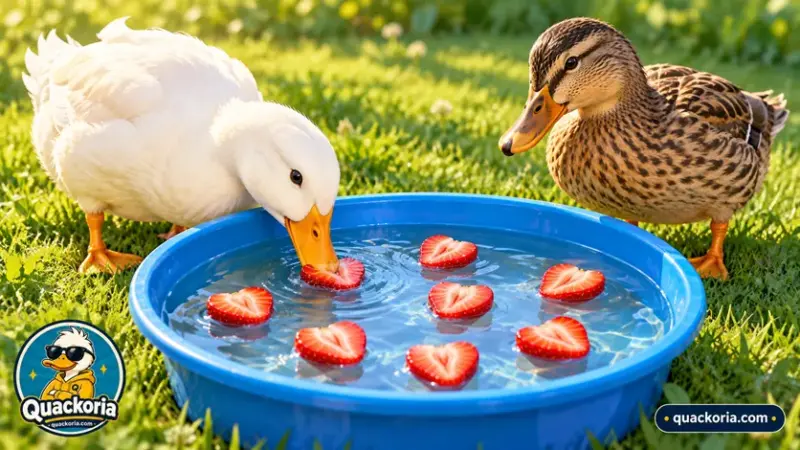
Quantity follows the rule that runs through every extension service’s poultry advice: treats of all kinds under a tenth of the diet. Colorado State University Extension: “Treats should make up no more than 10% of their daily diet.” Purina’s nutritionist makes it concrete — “treats should not exceed 2 tablespoons” per bird. Two or three halved strawberries per duck, a couple of times a week, is the sensible shape of it. Floated in a tub of clean water they double as entertainment, because a duck has to dabble to get them.
When strawberries are a problem
Almost never on their own. The risks are the general ones: a whole large berry in a small duck; unwashed fruit; mould; and a flock that learns to hold out for berries and picks at its pellets. Strawberry leaves and the plants themselves are not on any avoid list we could find, but a free-ranging flock in a strawberry bed will flatten it, which is a gardening problem rather than a health one. Jam, strawberry yoghurt and anything sweetened are not strawberries — the sugar, and in the case of yoghurt the dairy, rule them out.
Ducklings
Wait. A duckling’s job in its first weeks is to eat a starter feed with enough niacin to build straight legs, and treats get in the way of that. When you do introduce fruit, mash or mince it, and offer a taste, not a meal. The week-by-week feeding plan is in raising ducklings.
For the rest of the fruit bowl, grapes need halving and come with a warning that turns out to be about dogs, apples need coring, and bananas are the softest option of all. The complete list, with the ones to avoid, is in our can-ducks-eat checker, and the diet those treats sit on top of is in what do ducks eat.
Frequently asked questions
Can ducks eat strawberries?
Yes. They are on every duck treat list we checked and no avoid list. Wash them, halve them and offer a few at a time.
Can ducks eat strawberry tops and leaves?
The green hull is harmless and most ducks eat it. Strawberry plants are not on any avoid list we could find, though a flock in a strawberry bed will flatten it.
Are strawberries good for ducks?
As a treat, yes: low sugar, high water, nothing toxic. As nutrition, no — under 1 per cent protein against the 16 to 20 per cent in a complete feed.
Can ducklings eat strawberries?
Wait until they are on grower feed, then a mashed taste. Starter feed and its niacin come first.
How many strawberries can a duck have?
Two or three halved berries, a couple of times a week. Colorado State University Extension's rule is that treats stay under 10 per cent of the daily diet.
Sources
- Metzer Farms — Treats your ducks will love
- The Open Sanctuary Project — Daily diet, treats and supplements for ducks
- Purina Animal Nutrition — What to feed chickens: treats to feed and avoid
- USDA FoodData Central (SR Legacy) — Strawberries, raw, FDC ID 167762, as reproduced by www.healthscienceinsights.com
- Environmental Working Group — 2026 Shopper's Guide to Pesticides in Produce
- Environmental Working Group — Dirty Dozen, full 2026 ranking
- Merck Veterinary Manual — Nutritional requirements of poultry (vitamin C)
- Colorado State University Extension — Raising poultry the organic way: disease control and feeding
- NC State Extension — Feeding ducks (Ferket & Davis)
- Metzer Farms — Foods ducks should not eat
- The Open Sanctuary Project — Things that are toxic to ducks