Quackoria Learn
Can Ducks Eat Lettuce?
Yes — lettuce is one of the few treats that wildlife bodies actively recommend for pond ducks. The useful detail is which lettuce: romaine and dark leaves carry real nutrition; iceberg is mostly water, and the one duck-specific source that addresses it says not to make a habit of it.
Key takeaways
- Ducks can eat lettuce. The Canal & River Trust and the Scottish SPCA both recommend it for pond ducks, torn into pieces.
- Romaine carries seventeen times the vitamin A of iceberg per 100 g, with nearly twice the calcium and fibre.
- The Open Sanctuary Project: iceberg "holds no nutrients for the ducks and should not be given with regularity. It can cause scours (diarrhea)."
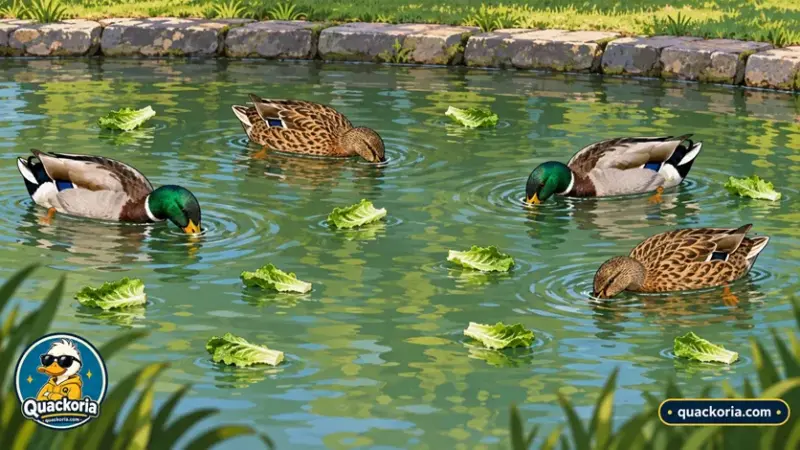
- Tear or chop every leaf; a whole leaf is a choking risk. Floated on water it stays clean and gives the ducks something to dabble for.
- Kale and spinach are the greens to limit — the Scottish SPCA notes kale binds calcium and spinach is high in oxalates.
Yes — and lettuce is one of the few treats that wildlife bodies actively recommend for pond ducks rather than merely tolerate. The useful detail is which lettuce: romaine and the dark leaves carry real nutrition; iceberg is mostly water, and the one duck-specific source that addresses it says not to make a habit of it.
The short answer
The Canal & River Trust puts lettuce second on its list of the six best things to feed ducks: “rip it into pieces and treat your local ducks. Rocket, kale, and iceberg are all great choices.” The Scottish SPCA leads its vegetable list with romaine — “When ripped into smaller pieces, these lettuce leaves are easy for the ducks to catch and digest” — followed by cabbage leaves, spring greens and watercress. Metzer Farms, a California duck hatchery, has lettuce, cabbage and swiss chard on its list of green vegetable treats. The Open Sanctuary Project’s duck diet guide agrees on lettuce and adds the caveat the others leave out: “romaine lettuce is the most nutritious. Iceberg lettuce holds no nutrients for the ducks and should not be given with regularity. It can cause scours (diarrhea).”
Romaine or iceberg: the numbers
The difference is not a matter of taste. Per 100 grams, the US Department of Agriculture’s reference data give romaine 94.6 g water, 17 kcal, 1.23 g protein, 2.1 g fibre, 33 mg calcium, 247 mg potassium and 436 µg of vitamin A as retinol activity equivalents. Iceberg is 95.6 g water, 14 kcal, 0.9 g protein, 1.2 g fibre, 18 mg calcium, 141 mg potassium and 25 µg of vitamin A. Same water, same calories, and seventeen times the vitamin A in the romaine, with nearly twice the calcium and fibre. Open Sanctuary explains why the dark leaf matters to a duck: “fresh greens provide Vitamin E, important for a duck’s immune system, along with Riboflavin, Vitamin A, and Calcium.”
Neither is food in the sense a duck needs it. Both are under 1.3 per cent protein against the 16 to 20 per cent in a complete feed. Lettuce is a green, hydrating extra that mimics the grazing a free-ranging duck does for itself.
How to feed lettuce to ducks
Tear it. Every one of the sources above says the same thing — rip, tear, chop — because a whole leaf is a long slippery thing a duck can get part-way down and no further. The Scottish SPCA’s rule for every vegetable is to chop or slice all of it “to make sure they don’t choke.” Small pieces floated on water are ideal: ducks dabble for them, the leaves stay clean, and the tub does the washing for you.
Wash it first. Leafy greens carry pesticide residue — the Environmental Working Group’s 2026 guide puts spinach and the kale group at the top of its list — and outer leaves carry soil. Quantity follows the poultry extension rule that treats of all kinds stay under a tenth of the diet; a few torn leaves per duck is the right scale, and a whole head at once is a bowl of water with a side of diarrhoea.
Other greens, and the ones to go easy on
Kale, cabbage, spring greens, watercress, rocket and chard are all on the lists above. Two greens come with a caveat. The Scottish SPCA lists kale and spinach among vegetables to feed “in moderation and in small amounts”, noting that kale “binds calcium” and spinach is “high in oxalates” — a concern for laying ducks, which need their calcium for shells. Spinach is also on Metzer’s avoid list for the same reason. A leaf will not hurt a duck; a regular spinach diet is a bad idea, and it has its own entry in our can-ducks-eat checker.
When lettuce is a problem
Iceberg in quantity, for the reason Open Sanctuary gives. Whole leaves, for the choking reason. Slimy or mouldy leaves — ducks are unusually sensitive to mould toxins, so the brown bag at the back of the fridge is compost, not treats. Dressed salad, for the oil, salt and onion. And lettuce is not a substitute for grazing: a duck on a bare run needs greens from somewhere, but a duck on grass is already eating better greens than you can buy.
At the pond
Torn lettuce is on both British wildlife bodies’ lists for a reason: it floats, it is harmless, and it is close to what a pond duck eats anyway. Bring a few leaves, tear them small, and scatter them where the ducks are dabbling. It costs nothing and does none of the harm set out in can ducks eat bread. Sweetcorn, rice, peas and oats round out the pond list. What a duck’s diet looks like across a year is in what do ducks eat.
Frequently asked questions
Can ducks eat lettuce?
Yes. The Canal & River Trust says to "rip it into pieces and treat your local ducks"; the Scottish SPCA leads its vegetable list with romaine. Tear it small.
Can ducks eat iceberg lettuce?
They can, and the Canal & River Trust lists it, but the Open Sanctuary Project says it holds no nutrients and can cause diarrhoea if fed regularly. Romaine is the better choice.
Is lettuce good for ducks?
Romaine and dark greens are: the Open Sanctuary Project notes fresh greens supply vitamin E, riboflavin, vitamin A and calcium. No lettuce supplies meaningful protein.
Can ducks eat kale, cabbage or spinach?
Kale and cabbage yes, in moderation; the Scottish SPCA notes kale binds calcium. Spinach is high in oxalates and on Metzer Farms' avoid list — a leaf is harmless, a regular spinach diet is not.
Can I feed lettuce to wild ducks at the pond?
Yes — it is on both British wildlife bodies' lists. Tear it small, scatter it where the ducks are dabbling, and bring a few leaves rather than a head.
Sources
- Canal & River Trust — What do ducks eat? 6 things you can feed ducks
- Scottish SPCA — What to feed ducks
- Metzer Farms — Treats your ducks will love
- The Open Sanctuary Project — Daily diet, treats and supplements for ducks
- USDA FoodData Central (SR Legacy) — Lettuce, cos or romaine, raw, FDC ID 169247, as reproduced by rawpawiq.com
- USDA FoodData Central (SR Legacy) — Lettuce, iceberg (includes crisphead types), raw, FDC ID 169248, as reproduced by foodstruct.com
- Metzer Farms — Foods ducks should not eat
- Environmental Working Group — 2026 Shopper's Guide to Pesticides in Produce
- Environmental Working Group — Dirty Dozen, full 2026 ranking
- Colorado State University Extension — Raising poultry the organic way: disease control and feeding
- NC State Extension — Feeding ducks (Ferket & Davis)
- The Open Sanctuary Project — Things that are toxic to ducks