Quackoria Learn
Can Ducks Eat Carrots?
Key takeaways
- Ducks can eat carrots and carrot tops. Metzer Farms lists carrots as a treat; the Scottish SPCA says the tops are "just as good".
- Per 100 g a raw carrot carries 835 µg of vitamin A as retinol activity equivalents — twice romaine lettuce and hundreds of times an apple.
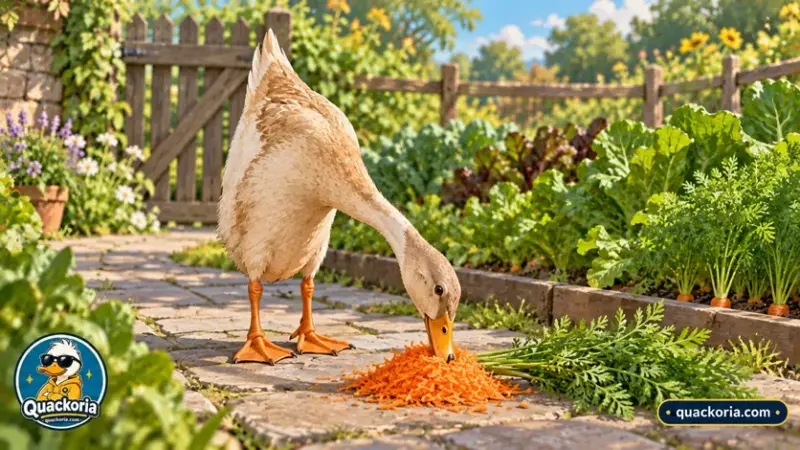
- A whole raw carrot is a choking risk for a bird that does not chew: grate, dice finely or cook plain and soft.
- Carrots probably do not colour yolks much: yolk colour comes from xanthophylls in corn, grass and greens, and a 2023 study found beta-carotene only "slightly changing the yolk color".
- A grated carrot between three or four ducks is the right scale; all treats stay under a tenth of the diet.
Yes. Carrots are on every duck treat list, the tops are edible too, and they carry more vitamin A than anything else a duck is likely to be offered. The only thing to get right is texture: a raw carrot is the hardest vegetable in the kitchen, and a bird with no teeth needs it grated, chopped fine or cooked soft.
The short answer
Metzer Farms, a California duck hatchery, lists “Peas, lettuce, carrots, corn, swiss chard, cucumber, zucchini, leeks, cabbage, and other such green veggies” as great treats. The Scottish SPCA includes carrots in its vegetable advice for pond ducks with a note on preparation — “Ideally cooked so that they’re easier to eat” — and adds: “don’t forget the tops of your carrots, they’re just as good for your duck friends.” Purina’s poultry nutritionists list carrots among safe vegetables for chickens. No avoid list we could find mentions any part of the plant.
What is in a carrot for a duck
Per 100 grams of raw carrot, the US Department of Agriculture’s reference data give 88.3 g water, 41 kcal, 4.7 g sugars, 0.93 g protein and 2.8 g fibre, with 320 mg potassium, 33 mg calcium, 5.9 mg vitamin C and 835 µg of vitamin A as retinol activity equivalents, from 8,285 µg of beta-carotene. That vitamin A figure is the carrot’s claim to fame — twice the romaine lettuce that is itself the best green on this site, and more than 250 times an apple’s. Vitamin A matters to a duck for eyes, skin and the lining of the airways, and a complete feed already supplies it; a carrot tops it up in a form a duck enjoys.
What a carrot does not supply is protein — under 1 per cent against the 16 to 20 per cent in a complete feed — and the sugar, at 4.7 g, is about the same as a strawberry. It is a vegetable treat in the best sense: crunchy, bright, harmless, and not nutrition on its own.
Does carrot colour the yolks?
Probably not much, and it is worth being honest about that because it is the most repeated claim about carrots and hens. Yolk colour comes from carotenoid pigments. The University of Florida’s extension advice names the feeds that supply them — “corn, marigold petals, grass, alfalfa, and leafy greens” — and does not mention carrots. The pigments doing the colouring in those feeds are mainly xanthophylls such as lutein and zeaxanthin, the yellows of corn and greens. Beta-carotene, the carrot pigment, is a different molecule: a 2023 study in Food Chemistry found that beta-carotene fed to laying hens “could be partially deposited in egg yolk” and raised the yolk’s vitamin A, but described its effect on colour as “slightly changing the yolk color.” If you want orange yolks, grass and greens do it; carrots are for the duck, not the egg.
How to feed carrots to ducks
Grate them. A grated carrot is the ideal form: small enough to swallow, crunchy enough to be interesting, easy to scatter on water where ducks dabble for the shreds. Finely diced is the next best. Cooked soft — steamed or boiled plain, no salt, no butter — is the Scottish SPCA’s suggestion and the right one for older birds. What does not work is a whole carrot or thick raw coins: ducks do not chew, as our explainer on duck teeth sets out, and a hard chunk is a lodging risk. Wash them; peeling is optional.
The tops go in too — chopped, like any green, following the Scottish SPCA’s rule for all vegetables that they should be chopped or sliced “to make sure they don’t choke.” Quantity follows the poultry extension rule that treats of all kinds stay under a tenth of the diet — Colorado State University Extension: “Treats should make up no more than 10% of their daily diet.” A grated carrot between three or four ducks is about right.
When carrots are a problem
Whole or in chunks, for the reason above. Cooked carrots from the family dinner, for the butter, salt and gravy. Mouldy or slimy bagged carrots, because ducks are especially susceptible to the toxins mould produces. And, as with every treat, a flock that gets carrots daily and starts leaving its pellets is a flock eating the wrong thing; the pellets carry the protein, the niacin and the calcium in the amounts a duck needs, and a carrot does not.
Ducklings
Finely grated carrot is one of the gentler first treats once ducklings are off starter and on grower feed — soft, small, and nothing in it to worry about. Before that, the starter ration and its niacin come first; the plan is in raising ducklings week by week.
Other vegetables: lettuce is the one to float, sweetcorn is the pond favourite, and tomatoes are fine ripe and dangerous green. Everything we have checked is in the can-ducks-eat checker; the diet these treats sit on top of is in what to feed ducks.
Frequently asked questions
Can ducks eat carrots?
Yes. Grate them, dice them finely or cook them plain and soft. The Scottish SPCA suggests "ideally cooked so that they're easier to eat"; Metzer Farms lists carrots among vegetable treats.
Can ducks eat raw carrots?
Yes, grated or finely chopped. A whole raw carrot or thick coins are too hard and too big for a duck to manage safely.
Can ducks eat carrot tops?
Yes. The Scottish SPCA: "don't forget the tops of your carrots, they're just as good for your duck friends." Chop them like any green.
Do carrots make duck egg yolks orange?
Not much. Yolk colour comes mainly from xanthophyll pigments in corn, grass, alfalfa and leafy greens; a 2023 Food Chemistry study found beta-carotene from the diet only slightly changed yolk colour, though it raised the yolk's vitamin A.
Are carrots good for ducks?
As a treat, yes: 835 µg of vitamin A per 100 g, fibre, and only 4.7 per cent sugar. They carry under 1 per cent protein, so the complete feed still does the real work.
Sources
- Metzer Farms — Treats your ducks will love
- Scottish SPCA — What to feed ducks
- Purina Animal Nutrition — What to feed chickens: treats to feed and avoid
- USDA FoodData Central (SR Legacy) — Carrots, raw, FDC ID 170393, as reproduced by tools.myfooddata.com
- UF/IFAS Extension — Why are my egg yolks yellow?
- Miao et al. (2023), β-carotene supplementation in laying hens, Food Chemistry 414
- Colorado State University Extension — Raising poultry the organic way: disease control and feeding
- NC State Extension — Feeding ducks (Ferket & Davis)
- Metzer Farms — Foods ducks should not eat
- The Open Sanctuary Project — Things that are toxic to ducks