Quackoria Learn
Why Do Ducks Wag Their Tails?
Key takeaways
- Ethologists file the tail-wag under comfort behaviour, with bathing and preening; a 2024 mallard study found comfort behaviours took 12 per cent of the ducks' time.
- In mallards, tail-wagging appears "as the first, last, or both first and last component" of courtship displays — a 1974 paper asked whether it is "punctuation".
- Keepers report tail-wagging when ducks are excited or greeting them; no published study has recorded it outside comfort and courtship.
- In other birds, a meta-analysis found tail-flicking tracks vigilance and predation risk rather than social communication.
- A tail that bobs slowly in time with each breath is a veterinary sign of laboured breathing, not a wag.
Two reasons are documented, and one is not. Ducks wag their tails as a comfort movement — the shake that gets water out of the feathers after a swim, which ethologists list alongside bathing and preening — and mallards have been seen wagging them at the start and end of courtship displays, which one paper suggested may work as a kind of punctuation. The third reason, that a wagging tail means a happy duck, is what every keeper will tell you and what no study has ever measured. There is also one tail movement that is a warning sign, and it is worth knowing the difference.
A comfort movement
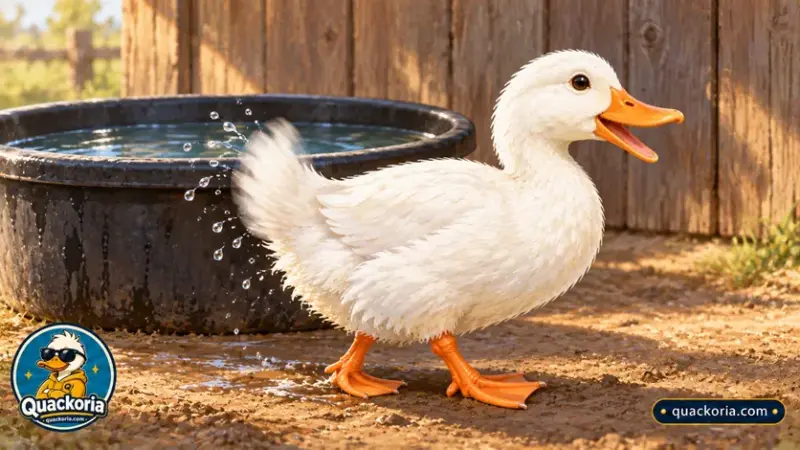
Ethologists sort a duck’s day into categories, and the tail-wag lives in the one called comfort. A 2024 study in acta ethologica that followed a mallard population through a winter and spring in a city park in Portugal built its list of 45 behaviours from the classic literature and defined a class it calls Display Comfort Behaviours: “behaviours belonging to the Comfort category (e.g., Tail-Wag, Bathing) when performed in a display context”. Comfort behaviours took up 12.19 per cent of the ducks’ time and, the authors note, “remained constant throughout the observation period, which is to be expected since comfort behaviours are daily activities that are required for the maintenance of the individual’s hygiene and wellbeing.” Among the works the study builds its list on is Frank McKinney’s 1965 monograph on the comfort movements of waterfowl. The practical version is what any pond shows: a duck climbs out, shakes its body, and finishes with its tail. Why the water comes off at all is in why ducks don’t get wet.
Punctuation for courtship
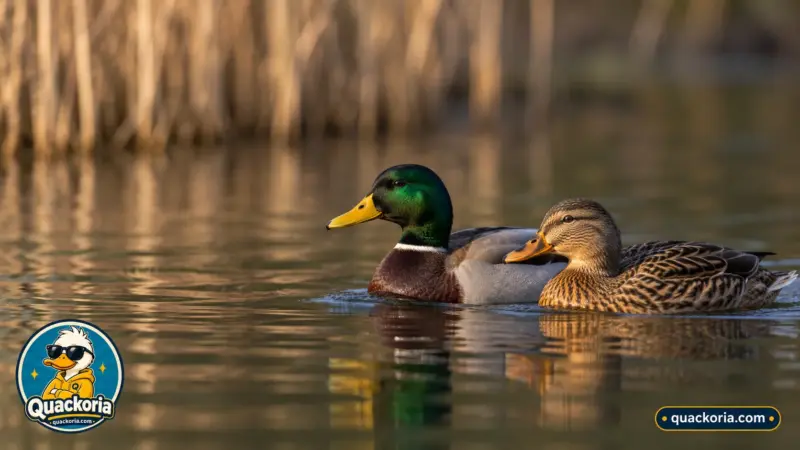
The second reason is stranger. In 1974 two researchers published a short paper in The American Naturalist with the title “Mallard tail-wagging: Punctuation for animal communication?”, having noticed, in the summary given by a later study, “the occurrence of tail wagging as the first, last, or both first and last component of some of the other displays.” That later study, of white Pekin ducks in 1977, agreed: “Although tail wagging was not quantified in the present study, I observed that it was indeed closely linked with these other motor patterns in the Pekings.” The Birder’s Handbook describes drakes “swimming in the presence of females” that “may be seen shaking their heads (head-shake display) and tails (tail-shake)”. The idea is that a wag brackets a display the way a capital letter and a full stop bracket a sentence. It fits what Paul Johnsgard, the great cataloguer of duck behaviour, argued about the displays themselves: that they “evolved from simpler, non-display responses including body-maintenance, or ‘comfort,’ activities, such as preening or shaking”. A tail-wag is a comfort movement that courtship borrowed. The displays it punctuates are described in why do ducks bob their heads.
What keepers see
Ask anyone with backyard ducks and the answer is happiness. One keeper’s account is typical: “If your duck has just taken a swim, they will give themselves a shake to dry off usually ending with a good tail shake. But I have also seen ducks shaking their tails when they are excited, like when I am filling up their pool or they are waiting for a tasty treat from the garden.” A conservation centre that keeps Muscovies writes that “They also wag their tails like dogs when they get excited”. We have no reason to doubt any of it, and no evidence for it either: no published study has recorded tail-wagging in ducks outside the comfort and courtship contexts above, so “excited” is a keeper’s reading of a movement, not a finding. Our own guess is that the reading is right: anticipation of food and the approach of a familiar person are exactly the moments a bird is aroused, and a comfort movement that has already been co-opted once, for courtship, could easily surface then too. A guess is all it is. But the dog comparison should stop at the wag; nobody has shown that a duck’s tail says what a dog’s does.
What tails mean in other birds
Where tail movements have been studied in birds, they mostly turn out to be about danger, not joy. A 2020 meta-analysis of tail-flicking across bird species found “the general trend for flicking being a reflection of vigilance and predation risk”, with flicking rates falling as flocks grew, and its authors wrote that “our results suggested that flicking is not used for social communication, as it was not related to the presence of a conspecific or social status of an individual.” That work was on other kinds of birds, and a flick is not a wag, so the finding is context rather than answer. It does mean that “my duck is talking to me with its tail” has less science behind it than it sounds.
When a tail movement is a warning
One tail movement is not a wag and should not be mistaken for one. A bird in respiratory trouble moves its tail up and down in time with every breath. LafeberVet, the avian veterinary reference, lists the “Signs of respiratory difficulty or dyspnea in the bird” as “open-mouth breathing, increased sternal motion, and tail bobbing”; VCA Animal Hospitals describes it as “moving the tail up and down with each breath (tail bobbing)”. The Open Sanctuary Project’s daily checklist for ducks tells keepers to watch for “Labored breathing, open-mouth breathing (open-mouth breathing can also be a sign a duck is too hot), or severe tail bobbing”, and for “Sneezing, coughing, wheezing, wet-sounding breathing (gurgling), or other audible breathing.” The difference is rhythm: a wag is a quick side-to-side or up-and-down flourish that starts and stops, usually after water or in company; a bob is slow, regular, and locked to breathing, in a bird that is otherwise quiet. The first needs nothing. The second needs a vet, and the rest of the signs are in common duck health problems.
The drake’s tail
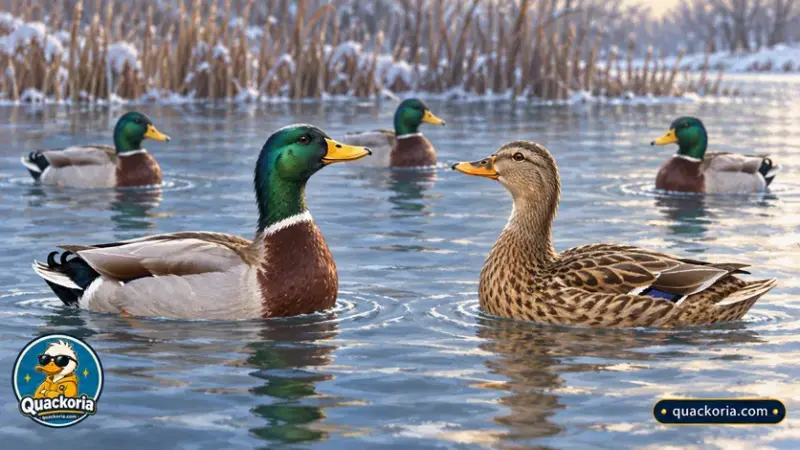
The tail being wagged is, on a mallard drake, the one with the curl: Cornell describes the breeding male’s “gleaming green head, gray flanks, and black tail-curl”. The curled feathers are a sex marker, and Metzer Farms says they appear within about eight weeks — see what a male duck is called. Whether they are wagged more than a hen’s plain tail is one more thing nobody has counted. What a duck needs to keep its tail feathers in order is water, and how much is in duck water needs.
Frequently asked questions
Why does my duck wag its tail after swimming?
It is a comfort movement: the body shake that dries the feathers ends with the tail. The 2024 mallard ethogram lists Tail-Wag beside bathing.
Do ducks wag their tails when they are happy?
Keepers say so, and it is plausible, but no study has tested it. The dog comparison should stop at the wag.
Why do mallard drakes wag their tails during courtship?
Ethologists have noted tail-wagging at the start and end of displays like the grunt-whistle, and suggested it works as punctuation between signals.
When is a duck's tail movement a bad sign?
When the tail bobs up and down with every breath. LafeberVet and VCA list "tail bobbing" among the signs of respiratory difficulty; that duck needs a vet.
Do hens wag their tails too?
Yes; the tail-wag is a comfort movement of both sexes. Whether drakes, with their curled tail feathers, wag more has not been counted.
Sources
- Santos, de Sousa and Magalhães (2024), Time budget of a mallard duck population residing in an urban park in northern Portugal, acta ethologica
- Miller, D. B. (1977), Social displays of mallard ducks: effects of domestication, Journal of Comparative and Physiological Psychology 91(2)
- Ehrlich, Dobkin and Wheye (1988), Duck displays, The Birder's Handbook (Stanford)
- Paul A. Johnsgard (1968), The evolution of duck courtship, Natural History 77(2)
- Cornell Lab of Ornithology, All About Birds — Mallard identification
- Cornell Lab of Ornithology, All About Birds — Mallard overview
- Randler and Kalb (2020), The functions of tail flicking in birds: a meta-analysis, Avian Biology Research
- LafeberVet — Recognizing signs of illness in birds (Christal Pollock)
- VCA Animal Hospitals — Recognizing the signs of illness in pet birds
- The Open Sanctuary Project — Daily observation for duck health and well-being
- The Cape Coop — Understanding backyard duck behavior (keeper observations)
- Wellington Conservation Center — Our Muscovy ducks (keeper observations)
- Metzer Farms — Male vs female: how to identify adult ducks