Quackoria Learn
Green-winged Teal: North America’s Smallest Dabbling Duck
The green-winged teal is North America's smallest dabbling duck, a compact bird whose drake has a chestnut head with a green stripe behind the eye. The American drake carries a vertical white bar on its side and the Eurasian teal a horizontal one, and whether the two are one species or two depends on which checklist you follow.

Key takeaways
- Cornell measures it at 31-39 cm and 140-500 g, and Ducks Unlimited says females "can weigh as little as six ounces".
- Cornell: the Eurasian teal differs "by lacking the vertical white shoulder stripe and having a horizontal white stripe along the back instead."
- The AOU/AOS has treated the two as one species since 1973 and voted down a split in 2024; the IOC, HBW-BirdLife (since 2020) and the BOU (since 2000) treat them as two.
- In winter, Cornell says, green-winged teal gather in roosting flocks of up to 50,000 birds.
- The BTO calls the American bird a "scarce, but annual" visitor to Britain, where around half a million Eurasian teal arrive from the Continent each winter.
The green-winged teal is, in Cornell’s words, “the smallest dabbling duck in North America”, and the drake of the American form carries one vertical white bar on its side. Its scientific name depends on whose list you follow: Anas crecca carolinensis to the North American checklist, which counts it as one species with the Eurasian teal, or Anas carolinensis to the lists that split them. Americans see it on shallow ponds and flooded fields from autumn to spring; in Britain it is a rare visitor.
How to recognise a green-winged teal
Cornell calls it “A very small duck: much smaller than a Mallard; slightly larger than an Eared Grebe”, 31-39 cm (12.2-15.3 in) long and 140-500 g (4.9-17.6 oz), and Ducks Unlimited adds that “Female green-winged teal can weigh as little as six ounces”. The breeding male has “grayish bodies with a narrow white vertical stripe extending from the waterline to the shoulder”, in Cornell’s description, and a head that in good light is “cinnamon with a wide green swoop from the eye to the back of the neck”.
Females are harder. Cornell describes them as “brown with a yellowish streak along the tail” and points to the silhouette: “small and compact, sitting high in the water, with a fairly small bill.” Males out of breeding plumage look much the same: Ducks Unlimited says “Females and males in basic plumage are mottled brown”, and gives the female “dark gray bills and gray feet”. Both sexes show a green speculum in flight. The male’s call is a “decidedly non-ducklike whistle”, in Cornell’s phrase, and Tennessee’s wildlife agency describes the female’s as “a shrill, weak quack.”
Green-winged teal or Eurasian teal?
On a drake it comes down to one white line. Cornell: “The Eurasian teal differ from the American by lacking the vertical white shoulder stripe and having a horizontal white stripe along the back instead.” BirdGuides describes scanning a flock of Eurasian teal until “the penny drops and you will notice that there is a distinctive vertical white bar at the front of the flanks instead”. On the head, the green stripe “is bordered only faintly by the creamy-buff borders on the Green-winged Teal – these are quite noticeable on Eurasian Teal.” The same source adds two cautions: hybrids occur, so with a vertical stripe “make sure there’s not a horizontal one as well”, and “the identification of females with confidence is considered to be extremely difficult”.
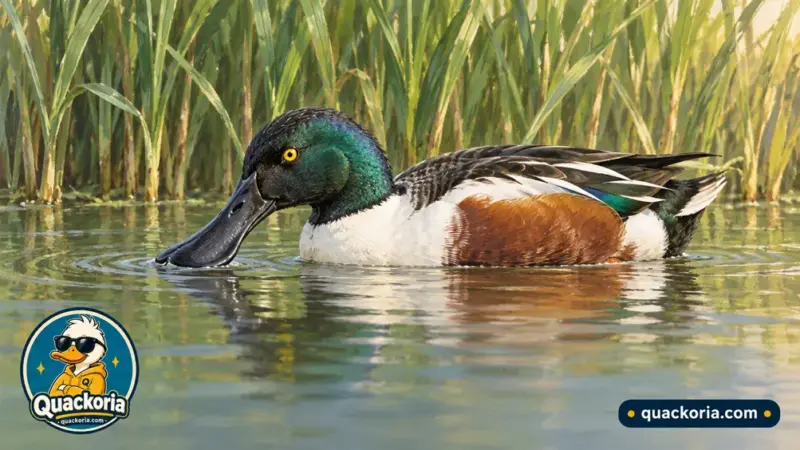
Cornell notes that male American wigeons “lack the cinnamon-brown head and the vertical white flank stripe of male Green-winged Teals”, and that blue-winged and cinnamon teal drakes in flight show “a blue upper wing patch that Green-winged Teals lack”. Beside a northern shoveler the teal is smaller with a smaller bill, and its drakes “only have a small white bar on their sides, not an entirely white breast.”
Where and when you will see one
Green-winged teal breed, according to Cornell, “mostly in isolated river deltas, forest wetlands, and mixed prairie regions across northern North America”; they use the prairie pothole region but “are not as restricted to it as many other dabbling ducks”. Ducks Unlimited’s winter range covers coastal British Columbia, most of the western and southeastern United States, and Mexico, and Audubon notes that the bird “remains further north in the winter than other teal.” Tennessee’s wildlife agency has them arriving “in mid-August”, with spring migrants that “arrive in March, and most birds depart by late April.” In winter, Cornell says, they “gather in roosting flocks of up to 50,000 birds.”
Britain has two teal to consider. The American bird is, in the BTO’s words, “a scarce, but annual, visitor from North America; most records are in autumn/winter and almost all proven ones are male”. The Eurasian teal is the common one: the BTO calls it “an uncommon breeding bird in the UK, with an estimated population of just 4,000 pairs but this population is dwarfed by the winter arrival of around half a million birds from the Continent”, while the figures on the same page give 2,700 breeding pairs (2016) and 435,000 wintering birds (2012-17).
What it eats, and how
Green-winged teal are dabbling ducks that will try most methods. Cornell says they “dabble along the surface where they pluck or strain seeds and invertebrates, and dip their head and neck or tip up to reach submerged food”, and that they “occasionally dive for food and to avoid predators”. On diet the sources lean different ways. Cornell says “Green-winged Teal eat mainly aquatic invertebrates and seeds”; Ducks Unlimited says “Their diet is typically 80 to 90 percent seeds, with greater than 10 percent invertebrates”; Audubon says the bird “May feed more on animal matter in summer, seeds in winter.”
Nesting and ducklings
Courtship, Cornell says, “starts in the fall and peaks in January and February”, and teal “choose new partners each year” (see do ducks mate for life). The male then “deserts the female once incubation is underway.” She nests on the ground, “usually within about 200 yards of water” by Cornell’s account; Audubon says “within 200 ft of water” and Ducks Unlimited “within 700 feet of water”. Cornell gives 6-9 eggs, “Creamy white to pale olive-buff”, and 20-23 days of incubation; Audubon gives “6-11 eggs, rarely up to 18” and 20-24 days, “usually 21.” A few hours after hatching, Cornell says, “the chicks can swim, dive, walk, and forage for themselves”; Audubon has the young fledging “at about 35 days”.
Is the green-winged teal the same species as the Eurasian teal?
It depends on whose list you read. North America says one species. A November 2023 proposal to the South American Classification Committee (SACC) records that the AOU/AOS has treated the two as a single biological species since 1973, and the American Birding Association’s report on the AOS’s 2024 checklist supplement lists “splits of Green-winged Teal” among the actions its committee “voted down”. Britain went the other way: BirdGuides records that treating the American bird as a species was “the view adopted by the British Ornithologist’s Union (BOURC) in their 27th report in October 2000”, and the BTO lists it separately while noting it is “considered a subspecies by some”. The SACC proposal adds that the IOC has kept the two apart “since version 1.0”, and that HBW-BirdLife, which treated them as one in 1992 and again in 2014, split them in 2020. Its own recommendation was that “these taxa are not biological species”, given “substantial levels of gene flow”. Whatever your list calls it, the white bar tells you which bird you are looking at.
How green-winged teal are doing
Well. Cornell says “their population increased between 1966 and 2019”, with Partners in Flight estimating a global breeding population of 6.7 million, and it credits the breeding grounds: most birds nest in Canada and Alaska, “where relatively remote and inaccessible nesting areas buffer this species from habitat losses farther south”. The US Fish and Wildlife Service’s 2025 survey estimated “2.6 ± 0.2 million”, “similar to their 2024 estimates and their long-term averages”. The Eurasian teal is on the UK’s Amber list, the RSPB says, because Britain holds “a significant percentage of the north-west European wintering population”, even as the BTO records rises of 63% in breeding numbers (1995-2024) and 14% in winter (1998-2023).
If you think you have found that vertical bar, or a small brown dabbler you cannot place, check it in which wild duck did I see. Spot the Duck, a timed hunt for ducks hidden in drawn scenes, rewards the same habit of looking twice.
Frequently asked questions
What is the smallest duck in North America?
Among dabbling ducks, the green-winged teal: Cornell calls it "the smallest dabbling duck in North America". Ducks Unlimited says females "can weigh as little as six ounces, making them the smallest of North America's waterfowl."
What is the difference between a green-winged teal and a Eurasian teal?
On the drake, one white line. Cornell says "The Eurasian teal differ from the American by lacking the vertical white shoulder stripe and having a horizontal white stripe along the back instead." BirdGuides adds that the creamy-buff borders of the green head stripe are faint on the American bird and "quite noticeable on Eurasian Teal."
Are green-winged teal and common teal the same species?
In North America, yes: a 2023 SACC proposal records that the AOU/AOS has treated them as one species since 1973, and the American Birding Association reports that the AOS committee voted down a split in 2024. The IOC, HBW-BirdLife and the BOU treat them as two, and the BTO notes the American bird is "considered a subspecies by some".
How fast do green-winged teal fly?
The sources pull different ways. Cornell calls green-winged teal "fast, agile, buoyant flyers", while Ducks Unlimited says teal, "thought by many hunters to be the fastest ducks, are actually among the slowest, having a typical flight speed of only 30 mph."
Do green-winged teal come to the UK?
Rarely, but every year. The BTO calls the American bird "a scarce, but annual, visitor from North America; most records are in autumn/winter and almost all proven ones are male", and BirdGuides dates the first British record to "1840 or thereabouts".
Sources
- Cornell Lab of Ornithology — Green-winged Teal Overview, All About Birds
- Cornell Lab of Ornithology — Green-winged Teal Identification, All About Birds
- Cornell Lab of Ornithology — Green-winged Teal Life History, All About Birds
- Cornell Lab of Ornithology — Green-winged Teal Similar Species, All About Birds
- Cornell Lab of Ornithology — Northern Shoveler Similar Species, All About Birds
- National Audubon Society — Green-winged Teal, Guide to North American Birds
- Ducks Unlimited — Green-winged Teal, Waterfowl ID
- Ducks Unlimited — Amazing Waterfowl Facts
- U.S. Fish and Wildlife Service — Waterfowl Population Status, 2025
- Tennessee Wildlife Resources Agency — Green-winged Teal
- BTO — Green-winged Teal, BirdFacts
- BTO — Teal, BirdFacts
- RSPB — Teal
- BirdGuides — Focus on: Green-winged Teal
- South American Classification Committee — Proposal 986: Split Anas crecca into two species (November 2023)
- American Birding Association — The AOS supplement, 2024